Short answer: ServiceNow App Engine wins when your organization already runs ServiceNow and the new app should share its data, roles, approvals and release governance, including FedRAMP High hosting. Devfab wins when an agency or IT team must ship a standalone app as code in its own GitHub, with domain research, an approved plan, UI and flow tests, and deploy to its own server.
You run delivery for a services firm, and a client says "we have ServiceNow." Do you build on it, or deliver code they own?
The answer matters for margin and for trust. Build inside the client's instance and you inherit its license, its rules and its release calendar. Ship standalone code and you own testing, hosting and handover. Neither path is wrong. They suit different clients.
In this comparison:
- What each tool is built for
- Switching triggers
- Cost model by team size
- Where ServiceNow App Engine is the better choice
- Where Devfab is the better choice
Use it as a checklist for the next client call.
What each tool is built for
ServiceNow App Engine
App Engine is ServiceNow's platform for building, deploying and governing custom workflow apps on the Now Platform. There are three ways to build: ServiceNow Studio for business technologists and admins, the ServiceNow IDE for professional developers, and the Build Agent SDK for outside tools (App Engine).
The 2026 change is Build Agent. It generates workflows, UI and AI agents from a plain-language description, and acts as an MCP client that pulls context from Figma and GitHub (same source). On May 6, 2026, ServiceNow extended Build Agent skills into Cursor, Windsurf, Claude Code and GitHub Copilot, so apps coded there inherit platform governance (ServiceNow, May 6, 2026). Generated apps get a sandbox, a self-healing test loop against quality gates, and Custom Instructions for org standards (same source).
Governance runs through App Engine Management Center (AEMC): deployment approvals, release management and lifecycle control. In live apps, "ServiceNow Otto for App Engine" adds record summaries, in-app guidance and AI-assisted search (App Engine).
Devfab
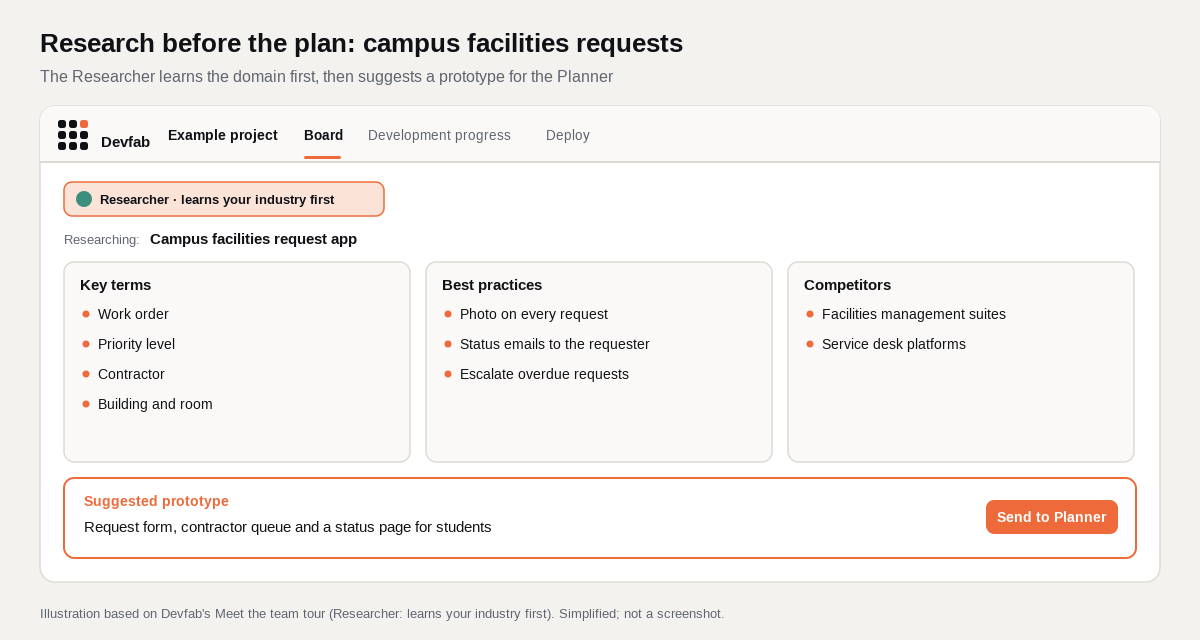
Devfab is a Software Factory in the Autonomous Software Lifecycle category. Seven agents (Researcher, Planner, Coordinator, Developers, Blueprint, QA agent and Deploy) take an idea from research to a deployed app. The Researcher maps key terms, best practices and competitors before the Planner writes anything, then suggests a prototype. A person approves the plan. The Coordinator splits it into tickets for dev agents.
The code lives in your own GitHub account or your organization's. You deploy to your own server, with an optional custom domain.
Switching triggers
| Trigger | ServiceNow App Engine | Devfab | Source |
|---|---|---|---|
| The client does not run ServiceNow | Apps are built and governed on the Now Platform | Standalone code on the client's own server | App Engine |
| Many custom tables or apps on a small package | Foundation caps custom tables at 15 and scoped apps at 3; unlimited only on Prime | No platform table or app caps; it is your codebase | App Engine packages |
| Budget needs a public price | No prices shown; custom quote per package | No published price; cost logged per task and per project (Beta) | App Engine packages |
| Unclear governance pricing | AEMC is described as "no additional cost" next to a separate freemium tier expected in Q3 2026, without saying how they fit | Not applicable | ServiceNow, May 6, 2026 |
| Client wants the code in its own repo | Build Agent pulls context from GitHub; exporting an app as a standalone codebase is not covered in the pages we checked | Code in the client's GitHub account or organization | App Engine |
| Client needs domain research before scoping | Not covered in the pages we checked | Researcher maps the domain before the Planner | App Engine |
Cost model by team size
| Team size | ServiceNow App Engine | Devfab |
|---|---|---|
| 1 person | Personal developer instances get 25 free Build Agent calls; production use needs a quoted package | Cost logged per task and per project (Beta) |
| 5 people | App Engine Foundation, custom quote (15 custom tables, 3 scoped apps) | Cost logged per task and per project (Beta) |
| 25 people | App Engine Prime, custom quote (unlimited tables and scoped apps, AEMC, Process Mining, Mobile Publishing) | Cost logged per task and per project (Beta) |
ServiceNow shows no prices on its packages page. On April 9, 2026 it said AI, data connectivity, security and governance are built into all products and "not a separate purchase," with 100 free Build Agent calls for customers (ServiceNow, Apr 9, 2026). Devfab is in Beta and offers predictable cost: cost is logged after each run, per task and per project.
Moving from ServiceNow App Engine to Devfab
Most teams don't move a whole app. They move one workflow that has outgrown the instance, for example a campus facilities request app that students and contractors must use without ServiceNow accounts.
- Document the current app. List its tables, roles, approval steps and notifications, and screenshot the forms people use.
- Get the data out through the integration path your ServiceNow admin already uses. A standalone code export is not covered in the pages we checked, so plan a rebuild from a spec.
- In Devfab, pick "Start a new project" and describe the app under "What should we build?" Attach the spec and screenshots.
- Review the research. The Researcher returns key terms, practices and a suggested prototype for facilities requests.
- Approve the plan. Only then does the Coordinator create tickets and assign dev agents.
- Let the QA agent test it. It runs UI and flow tests (a student files a request, a contractor closes it) plus logic tests, then you deploy to your server.
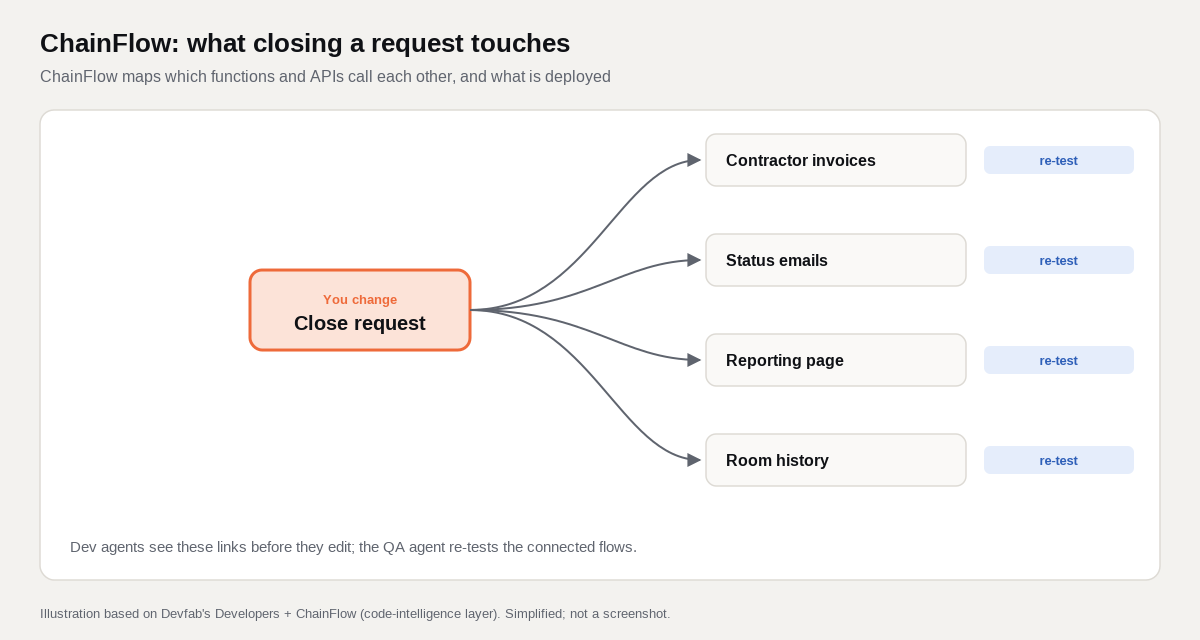
Later changes go through "Work on an existing project": pick the repo, leave the change box empty, and ChainFlow maps the code and suggests three small first tickets.
Where ServiceNow App Engine is the better choice
- Your organization already runs ITSM, HR or ESM on ServiceNow. New apps share the same data, roles and workflows.
- You need government-grade hosting under one contract. ServiceNow cites a US Government Community Cloud certified at FedRAMP High and DoD IL-4, plus a National Security Cloud for IL5 (ServiceNow for state government).
- You want AI-coded apps forced through central approvals. Build Agent skills inside Cursor or Claude Code inherit platform governance, release management and audit trails.
- Business technologists build alongside developers. ServiceNow Studio and the ServiceNow IDE share one platform.
- You want AI inside the live app. Otto for App Engine adds summaries, guidance and search for end users.
Where Devfab is the better choice
Low-code platforms automate the app inside their walls. Devfab automates the development lifecycle.
- Research before the plan. The Researcher maps terms, practices and competitors, then suggests a prototype a client can react to.
- A person approves the plan. Human in the loop is the default mode, so nothing reaches tickets before a sign-off.
- ChainFlow sees the impact of a change. It maps which functions and APIs call each other and what is deployed. Change how a request is closed, and dev agents see the effect on contractor invoices, status emails and the reporting page.
- The QA agent tests screens and journeys. UI and flow tests click through the app end to end, plus logic tests.
- The client owns the result. Code in its GitHub, deploy to its server, plus blueprints, sequence flows and user manuals.
- Cost per task. Cost is logged after each run, per task and per project.
Devfab's honest limits: it is in Beta, has a smaller community, has fewer integrations than a mature platform like ServiceNow, is not an editor for hands-on coding, and needs a GitHub account.
FAQ
Is ServiceNow App Engine only for companies that already use ServiceNow?
In practice it fits best there. App Engine builds apps on the Now Platform, so new apps share the instance's data, roles and workflows. If your organization does not run ServiceNow, you would be buying a platform to host the app.
How much does ServiceNow App Engine cost?
ServiceNow does not publish prices. App Engine comes in Foundation and Prime packages, each quoted by sales. In April 2026 ServiceNow said AI and governance are built into all packages and not a separate purchase, with 100 free Build Agent calls.
Can an agency build client apps with App Engine?
Only if the client runs ServiceNow. The app lives in the client's instance, under its license and governance. If the client wants a standalone web app on its own server with code in its own GitHub, Devfab fits that delivery model better.
Does Devfab replace ServiceNow?
No. Devfab does not run IT service management, HR service delivery or a workflow platform. It plans, builds, tests and deploys custom software as code. Some teams keep ServiceNow for internal workflows and use Devfab for client-facing apps.
Read next
- What is an AI software factory?
- ServiceNow App Engine alternatives
- Low-code vs an AI software factory
- ServiceNow App Engine vs Power Apps
Have a client app that doesn't belong inside an instance? Book a Devfab demo
Sources (checked November 2026): ServiceNow App Engine; App Engine plans and packages; ServiceNow press release, Apr 9, 2026; ServiceNow press release, May 6, 2026; ServiceNow for state government.
Frequently asked questions
Is ServiceNow App Engine only for companies that already use ServiceNow?
In practice it fits best there. App Engine builds apps on the Now Platform, so new apps share the instance's data, roles and workflows. If your organization does not run ServiceNow, you would be buying a platform to host the app.
How much does ServiceNow App Engine cost?
ServiceNow does not publish prices. App Engine comes in Foundation and Prime packages, each quoted by sales. In April 2026 ServiceNow said AI and governance are built into all packages and not a separate purchase, with 100 free Build Agent calls.
Can an agency build client apps with App Engine?
Only if the client runs ServiceNow. The app lives in the client's instance, under its license and governance. If the client wants a standalone web app on its own server with code in its own GitHub, Devfab fits that delivery model better.
Does Devfab replace ServiceNow?
No. Devfab does not run IT service management, HR service delivery or a workflow platform. It plans, builds, tests and deploys custom software as code. Some teams keep ServiceNow for internal workflows and use Devfab for client-facing apps.