Short answer: Airtable wins when a business team wants to own its data and build trackers itself, with Omni setting up bases, interfaces and automations in plain language. Power Apps wins when your company runs on Microsoft 365, Entra and Dataverse and IT needs apps inside that tenant's governance and data loss prevention rules.
You need a permit tracker by next quarter, and two camps in your company disagree. Operations wants Airtable because they can build it themselves. IT wants Power Apps because the company already pays Microsoft.
Both sides have a point, and the stakes are real: whichever tool you pick will hold your records for years. This page referees the debate with sourced facts checked on November 20, 2026.
In this comparison:
- Airtable and Power Apps at a glance
- Feature comparison
- Cost model by team size
- Where Airtable wins
- Where Power Apps wins
Use the sections below as a checklist for that meeting.
Airtable and Power Apps at a glance
Airtable changed owners this year. Bending Spoons closed its acquisition in early September 2026. On October 12, Airtable announced layoffs of much of the pre-acquisition team and said plans and pricing were unchanged (Airtable newsroom). On October 21, the Fall Release added Omni 2.0, Airtable Canvas (open beta), a bigger MCP server and agent audit logs (Airtable Fall Release).
Airtable is a no-code database and app platform. Omni gives every builder, editor or viewer a conversational agent that respects their permissions (Airtable newsroom, 2025).
Power Apps added AI building and retired some environments. The September 2026 update made the "app-builder skill" for building model-driven apps from AI coding tools generally available (Microsoft Power Platform blog). From November 15, 2026, new unmanaged developer environments and new Dataverse for Teams environments can't be created (Power Platform licensing FAQ).
Power Apps is Microsoft's low-code platform for business users, developers and IT working in one place, with data in Microsoft Dataverse (Power Apps).
Feature comparison
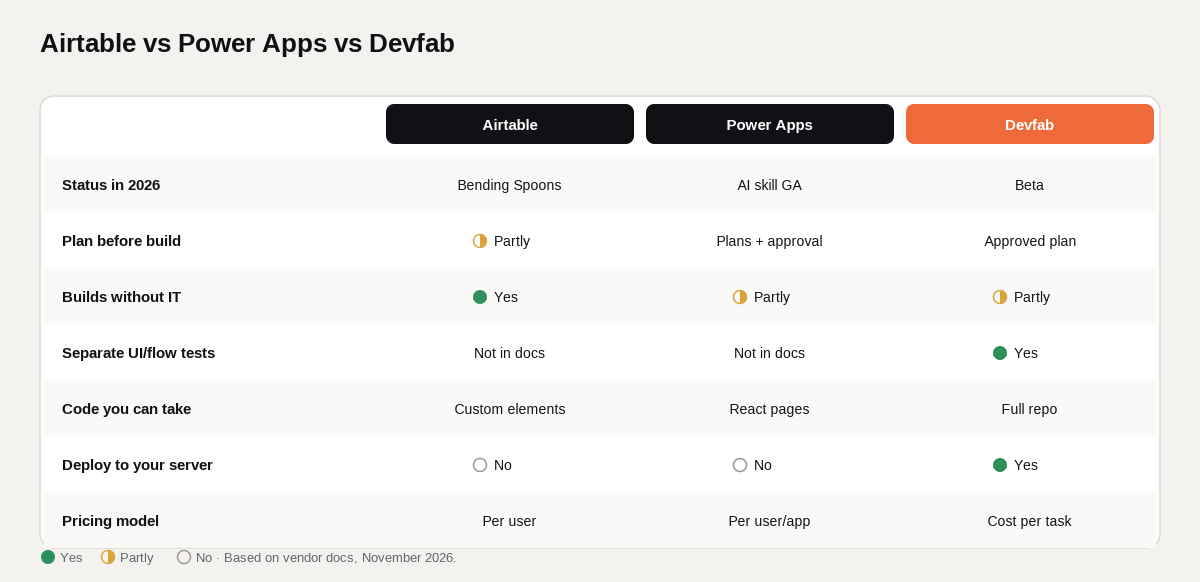
| Aspect | Airtable | Power Apps | Source |
|---|---|---|---|
| Where it runs | Web, Mac and Windows apps; MCP for Claude, ChatGPT, Gemini and Cursor | Maker studio in the browser; also GitHub Copilot CLI and Claude Code | Airtable Fall Release; Power Platform blog |
| Planning and spec | Omni 2.0 builds data models from spreadsheets, PDFs and images | "Plans" uses agents as requirements analyst, data modeler and solution architect | Airtable Fall Release; The New Stack |
| Agent autonomy | Omni confirms deletions; you publish interfaces and turn on automations | App-builder skill creates nothing until you approve the build plan | Airtable support; Power Platform blog |
| Testing | Not covered in the pages we checked | Not covered in the pages we checked | — |
| Hosting | Airtable cloud | Microsoft cloud on Dataverse | Power Apps |
| Code and export | Custom element code editable or downloadable | Generative pages produce native React code; "convert a vibe app to a code app" guidance | Airtable community; The New Stack; Power Platform blog |
| Team and admin | MCP on/off org-wide; agent audit logs on Enterprise | Central policies for environments, DLP, access and auditing | Airtable Fall Release; Power Apps |
| Model choice | Anthropic and OpenAI models for custom elements | AI features draw on AI Builder or Copilot Credits | Airtable community; Licensing FAQ |
| Pricing model | Per billable collaborator, plus pooled AI credits | Per user, per user per app, or pay-as-you-go via Azure | Airtable plans; Licensing FAQ |
Cost model by team size
| Team size | Airtable | Power Apps | Devfab |
|---|---|---|---|
| 1 person | Free (capped records, runs and editors) or Team, USD 20 per user per month billed annually | Developer Plan, free for non-production use | Cost logged per task and per project (Beta) |
| 5 people | Team, USD 20 per user per month billed annually | Premium, USD 20 per user per month paid yearly; or per-app or pay-as-you-go licenses | Cost logged per task and per project (Beta) |
| 25 people | Business, USD 45 per user per month billed annually, or Enterprise Scale (custom) | Premium, USD 20 per user per month paid yearly; Dataverse capacity add-on USD 40 per GB per month | Cost logged per task and per project (Beta) |
Prices as of November 2026 from Airtable pricing and Power Apps pricing. Microsoft notes prices may vary by country or region, and a USD 12 Premium rate applies only at a 2,000-seat minimum. Devfab is in Beta and offers predictable cost: cost is logged after each run, per task and per project.
Where Airtable wins
- Business staff build without IT. Omni sets up tables, automations, dashboards and interface pages from a prompt.
- Building does not use AI credits. Only Q&A with Omni draws on them.
- Your data lives in many spreadsheets today. Omni 2.0 turns spreadsheets, PDFs and images into a data model.
- Licensing stays simple. One per-collaborator plan, without connector tiers.
- You want MCP access from outside AI tools with org-wide on/off control.
Where Power Apps wins
- You're standardized on Microsoft 365 and Entra. Apps sit inside your tenant's DLP, environments and auditing.
- You need Microsoft connectors for SharePoint, Teams and Dynamics 365.
- Large internal audiences. Some users already have seeded Microsoft 365 rights, and big rollouts get a lower seat price.
- Developers want code. Generative pages emit React, and AI coding tools can build whole model-driven apps.
- Copilot inside the app. Microsoft 365 Copilot can be embedded in custom apps.
Power Apps has its own fine print. Several AI building pieces are still in preview, and premium, on-premises and custom connectors need standalone licenses (Licensing FAQ).
Switching from one to the other
From Airtable to Power Apps. Microsoft offers no Airtable importer in the pages we checked. Move records into Dataverse tables, then describe the app in Power Apps and review the plan the agents propose. Note that Omni cannot export data for you (Airtable support), so export views by hand.
From Power Apps to Airtable. Export Dataverse tables, import them into a new base, and ask Omni to rebuild interfaces and automations. Omni can't create new views or rebuild elements it didn't create, so plan some manual setup.
Where Devfab fits
Airtable and Power Apps both keep your app inside a vendor platform. That is fine for internal trackers. It gets harder when the permit tracker must face the public, carry custom logic and run on your own server.
App builders automate the first version. Devfab automates the development lifecycle. Its Researcher maps permit rules, key terms and similar products before the Planner writes a plan. A person approves the plan. ChainFlow maps which functions and APIs call each other, so a change to fee logic shows its impact on payments and notifications. Code lives in your own GitHub account. Devfab is in Beta, has a smaller community and fewer integrations, and needs a GitHub account. See Devfab vs Airtable and Devfab vs Power Apps.
FAQ
Is Airtable or Power Apps easier for non-technical staff?
Airtable is usually the gentler start. It is a no-code database, and Omni builds tables, automations and interfaces from plain language. Power Apps also generates apps from natural language, but its depth (Dataverse, connectors, environments, licensing) assumes some IT involvement.
Do Microsoft 365 licenses include Power Apps?
Some Microsoft 365 licenses include limited Power Apps use. Premium, on-premises and custom connectors, and now SQL, Azure and Dynamics 365 connectors, need a standalone Power Apps license, according to Microsoft's licensing FAQ.
What happened to Airtable in 2026?
Bending Spoons closed its acquisition of Airtable in early September 2026. On October 12 Airtable announced layoffs of much of the earlier team and said plans and pricing were unchanged. The October 21 Fall Release added Omni 2.0, Airtable Canvas in open beta and agent audit logs.
Which is cheaper for a team of 25?
As of November 2026, Power Apps Premium is USD 20 per user per month, paid yearly, and Airtable Business is USD 45 per user per month, billed annually, with Team at USD 20. Power Apps can add Dataverse capacity costs; Airtable adds credit packs for heavy AI Q&A.
Read next
- What is an AI software factory?
- Power Apps alternatives
- Airtable alternatives
- Build page: public works asset tracker
Need the tracker to run on your own server? Try Beta
Sources (checked November 2026): Airtable pricing; Airtable newsroom: Back to bases (Oct 12, 2026); Airtable Fall Release (Oct 21, 2026); Airtable: AI-generated custom elements out of beta; Airtable support: Using Omni; Airtable plans overview; Airtable newsroom: The AI-native Airtable (2025); Microsoft Power Apps; Power Apps pricing; Power Platform licensing FAQ; What's new in Power Platform: September 2026; The New Stack: Power Apps Plans (May 2025).
Frequently asked questions
Is Airtable or Power Apps easier for non-technical staff?
Airtable is usually the gentler start. It is a no-code database, and Omni builds tables, automations and interfaces from plain language. Power Apps also generates apps from natural language, but its depth (Dataverse, connectors, environments, licensing) assumes some IT involvement.
Do Microsoft 365 licenses include Power Apps?
Some Microsoft 365 licenses include limited Power Apps use. Premium, on-premises and custom connectors, and now SQL, Azure and Dynamics 365 connectors, need a standalone Power Apps license, according to Microsoft's licensing FAQ.
What happened to Airtable in 2026?
Bending Spoons closed its acquisition of Airtable in early September 2026. On October 12 Airtable announced layoffs of much of the earlier team and said plans and pricing were unchanged. The October 21 Fall Release added Omni 2.0, Airtable Canvas in open beta and agent audit logs.
Which is cheaper for a team of 25?
As of November 2026, Power Apps Premium is USD 20 per user per month, paid yearly, and Airtable Business is USD 45 per user per month, billed annually, with Team at USD 20. Power Apps can add Dataverse capacity costs; Airtable adds credit packs for heavy AI Q&A.