Short answer: If you run on Microsoft 365, start with Power Apps (it has GCC). For in-house developers, GitHub Copilot. For enterprise low-code with government clouds, OutSystems, Mendix, Appian or ServiceNow. To self-host open source, Budibase. For custom apps you own and host yourself, with a plan you approve first, Devfab.
You run IT for a city or county. Residents expect online services, council wants AI on the agenda, and the budget barely covers keeping old systems alive.
Every vendor now sells AI. The hard part is fit: where the data lives, which compliance programs apply, how procurement works, and whether your team can maintain what gets built. This list compares eight tools on exactly that.
In this guide, you'll learn:
- What local government IT needs from AI tools
- Eight tools in one table
- Each tool's best use and limits
- How to choose for your city or county
Here's how they compare.
What local government IT needs
A few facts frame the choice:
- AI is now the top state priority. NASCIO's 2026 state CIO Top 10 puts AI and agentic AI first, then cybersecurity, budget and cost control, and modernization. That's state data, but cities feel the same push.
- Legacy is the barrier. A NASCIO forecast from January 2026 says state security chiefs name legacy infrastructure as their top barrier.
- Cities are starting with policy. In GovTech's 2026 Digital Cities survey, Corona, California inventoried "shadow AI" before writing policy, and Schaumburg, Illinois made Microsoft Copilot its preferred internal AI tool. Corona also replaced a decades-old ERP and HR system.
- Procurement rules moved. For federal awards made on or after October 1, 2025, the micro-purchase threshold rose from USD 10,000 to USD 15,000 and the simplified acquisition threshold from USD 250,000 to USD 350,000. MRSC notes local agencies must update their own policies first, and stricter local rules still apply.
- Compliance labels differ. FedRAMP is federal. GovRAMP is a nonprofit that verifies cloud products for state, local, tribal and education governments. None of the vendor pages we checked stated a GovRAMP status.
How we picked and compared
We chose tools that local government IT teams use or evaluate for building and running apps with AI, and checked vendor and public-sector pages in November 2026. We did not run hands-on tests. We compared on government cloud and compliance, where the app runs, how AI helps build, who maintains the result, and the pricing model.
Quick comparison table
| Tool | Type | Government cloud or compliance (from vendor pages) | Where apps run | AI building | Pricing model |
|---|---|---|---|---|---|
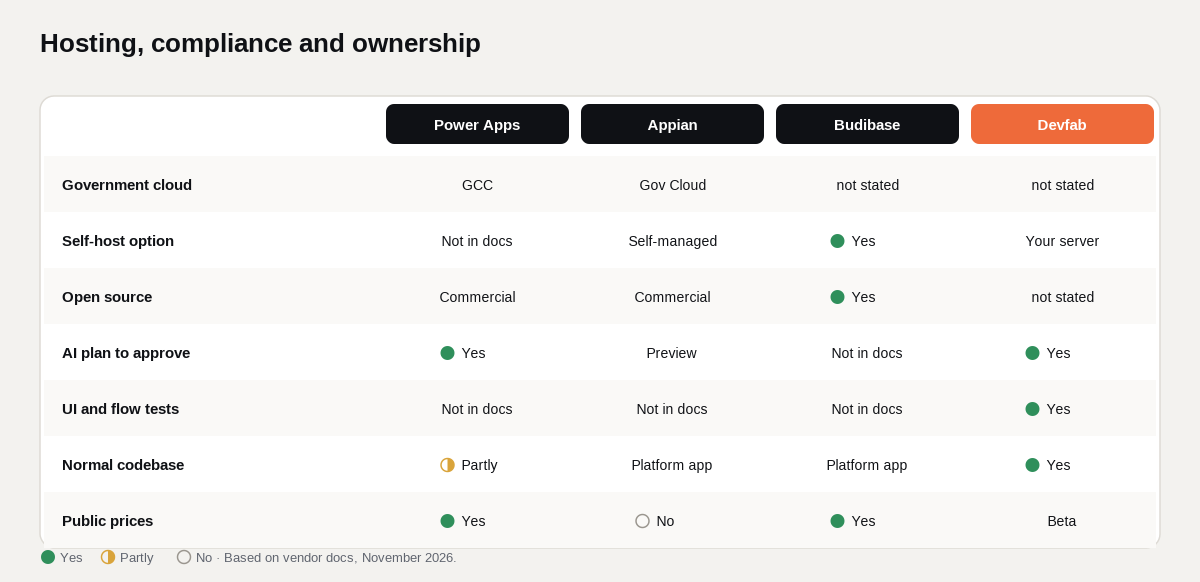
| Microsoft Power Apps | Low-code on Dataverse | GCC (FedRAMP High, CJIS), GCC High, DoD | Microsoft cloud | Natural-language apps, Plans, app-builder skill | Per user or per app |
| GitHub Copilot | Coding assistant and agent | GitHub Enterprise Cloud FedRAMP Tailored; FedRAMP-models policy | Your repos and IDEs | Code completion, agents, PR review | Per seat plus AI credits |
| ServiceNow App Engine | Platform apps | Government Community Cloud (FedRAMP High, DoD IL-4) | ServiceNow cloud | Not covered in the page we checked | See vendor |
| OutSystems | Enterprise low-code | FedRAMP (managed cloud with Knox); TX-RAMP | Managed, self-hosted, private, sovereign | Mentor app generator | Custom quote |
| Mendix | Enterprise low-code | Mendix Cloud for Government (FedRAMP, AWS GovCloud) | Mendix Cloud, Kubernetes, own servers and more | Maia, external agents via MCP | Per app and users |
| Appian | Low-code process platform | Appian Government Cloud (FedRAMP High, DISA IL5) | Appian Cloud or self-managed | Composer (preview), Agent Studio | Per user, per month, per app |
| Budibase | Open-source apps and agents | Not stated; self-host incl. air-gapped | Budibase Cloud or your servers | Agents with approval policies | Free self-hosted; Cloud and Enterprise paid |
| Devfab | AI software factory | Not stated | Your own server | Research, plan approval, dev, QA and deploy agents | Cost logged per task and per project (Beta) |
The tools one by one
Microsoft Power Apps
Power Apps US Government is open to federal, state, local, tribal and territorial government entities, subject to eligibility checks. GCC meets FedRAMP High, DoD DISA IL2 and CJIS requirements; customer content at rest stays in US datacenters, with Microsoft admin access limited to screened US citizens. Makers describe apps in natural language, and the Plans workspace uses AI agents as requirements analyst, data modeler and solution architect. Since September 2026, an app-builder skill lets tools like GitHub Copilot CLI build model-driven apps, creating nothing until the user approves the build plan. IT can centralize data loss prevention, access and auditing.
Pricing: Power Apps Premium is USD 20 per user per month, paid yearly, on the commercial pricing page, as of November 2026; government plans are separate per-app and per-user plans.
Best for cities standardized on Microsoft 365 that want apps inside existing tenant governance. Limits: premium, on-premises and custom connectors need standalone licenses; several AI building pieces are still in preview.
GitHub Copilot
For cities with developers, Copilot adds AI to the editor, terminal and GitHub itself. GitHub Enterprise Cloud has FedRAMP Tailored authorization. Since April 13, 2026, Copilot data residency in the US or EU is available on Enterprise Cloud with data residency; model hosts are FedRAMP Moderate, but GitHub said "Copilot itself" was not yet FedRAMP authorized, and requests cost 10% more. An optional policy restricts Copilot to FedRAMP Moderate models. Enterprise AI Controls added an AI administrator role and agent activity in audit logs in February 2026.
Pricing: Business USD 19 and Enterprise USD 39 per granted seat per month, as of November 2026, with pooled AI credits.
Best for in-house development teams already on GitHub. Limits: it helps developers code; planning, testing and deployment stay with your team. The cloud agent works only with repositories hosted on GitHub.
ServiceNow App Engine
ServiceNow's state government page lists App Engine ("Build apps that automate manual work and modernize legacy processes") and Public Sector Digital Services. It cites a US Government Community Cloud certified at FedRAMP High and DoD IL-4, plus a separate National Security Cloud for IL5 defense data. StateRAMP or GovRAMP isn't mentioned on that page.
Pricing: not on the page we checked; contact ServiceNow.
Best for governments already running ServiceNow for IT service management. Limits: we found fewer public details on its AI building features than for other tools here; ask for a demo on your own use case.
OutSystems
OutSystems is an enterprise low-code platform with an AI assistant, Mentor, that generates apps and proposes a plan before applying changes. In 2026 it achieved FedRAMP Authorization through a managed cloud with Knox (aimed at federal agencies; impact level not stated in the release) and Texas TX-RAMP certification, so eligible Texas public entities can rely on a state-verified assessment. It lists government among target industries and deployment options including on-premises and sovereign cloud, with pre-built connections to 400+ systems.
Pricing: free Personal Edition for development; paid platform by custom quote, sized by Application Objects and users.
Best for larger agencies with many connected apps and a long-term platform budget. Limits: no public prices, and apps are platform apps that are hard to move. See OutSystems alternatives.
Mendix
Mendix Cloud for Government runs on AWS GovCloud, is managed by Siemens Government Technologies, and was reported FedRAMP Authorized in February 2025, aimed at federal agencies. Outside the government cloud, Mendix deploys to Mendix Cloud, Azure, Kubernetes, SAP BTP or your own servers. Maia Plan turns user stories into app plans, and since 2026 outside agents such as Claude Code and GitHub Copilot can work with Studio Pro and Mendix Cloud through MCP.
Pricing: Standard One App "starting at" USD 1,090 per month, as of November 2026; Premium by quote.
Best for agencies that need flexible deployment under one license. Limits: its government cloud targets federal agencies; policies for outside agents give visibility but no enforcement in 11.12.
Appian
Appian Government Cloud obtained FedRAMP High authorization in April 2025 and renewed its DISA IL5 authorization; Appian Cloud has held FedRAMP Moderate since 2015. The platform is built for process automation and case management, with Agent Studio for AI agents and an audit view of every step an agent took. AI can run self-managed on air-gapped infrastructure, and Composer turns legacy requirements into an app plan (preview).
Pricing: per user, per month, per app across three tiers; no dollar amounts on the pricing page. AI Agents and Composer aren't on Standard.
Best for case-heavy work such as licensing, benefits and inspections with strict audit needs. Limits: the release doesn't mention state or local government; a 2026 competitor review cites high per-user pricing for smaller organizations. See Devfab vs Appian.
Budibase
Budibase is open source (GPL v3 core) and positions itself for regulated organizations, with industry pages for the public sector. It runs on Budibase Cloud or self-hosted on private cloud, on-premises or air-gapped infrastructure, and lists ISO 27001 and Iron Bank container images. Budibase 4.0, released November 10, 2026, added agent approval policies that decide when a person must step in, plus agent audit logs and approvals in Slack and Teams.
Pricing: Community (self-managed) USD 0; Cloud from USD 299 per month; Enterprise custom, as of November 2026.
Best for IT teams that must self-host and want open source with no license per user on Community. Limits: Community has one workspace and short automation log retention; "Budibase AI" isn't in Community.
Devfab
Devfab is an AI software factory. Instead of building on a vendor platform, its agents produce a normal codebase that lives in your own GitHub account or your organization's, and you deploy it to your own server. That keeps resident data on infrastructure you control.
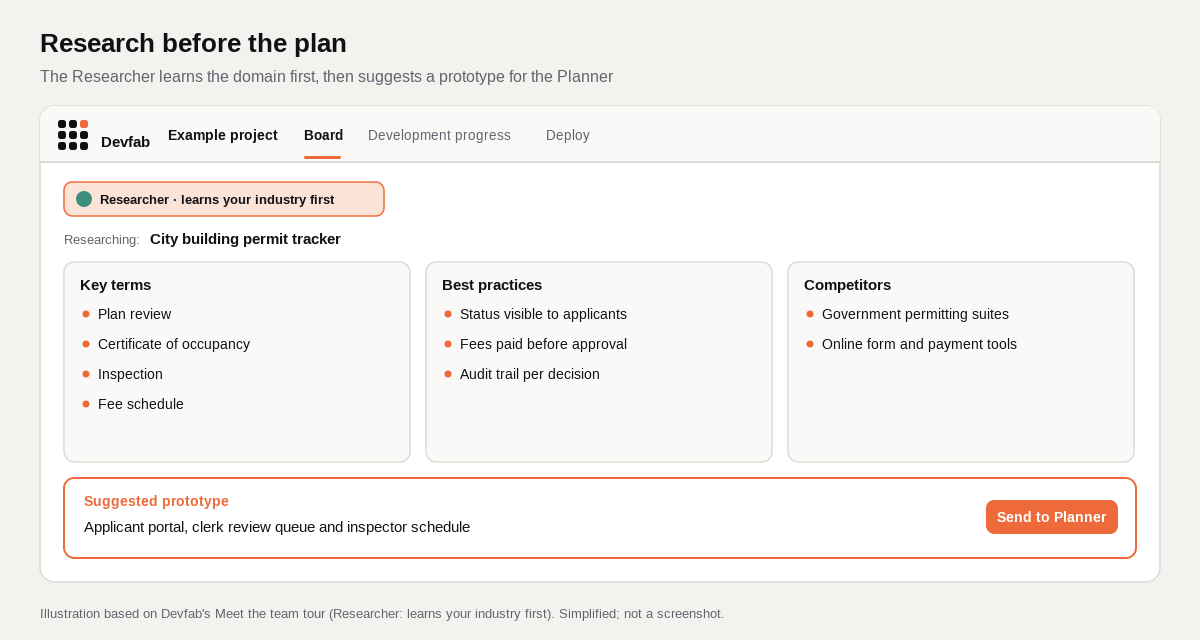
The process fits public-sector review. Before any plan, Devfab's research step maps the domain: for a permit tracker, terms like plan review and certificate of occupancy, practices like fee rules and inspection scheduling, and how comparable products work. It then suggests a prototype, so staff can see the app before the build. A person approves the plan before the Coordinator creates tickets. ChainFlow maps which functions and APIs call each other, so changes to one service don't silently break another. The QA agent runs UI and flow tests (screens, buttons and user journeys clicked end to end) plus logic tests. Docs include blueprints, sequence flows and user manuals, and a feedback module turns resident or staff reports into tickets.
Coding agents automate the developer. Devfab automates the development lifecycle.
Pricing: predictable cost: cost is logged after each run, per task and per project, which helps when you report spend per project.
Best for cities and counties, and the agencies that serve them, that want custom apps they own and host. Honest limits: Devfab is in Beta; no FedRAMP, GovRAMP or other certifications are stated; it has a smaller community and fewer integrations than the platforms above; it isn't an editor for hands-on coding; it needs a GitHub account; and you are responsible for the servers. See our 311 service request portal build and the public works asset tracker build.
Where a platform or assistant is the better choice
- You need a named government cloud today. Power Apps GCC, ServiceNow's Government Community Cloud, Appian Government Cloud and Mendix Cloud for Government have them; Devfab states none.
- Your city is all-in on Microsoft 365. Power Apps fits existing licensing and governance.
- Texas public entities can rely on OutSystems' TX-RAMP certification.
- Developers want help writing code in their own tools. Copilot is the simpler fit.
- Long-term vendor support matters more than owning the code.
How to choose
- Start with policy. Inventory the AI tools staff already use, as Corona did.
- Check hosting and compliance needs for the data involved before looking at features.
- Check procurement. Note whether federal funds and thresholds apply.
- Pick one contained app, such as a permit tracker or service request portal, with clear rules.
- Match the tool: Microsoft shop → Power Apps; developers on GitHub → Copilot; government cloud required → Appian, Mendix, OutSystems or ServiceNow; self-host open source → Budibase; custom app you own and host → Devfab. Compare with Devfab vs Power Apps.
FAQ
What AI tools can local governments use for building apps?
Common choices are low-code platforms with government clouds (Power Apps, OutSystems, Mendix, Appian, ServiceNow), coding assistants such as GitHub Copilot for in-house developers, open-source self-hosted builders like Budibase, and software factories like Devfab that build custom apps you host yourself.
Do AI tools for government need FedRAMP?
FedRAMP is a federal program. Many state and local agencies look at it anyway, or at GovRAMP, a nonprofit that verifies cloud products for state, local, tribal and education governments. None of the vendor pages we checked stated a GovRAMP status, so ask each vendor directly.
Can a city run AI-built apps on its own servers?
Yes, with the right tool. Budibase can be self-hosted, including air-gapped. Mendix and OutSystems list on-premises or private-cloud options. With Devfab, the code lives in your own GitHub account and you deploy to your own server.
How should a small city IT team start with AI?
Inventory the AI tools staff already use, write a short policy, then pick one contained app with clear rules, such as a permit tracker or a service request portal. Check hosting, data and procurement rules before you choose a tool.
Read next
Planning a resident-facing app? See the research and the plan before you commit budget. Try the Devfab Beta
Sources (checked November 2026): NASCIO 2026 Top 10 (StateTech, Dec 22, 2025); NASCIO-PTI Tech Forecast, Jan 2026 (PDF); GovTech: Digital Cities 2026; MRSC: Federal thresholds update (Nov 2025); GovRAMP; Power Apps US Government (Microsoft Learn); Power Apps pricing; Power Apps product page; What's new in Power Platform, September 2026; The New Stack: Power Apps Plans; Power Platform licensing FAQs; FedRAMP and GitHub; GitHub Changelog: Copilot data residency and FedRAMP (Apr 13, 2026); GitHub Docs: FedRAMP models; GitHub Copilot plans; GitHub Changelog: Enterprise AI Controls (Feb 26, 2026); GitHub Docs: Copilot cloud agent; ServiceNow for state government; Business Wire: OutSystems FedRAMP; OutSystems TX-RAMP (Nov 3, 2026); OutSystems Developer Cloud; OutSystems pricing and editions; OutSystems FAQs; Mendix Cloud for Government; WashingtonExec: Mendix Cloud for Government FedRAMP (Feb 2025); Mendix pricing; Mendix release 11.12; Appian Government Cloud FedRAMP High; Appian pricing; Appian What's New; Appian Q1 2026 highlights; Blaze: Appian reviews (competitor, Feb 2026); Budibase; Budibase pricing; Budibase 4.0 (Nov 10, 2026); Budibase on GitHub.
Frequently asked questions
What AI tools can local governments use for building apps?
Common choices are low-code platforms with government clouds (Power Apps, OutSystems, Mendix, Appian, ServiceNow), coding assistants such as GitHub Copilot for in-house developers, open-source self-hosted builders like Budibase, and software factories like Devfab that build custom apps you host yourself.
Do AI tools for government need FedRAMP?
FedRAMP is a federal program. Many state and local agencies look at it anyway, or at GovRAMP, a nonprofit that verifies cloud products for state, local, tribal and education governments. None of the vendor pages we checked stated a GovRAMP status, so ask each vendor directly.
Can a city run AI-built apps on its own servers?
Yes, with the right tool. Budibase can be self-hosted, including air-gapped. Mendix and OutSystems list on-premises or private-cloud options. With Devfab, the code lives in your own GitHub account and you deploy to your own server.
How should a small city IT team start with AI?
Inventory the AI tools staff already use, write a short policy, then pick one contained app with clear rules, such as a permit tracker or a service request portal. Check hosting, data and procurement rules before you choose a tool.