Short answer: Budibase wins when IT in a regulated organization wants AI agents that handle requests, with approval rules for when a human signs off, self-hosted and even air-gapped. ToolJet wins when developers want their own coding agents to build governed internal apps over MCP, priced per builder rather than per end user.
You run IT for a school district. The help desk drowns in requests, and staff want a portal for room bookings and device loans. Both Budibase and ToolJet are open source and self-hostable. Yet in late 2026 they answer different questions.
Budibase now asks: which work can an agent do, and when must a person approve it? ToolJet asks: how do your coding agents build apps that IT can govern? This page compares them on vendor pages checked in November 2026.
In this comparison:
- Budibase and ToolJet at a glance
- Feature comparison
- Cost model by team size
- Where Budibase wins
- Where ToolJet wins
Each section answers one buying question.
Budibase and ToolJet at a glance
Budibase 4.0 shipped on November 10, 2026. It moved agents to "ready for real-world operations" (Budibase 4.0). Budibase is an open-source platform for IT teams to build AI agents, apps and automations around existing systems. It says it is "Built for regulated enterprises," with industry pages for public sector, finance, utilities and manufacturing (Budibase). The core is GPL v3, and paid features use a Business Source License (GitHub). Plans were also restructured: a reviewer in September 2026 saw Pro, Premium and Business tiers, while the pricing page now lists Community, Cloud and Enterprise (Jet Admin review; Budibase pricing).
The "new ToolJet" arrived on September 2, 2026. It lets teams "Build apps from your own coding agents (Claude Code, Codex, Grok Build, Cursor, etc)" through ToolJet MCP, and its AI Builder "can create complete business applications" that stay editable in the visual builder (ToolJet blog). The Community Edition is AGPL-3.0 (ToolJet vs Superblocks).
Feature comparison
| Aspect | Budibase | ToolJet | Source |
|---|---|---|---|
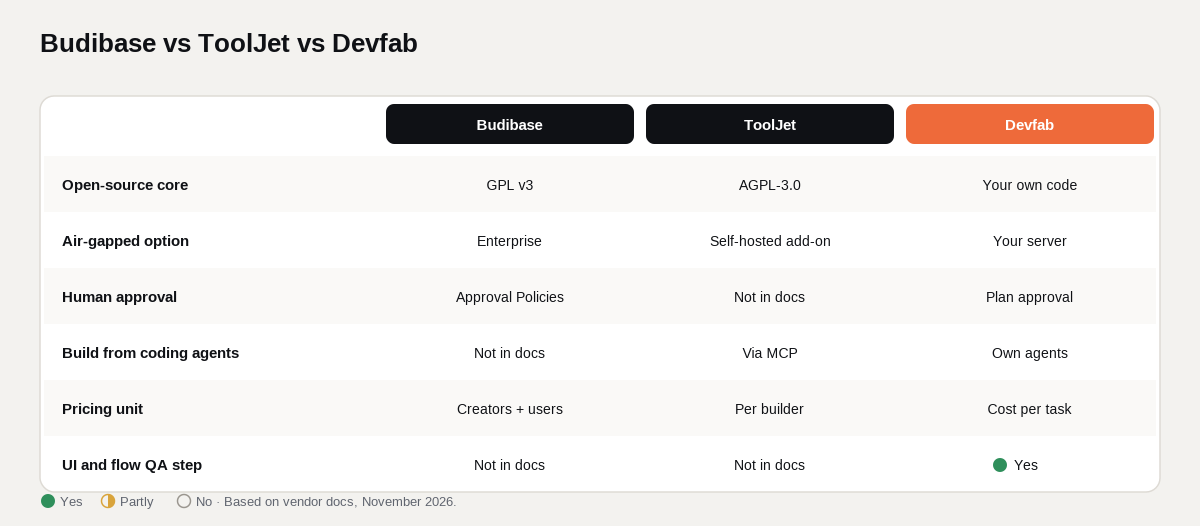
| Where it runs | Budibase Cloud, or self-host on private cloud, on-premise or air-gapped; agents usable inside Microsoft Teams | ToolJet Cloud, VPC or self-hosted on Docker, Kubernetes, AWS, Azure, GCP or on-prem | Budibase; ToolJet vs Superblocks |
| Planning or spec | Not covered in the pages we checked | AI assistant reads API specs and builds multi-page apps | ToolJet 2026 post |
| Agent autonomy | Agents with tools, escalation logic and Approval Policies for human sign-off | Coding agents build apps via ToolJet MCP; Governance MCP manages permissions | Budibase 4.0; ToolJet blog |
| Testing | Agent testing tools and agent audit logs | Auto-fixes component errors; app testing not covered | Budibase 4.0; ToolJet 2026 post |
| Deploy and hosting | Docker, Docker Compose, Kubernetes, DigitalOcean, Portainer | Workflows and AI agents listed as self-hosted only | Budibase GitHub; ToolJet vs Superblocks |
| Code and export | Projects can be imported and exported as reusable templates | Git-based workflows with dev and prod environments | Budibase 4.0; ToolJet blog |
| Team and admin | Granular roles, SSO and SCIM; enforceable SSO on Enterprise | SSO with SCIM; fine-grained RBAC on queries, components and pages | Budibase pricing; ToolJet 2026 post |
| Model choice | Any OpenAI-format model through LiteLLM, incl. open-source models | Several model families on paid plans; bring your own key on Enterprise | Budibase 2026 post; ToolJet vs Superblocks |
| Pricing model | Community free; Cloud subscription with creators, end users, actions and AI credits | Per builder, with end-user caps and AI credits | Budibase pricing; ToolJet pricing |
Cost model by team size
| Team size | Budibase | ToolJet |
|---|---|---|
| 1 person | Community USD 0, self-managed, bring your own AI key | Free USD 0: 1 builder, 10 end users, 3 apps |
| 5 people | Community (free), or Cloud from USD 299 per month | Pro USD 79 per month (annual): 5 builders, 50 end users |
| 25 people | Cloud plus add-ons: creators USD 50 and end users USD 5 per user per month (annual); or Enterprise custom | Team USD 199 per builder per month billed annually (100 end users), or Enterprise custom |
Prices as of November 2026 from Budibase pricing and ToolJet pricing. Budibase Cloud actions are hard monthly limits; going over halts work until reset or upgrade, per a competitor review (Jet Admin).
Where Budibase wins
- Regulated and air-gapped. ISO 27001, Iron Bank container images and air-gapped Enterprise installs (Budibase).
- Request handling with human sign-off. Approval Policies decide when a person steps in, and approvals can happen in Slack or Teams.
- Free for everyone in-house. Community has unlimited users, apps, agents and automations when self-managed.
- Your own small models. LiteLLM lets IT run open-source models behind an OpenAI-format endpoint.
Where ToolJet wins
- Developers already use coding agents. ToolJet MCP turns Claude Code, Codex or Cursor sessions into governed apps.
- Per-builder pricing suits a few builders serving many staff.
- Workflows with code. Scheduled and event-driven workflows can pull in external NPM libraries.
- Observability and audits. OpenTelemetry, SOC 2 Type II and ISO 27001 are listed (ToolJet 2026 post).
Switching from one to the other
Neither vendor documents a direct migration path in the pages we checked. Both connect to existing databases and APIs, so the practical route is to point the new platform at the same data sources and rebuild screens. Going to ToolJet, a coding agent can do much of the rebuild through ToolJet MCP. Going to Budibase, start with the service portal and data tables, then add agents with Approval Policies for the requests you want automated. On Budibase Community, note the single workspace and short automation log retention (Budibase pricing).
Where Devfab fits
Both platforms keep your app inside their runtime. That is a strength for internal tools. It is a limit when the school portal must become a product the district owns as code.
Coding agents automate the developer. Devfab automates the development lifecycle. A person approves Devfab's plan, not each agent action, and the QA agent runs UI and flow tests (screens, buttons and user journeys clicked end to end) plus logic tests. Code lives in your GitHub account, and Deploy ships to your own server. Devfab is in Beta, with fewer integrations than either platform. See Devfab vs Budibase and Devfab vs ToolJet.
FAQ
What changed in Budibase 4.0?
Budibase 4.0, launched November 10, 2026, moved agents to ready for real-world operations. Agents get their own instructions, tools, escalation logic and permissions; Approval Policies decide when a human must step in; and approvals and file submissions can happen in Slack and Teams.
Which is better for self-hosting?
Both self-host. Budibase's free Community plan runs self-managed with unlimited users, apps and agents, and Enterprise supports air-gapped installs. ToolJet self-hosts on Docker, Kubernetes and the major clouds, and its workflows and AI agents are listed as self-hosted only.
Which costs less for a team of 25?
It depends on the split between builders and users. As of November 2026, Budibase Cloud starts at USD 299 per month, with extra creators at USD 50 and end users at USD 5 per month (annual). ToolJet's Team plan is USD 199 per builder per month billed annually, with 100 end users.
Can coding agents build Budibase or ToolJet apps?
ToolJet is designed for it: ToolJet MCP lets agents such as Claude Code, Codex and Cursor create and modify apps, and that building uses no ToolJet AI credits. Budibase focuses on running AI agents inside your operations, with models through LiteLLM, rather than on outside coding agents.
Read next
- What is an AI software factory?
- Budibase alternatives for teams that ship to production
- Appsmith vs ToolJet: which should your team pick?
Need a portal your organization owns as code? Try Beta
Sources (checked November 2026): Budibase homepage; Budibase pricing; Introducing Budibase 4.0 (Nov 10, 2026); Budibase 2026: the AI workflow toolkit (Dec 8, 2025); Budibase on GitHub; Jet Admin: Budibase review (competitor, Sep 30, 2026); Meet the new ToolJet (Sep 2, 2026); ToolJet at the start of 2026 (Jan 8, 2026); ToolJet vs Superblocks (ToolJet's own page); ToolJet pricing.
Frequently asked questions
What changed in Budibase 4.0?
Budibase 4.0, launched November 10, 2026, moved agents to ready for real-world operations. Agents get their own instructions, tools, escalation logic and permissions; Approval Policies decide when a human must step in; and approvals and file submissions can happen in Slack and Teams.
Which is better for self-hosting?
Both self-host. Budibase's free Community plan runs self-managed with unlimited users, apps and agents, and Enterprise supports air-gapped installs. ToolJet self-hosts on Docker, Kubernetes and the major clouds, and its workflows and AI agents are listed as self-hosted only.
Which costs less for a team of 25?
It depends on the split between builders and users. As of November 2026, Budibase Cloud starts at USD 299 per month, with extra creators at USD 50 and end users at USD 5 per month (annual). ToolJet's Team plan is USD 199 per builder per month billed annually, with 100 end users.
Can coding agents build Budibase or ToolJet apps?
ToolJet is designed for it: ToolJet MCP lets agents such as Claude Code, Codex and Cursor create and modify apps, and that building uses no ToolJet AI credits. Budibase focuses on running AI agents inside your operations, with models through LiteLLM, rather than on outside coding agents.