Short answer: DronaHQ wins when an enterprise needs internal apps on web and mobile plus governed AI agents with approvals and tracing, in the cloud or self-hosted, with compliance paperwork ready. ToolJet wins when you want an open-source core, a low per-builder price and a platform your developers' coding agents build on through MCP.
A regional bank's lending team tracks loan documents in shared folders: pay slips, title deeds, signed forms. Compliance wants an internal app with audit trails and, ideally, an assistant that flags missing documents. Security wants it on the bank's own servers. DronaHQ sells to banks and promises governed agents. ToolJet is open source and lets developers build with the coding agents they already use. Here is a fair comparison from vendor pages checked in November 2026.
In this comparison:
- DronaHQ and ToolJet at a glance
- Feature comparison
- Cost model by team size
- Where DronaHQ wins
- Where ToolJet wins
The deciding question is who builds: business builders and ops leads, or developers with coding agents.
DronaHQ and ToolJet at a glance
ToolJet relaunched for coding agents. On September 2, 2026, ToolJet announced the "new ToolJet": build governed internal tools "from your own coding agents (Claude Code, Codex, Grok Build, Cursor, etc)" through ToolJet MCP, with a Governance MCP to manage permissions from agents (ToolJet blog). Its AI Builder "can create complete business applications" across "100+ integrations," and every generated app stays editable in the visual builder. ToolJet positions itself as "Designed for self-hosted, security-sensitive environments" (ToolJet 2026 post).
DronaHQ is active and pitches apps and agents together. Its homepage targets ops leads, staff engineers, product managers and internal-tools developers in BFSI, retail, manufacturing and healthcare (DronaHQ). You build with prompts, a visual builder, JavaScript, or AI coding tools through DronaHQ MCP. One build serves web and mobile. A "Vibe code SWE Agent" is in beta, with access on request.
Both are enterprise-minded internal tool platforms. DronaHQ adds mobile and a fuller agent product. ToolJet adds an open-source core and puts coding agents at the center.
Feature comparison
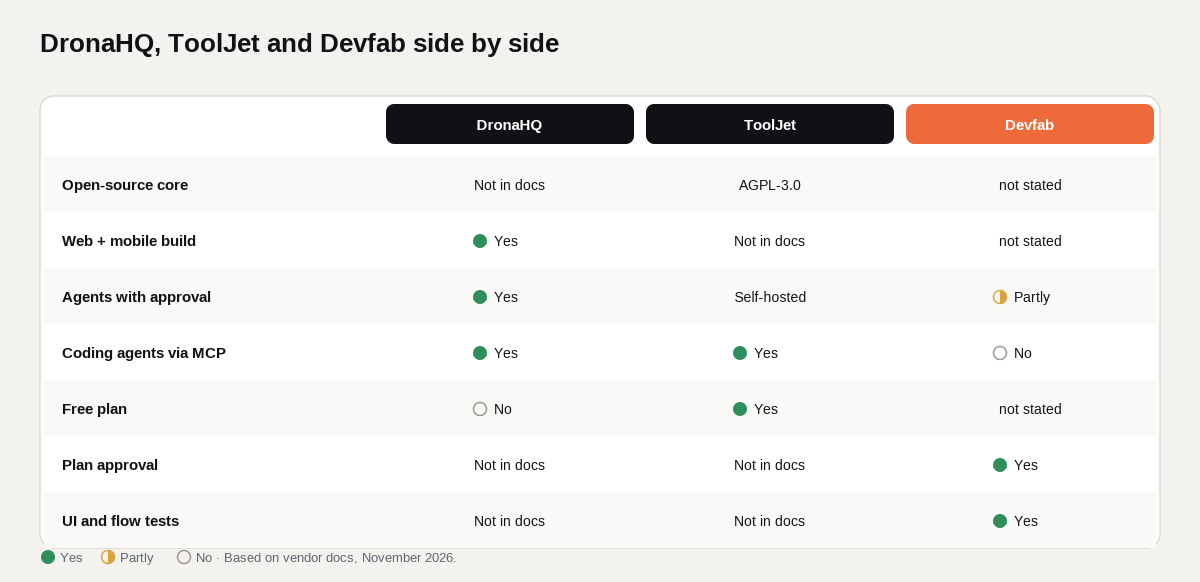
| Aspect | DronaHQ | ToolJet | Source |
|---|---|---|---|
| Where it runs | Cloud, dedicated cloud with data residency, or self-hosted | ToolJet Cloud, VPC, or self-hosted on Docker, Kubernetes, AWS, Azure, GCP or on-prem | DronaHQ; ToolJet vs Superblocks |
| Open source | Not described on the pages we checked | Community Edition AGPL-3.0; MCP server MIT | ToolJet vs Superblocks |
| AI building | Prompt-based generation; SWE agent in beta; 300 AI credits on cloud plans | AI Builder for complete apps; AI assistant reads API specs and auto-fixes component errors | DronaHQ pricing; ToolJet 2026 post |
| Coding agents | Claude Code and Cursor via DronaHQ MCP | Claude Code, Codex, Grok Build, Cursor via ToolJet MCP; no ToolJet AI credits used | DronaHQ; ToolJet vs Superblocks |
| AI agents in apps | Sub-agents, retrieval, guardrails, tracing, human approval; chat, voice, WhatsApp, email, API | AI agents and workflows listed as self-hosted only | DronaHQ; ToolJet vs Superblocks |
| Mobile | One build for web and mobile; offline on Enterprise | Not covered in the pages we checked | DronaHQ pricing |
| Testing | Not covered in the pages we checked | Auto-fixes component errors; testing not covered | ToolJet 2026 post |
| Security and admin | SOC 2 Type II, ISO 27001, SSO/SAML from Business, RBAC, audit trails; HIPAA via self-hosted | SSO with SCIM, fine-grained RBAC, audit logs, OpenTelemetry; SOC 2 Type II, ISO 27001, GDPR | DronaHQ; ToolJet 2026 post |
| Git | Self-hosted only | Git-based workflows, dev and prod environments | DronaHQ pricing; ToolJet blog |
| Pricing model | Monthly plans with task quotas; pay-as-you-go tasks | Per builder, with end-user caps and AI credits per builder | DronaHQ pricing; ToolJet pricing |
Cost model by team size
| Team size | DronaHQ | ToolJet |
|---|---|---|
| 1 person | No permanent free plan; free Business trial; pay-as-you-go tasks at USD 0.002 per task | Free USD 0: 1 builder, 10 end users, 3 apps, 100 AI credits per month |
| 5 people | Cloud Starter USD 140 per month (USD 100 per month billed annually) | Pro USD 79 per month billed annually: 5 builders, 50 end users, unlimited apps |
| 25 people | Cloud Business USD 700 per month (USD 500 billed annually), or Self-hosted Business USD 1,500 per month billed annually | Team USD 199 per builder per month billed annually (USD 249 monthly), 100 end users; or Enterprise (custom) |
Prices as of November 2026 from DronaHQ pricing and ToolJet pricing. DronaHQ's page does not clearly label which user-based prices are monthly or annual. ToolJet's included AI credits expire monthly; add-on credits are USD 1 per 100 (minimum 2,000) and last one year.
The shapes differ. With 25 staff using the app and 2 builders, ToolJet's per-builder model can stay small. With many builders, compare DronaHQ's plan price, and what its plan allows, against ToolJet's per-builder total. Self-hosting has its own cost: a competitor's review notes ToolJet self-hosting adds infrastructure and DevOps work and is production-ready only "with proper DevOps practices" (Jet Admin).
Where DronaHQ wins
- Staff need the app on phones, sometimes offline. One build covers web and mobile, with offline access on Enterprise.
- You want AI agents with guardrails in production. Tracing, guardrails and human approval for sensitive steps are on the homepage, with channels from WhatsApp to voice.
- Regulated data. HIPAA via the self-hosted version, plus SOC 2 Type II and ISO 27001.
- Data residency without running servers. A dedicated cloud with data residency sits between shared cloud and self-hosted.
- Many builders on one plan. Plan pricing with task quotas does not multiply per builder.
Where ToolJet wins
- You want an open-source core. The Community Edition is AGPL-3.0, and the MCP server is MIT.
- Your developers already use coding agents. ToolJet MCP lets Claude Code, Codex and Cursor build and change apps, with no ToolJet AI credits used.
- Few builders, many end users. Pricing is per builder, starting with a free plan.
- Everything must run in your own infrastructure. Self-hosting covers the whole platform on Docker, Kubernetes, AWS, Azure, GCP or on-prem.
- Fine-grained control. RBAC reaches queries, components and pages, with promote and release permissions.
Switching from one to the other
From DronaHQ to ToolJet. No importer is named on either vendor's pages. Reconnect your data sources (ToolJet lists 100+ integrations), then rebuild screens with the AI Builder or point a coding agent at ToolJet MCP. Mobile and offline needs should be tested before you commit, since the pages we checked don't cover ToolJet mobile apps.
From ToolJet to DronaHQ. Reconnect data sources and rebuild with prompts, the visual builder or DronaHQ MCP. If your ToolJet workflows run self-hosted, plan the move around DronaHQ's self-hosted plan, which is also where its Git source control lives.
Where Devfab fits
Both platforms are strong at internal apps on existing data. Neither page we checked describes researching the domain before building, a project plan a person approves, or a QA step that clicks through complete user journeys before release.
Coding agents automate the developer. Devfab automates the development lifecycle. The Researcher maps the domain first, such as which documents a loan file needs and which rules apply, before the Planner writes a plan a person approves. Dev agents build with ChainFlow, the QA agent runs UI, flow and logic tests, and Deploy ships to your own server, with the code in your own GitHub account. Devfab is in Beta, with a smaller community and fewer integrations than either platform. See Devfab vs DronaHQ and Devfab vs ToolJet.
FAQ
Is ToolJet open source and DronaHQ not?
ToolJet's Community Edition is open source under AGPL-3.0, and its MCP server is MIT-licensed, according to ToolJet's own comparison page. DronaHQ's pages we checked do not describe an open-source edition; it offers cloud, dedicated cloud and self-hosted plans instead.
Which is cheaper, DronaHQ or ToolJet?
ToolJet usually starts lower. As of November 2026, ToolJet has a Free plan for 1 builder and Basic at USD 23 per builder per month billed annually. DronaHQ has no permanent free plan; Cloud Starter is USD 140 per month, or USD 100 per month billed annually. At scale, ToolJet charges per builder and DronaHQ per plan with task quotas.
Can Claude Code or Cursor build apps on DronaHQ and ToolJet?
Yes, both describe it. DronaHQ lets AI coding tools such as Claude Code and Cursor build through DronaHQ MCP. ToolJet's September 2026 relaunch is built around it: ToolJet MCP lets Claude Code, Codex, Grok Build and Cursor create, inspect and modify apps, and building this way uses no ToolJet AI credits.
Which is better for AI agents inside the business?
DronaHQ, on the pages we checked. It lists agents with sub-agents, document retrieval, guardrails, tracing and human approval for sensitive steps, across chat, voice, WhatsApp, email or API. ToolJet lists AI agents and workflows as self-hosted only, according to its own comparison page.
Read next
Need the app planned, tested and shipped to your own servers? Try Beta
Sources (checked November 2026): DronaHQ homepage; DronaHQ pricing; Meet the new ToolJet (Sep 2, 2026); ToolJet at the start of 2026 (Jan 8, 2026); ToolJet vs Superblocks (ToolJet's own comparison page); ToolJet pricing; Jet Admin: ToolJet vs Retool 2026 (competitor, Jul 27, 2026).
Frequently asked questions
Is ToolJet open source and DronaHQ not?
ToolJet's Community Edition is open source under AGPL-3.0, and its MCP server is MIT-licensed, according to ToolJet's own comparison page. DronaHQ's pages we checked do not describe an open-source edition; it offers cloud, dedicated cloud and self-hosted plans instead.
Which is cheaper, DronaHQ or ToolJet?
ToolJet usually starts lower. As of November 2026, ToolJet has a Free plan for 1 builder and Basic at USD 23 per builder per month billed annually. DronaHQ has no permanent free plan; Cloud Starter is USD 140 per month, or USD 100 per month billed annually. At scale, ToolJet charges per builder and DronaHQ per plan with task quotas.
Can Claude Code or Cursor build apps on DronaHQ and ToolJet?
Yes, both describe it. DronaHQ lets AI coding tools such as Claude Code and Cursor build through DronaHQ MCP. ToolJet's September 2026 relaunch is built around it: ToolJet MCP lets Claude Code, Codex, Grok Build and Cursor create, inspect and modify apps, and building this way uses no ToolJet AI credits.
Which is better for AI agents inside the business?
DronaHQ, on the pages we checked. It lists agents with sub-agents, document retrieval, guardrails, tracing and human approval for sensitive steps, across chat, voice, WhatsApp, email or API. ToolJet lists AI agents and workflows as self-hosted only, according to its own comparison page.