Short answer: For an open-source internal-tool builder with a permissive license, pick Appsmith. For open source with stronger AI app generation, ToolJet. For a mature commercial platform, Retool. For client portals that non-engineers maintain, Softr. If the app has outgrown a builder and should be tested code on your own server, Devfab.
You chose Budibase to self-host forms and approvals without paying per seat. Then you moved to Cloud, and actions became hard monthly limits. Or the Community plan's single workspace and one-day automation logs got in the way. Budibase 4.0 just shipped a strong agent story. But if your problem is app building, not agents, it's worth comparing.
In this guide, you'll learn:
- Why teams leave Budibase
- How six alternatives compare
- Each alternative's verdict and trade-off
- Where Budibase is still the better choice
- How to choose
Start with the triggers; skip to the table if you know them.
Why teams leave Budibase
Status first. Budibase is active. On November 10, 2026 it announced Budibase 4.0, which moves its AI agents to "ready for real-world operations." The plan lineup also changed recently: a review dated September 2026 describes Pro, Premium and Business tiers, while the current pricing page shows Community, Cloud and Enterprise.
The switching triggers we found:
- Hard limits on Cloud. Cloud plans include a monthly number of "actions" that Budibase calls hard limits. Jet Admin's review (a competitor, Sep 2026) says exceeding them halts work until reset or upgrade.
- Per-end-user cost on Cloud. Cloud includes a set number of creators and end users, with paid add-ons; Jet Admin notes this raises cost for larger audiences.
- Community plan limits. The free self-hosted plan has one workspace and one-day automation log retention, and "Budibase AI" is not included.
- Feature gaps between editions. Self-hosted feature availability may differ from Cloud, per Jet Admin. Paid features are under a Business Source License, not the GPL core.
- Agents first, apps second. Budibase now leads with agents and automations. Some features, such as "Functions," are labeled Alpha.
Quick comparison
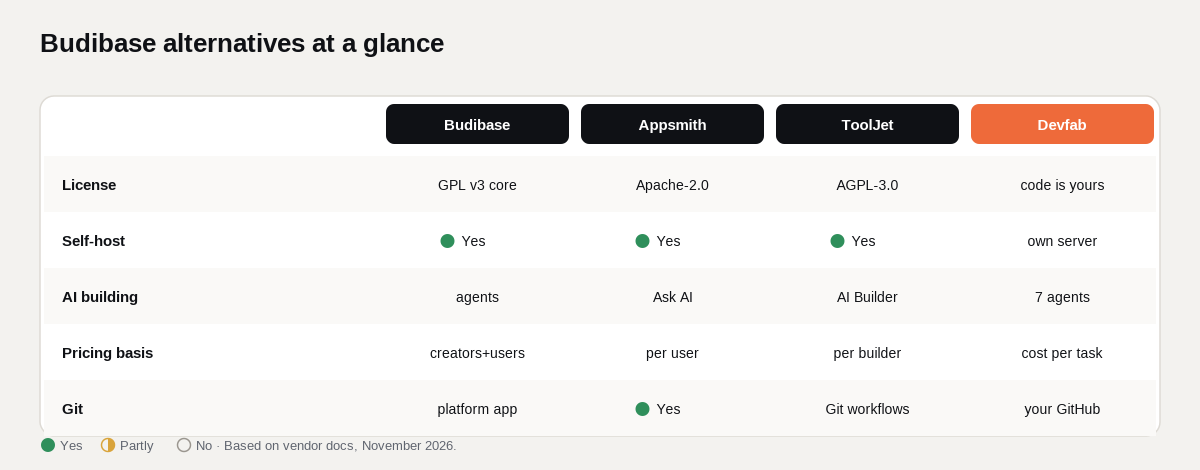
| Tool | Type | Self-host | AI building | Code and Git | Pricing model |
|---|---|---|---|---|---|
| Budibase (baseline) | Open-source apps, automations, agents | Yes, incl. air-gapped | Agents with approval policies | Platform apps | Free self-hosted; Cloud with hard action limits |
| Appsmith | Open-source internal-tool builder | Yes, any edition | Ask AI for JS and queries | Git sync with branches and PRs | Free self-hosted; cloud per user |
| ToolJet | Open-source internal-tool builder | Yes, whole platform | AI Builder; MCP for coding agents | Git-based workflows | Per builder, with AI credits |
| Retool | Internal-tool and AI app builder | Enterprise only | Prompt-first React builder | Editable React and TypeScript | Per builder and per user, plus AI credits |
| Softr | No-code portal and app builder | No, hosted | Prompt to pages, data, permissions | Hosted apps | Workspace plans with builders and users |
| Microsoft Power Apps | Low-code platform | Microsoft cloud | Natural language, app-builder skill | Dataverse solutions | Per user or per app, plus capacity |
| Devfab | AI software factory | Deploys to your own server | Research, plan, build, QA, deploy | Normal codebase in your GitHub | Cost logged per task and per project (Beta) |
The alternatives
1. Appsmith
Verdict: the closest open-source swap for hand-built internal tools. Best for: engineers building CRUD screens and admin panels on their own databases. Trade-off: thin AI building; Appsmith Agents is Legacy. Pricing: free self-managed Community edition; cloud Free plan capped at 5 users; Business per user; Enterprise flat base fee. No charge for developers.
- Apache-2.0 license, about 41k GitHub stars, self-hosted via Docker, Kubernetes or an AWS AMI.
- Native connectors include PostgreSQL, MongoDB, MySQL, MS SQL, Redis and Snowflake, plus REST and GraphQL.
- Apps sync to Git for branches, commits, pull requests and merges.
Compare directly in Appsmith vs Budibase.
2. ToolJet
Verdict: the open-source pick if you want AI to build the apps. Best for: security-sensitive teams that self-host and already use coding agents. Trade-off: AGPL-3.0; workflows and AI agents are self-hosted only. Pricing: per builder, not per end user; free tier; paid tiers include AI credits per builder; Enterprise custom.
- Its AI Builder creates complete business apps, each one editable in the visual builder.
- Coding agents such as Claude Code, Codex or Cursor can build ToolJet apps through ToolJet MCP without using ToolJet AI credits.
- Per-builder pricing suits apps with many end users and few builders.
3. Retool
Verdict: the commercial standard for internal tools. Best for: engineering teams that want polish, governance and a large community. Trade-off: self-hosting is Enterprise-only, which matters if you left Budibase Cloud for self-hosting. Pricing: free tier up to 5 users; per-seat plans with separate builder and internal-user rates; pooled AI credits; Enterprise custom.
- Retool's AI app builder writes React and TypeScript you can edit in a Code tab.
- Apps inherit central authentication, role-based access and data access policies.
- Retool Workflows add schedules, webhooks, versioned releases and run history.
4. Softr
Verdict: the no-code pick when business users, not IT, will maintain the app. Best for: client portals and internal apps on Airtable, Google Sheets or Notion. Trade-off: hosted only, with app users capped per plan. Pricing: workspace plans with included builders and app users, a monthly workflow limit and monthly AI credits.
- From a prompt, Softr generates pages, a database, permissions and workflows.
- Record-level data restrictions and user groups control who sees what.
- It lists SOC 2 Type II and GDPR with EU or US hosting.
5. Microsoft Power Apps
Verdict: the choice if your users and data already live in Microsoft 365. Best for: request and approval apps on SharePoint, Dataverse and Teams. Trade-off: licensing has several meters. Pricing: per-user or per-app licenses; pay-as-you-go via Azure (preview); Dataverse capacity as a paid add-on.
- IT can centralize policies for environments, data loss prevention, access and auditing.
- Premium and custom connectors need a standalone license beyond Microsoft 365.
- See Microsoft Power Apps alternatives for its own trade-offs.
6. Devfab
Verdict: the move when an internal app has grown rules, roles and users that need a real codebase. Best for: agencies and IT teams that want tested code in their own GitHub, deployed to their own server. Trade-off: not open source, not a visual builder, and fewer integrations. Pricing: predictable cost: cost is logged after each run, per task and per project. Devfab is in Beta.
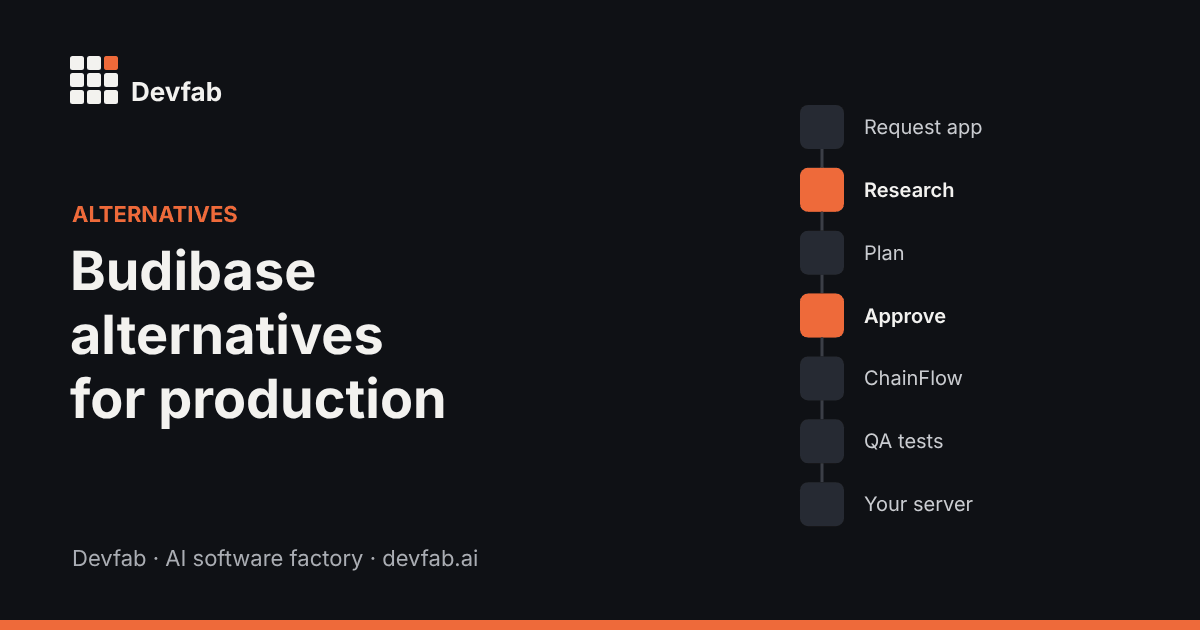
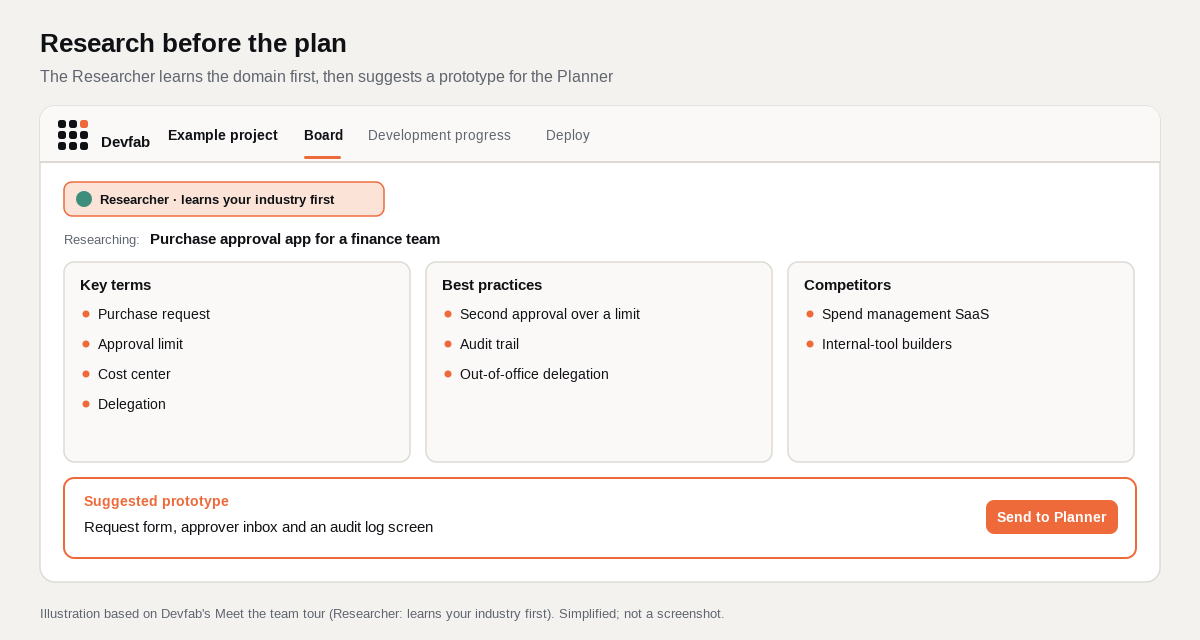
Devfab is an AI software factory with seven agents. Its research step maps the domain before the plan: key terms, best practices for that kind of app, and competitors, then suggests a prototype. For a purchase-approval app, that puts approval limits, audit trails and delegation on the table first. A person approves the plan; Budibase users will recognize the idea of a human sign-off step. Developer agents build with ChainFlow, which maps which functions and APIs call each other, so a change to the approval rule doesn't break notifications or reports. The QA agent runs UI and flow tests (screens, buttons and user journeys clicked end to end) plus logic tests. Code lives in your own GitHub account (or your organization's); Deploy ships to your own server.
Coding agents automate the developer. Devfab automates the development lifecycle.
Devfab's honest limits:
- It's new and in Beta, with a much smaller community than Budibase's open-source project.
- It isn't open source.
- It has fewer ready-made integrations than Budibase.
- It isn't an editor for hands-on coding, and it needs a GitHub account.
More detail: Devfab vs Budibase.
Where Budibase is still the better choice
- Self-hosting in regulated or air-gapped settings. Budibase runs on private cloud, on-premise or air-gapped infrastructure and lists ISO 27001 and Iron Bank container images.
- Agents with human approval. Approval Policies, tool-level permissions and agent audit logs are built in as of 4.0.
- Approvals inside Slack and Teams. People can approve or submit files to agents without opening another app.
- Your own models. LiteLLM support means any OpenAI-format model, including small open-source models.
- Free at scale when self-hosted. The Community plan has unlimited users, apps, agents and automations.
How to choose
- Same open-source model, more mature app builder, permissive license? Appsmith.
- Open source plus AI app generation and coding agents? ToolJet.
- Commercial platform and budget for seats? Retool.
- Business users maintain it, data in Airtable or Sheets? Softr.
- Everyone is on Microsoft 365? Power Apps.
- The app needs a real codebase, tests and your own server? Devfab. Read What is an AI software factory? and Internal tool builder vs custom app.
FAQ
What is new in Budibase 4.0?
Budibase announced 4.0 on November 10, 2026. It moves agents to production use, with Operations that have their own instructions, tools and permissions, Approval Policies for when a human must step in, agent audit logs, and approvals through Slack and Teams.
What happens when I hit Budibase Cloud action limits?
Budibase's pricing page calls Cloud action allowances hard monthly limits. Jet Admin's review (a competitor, September 2026) says work halts until the limit resets or you upgrade. The self-hosted Community plan lists unlimited users, apps, agents and automations.
What is the best open-source alternative to Budibase?
Appsmith (Apache-2.0) for hand-built internal tools on your own databases, and ToolJet (AGPL-3.0) if you want AI app generation and coding agents building governed apps through MCP.
Is Devfab open source like Budibase?
No. Devfab is not open source. It writes your app as a normal codebase in your own GitHub account and deploys it to your own server, so the code you ship is yours. Devfab itself is a hosted service in Beta.
Read next
- What is an AI software factory?
- Devfab vs Budibase
- Appsmith vs Budibase
- Internal tool builder vs custom app
Outgrown your internal-app builder? Try the Devfab Beta
Sources (checked November 13, 2026): Budibase homepage; Budibase pricing; Introducing Budibase 4.0 (Nov 2026); Budibase 2026 roadmap (Dec 2025); Budibase on GitHub; Budibase Review 2026 (Jet Admin, a competitor, Sep 2026); appsmithorg/appsmith on GitHub; Appsmith pricing; Appsmith Agents (Legacy); Appsmith Review 2026 (Superblocks, a competitor, Sep 2026); Meet the new ToolJet (Sep 2026); ToolJet vs Superblocks (ToolJet); Retool pricing; Retool launches a React AI app builder (Jun 2026); Retool extends governance to vibe-coded apps; Retool Review 2026 (Jet Admin, a competitor, Sep 2026); Softr homepage; Softr AI App Builder; Softr pricing and plans (docs); Microsoft Power Apps; Power Platform licensing FAQ.
Frequently asked questions
What is new in Budibase 4.0?
Budibase announced 4.0 on November 10, 2026. It moves agents to production use, with Operations that have their own instructions, tools and permissions, Approval Policies for when a human must step in, agent audit logs, and approvals through Slack and Teams.
What happens when I hit Budibase Cloud action limits?
Budibase's pricing page calls Cloud action allowances hard monthly limits. Jet Admin's review (a competitor, September 2026) says work halts until the limit resets or you upgrade. The self-hosted Community plan lists unlimited users, apps, agents and automations.
What is the best open-source alternative to Budibase?
Appsmith (Apache-2.0) for hand-built internal tools on your own databases, and ToolJet (AGPL-3.0) if you want AI app generation and coding agents building governed apps through MCP.
Is Devfab open source like Budibase?
No. Devfab is not open source. It writes your app as a normal codebase in your own GitHub account and deploys it to your own server, so the code you ship is yours. Devfab itself is a hosted service in Beta.