Short answer: Appsmith wins when you want a permissively licensed (Apache-2.0) builder you self-host for free, with no charge for developers and a widget canvas for CRUD screens. ToolJet wins when your developers already use coding agents and want them to build governed internal apps over MCP, with pricing per builder for large audiences.
You need a warehouse picking dashboard by next sprint, and the budget says open source. Appsmith and ToolJet both show up first. Most comparisons treat them as twins. In 2026 they split: one stayed a builder's canvas, and the other rebuilt itself around coding agents.
One side says license and price decide it. The other says AI does. This page referees both claims with vendor pages checked in November 2026.
In this comparison:
- Appsmith and ToolJet at a glance
- Feature comparison
- Cost model by team size
- Where Appsmith wins
- Where ToolJet wins
The sections follow the questions buyers ask most.
Appsmith and ToolJet at a glance
Appsmith: active, AI pulled back. Appsmith is an open-source low-code platform for "admin panels, internal tools, and dashboards" that connect to "25+ databases and any API" (GitHub). It is Apache-2.0 licensed, with about 41,000 GitHub stars. In 2026 the 2.x line shipped. Version 2.3 (August 2026) added Ask AI to the Community Edition, and the Appsmith AI datasource was removed on September 30, 2026, with no replacement named (Appsmith 2.3 notes). The separate Appsmith Agents product is labeled Legacy and closed to new sign-ups (Appsmith Agents).
ToolJet: active, rebuilt for agents. On September 2, 2026, ToolJet announced the "new ToolJet": build governed apps "from your own coding agents (Claude Code, Codex, Grok Build, Cursor, etc)" through ToolJet MCP, plus an AI Builder that "can create complete business applications" you can edit in the visual builder (ToolJet blog). The Community Edition is AGPL-3.0, and ToolJet positions itself for "self-hosted, security-sensitive environments" (ToolJet 2026 post).
Both are for developers and IT teams that build internal tools on top of existing data.
Feature comparison
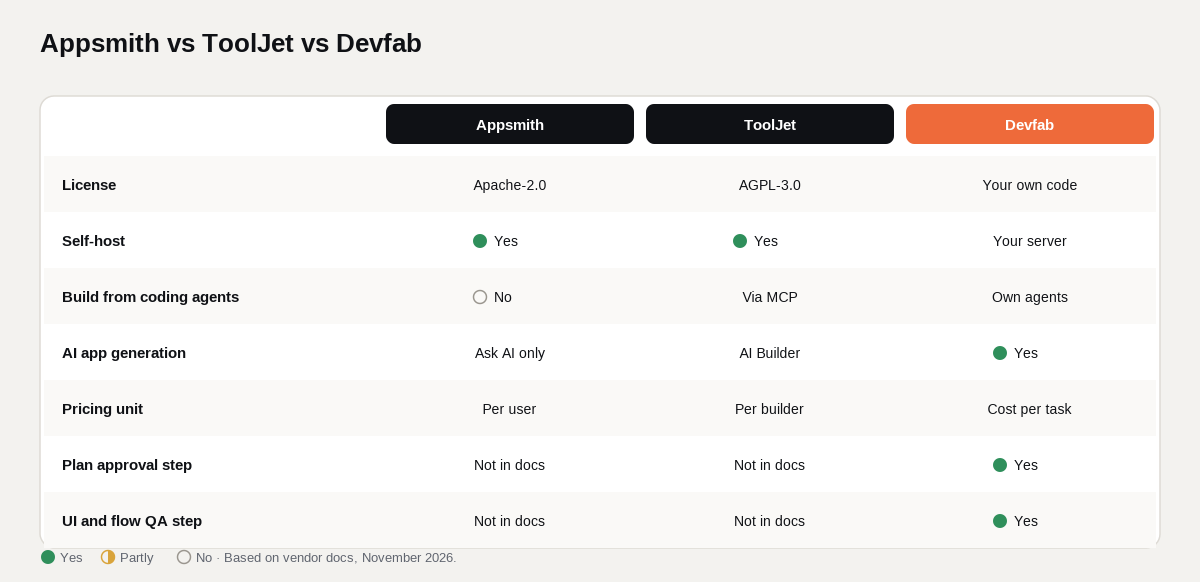
| Aspect | Appsmith | ToolJet | Source |
|---|---|---|---|
| Where it runs | Appsmith Cloud, or self-host on Docker, Kubernetes or AWS AMI | ToolJet Cloud, VPC or self-hosted on Docker, Kubernetes, AWS, Azure, GCP or on-prem | Appsmith GitHub; ToolJet vs Superblocks |
| Planning or spec | Not covered in the pages we checked | AI assistant reads API specs and builds multi-page apps | ToolJet 2026 post |
| AI and agents | Ask AI for JavaScript and queries; AI datasource removed; Agents is Legacy | AI Builder; ToolJet MCP for coding agents; Governance MCP for permissions | Appsmith 2.3; ToolJet blog |
| Testing | Not covered in the pages we checked | Auto-fixes component errors; testing not covered | ToolJet 2026 post |
| Code and Git | Git sync with branches, commits and pull requests; free tier limited to 3 repos, per a competitor review | Git-based workflows, dev and prod environments | Superblocks review; ToolJet blog |
| Open source | Apache-2.0 | AGPL-3.0 core; MCP server under MIT | Appsmith GitHub; ToolJet vs Superblocks |
| Team and admin | Google/GitHub OAuth; SAML/OIDC on Enterprise; custom RBAC on Business | SSO with SCIM; fine-grained RBAC on queries, components and pages; audit logs | Appsmith pricing; ToolJet 2026 post |
| Model choice | No AI features listed on any plan | Several model families on paid plans; bring your own key on Enterprise | Appsmith pricing; ToolJet vs Superblocks |
| Pricing model | Per user; developers not charged | Per builder, with end-user caps and AI credits | Appsmith pricing; ToolJet pricing |
Cost model by team size
| Team size | Appsmith | ToolJet |
|---|---|---|
| 1 person | Community free (self-managed) or cloud Free (up to 5 users) | Free USD 0: 1 builder, 10 end users, 3 apps, 100 AI credits per month |
| 5 people | Business USD 15 per user per month | Pro USD 79 per month (annual): 5 builders, 50 end users, unlimited apps |
| 25 people | Business per user, or Enterprise USD 2,500 per month for 100 users | Team USD 199 per builder per month billed annually (100 end users), or Enterprise custom |
All prices as of November 2026 from Appsmith pricing and ToolJet pricing. ToolJet's included AI credits expire monthly; add-on credits are USD 1 per 100 (minimum 2,000). Building through Claude Code or Codex over MCP uses no ToolJet AI credits (ToolJet vs Superblocks).
Where Appsmith wins
- License matters most. Apache-2.0 lets you modify and embed it without AGPL's share-alike terms.
- You have few users and many builders. Appsmith states "there is no additional charge for developers."
- You build many CRUD screens on databases like PostgreSQL, MongoDB, MySQL and Snowflake, where a widget canvas is the quickest route.
- You want a free, mature self-hosted tool with a large GitHub community.
Where ToolJet wins
- Your developers live in coding agents. ToolJet MCP lets Claude Code, Codex or Cursor build and change apps inside a governed runtime.
- Many viewers, few builders. Pricing is per builder, not per end user.
- You need fine-grained controls: RBAC down to queries and components, SCIM, OpenTelemetry, and SOC 2 Type II and ISO 27001 listed.
- You want workflows, scheduled or event-driven, with external NPM libraries.
Switching from one to the other
There is no direct import between the two in the pages we checked, so plan a rebuild. Appsmith apps sync to Git, which gives you a record of queries and JavaScript to port. From Appsmith to ToolJet, point ToolJet's AI assistant at your API specs, or let your coding agent rebuild screens through ToolJet MCP. From ToolJet to Appsmith, re-create data sources first, then screens. Note one upgrade trap: self-hosted Appsmith older than v1.96 must step through v1.99 before moving to 2.x (Appsmith 2.1 notice).
Where Devfab fits
Both tools build internal screens on top of data you already have. Neither, in the pages we checked, researches the domain before planning, routes a project plan to a person for approval, or runs a separate test step on user journeys. And with either one, the app runs on the platform's runtime.
Coding agents automate the developer. Devfab automates the development lifecycle. When the warehouse app has to become a product your client owns, Devfab's Researcher maps the domain first, a person approves the plan, and the QA agent runs UI, flow and logic tests before Deploy ships plain code to your own server. Devfab is in Beta, with fewer integrations than either tool. See Devfab vs Appsmith and Devfab vs ToolJet.
FAQ
Is Appsmith or ToolJet more open source?
Both have open-source cores, under different licenses. Appsmith uses Apache-2.0, a permissive license. ToolJet's Community Edition uses AGPL-3.0, which requires you to share changes if you offer a modified version over a network, and its MCP server is MIT-licensed.
Which is cheaper for a large internal audience?
It depends on who you count. Appsmith charges per user on Business (USD 15 per user per month) and does not charge for developers. ToolJet charges per builder and caps end users per plan. With many viewers and few builders, ToolJet can cost less; with few users, Appsmith can.
Can I use Claude Code or Codex with these tools?
ToolJet is built for it: its MCP server lets coding agents such as Claude Code, Codex and Cursor create, inspect and change ToolJet apps, without using ToolJet AI credits. Appsmith offers an Ask AI assistant for JavaScript and queries, and its separate Agents product is now Legacy.
Did Appsmith remove AI features?
Partly. The Appsmith AI datasource was removed on September 30, 2026, and Appsmith Agents is marked Legacy with no new sign-ups. Ask AI is still available, and version 2.3 added it to the Community Edition.
Read next
- What is an AI software factory?
- Appsmith alternatives for teams that ship to production
- ToolJet alternatives for teams that ship to production
- Budibase vs ToolJet: which should your team pick?
Need the app as code your client owns? Try Beta
Sources (checked November 2026): appsmithorg/appsmith on GitHub; Appsmith pricing; Appsmith Agents (Legacy); Appsmith 2.1 upgrade notice (Jun 5, 2026); Appsmith 2.3 release, AI datasource EOL (Aug 14, 2026); Superblocks: Appsmith review (competitor, Sep 15, 2026); Meet the new ToolJet (Sep 2, 2026); ToolJet at the start of 2026 (Jan 8, 2026); ToolJet vs Superblocks (ToolJet's own page); ToolJet pricing.
Frequently asked questions
Is Appsmith or ToolJet more open source?
Both have open-source cores, under different licenses. Appsmith uses Apache-2.0, a permissive license. ToolJet's Community Edition uses AGPL-3.0, which requires you to share changes if you offer a modified version over a network, and its MCP server is MIT-licensed.
Which is cheaper for a large internal audience?
It depends on who you count. Appsmith charges per user on Business (USD 15 per user per month) and does not charge for developers. ToolJet charges per builder and caps end users per plan. With many viewers and few builders, ToolJet can cost less; with few users, Appsmith can.
Can I use Claude Code or Codex with these tools?
ToolJet is built for it: its MCP server lets coding agents such as Claude Code, Codex and Cursor create, inspect and change ToolJet apps, without using ToolJet AI credits. Appsmith offers an Ask AI assistant for JavaScript and queries, and its separate Agents product is now Legacy.
Did Appsmith remove AI features?
Partly. The Appsmith AI datasource was removed on September 30, 2026, and Appsmith Agents is marked Legacy with no new sign-ups. Ask AI is still available, and version 2.3 added it to the Community Edition.