Short answer: Appsmith wins when you want a permissively licensed (Apache-2.0) builder for CRUD screens and dashboards, self-hosted for free, with no charge for developers. Budibase wins when you want AI agents that handle requests under approval rules, inside Slack or Teams, with air-gapped hosting and any model you choose.
You run the internal tools backlog and want to own the platform, not rent it. Appsmith and Budibase are the two open-source names everyone suggests. Most comparisons treat them as twins. In 2026 they split in direction: Budibase bet on agents with approval rules, while Appsmith stepped back from some AI products. This page referees with current vendor docs and dated reviews.
In this comparison:
- Appsmith and Budibase at a glance
- Feature comparison
- Cost model by team size
- Where Appsmith wins and where Budibase wins
- Switching from one to the other
Each section answers one buying question.
Appsmith and Budibase at a glance
Changes in 2026
- Budibase 4.0 was announced on November 10, 2026. It moved agents to "ready for real-world operations," with approval policies, tool-level permissions, testing tools and agent audit logs. Budibase's plan lineup also changed: a September 2026 review listed different tiers from today's Community, Cloud and Enterprise.
- Appsmith removed its AI datasource on September 30, 2026, with no replacement named in the release note. Its separate Appsmith Agents product is labeled Legacy and closed to new sign-ups. Version 2.3 (August 2026) brought the Ask AI assistant to the Community Edition.
Appsmith
Appsmith is an open-source low-code platform for "admin panels, internal tools, and dashboards." It connects to "25+ databases and any API," including PostgreSQL, MongoDB, MySQL, MS SQL, Redis and Snowflake. You build in a browser IDE with widgets, queries and JavaScript. It is Apache-2.0 licensed, with about 41,000 GitHub stars. Self-host with Docker, Kubernetes or an AWS AMI, or use Appsmith Cloud. Apps sync to Git for branches, commits and pull requests.
Budibase
Budibase now describes itself as a platform for IT teams to build AI agents, apps and automations around existing systems. It is "built for regulated enterprises," with pages for public sector, finance, utilities and manufacturing. You get data tables, an API explorer, a service portal and automations. Agents get their own instructions, tools, escalation logic and permissions, and Approval Policies decide when a person must step in. Models connect through LiteLLM, so any OpenAI-format model works. Budibase lists ISO 27001 and Iron Bank container images.
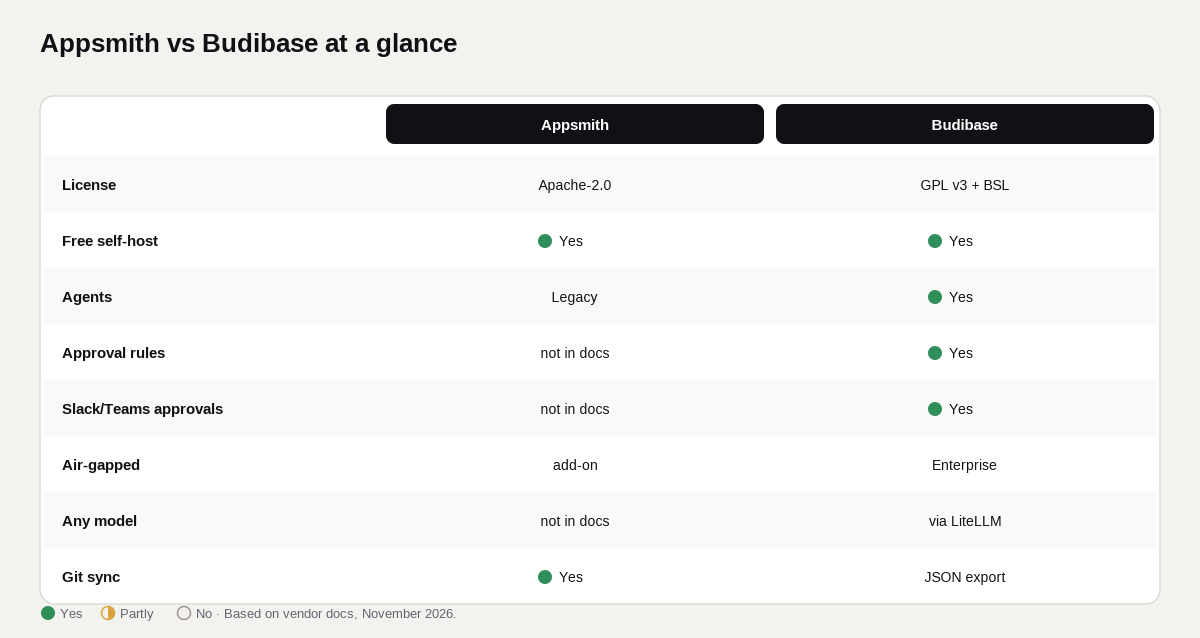
Feature comparison
| Aspect | Appsmith | Budibase | Source |
|---|---|---|---|
| Where it runs | Self-host (Docker, Kubernetes, AWS AMI) or Appsmith Cloud | Budibase Cloud, or self-host on private cloud, on-prem or air-gapped | Appsmith GitHub; Budibase |
| License | Apache-2.0 | Core GPL v3; libraries MPL; paid features under Business Source License | Appsmith GitHub; Budibase GitHub |
| How you build | Widgets, queries and JavaScript; Ask AI for code and queries | Tables, screens, automations and agents; "Functions" in Alpha | Appsmith 2.3; Budibase |
| Agents and approvals | Appsmith Agents is Legacy, closed to sign-ups | Agents with Approval Policies, tool permissions, audit logs; approvals in Slack and Teams | Appsmith Agents; Budibase 4.0 |
| Testing | Not covered in the docs we checked | Testing tools for agents | Budibase 4.0 |
| Code and Git | Git sync with branches and pull requests; free tier limited to 3 repos | Workspace export as a JSON file | Superblocks review; Budibase export docs |
| Team / admin | Google/GitHub OAuth; SAML/OIDC on Enterprise; custom roles on Business | Granular roles, SSO and SCIM; enforceable SSO on Enterprise | Appsmith pricing; Budibase pricing |
| Model choice | No AI features listed on the pricing page | Any OpenAI-format model via LiteLLM; bring your own key on Community | Appsmith pricing; Budibase 2026 post |
| Pricing model | Free Community; per user on Business; flat base on Enterprise | Free Community; Cloud subscription with creators, end users, actions and AI credits; custom Enterprise | Appsmith pricing; Budibase pricing |
Cost model by team size
| Team size | Appsmith | Budibase |
|---|---|---|
| 1 person | Free Community edition, self-hosted; cloud Free plan up to 5 users | Free self-hosted Community plan: unlimited users, apps, agents and automations; bring your own AI key |
| 5 people | Business, priced per user per month (15-day trial); "no additional charge for developers" | Cloud subscription with included creators and end users, monthly actions and AI credits (14-day trial) |
| 25 people | Enterprise: flat monthly base for a block of users, SAML/OIDC; air-gapped and managed hosting as add-ons | Enterprise (custom, self-hosted incl. air-gapped): enforceable SSO, SCIM, "Budibase AI" |
Check Appsmith's pricing page and Budibase's pricing page for amounts as of November 2026. Two meters matter. Budibase Cloud actions are "hard monthly limits," and a Jet Admin review (a competitor, September 2026) says going over halts work until reset or upgrade. Budibase's Community plan keeps automation logs for one day and has one workspace. For reference, Devfab (Beta) logs cost after each run, per task and per project.
Where Appsmith wins
- You want the most permissive license. Apache-2.0 lets you modify and redistribute with few strings.
- You build many CRUD screens. A widget editor on 25+ databases is quick for admin panels.
- Many people build. Appsmith says developers who build in the IDE cost nothing extra.
- You work in Git. Apps sync to Git with branches and pull requests.
Know the weak spots: G2 reviewers quoted by Superblocks (a competitor, September 2026) say Appsmith "can be slow or buggy at times." Self-hosted instances older than v1.96 must step through v1.99 before upgrading to 2.x.
Where Budibase wins
- Requests need a human sign-off. Approval Policies decide when a person steps in, and approvals can happen in Slack or Teams.
- You must run air-gapped. Budibase lists private cloud, on-prem and air-gapped hosting.
- You want to pick the model. LiteLLM supports any OpenAI-format model, including open-source ones.
- You need an audit trail for agents. Budibase 4.0 adds agent audit logs and testing tools.
Switching from one to the other
Appsmith to Budibase. We found no Appsmith importer in the Budibase docs. Budibase imports only workspaces exported from Budibase, as JSON. Since both tools sit on top of your existing databases, connect Budibase to the same data, then rebuild screens and move logic into automations.
Budibase to Appsmith. Same story in reverse: connect Appsmith to the same databases and APIs and rebuild. One warning if you export a Budibase workspace as a backup first: "data source configuration and credentials will still be exported" unless you use environment variables. Use the "Encrypt my export" option.
Where Devfab fits
Both tools are strong for screens and workflows on data you already have. Some internal tools grow into products: a client portal, a field app, a system customers log into. Then you need research, an approved plan, tested user journeys and a deploy you control.
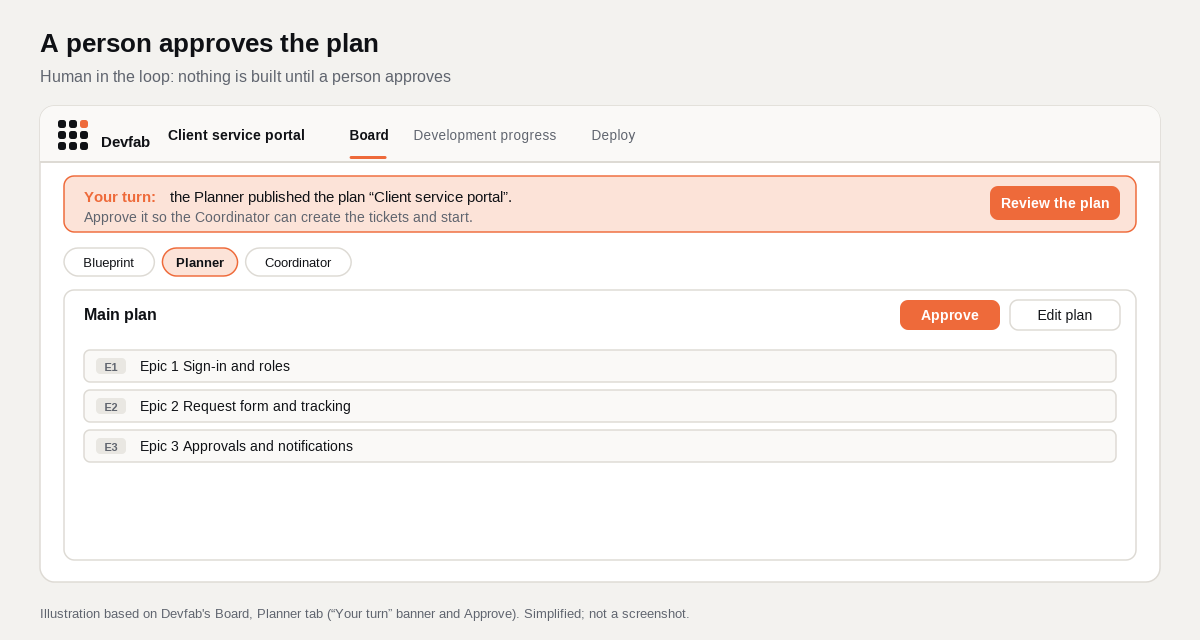
Coding agents automate the developer. Devfab automates the development lifecycle. Devfab is an AI software factory. Its Researcher maps the domain before the Planner writes: key terms, best practices and competitors. A person approves the plan. The QA agent runs UI and flow tests (screens, buttons and user journeys) plus logic tests. Code lives in your own GitHub account (or your organization's), and Deploy ships to your own server.
Devfab's honest limits: it is new and in Beta, with a smaller community and fewer data connectors than either tool. It is not a drag-and-drop builder or an editor for hands-on coding, and it needs a GitHub account. For a quick admin panel or an approval bot in Teams, Appsmith or Budibase is the simpler choice. See Devfab vs Appsmith and Devfab vs Budibase.
FAQ
Is Appsmith or Budibase more open source?
Appsmith is Apache-2.0, a permissive license. Budibase's core is GPL v3, its client and component libraries are MPL, and its paid features sit under the Business Source License. Both offer a free self-hosted edition.
Which one has better AI features in 2026?
Budibase, going by what each vendor ships. Budibase 4.0 (November 10, 2026) moved its agents to real-world use with approval policies, audit logs and Slack or Teams approvals. Appsmith added an Ask AI assistant but removed its AI datasource and put Appsmith Agents into Legacy.
Can I move an app from Appsmith to Budibase?
Not directly in the docs we checked. Budibase imports workspaces exported from Budibase as JSON, and we found no Appsmith importer. Because both tools connect to your existing databases, the usual path is to point Budibase at the same data and rebuild the screens.
Which is cheaper for a large internal audience?
It depends on who counts as a user. Appsmith says there is no extra charge for developers, and its free Community edition is self-hosted. Budibase's Community plan allows unlimited users when self-hosted, while its Cloud plan charges for end users and caps monthly actions. Check both pricing pages.
Read next
- What is an AI software factory?
- Appsmith alternatives
- Budibase alternatives
- Devfab vs Budibase
- Internal tool builder vs custom app
Internal tool turning into a product? Try Devfab Beta
Sources (checked November 13, 2026): Appsmith on GitHub; Appsmith pricing; Appsmith Agents (Legacy); Appsmith 2.1 release (Jun 2026); Appsmith 2.3 and AI datasource EOL (Aug 14, 2026); Superblocks: Appsmith review (competitor, Sep 15, 2026); Budibase homepage; Budibase pricing; Introducing Budibase 4.0 (Nov 10, 2026); Budibase 2026: the AI Workflow Toolkit (Dec 8, 2025); Budibase on GitHub; Budibase: export and import workspaces; Jet Admin: Budibase review (competitor, Sep 30, 2026).
Frequently asked questions
Is Appsmith or Budibase more open source?
Appsmith is Apache-2.0, a permissive license. Budibase's core is GPL v3, its client and component libraries are MPL, and its paid features sit under the Business Source License. Both offer a free self-hosted edition.
Which one has better AI features in 2026?
Budibase, going by what each vendor ships. Budibase 4.0 (November 10, 2026) moved its agents to real-world use with approval policies, audit logs and Slack or Teams approvals. Appsmith added an Ask AI assistant but removed its AI datasource and put Appsmith Agents into Legacy.
Can I move an app from Appsmith to Budibase?
Not directly in the docs we checked. Budibase imports workspaces exported from Budibase as JSON, and we found no Appsmith importer. Because both tools connect to your existing databases, the usual path is to point Budibase at the same data and rebuild the screens.
Which is cheaper for a large internal audience?
It depends on who counts as a user. Appsmith says there is no extra charge for developers, and its free Community edition is self-hosted. Budibase's Community plan allows unlimited users when self-hosted, while its Cloud plan charges for end users and caps monthly actions. Check both pricing pages.