Short answer: Claude Code wins when you want one vendor's agent everywhere, with plan mode, managed GitHub code review and enterprise deployment on your own cloud account. Amp wins when you want an agent that picks among several labs' models, runs unsupervised in cloud sandboxes, and bills model use at provider prices.
You already trust an agent with real changes to real repos. The next question is about bets. Do you bet on one model family and its tooling? Or on an agent that swaps models as the field moves? That choice shapes cost, control and lock-in for every developer on the team.
Fans of Claude Code point to depth and enterprise controls. Fans of Amp point to model freedom and cloud sandboxes. This page referees with vendor docs checked on November 20, 2026.
In this comparison:
- Claude Code and Amp at a glance
- Feature comparison
- Cost model by team size
- Where Claude Code wins
- Where Amp wins
Each section answers one buying question.
Claude Code and Amp at a glance
Amp is now its own company. Sourcegraph and Amp announced on December 2, 2025 that they were becoming "two separate companies." Amp Inc. is led by co-founder Quinn Slack, and Sourcegraph by Dan Adler (Sourcegraph blog). In 2026 Amp removed ads from its free tier (March 30), launched monthly subscriptions in beta (July 18) and shipped Spaces, Boxes and a Windows app in November (Amp news).
Amp is a coding agent you run on the web, in desktop and mobile apps, or as a CLI. Its "orbs" are cloud sandboxes where agents keep working after you close your laptop (Amp). Amp pitches itself to "devs and teams who want to be a year ahead of everyone else."
Claude Code is Anthropic's agentic coding tool. It reads your codebase, edits files, runs commands and opens pull requests from the terminal, IDEs, a desktop app, the web and mobile (Claude Code docs). It is active, with cloud scheduled tasks and managed Code Review among recent additions.
Feature comparison
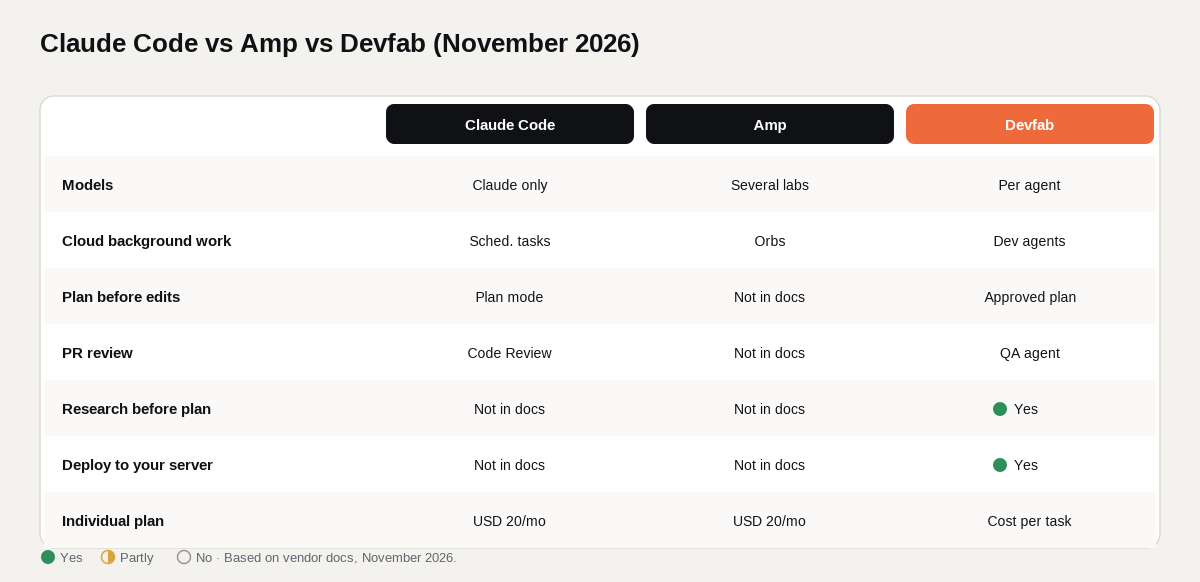
| Aspect | Claude Code | Amp | Source |
|---|---|---|---|
| Where it runs | Terminal, VS Code, JetBrains, desktop, web, mobile | Web, Mac, Windows, Linux, iPhone, iPad, Android, CLI | Claude Code docs; Amp manual |
| Background work | Cloud scheduled tasks triggered by schedules, API calls or GitHub events | Orbs run agents unsupervised; Automations wake on schedules, new Linear issues or failing CI | Claude Code docs; Amp |
| Planning | Plan mode proposes an approach for approval before editing | Not covered in the docs we checked | Claude Code costs |
| Collaboration | Agent teams (experimental); projects on the web | Multiplayer shared control, Spaces, shared terminal, Portals live preview | Claude Code docs; Amp |
| Code review | Managed Code Review on GitHub PRs (Team and Enterprise) | Not covered in the docs we checked | Code Review |
| Model choice | Claude models only | Several models from OpenAI, Anthropic and others | Claude Code costs; Amp manual |
| Team and admin | SSO, managed settings, spend limits; Enterprise adds role-based permissions | Teams: SSO, permissions, admin analytics, self-hosted orbs; Enterprise: SCIM, audit logs, IP allowlisting | Enterprise deployment; Amp pricing |
| Where inference runs | Anthropic, Amazon Bedrock, Google Cloud, Microsoft Foundry, or your gateway | Provider APIs; regional endpoints on Enterprise | Enterprise deployment; Amp pricing |
| Pricing model | Included in paid Claude plans; usage limits shared across Claude | Free BYOK tier; subscriptions with included usage; paid credits at provider prices | Claude pricing; Amp pricing |
Cost model by team size
| Team size | Claude Code | Amp |
|---|---|---|
| 1 person | Pro USD 20 per month (USD 17 billed annually); Max USD 100; Ultra USD 200 | Hobby free (bring your own keys); Individual USD 20 per month; a higher tier at USD 50 per month |
| 5 people | Team Standard USD 25 per user per month (USD 20 annual) | Teams workspace at no extra charge; members keep their own tiers and pool credits |
| 25 people | Team Premium USD 125 per user per month, or Enterprise at USD 20 per seat per month (annual, 20-seat minimum) plus API-rate usage | Teams, or Enterprise on custom terms |
Prices as of November 2026 from Claude pricing and Amp pricing. Amp bills orb runtime separately, and model usage beyond included amounts is charged at provider API prices, with no markup for individuals and non-enterprise workspaces.
Where Claude Code wins
- You need inference in your own cloud account. Claude Code supports Bedrock, Google Cloud and Microsoft Foundry, plus corporate gateways.
- You want a plan before any edit. Plan mode explores the codebase and proposes an approach for approval.
- You want managed PR review. Code Review runs several agents per GitHub PR and filters false positives.
- Security sets the rules. Managed permissions can't be overridden by local config.
- One subscription covers chat and code. Paid Claude plans include Claude Code alongside web, desktop and mobile chat.
Where Amp wins
- You want the best model for each job, from several labs, without switching tools.
- Agents should run unsupervised in the cloud. Orbs keep working after you close your laptop, and
amp syncmirrors changes locally. - You want pass-through model pricing. Paid credits use provider API prices with no markup for individuals.
- Pairing matters. Multiplayer lets teammates share control of the same agent, code and running app.
- You already pay for ChatGPT. Amp can run OpenAI models on a linked ChatGPT Plus or Pro subscription.
Switching from one to the other
Both tools work in your own repo, so there is no code to export. What moves is configuration.
From Claude Code to Amp. Amp reads AGENTS.md and supports MCP (Amp manual). Copy your CLAUDE.md rules into AGENTS.md, or keep using AGENTS.md if you already do, since Claude Code reads it too. Re-add MCP servers in Amp.
From Amp to Claude Code. Claude Code reads AGENTS.md or CLAUDE.md, and supports MCP, skills and hooks (Claude Code docs). Replace Amp Automations with cloud scheduled tasks triggered by GitHub events or API calls.
Where Devfab fits
Claude Code and Amp both make a developer faster inside a repo. Neither, in the docs we checked, starts with domain research, gets a project plan approved by a person, or runs UI and flow tests before deploying the app.
Coding agents automate the developer. Devfab automates the development lifecycle. Say a field-service company needs a work-order app. Devfab's Researcher first maps the domain: key terms like dispatch and SLA, common practices and competing apps, then suggests a prototype. The Planner writes the plan, a person approves it, and the QA agent clicks through "technician closes a job" end to end. Cost is logged after each run, per task and per project.
Devfab is in Beta, has a smaller community and fewer integrations, is not an editor for hands-on coding, and needs a GitHub account. See Devfab vs Amp and Devfab vs Claude Code.
FAQ
Is Amp still part of Sourcegraph?
No. Sourcegraph and Amp announced on December 2, 2025 that they were becoming two separate companies. Amp Inc. is led by co-founder Quinn Slack as CEO, and Sourcegraph is led by Dan Adler.
Which models does Amp use compared with Claude Code?
Claude Code runs Claude models only, switchable with /model. Amp uses several models from OpenAI, Anthropic and others, choosing each for what it does best. OpenAI models in Amp can run on a linked ChatGPT Plus or Pro subscription.
Is Amp cheaper than Claude Code?
It depends on use. As of November 2026 both list an individual plan at USD 20 per month. Amp also has a free Hobby tier with your own keys and charges model usage at provider API prices with no markup for individuals. Claude Code's usage limits are shared with the rest of your Claude plan.
Can Amp agents keep working when my laptop is closed?
Yes. Amp's orbs are cloud sandboxes where agents run unsupervised and keep working after you close your laptop. Claude Code offers cloud scheduled tasks, which run even when your computer is off.
Read next
Want the whole project run, not just the code? Try Beta
Sources (checked November 2026): Claude Code docs: Overview; Claude Code docs: Manage costs; Claude Code docs: Code Review; Claude Code docs: Enterprise deployment; Claude pricing; Amp; Amp manual; Amp pricing; Amp news; Amp: Subscriptions, At Last (Jul 18, 2026); Amp Free Is Ad-Free (Mar 30, 2026); Sourcegraph blog: Why Sourcegraph and Amp are becoming independent companies.
Frequently asked questions
Is Amp still part of Sourcegraph?
No. Sourcegraph and Amp announced on December 2, 2025 that they were becoming two separate companies. Amp Inc. is led by co-founder Quinn Slack as CEO, and Sourcegraph is led by Dan Adler.
Which models does Amp use compared with Claude Code?
Claude Code runs Claude models only, switchable with /model. Amp uses several models from OpenAI, Anthropic and others, choosing each for what it does best. OpenAI models in Amp can run on a linked ChatGPT Plus or Pro subscription.
Is Amp cheaper than Claude Code?
It depends on use. As of November 2026 both list an individual plan at USD 20 per month. Amp also has a free Hobby tier with your own keys and charges model usage at provider API prices with no markup for individuals. Claude Code's usage limits are shared with the rest of your Claude plan.
Can Amp agents keep working when my laptop is closed?
Yes. Amp's orbs are cloud sandboxes where agents run unsupervised and keep working after you close your laptop. Claude Code offers cloud scheduled tasks, which run even when your computer is off.