Short answer: If you want another frontier agent you drive yourself, pick Claude Code for the terminal or Cursor for an editor with cloud agents. Pick Kiro for spec-first work on AWS. Pick Devfab when production needs research, an approved plan, UI and flow tests and a deploy to your own server.
You picked Amp because it moved fast. Three things now push teams to look around. Amp was pay-as-you-go only until July 2026, and Amp itself said that made it more expensive than agents on monthly plans. Its free daily allowance was reduced for more users in May. And the company split from Sourcegraph, so buyers are re-checking the vendor. None of that makes Amp a bad agent. It does make this a good moment to compare.
In this guide, you'll learn:
- Why teams leave Amp
- Quick comparison
- The alternatives
- Where Amp is still the better choice
- How to choose
Use the sections below as your shortlist.
Why teams leave Amp
Status: active, now an independent company. Sourcegraph and Amp announced on December 2, 2025 that they were becoming "two separate companies." Amp Inc. is led by co-founder Quinn Slack as CEO (Sourcegraph blog; Tessl, Dec 3, 2025). Amp still ships often: Spaces, Boxes and Amp for Windows all landed in November 2026 (Amp news).
The switching triggers we found, each from Amp's own pages:
- Cost before subscriptions. Amp says pure pay-as-you-go made it "more expensive than agents on monthly plans." Subscriptions launched in beta on July 18, 2026 (Amp: Subscriptions, At Last).
- Usage beyond the plan. Going past subscription limits needs paid credits or a linked ChatGPT subscription (same source). Orbs, Amp's cloud sandboxes, are billed by the minute (Amp pricing docs).
- A smaller free tier. An update dated May 23, 2026 says the free daily allowance was paused or reduced for more users and restricted for older client releases (Amp Free Is Ad-Free).
- Agent, not delivery process. Amp is built for developers who drive a frontier agent. Plan sign-off by a non-developer, a separate QA step and deployment are not covered in the pages we checked.
Quick comparison
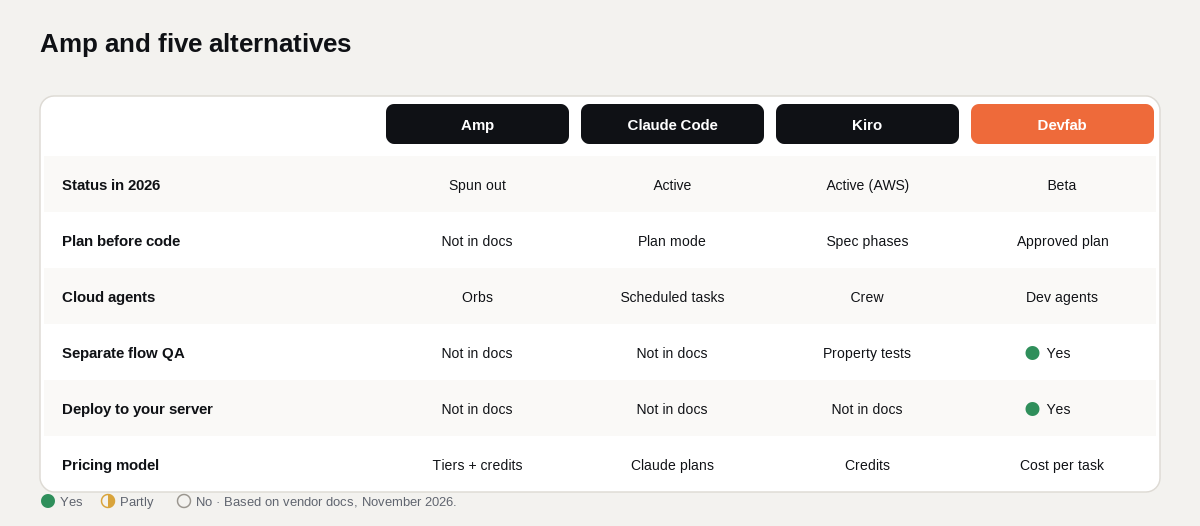
| Tool | Best for | Where it runs | Planning | Testing and review | Pricing (as of Nov 2026) |
|---|---|---|---|---|---|
| Claude Code | Terminal-first developers | Terminal, IDEs, desktop, web, CI | Plan mode with approval | Managed Code Review on GitHub PRs | Pro USD 20 per month; Team Standard USD 25 per user per month |
| Cursor | Editor-first teams | Editor, CLI, cloud agents | Plan Mode | Bugbot PR review, Autofix | Free; Plus USD 8 per month; Teams USD 30+ per user per month |
| Kiro | Spec-first teams on AWS | IDE, CLI, Web, Mobile, Crew | Requirements, design, tasks | Property-based tests | Free; Pro USD 20 per user per month; Teams USD 20 per seat per month |
| Devfab | Teams shipping client apps | Web workspace on your GitHub repo | Research, then a plan a person approves | QA agent: UI, flow and logic tests | Cost logged per task and per project (Beta) |
| Devin Desktop (formerly Windsurf) | Running many agents from one hub | Desktop IDE, Devin Cloud | Not covered in the docs we checked | Devin Review | Free; Pro USD 20 per month; Teams USD 80 per month plus USD 40 per seat |
| Aider | Free, local, BYOK pair programming | Terminal, browser | Architect mode | Lints and tests after each change | Free and open source; you pay your model provider |
The alternatives
1. Claude Code
Verdict: the closest swap for Amp's terminal-and-agents style, with stronger enterprise controls. Best for: developers who script their agent and run it in CI and Slack. Trade-off: Anthropic's models only; usage limits are shared across Claude apps. Pricing: included in paid Claude plans; Pro USD 20 per month, Max USD 100, Team Standard USD 25 per user per month, as of November 2026 (Claude pricing).
- Runs in the terminal, VS Code, JetBrains, a desktop app, the web and mobile (Claude Code overview).
- Plan mode explores the code and proposes an approach for approval before edits (Claude Code costs doc).
- Cloud scheduled tasks run when your computer is off and can trigger on GitHub events, much like Amp's Automations (Claude Code overview).
- Inference can run through Amazon Bedrock, Google Cloud or Microsoft Foundry (Claude Code enterprise docs).
2. Cursor
Verdict: the pick for teams that want an editor first and cloud agents second. Best for: developers who review code by hand and want agents on GitHub, GitLab, Bitbucket or Azure DevOps. Trade-off: cloud agents need Premium or higher; Free and Plus don't include them (Cursor cloud agents). Pricing: Free; Plus USD 8 per month (Grok models only); Premium USD 30 per month; Teams USD 30+ per user per month, as of November 2026 (Cursor pricing).
- Status: Cursor's maker is now owned by SpaceX; Cursor says the deal closed in August 2026 (Cursor blog).
- Plan Mode drafts an editable plan before code (Cursor Plan Mode).
- Cloud agents run in isolated VMs, many in parallel, each on its own branch (Cursor cloud agents).
- Bugbot reviews PRs; Autofix pushes fixes to a branch (Cursor Bugbot).
3. Kiro
Verdict: the choice when you want agents to work from a written spec. Best for: AWS-centric teams, including those leaving Amazon Q Developer. Trade-off: spec tasks use more credits than simple prompts (Kiro pricing). Pricing: Free (50 credits); Pro USD 20 per user per month; Teams USD 20 per seat per month with pooled credits, as of November 2026 (Kiro pricing).
- Specs produce requirements.md, design.md and tasks.md before code (Kiro spec docs).
- Available as IDE, CLI, Web, Mobile and Crew background agents (Kiro).
- Agent hooks run on events such as file save (Kiro hooks).
- Enterprise Management (preview) applies one AWS-console policy across surfaces (Kiro changelog).
4. Devfab
Verdict: the pick when the problem is getting a whole app to production, not getting one agent to code faster. Best for: agencies and product teams that ship client apps and need sign-off, test evidence and deployment. Trade-off: in Beta, with a smaller community and fewer integrations; not an editor; needs a GitHub account. Pricing: predictable cost; cost is logged after each run, per task and per project.
Coding agents automate the developer. Devfab automates the development lifecycle. Take a field-service app for technicians. The Researcher maps work orders, dispatch and parts terms and suggests a prototype before the Planner writes a plan. A person approves it, and the Coordinator creates tickets for dev agents. ChainFlow maps which functions and APIs call each other, so changing job status shows its effect on dispatch, invoices and customer texts. The QA agent clicks through the technician's journey end to end and runs logic tests. Deploy ships to your own server. See Devfab vs Amp.
5. Devin Desktop (formerly Windsurf)
Verdict: the nearest match to Amp's many-agents style, in a desktop app. Best for: teams that dispatch local, cloud and third-party agents from one place. Trade-off: no free trial of paid plans (Devin usage docs). Pricing: Free; Pro USD 20 per month; Max USD 200 per month; Teams USD 80 per month plus USD 40 per full dev seat, as of November 2026 (Devin pricing).
- Windsurf was renamed Devin Desktop on June 2, 2026 (Devin Desktop FAQ).
- Sessions move to Devin Cloud and keep running when you close your laptop, like Amp's orbs (Devin Desktop).
- ACP support runs third-party agents and frontier models from one place (same source).
6. Aider
Verdict: the low-cost, open-source fallback for solo developers. Best for: local or air-gapped setups and clean git history. Trade-off: not autonomous, no team features, and releases have slowed; the last PyPI release is 0.86.2 from February 2026 (PyPI). Pricing: free and open source; you pay your model provider directly (CodeMySpec review).
- Apache-2.0 licensed, with about 49.8k GitHub stars (GitHub).
- Builds a repo map and commits each change to git (same source).
- Works with almost any model, including local ones through Ollama or LM Studio (Aider docs).
Where Amp is still the better choice
- You want many unsupervised agents in cloud sandboxes. Orbs keep working after you close your laptop, and
amp syncmirrors their changes locally (Amp). - You want pass-through model pricing. Amp bills model usage at provider API prices with no markup for individuals and non-enterprise workspaces (Amp pricing docs).
- You pair with teammates on one agent. Multiplayer shares control of the same agent, code and running app; Portals preview changes live in the browser (Amp).
- You already pay for ChatGPT. Amp can run OpenAI models on a linked ChatGPT Plus or Pro subscription (Amp manual).
- You need self-hosted sandboxes cheaply. Self-hosted orbs are free and unlimited on the Hobby plan (Amp pricing docs).
How to choose
Start from the trigger that made you look.
- Cost was the issue: compare Claude Code's plans, Cursor's tiers and Kiro's credits against your real usage. Aider is the zero-subscription option.
- You want the same style in a new home: Devin Desktop for a desktop hub, Claude Code for the terminal.
- Agents drift without a plan: Kiro writes a spec; Devfab adds domain research and a plan a person approves.
- The gap is production: if tests, deploys and client sign-off are what slow you down, a faster agent won't fix it. Look at a factory. Read AI software factory vs AI coding tools first.
FAQ
What is the best alternative to Amp?
For a terminal-first agent with plan mode and managed PR review, Claude Code. For an editor with cloud agents on several Git hosts, Cursor. For spec-first work on AWS, Kiro. If you need research, an approved plan, UI and flow tests and deployment to your own server, Devfab.
Is Amp still part of Sourcegraph?
No. Sourcegraph and Amp announced on December 2, 2025 that they were becoming two separate companies. Amp Inc. is led by co-founder Quinn Slack as CEO, and Sourcegraph is led by Dan Adler.
Does Amp have a monthly subscription now?
Yes. Amp launched monthly subscriptions in beta on July 18, 2026; before that it was pay-as-you-go only. As of November 2026, Amp's pricing page lists a free Hobby tier, Individual at USD 20 per month, Megawatt 50 at USD 50 per month and custom Enterprise terms.
Is there a free, open-source alternative to Amp?
Aider is free and open source under Apache-2.0. You bring your own model key and pay the provider directly. It runs in the terminal and commits each change to git. Its last PyPI release was 0.86.2 in February 2026.
Read next
Need the whole path to production, not just a faster agent? Try Beta
Sources (checked November 2026): Amp homepage; Amp manual; Amp pricing docs; Amp news; Subscriptions, At Last (Amp, Jul 18, 2026); Amp Free Is Ad-Free (Amp, Mar 30, 2026); Why Sourcegraph and Amp are becoming independent companies; Tessl: Sourcegraph spins out Amp (Dec 3, 2025); Claude Code overview; Claude Code costs; Claude Code enterprise deployment; Claude pricing; Cursor pricing; Cursor Plan Mode; Cursor cloud agents; Cursor Bugbot; Cursor blog: Joining SpaceX; Kiro; Kiro pricing; Kiro spec docs; Kiro hooks; Kiro changelog; Devin Desktop; Devin Desktop FAQ; Devin usage docs; Devin pricing; Aider docs; Aider on GitHub; aider-chat on PyPI; CodeMySpec: Aider review 2026.
Frequently asked questions
What is the best alternative to Amp?
For a terminal-first agent with plan mode and managed PR review, Claude Code. For an editor with cloud agents on several Git hosts, Cursor. For spec-first work on AWS, Kiro. If you need research, an approved plan, UI and flow tests and deployment to your own server, Devfab.
Is Amp still part of Sourcegraph?
No. Sourcegraph and Amp announced on December 2, 2025 that they were becoming two separate companies. Amp Inc. is led by co-founder Quinn Slack as CEO, and Sourcegraph is led by Dan Adler.
Does Amp have a monthly subscription now?
Yes. Amp launched monthly subscriptions in beta on July 18, 2026; before that it was pay-as-you-go only. As of November 2026, Amp's pricing page lists a free Hobby tier, Individual at USD 20 per month, Megawatt 50 at USD 50 per month and custom Enterprise terms.
Is there a free, open-source alternative to Amp?
Aider is free and open source under Apache-2.0. You bring your own model key and pay the provider directly. It runs in the terminal and commits each change to git. Its last PyPI release was 0.86.2 in February 2026.