Short answer: Claude Code wins when you want Anthropic's agent across terminal, IDE, desktop and web, with plan mode, managed code review and inference inside your own cloud account. Kilo Code wins when you want an open-source agent in VS Code or JetBrains, free model choice across 500+ models at provider rates, and per-seat team billing.
Your developers argue about models, not tools. Some want Claude for everything. Others want to try each new open-weight model the week it ships. Pick the wrong agent and you settle that argument by accident, through what the tool allows.
One side says a vendor's own agent gets the most from its models. The other says open source and model freedom protect you from lock-in. This page referees, with docs and pricing checked on November 20, 2026.
In this comparison:
- Claude Code and Kilo Code at a glance
- Feature comparison
- Cost model by team size
- Where Claude Code wins
- Where Kilo Code wins
Use the sections below as a checklist for your team.
Claude Code and Kilo Code at a glance
Kilo Code now belongs to Anaconda. Anaconda announced on July 15, 2026 that it acquired Kilo Code. It says Kilo "remains available today with no changes to existing products, plans, or support for current users," and plans to bring Kilo's agent features into the Anaconda Platform (Anaconda press release). Earlier in 2026, Kilo rebuilt its VS Code extension on the open-source OpenCode server; that version became the default on April 2 (Kilo blog).
Kilo Code is an open-source, model-agnostic coding agent for VS Code, JetBrains and the terminal, with cloud agents and code review (Kilo docs). Kilo says its previous extension served over 2.2 million developers (vendor claim).
Claude Code is Anthropic's agentic coding tool. It reads a codebase, edits files, runs commands and opens pull requests, from the terminal, IDEs, a desktop app, the web and mobile (Claude Code docs). It is active and aimed at developers and engineering organizations.
Feature comparison
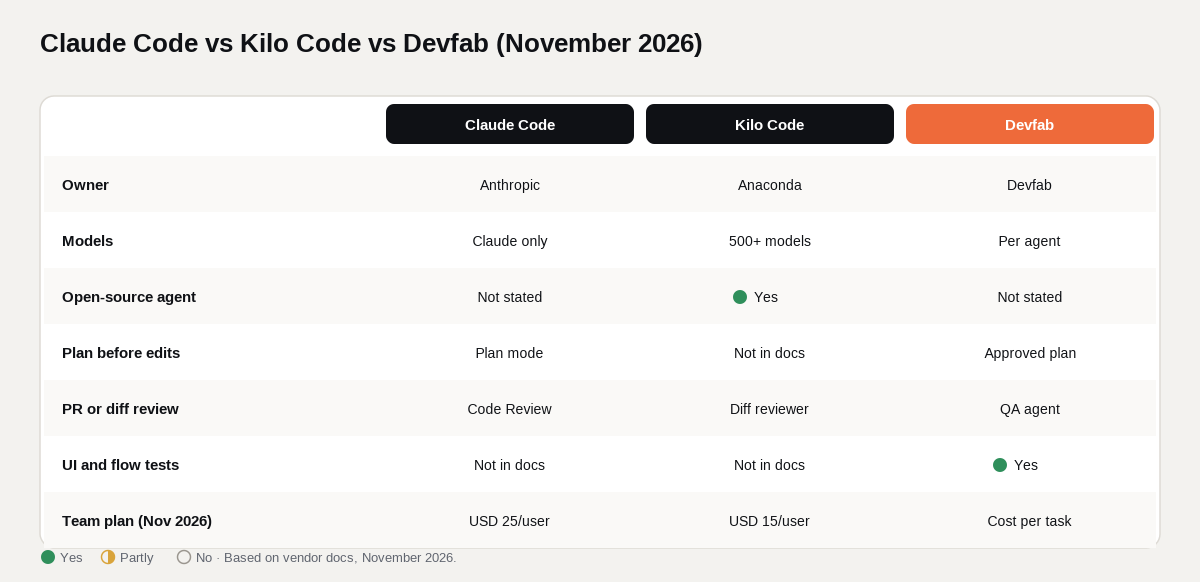
| Aspect | Claude Code | Kilo Code | Source |
|---|---|---|---|
| Status (Nov 2026) | Active | Active; owned by Anaconda since July 2026 | Claude Code docs; Anaconda |
| Where it runs | Terminal, VS Code, JetBrains, desktop, web, mobile | VS Code, JetBrains, Kilo CLI, Cloud Agents; Kilo Desktop now GA | Claude Code docs; Kilo pricing |
| Planning | Plan mode proposes an approach for approval | Modes unified into "Agents"; a separate plan mode is not covered in the pages we checked | Claude Code costs; Kilo blog |
| Parallel agents | Subagents, background agents, experimental agent teams | Agent Manager runs agent tabs, can isolate them in git worktrees | Claude Code docs; Kilo blog |
| Review | Managed Code Review on GitHub PRs | Diff reviewer with line comments; multi-model comparison of one prompt | Code Review; Kilo blog |
| Model choice | Claude models only | 500+ models from 60+ providers, BYOK, local via Ollama or LM Studio | Claude Code costs; Kilo pricing |
| Open source | Not described as open source in the docs we checked | Open-source extension | Kilo docs |
| Team and admin | SSO, managed settings, spend limits; Enterprise adds role-based permissions | Teams: analytics, shared agents, central billing; Enterprise: model limits, audit logs, SSO, SCIM | Enterprise deployment; Kilo pricing |
| Pricing model | Included in paid Claude plans | Free extension; inference at provider rates; per-seat Teams | Claude pricing; Kilo pricing |
Cost model by team size
| Team size | Claude Code | Kilo Code |
|---|---|---|
| 1 person | Pro USD 20 per month (USD 17 billed annually); Max USD 100; Ultra USD 200 | Free and open source, usage billed separately; optional Kilo Pass at USD 19, 49 or 199 per month |
| 5 people | Team Standard USD 25 per user per month (USD 20 annual) | Teams USD 15 per user per month, plus model usage |
| 25 people | Team, or Enterprise at USD 20 per seat per month billed annually (20-seat minimum) plus API-rate usage | Teams, or Enterprise (custom) with SSO, SCIM and audit logs |
Prices as of November 2026 from Claude pricing and Kilo pricing. Kilo Teams and Enterprise include no credits; a 5% processing fee applies to credit purchases, and cloud agents and code review are billed per second of compute (Kilo docs).
Where Claude Code wins
- You want more than an IDE extension. Claude Code also runs in a desktop app, the web, mobile and Slack.
- Inference must stay in your cloud account. Claude Code supports Bedrock, Google Cloud, Microsoft Foundry and corporate gateways.
- You want automated PR review. Code Review runs several agents per GitHub PR and posts severity-ranked comments.
- You want scheduled agents in the cloud. Cloud scheduled tasks run when your computer is off, triggered by schedules or GitHub events.
- A smaller issue backlog matters to you. A June 2026 review counted 1,300+ open GitHub issues on Kilo (rywalker.com).
Where Kilo Code wins
- You want model freedom. 500+ models through the Kilo Gateway, your own keys, or local models.
- You want open source you can inspect, with no seat fee for individuals.
- Seat cost matters. Teams is USD 15 per user per month, and inference is billed at provider rates.
- You are coming from Roo Code. Kilo published a Roo-to-Kilo migration path after Roo shut down (Kilo blog).
- You want to compare models side by side. Multi-model comparison runs one prompt on several models.
Switching from one to the other
Neither tool holds your code: both work in your own repo.
From Claude Code to Kilo Code. Install the VS Code or JetBrains extension, connect a provider through the Kilo Gateway or your own key, and add MCP servers from Kilo's MCP marketplace. Sessions carry across Kilo CLI and VS Code (Kilo blog).
From Kilo Code to Claude Code. Pick a paid Claude plan, then write your project rules into CLAUDE.md or AGENTS.md. Re-add MCP servers, and move repeat prompts into skills or hooks (Claude Code docs).
Where Devfab fits
Both agents serve the developer at the keyboard. In the docs we checked, neither maps the business domain before planning, sends a project plan to a person for approval, or deploys the finished app.
Coding agents automate the developer. Devfab automates the development lifecycle. Devfab's QA agent runs UI and flow tests (screens, buttons and journeys clicked end to end) plus logic tests. For a school portal, that means checking that a parent can sign in, see a timetable and message a teacher, not only that functions return the right values. You can choose the model for each agent or keep Devfab's default.
Devfab is in Beta, has a smaller community and fewer integrations, is not an editor, and needs a GitHub account. See Devfab vs Kilo Code and Devfab vs Claude Code.
FAQ
Who owns Kilo Code now?
Anaconda. Anaconda announced on July 15, 2026 that it acquired Kilo Code and said Kilo remains available with no changes to existing products, plans or support for current users. Anaconda plans to bring Kilo's agent features into the Anaconda Platform.
Can Kilo Code use Claude models?
Kilo Code routes more than 500 models from over 60 providers through the Kilo Gateway, and also supports bring-your-own-key and local models through Ollama or LM Studio. Check the Kilo Gateway list for the specific models you need.
Is Kilo Code free?
The extension is free and open source; you pay for model use at provider rates, with a 5% processing fee on credit purchases. As of November 2026, Teams is USD 15 per user per month and Enterprise is custom. Kilo Pass is an optional credit subscription.
Which is better for a team that wants admin controls?
Both have them. Claude Code offers SSO, managed settings and spend limits on Team, with role-based permissions on Enterprise. Kilo Teams has usage analytics, shared agents and centralized billing; Kilo Enterprise adds model and provider limits, audit logs, SSO and SCIM.
Read next
Want tested, deployed projects instead of faster edits? Try Beta
Sources (checked November 2026): Claude Code docs: Overview; Claude Code docs: Manage costs; Claude Code docs: Code Review; Claude Code docs: Enterprise deployment; Claude pricing; Anaconda Acquires Kilo Code (Jul 15, 2026); Kilo pricing; Kilo docs: About Plans; Kilo blog: The New Kilo Code for VS Code (Apr 2, 2026); Kilo blog: Thank you, Roo (Apr 21, 2026); Kilo research note (rywalker.com, Jun 2026).
Frequently asked questions
Who owns Kilo Code now?
Anaconda. Anaconda announced on July 15, 2026 that it acquired Kilo Code and said Kilo remains available with no changes to existing products, plans or support for current users. Anaconda plans to bring Kilo's agent features into the Anaconda Platform.
Can Kilo Code use Claude models?
Kilo Code routes more than 500 models from over 60 providers through the Kilo Gateway, and also supports bring-your-own-key and local models through Ollama or LM Studio. Check the Kilo Gateway list for the specific models you need.
Is Kilo Code free?
The extension is free and open source; you pay for model use at provider rates, with a 5% processing fee on credit purchases. As of November 2026, Teams is USD 15 per user per month and Enterprise is custom. Kilo Pass is an optional credit subscription.
Which is better for a team that wants admin controls?
Both have them. Claude Code offers SSO, managed settings and spend limits on Team, with role-based permissions on Enterprise. Kilo Teams has usage analytics, shared agents and centralized billing; Kilo Enterprise adds model and provider limits, audit logs, SSO and SCIM.