Short answer: Claude Code wins when developers want a polished agent that works out of the box on Claude models, across terminal, IDE, web and CI. OpenHands wins when you need MIT-licensed open source, full self-hosting in your VPC, open-weight models, or one canvas that runs several agents, Claude Code included.
Your security team asked a simple question: where does the agent run, and who holds the keys? Your developers asked a different one: which agent writes the best code today? Claude Code and OpenHands answer those two questions in opposite ways.
One camp says pay a vendor and get on with the work. The other says own the stack, including the models. This page is the referee, with facts checked on November 20, 2026.
In this comparison:
- Claude Code and OpenHands at a glance
- Feature comparison
- Where Claude Code wins
- Where OpenHands wins
- Switching from one to the other
Each section answers one buying question.
Claude Code and OpenHands at a glance
OpenHands changed its main interface in 2026. On June 16, 2026 it launched Agent Canvas, a self-hostable workspace that the company calls its main interface going forward (OpenHands blog). The GitHub repo now lives at OpenHands/OpenHands under the MIT license, and the homepage showed 93.8K GitHub stars on November 20, 2026 (GitHub; OpenHands). Monthly releases followed; v1.17 to v1.24 in September added Agent Profiles, automation templates, Docker runtimes and repo-installable Apps (OpenHands September notes).
OpenHands is for individual developers who self-host for free, engineering teams, and enterprises that need governed agents in their own environment (OpenHands pricing).
Claude Code is active and vendor-run. Anthropic's agentic coding tool reads your codebase, edits files, runs commands and opens pull requests. It runs in a terminal, VS Code, JetBrains, a desktop app, the web and mobile, plus GitHub Actions, GitLab CI/CD and Slack (Claude Code overview).
The key twist: OpenHands can run Claude Code. Agent Canvas runs third-party harnesses such as Claude Code and Codex through the Agent Client Protocol (OpenHands blog).
Feature comparison
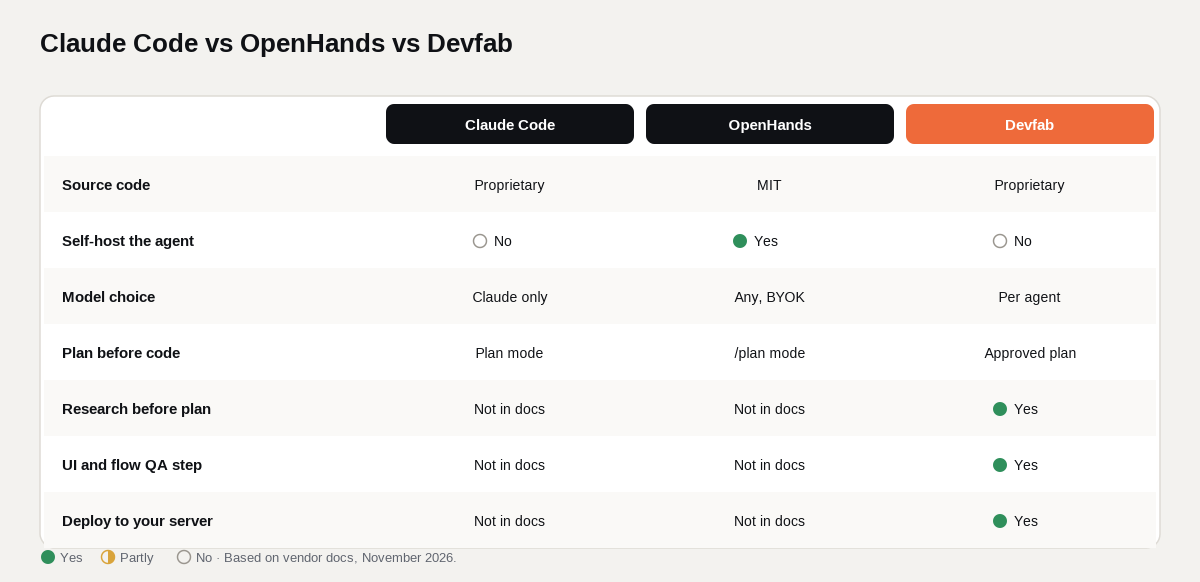
| Aspect | Claude Code | OpenHands | Source |
|---|---|---|---|
| Where it runs | Terminal, VS Code, JetBrains, desktop, web, mobile, CI, Slack | Agent Canvas (desktop/web); local, Docker, remote VMs, Kubernetes, Modal or enterprise VPC; Python SDK | Claude Code overview; OpenHands blog |
| Planning | Plan mode proposes an approach for approval | /plan and /code mode switching | Claude Code costs; OpenHands September notes |
| Agent autonomy | Subagents, background agents, cloud scheduled tasks | Scheduled and event-triggered automations; parallel sessions; runs Claude Code, Codex and others via ACP | Claude Code overview; OpenHands blog |
| Review and testing | Managed Code Review on GitHub PRs (Team and Enterprise) | Automations for PR reviews and issue triage | Code Review docs; OpenHands blog |
| Deploy and hosting | Not covered in the docs we checked | Not covered in the docs we checked | — |
| Source code | Proprietary tool | MIT license | GitHub |
| Team and admin | Team: SSO; Enterprise: role-based permissions, compliance API | Teams: RBAC, SSO/SAML, budgets; Enterprise: VPC, audit of every action, SLA | Enterprise deployment; OpenHands pricing |
| Model choice | Claude models only | Closed and open-weight models; LLM Profiles per task; BYOK | Claude Code costs; OpenHands |
| Pricing model | Included in paid Claude plans | Free self-hosted; Teams flat fee plus per-seat add-ons; Enterprise custom | Claude pricing; OpenHands pricing |
Cost model by team size
| Team size | Claude Code | OpenHands | Devfab |
|---|---|---|---|
| 1 person | Pro USD 20 per month; Max USD 100 per month | Open Source USD 0, self-hosted, plus your model costs | Cost logged per task and per project (Beta) |
| 5 people | Team Standard USD 25 per user per month (USD 20 annual) | Teams USD 500 per month flat for up to 10 users, or self-host for free | Cost logged per task and per project (Beta) |
| 25 people | Team, or Enterprise at USD 20 per seat per month billed annually plus usage at API rates | Teams USD 500 per month plus USD 50 per month per seat above 10; or Enterprise (custom, unlimited seats) | Cost logged per task and per project (Beta) |
Prices as of November 2026 from Claude pricing and OpenHands pricing. OpenHands Teams is capped at 5,000 sessions per month, and model usage is billed by your provider when you bring your own key. Devfab is in Beta and offers predictable cost: cost is logged after each run, per task and per project.
Where Claude Code wins
- You want it working today. Install, sign in, and start; no models, keys or sandboxes to run.
- Your developers move between surfaces: terminal, IDE, desktop, web and phone, with sessions you can hand between them.
- You want managed PR reviews that verify findings to filter false positives and post ranked inline comments.
- You want one vendor for model and tool, with org spend limits and per-user reporting.
Where OpenHands wins
- Open source is a requirement. OpenHands is MIT-licensed and you can read, fork and audit it.
- The agent must run inside your VPC with your own keys, on Docker, Kubernetes or remote VMs.
- You want open-weight or local models such as Kimi, DeepSeek or Qwen, for cost or data residency.
- Your platform team wants to orchestrate several agents, including Claude Code and Codex, from one canvas with shared automations.
- Five people can start free. Self-hosting costs nothing beyond your infrastructure and model usage.
Switching from one to the other
From Claude Code to OpenHands. You don't have to drop Claude Code. Install Agent Canvas via npm, Docker or source (GitHub), connect your repo, and add Claude Code as a harness through ACP. Then build automations around it, such as PR review or issue-to-PR.
From OpenHands to Claude Code. Both work in your repo, so nothing to export. Move your agent instructions into CLAUDE.md, recreate automations as cloud scheduled tasks or GitHub Actions, and re-add your MCP servers.
Where Devfab fits
OpenHands gives you an agent platform to assemble. Claude Code gives you a strong agent to script. Both leave the delivery process to you. In the docs we checked, neither researches the domain before planning, runs a separate QA step on user journeys, or deploys the app to your server.
Coding agents automate the developer. Devfab automates the development lifecycle. For a field-service app, Devfab's Researcher maps work-order terms and best practices before the Planner writes a plan. A person approves the plan, the Coordinator turns it into tickets, and the QA agent clicks through screens and journeys, such as a technician closing a job with a photo, plus logic tests. Devfab is in Beta, has a smaller community than OpenHands and is not open source. See Devfab vs OpenHands and Devfab vs Claude Code.
FAQ
Can OpenHands run Claude Code?
Yes. OpenHands' Agent Canvas can run third-party harnesses such as Claude Code and Codex through the Agent Client Protocol, and its homepage also lists Gemini CLI. So the two are not always rivals: a platform team can use OpenHands to orchestrate Claude Code sessions.
Is OpenHands free?
The open-source version is free to self-host under the MIT license, and you bring your own model keys. As of November 2026, the Teams plan is USD 500 per month flat for up to 10 users plus USD 50 per month per extra seat, and Enterprise is custom.
Can I use open-weight or local models?
With OpenHands, yes. It supports closed models and open-weight models such as Kimi, DeepSeek and Qwen, run locally, in the cloud or in a VPC, with LLM Profiles to switch per task. Claude Code uses Claude models only, though inference can run through Bedrock, Google Cloud or Foundry.
Which one needs less setup?
Claude Code. You install it and sign in with a paid Claude plan. With OpenHands you choose and govern models, keys and sandboxes yourself, and its September 2026 notes call Docker isolation a first major step, with other container options still being explored.
Read next
- What is an AI software factory?
- OpenHands alternatives for teams that ship to production (2026)
- OpenHands vs Devin
- Claude Code vs Google Jules
Want a delivery line instead of a kit of agents? Try Beta
Sources (checked November 2026): OpenHands homepage; OpenHands pricing; OpenHands GitHub repository; Introducing Agent Canvas (Jun 16, 2026); OpenHands in September (Oct 7, 2026); Claude Code docs: overview; Claude Code docs: manage costs; Claude Code docs: Code Review; Claude Code docs: enterprise deployment; Claude pricing.
Frequently asked questions
Can OpenHands run Claude Code?
Yes. OpenHands' Agent Canvas can run third-party harnesses such as Claude Code and Codex through the Agent Client Protocol, and its homepage also lists Gemini CLI. So the two are not always rivals: a platform team can use OpenHands to orchestrate Claude Code sessions.
Is OpenHands free?
The open-source version is free to self-host under the MIT license, and you bring your own model keys. As of November 2026, the Teams plan is USD 500 per month flat for up to 10 users plus USD 50 per month per extra seat, and Enterprise is custom.
Can I use open-weight or local models?
With OpenHands, yes. It supports closed models and open-weight models such as Kimi, DeepSeek and Qwen, run locally, in the cloud or in a VPC, with LLM Profiles to switch per task. Claude Code uses Claude models only, though inference can run through Bedrock, Google Cloud or Foundry.
Which one needs less setup?
Claude Code. You install it and sign in with a paid Claude plan. With OpenHands you choose and govern models, keys and sandboxes yourself, and its September 2026 notes call Docker isolation a first major step, with other container options still being explored.