Short answer: Amp wins when experienced developers want to drive a frontier agent directly, run many unsupervised agents in cloud sandboxes and pay model usage at provider prices. Devfab wins when an agency needs each client project run the same way: research, an approved plan, tickets, a QA agent, deployment to your server and cost per project.
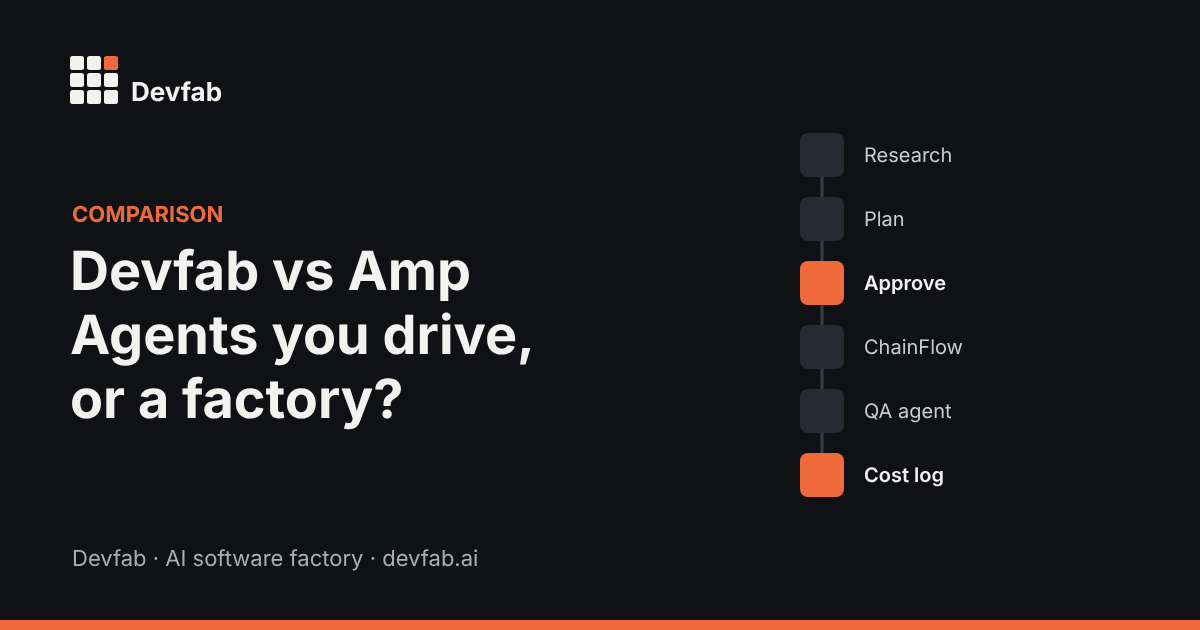
Your best developers love Amp. They run several agents at once in the cloud and keep shipping. The rest of the agency asks a different question: who wrote the plan the client signed, and where is the test report?
Amp's fans say strong developers plus strong agents is the whole answer. Process people say client delivery needs a line, not just speed. This page weighs both, using sources checked in November 2026.
In this comparison:
- What each tool is built for
- Switching triggers
- Cost model by team size
- Where Amp is the better choice
- Where Devfab is the better choice
Start with the status change below.
What each tool is built for
Amp
Status, November 2026: Amp is no longer part of Sourcegraph. On December 2, 2025, the two announced they were becoming separate companies. Amp Inc. is led by co-founder Quinn Slack as CEO, and Sourcegraph by Dan Adler (Sourcegraph blog; Tessl, Dec 3, 2025).
Amp is a frontier coding agent for "devs and teams who want to be a year ahead of everyone else" (Sourcegraph blog). The parts that matter here:
- Everywhere you work: a web app with no install, apps for Mac, Windows, Linux, iPhone, iPad and Android, and a CLI that runs locally, in an editor terminal or from scripts (Amp manual).
- Orbs: cloud sandboxes where agents run unsupervised and keep working after you close your laptop.
amp syncmirrors an orb's changes into a local checkout (Amp). - Working together: Portals preview the agent's changes live in the browser, and Multiplayer lets teammates share control of the same agent, code and running app (Amp).
- Automations: agents wake on a schedule or on events such as new Linear issues or failing CI (Amp).
- Models: Amp uses several models from OpenAI, Anthropic and others, picking each "for what each model is best at" (Amp manual).
- Team admin: the Teams plan adds pooled credits, thread sharing, permissions and SAML/OIDC SSO. Enterprise adds SCIM, spend limits, audit logs and IP allowlisting (Amp pricing).
Amp's main user is an experienced developer who wants the newest agent capabilities first.
Devfab
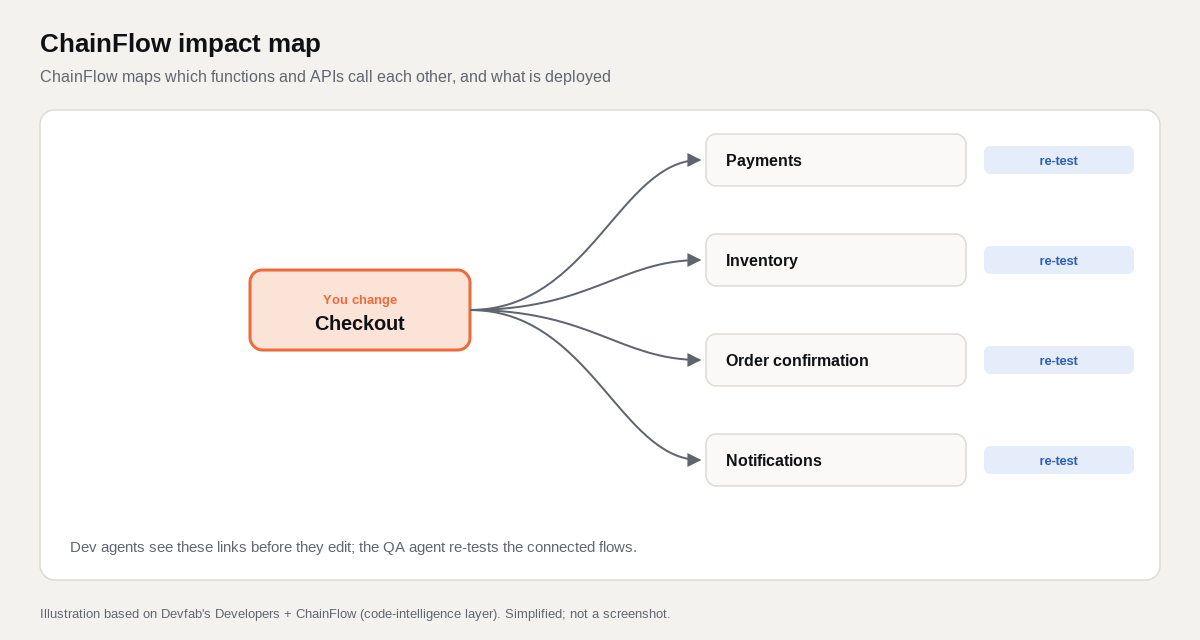
Devfab is an AI software factory. It is built around the client project, not the developer's session. A Researcher maps the domain before planning. A Planner publishes a plan a person approves. A Coordinator turns it into tickets and assigns dev agents, who work with ChainFlow, Devfab's map of which functions and APIs call each other and what is deployed. A QA agent runs UI, flow and logic tests, and Deploy ships to your own server. Docs follow: blueprints, prototypes and user manuals.
Coding agents automate the developer. Devfab automates the development lifecycle.
Switching triggers
| Trigger | Amp | Devfab | Source |
|---|---|---|---|
| Pay-as-you-go cost ran high | Amp said pure pay-as-you-go made it "more expensive than agents on monthly plans"; subscriptions launched in beta on Jul 18, 2026 | Predictable cost, logged per task and per project | Amp news |
| Free usage changed | Free daily allowance paused or reduced for more users (update dated May 23, 2026) | Not applicable | Amp news |
| Unsupervised agents need a checkpoint | Orbs run unsupervised; you review the result | A person approves the plan; optional QA review before Done | Amp |
| Clients need a QA report | Portals preview changes live; test strategy is yours | QA agent runs UI, flow and logic tests | Amp |
| App must be deployed for the client | Not covered in the docs we checked | Ship to production on your own server | Amp manual |
| Brand and vendor changed | Spun out of Sourcegraph as Amp Inc. (Dec 2025) | Devfab is new and in Beta | Sourcegraph blog |
Cost model by team size
| Team size | Amp | Devfab |
|---|---|---|
| 1 person | Free Hobby tier (bring your own key, pay-as-you-go hosted orbs, unlimited self-hosted orbs) or a paid Individual tier with included agent and orb usage; extra credits at provider API prices with no markup | Cost logged per task and per project (Beta) |
| 5 people | Teams at no extra charge: members can be on different tiers, with pooled credits, shared BYOK and SSO | Cost logged per task and per project (Beta) |
| 25 people | Teams, or Enterprise on custom terms with pooled credits only, no paid seats, SCIM, spend limits and audit logs | Cost logged per task and per project (Beta) |
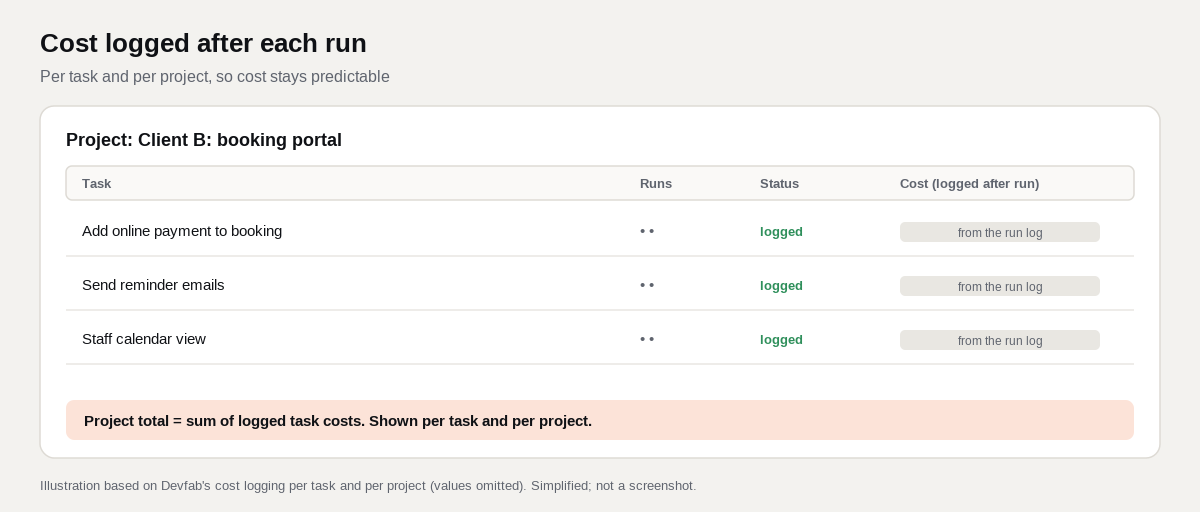
Amp's pricing model as of November 2026, from Amp's pricing docs. Orbs are billed per minute, and per-thread costs show in the thread sidebar. Devfab: predictable cost; cost is logged after each run, per task and per project; Devfab is in Beta.
Moving from Amp to Devfab
Amp already works in your repository and CI, so there is no code to export.
- Sync any orb work back. Use
amp syncto bring an orb's changes into your local checkout, then push to GitHub. - In Devfab, choose "Work on an existing project" and pick the repository in your own GitHub account or your organization's.
- Leave the change box empty. ChainFlow maps the code and suggests three small first tickets.
- Approve the plan. The Coordinator creates tickets only after a person approves.
- Run QA before Done. The QA agent runs UI, flow and logic tests on each ticket.
- Keep Amp where it shines. Developers can still run Amp agents on the same repo for exploratory and parallel work.
Where Amp is the better choice
- Experienced developers want to drive the agent directly and pick up new model capabilities quickly.
- You want many parallel, unsupervised agents in cloud sandboxes, with self-hosted orbs if needed.
- Pricing transparency matters most: provider API prices with no markup and per-thread cost in the sidebar.
- Real-time collaboration on one agent session, through Multiplayer and Portals.
- Event-driven work such as fixing failing CI or picking up new Linear issues automatically.
Where Devfab is the better choice
- You want research before anyone plans. The Researcher maps the client's domain, practices and competitors, then suggests a prototype.
- A plan must be approved before work starts, by a project manager or the client, in a shared workspace.
- Existing client apps are fragile. ChainFlow shows which connected features a change can affect before it ships.
- Testing must be visible to non-developers. The QA agent clicks through screens and journeys and reports UI, flow and logic results.
- You hand over a running app: deployment to your own server, with blueprints and user manuals.
- You report cost per client project, logged after each run, per task and per project.
Devfab's honest limits: it is new and in Beta, with a smaller community and fewer integrations than Amp. It is not an editor or CLI for hands-on coding, and it does not offer Amp-style multiplayer agent sessions. It needs a GitHub account.
FAQ
Is Amp still part of Sourcegraph?
No. Sourcegraph and Amp announced on December 2, 2025 that they were becoming two separate companies. Amp Inc. is led by co-founder Quinn Slack as CEO, and Sourcegraph is led by Dan Adler. Many people still search for it as Sourcegraph Amp.
Amp runs agents unsupervised in the cloud. Doesn't that make it a software factory?
Amp's orbs let agents keep working in cloud sandboxes, and Automations can wake agents on a schedule or on events such as new Linear issues or failing CI. A developer still decides what each agent does and reviews the result. Devfab adds research before the plan, a plan a person approves, a Coordinator that creates tickets, a separate QA agent and deployment to your own server.
How do Amp and Devfab show cost?
Amp bills model usage at provider API prices with no markup for individuals and non-enterprise workspaces, shows per-thread costs in the thread sidebar, and bills orbs by the minute. Devfab offers predictable cost: cost is logged after each run, per task and per project.
Can a team use Amp and Devfab on the same repository?
Yes. Amp works in your own repo and CI, and Devfab works on a repository in your own GitHub account or your organization's. Developers can keep Amp for hands-on and parallel agent work while client projects run through Devfab.
Read next
- What is an AI software factory?
- AI software factory vs AI coding tools: what's the difference?
- Cloud coding agents vs local coding agents: pros and cons
- How to track AI cost per task and per project
See a client project run from research to deploy. Book a Devfab demo
Sources (checked November 13, 2026): Amp homepage; Amp manual; Amp pricing docs; Subscriptions, At Last (Amp news, Jul 18, 2026); Amp Free Is Ad-Free (Amp news, Mar 30, 2026); Why Sourcegraph and Amp are becoming independent companies (Sourcegraph blog); Sourcegraph spins out Amp as a standalone company (Tessl, Dec 3, 2025).
Frequently asked questions
Is Amp still part of Sourcegraph?
No. Sourcegraph and Amp announced on December 2, 2025 that they were becoming two separate companies. Amp Inc. is led by co-founder Quinn Slack as CEO, and Sourcegraph is led by Dan Adler. Many people still search for it as Sourcegraph Amp.
Amp runs agents unsupervised in the cloud. Doesn't that make it a software factory?
Amp's orbs let agents keep working in cloud sandboxes, and Automations can wake agents on a schedule or on events such as new Linear issues or failing CI. A developer still decides what each agent does and reviews the result. Devfab adds research before the plan, a plan a person approves, a Coordinator that creates tickets, a separate QA agent and deployment to your own server.
How do Amp and Devfab show cost?
Amp bills model usage at provider API prices with no markup for individuals and non-enterprise workspaces, shows per-thread costs in the thread sidebar, and bills orbs by the minute. Devfab offers predictable cost: cost is logged after each run, per task and per project.
Can a team use Amp and Devfab on the same repository?
Yes. Amp works in your own repo and CI, and Devfab works on a repository in your own GitHub account or your organization's. Developers can keep Amp for hands-on and parallel agent work while client projects run through Devfab.