Short answer: Pick Claude Code if you want one vendor's polished agent across terminal, IDEs, desktop, web and Slack, with managed pull request review and inference through your own cloud account. Pick Cline if you want an open-source agent that runs any model, including local ones, and asks you to approve every action inside your editor.
You want an agent that edits files and runs commands, not just autocomplete. Half your team swears by Claude Code. The other half wants open source and model freedom, which points to Cline. The choice decides your vendor, your model bill and how much control each developer keeps.
In this comparison:
- Claude Code and Cline at a glance
- Feature comparison
- Cost model by team size
- Where Claude Code wins
- Where Cline wins
Here's how each one compares, with sources.
Claude Code and Cline at a glance
Status in 2026
- Claude Code is active and keeps adding surfaces. Its docs now cover cloud scheduled tasks (formerly "routines"), Remote Control and moving sessions between phone, web, desktop and terminal.
- Cline shipped a lot: CLI 2.0 (February), a Kanban board for parallel agents (March), ClinePass (June), a new harness for all users (August) and a Cline Desktop beta (September). In January 2026, OpenAI hired at least seven Cline employees and said it was not an acquisition. In February, an unauthorized npm publish of the Cline CLI led to a public post-mortem.
Claude Code
Claude Code is Anthropic's agentic coding tool. It reads your codebase, edits files, runs commands and opens pull requests. It runs in the terminal, in VS Code and JetBrains, in a desktop app, on the web and in the Claude mobile app. It also connects to GitHub Actions, GitLab CI/CD and Slack.
Plan mode explores the codebase and proposes an approach for your approval before editing. Subagents, background agents and experimental agent teams split bigger work. Projects carry instructions in CLAUDE.md or AGENTS.md, plus skills, hooks and MCP servers. On Team and Enterprise, managed Code Review runs several agents on each GitHub pull request and posts severity-ranked comments. It never approves or blocks a PR, and it doesn't build or run the code.
Claude Code runs Claude models only. Enterprises can route inference through Anthropic, Amazon Bedrock, Google Cloud or Microsoft Foundry.
Cline
Cline is an open-source coding agent. It runs as a VS Code extension, a JetBrains plugin, a CLI (interactive or headless for CI), a desktop app and an SDK. Through ACP it also works inside Cursor, Windsurf, Zed and Neovim. Cline says over 11 million developers have installed the VS Code extension; that is the vendor's own figure.
Every action requires your approval. Plan mode reads and discusses without editing, Act mode carries out the plan, and each mode can use a different model. /deep-planning runs a longer planning session, and Checkpoints let you roll back. Cline reads .clinerules, .cursorrules, .windsurfrules and AGENTS.md.
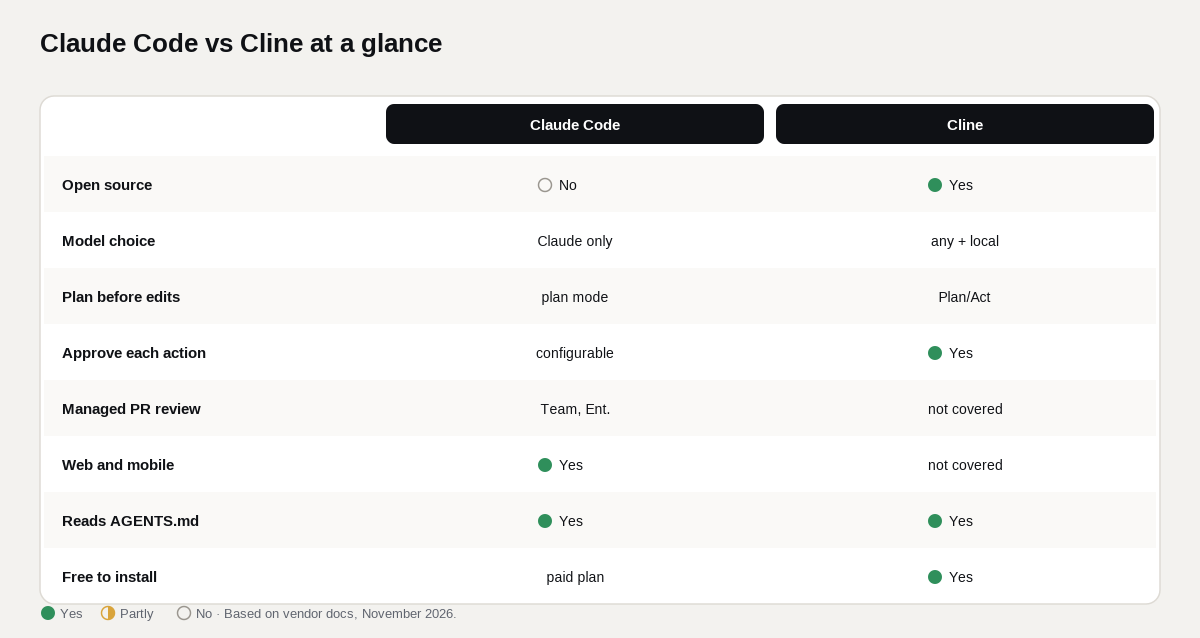
Feature comparison
| Aspect | Claude Code | Cline | Source |
|---|---|---|---|
| Where it runs | Terminal, VS Code, JetBrains, desktop, web, mobile; GitHub Actions, GitLab CI, Slack | VS Code, JetBrains, CLI, desktop, SDK, Kanban; other editors via ACP | Claude Code overview; Cline overview |
| Planning / spec | Plan mode proposes an approach for approval | Plan and Act modes; /deep-planning; Checkpoints | Claude Code costs; Cline Plan & Act |
| Agent autonomy | Subagents, background agents, agent teams (experimental); cloud scheduled tasks | Every action needs approval; Kanban runs agents in parallel | Claude Code overview; Cline overview |
| Review and testing | Managed Code Review on GitHub PRs (Team, Enterprise); doesn't run code | Not covered in the docs we checked | Claude Code review |
| Deploy / hosting | No app hosting; cloud sessions can run on self-hosted environments | No app hosting; FAQ mentions VPC and self-hosting | Claude Code enterprise; Cline pricing |
| Code and openness | Proprietary; stages commits and opens PRs | Extension, CLI and desktop app are open source | Claude Code overview; Cline Desktop |
| Team / admin | SSO, server-managed settings, spend limits, analytics, OpenTelemetry | Enterprise: SSO, RBAC, team dashboard, auth logs, provider restrictions | Claude Code costs; Cline pricing |
| Model choice | Claude models only | Any provider by your own key, local runtimes, ClinePass for open-weight models | Claude Code costs; Cline overview |
| Pricing model | Included in paid Claude plans; usage limits; or pay per token | Free extension; pay for inference, or ClinePass; Enterprise custom | Claude pricing; Cline pricing |
Cost model by team size
| Team size | Claude Code | Cline |
|---|---|---|
| 1 person | A paid Claude plan (Pro or Max); not on Free; limits reset on a rolling five-hour window plus weekly limits | Free extension; pay only for inference through Cline billing or your own key; ClinePass is a flat subscription for open-weight models |
| 5 people | Team plan with Standard or Premium seats, SSO and admin tools; Code Review available | Same free extension per developer plus inference; centralized billing needs Enterprise |
| 25 people | Enterprise: per-seat fee plus usage at API rates; or pay per token through the Console or a cloud provider | Enterprise (custom): SSO, RBAC, team dashboard, provider restrictions; VPC or self-hosting |
Check Claude pricing and Cline pricing for current amounts. Anthropic notes that agent teams use roughly seven times more tokens than standard sessions when teammates run in plan mode. For reference, Devfab (Beta) logs cost after each run, per task and per project.
Where Claude Code wins
- You want one agent on every surface. Terminal, IDEs, desktop, web, mobile and Slack share one tool, and sessions move between them.
- You want AI review on pull requests. Managed Code Review posts verified, severity-ranked comments on GitHub PRs.
- Inference must stay in your cloud account. Route it through Amazon Bedrock, Google Cloud or Microsoft Foundry, or your own gateway.
- You need spend controls. Org spend limits, an analytics dashboard, per-user reporting and OpenTelemetry export are documented.
- You want to build your own agent workflows. The Agent SDK, hooks, skills and cloud scheduled tasks are all there.
Where Cline wins
- You need open source. The extension, CLI and desktop app are open source, so you can audit and fork them.
- You want any model. Bring your own key, use local runtimes, or pay a flat ClinePass fee for open-weight models.
- Every step needs a human yes. Cline asks before each action, and Checkpoints let you undo.
- You want a free tool and pay only for inference. There is no seat fee on the free extension.
- Your team uses many editors. Cline runs in VS Code, JetBrains, Cursor, Windsurf, Zed and Neovim.
Switching from one to the other
Put shared project rules in AGENTS.md first. Claude Code reads CLAUDE.md or AGENTS.md, and Cline reads AGENTS.md.
From Cline to Claude Code: install the CLI or the VS Code extension and sign in with a paid Claude plan. Copy anything from .clinerules that isn't in AGENTS.md into CLAUDE.md, and add your MCP servers again.
From Claude Code to Cline: install the Cline extension. Cline's rules docs don't mention CLAUDE.md, so move its content into AGENTS.md or .clinerules. Add a provider key; an Anthropic key keeps the same model family.
Where Devfab fits
Claude Code and Cline both put a strong agent next to a developer. Neither describes itself as running a client project from research to deployment. Some teams need that wider loop.
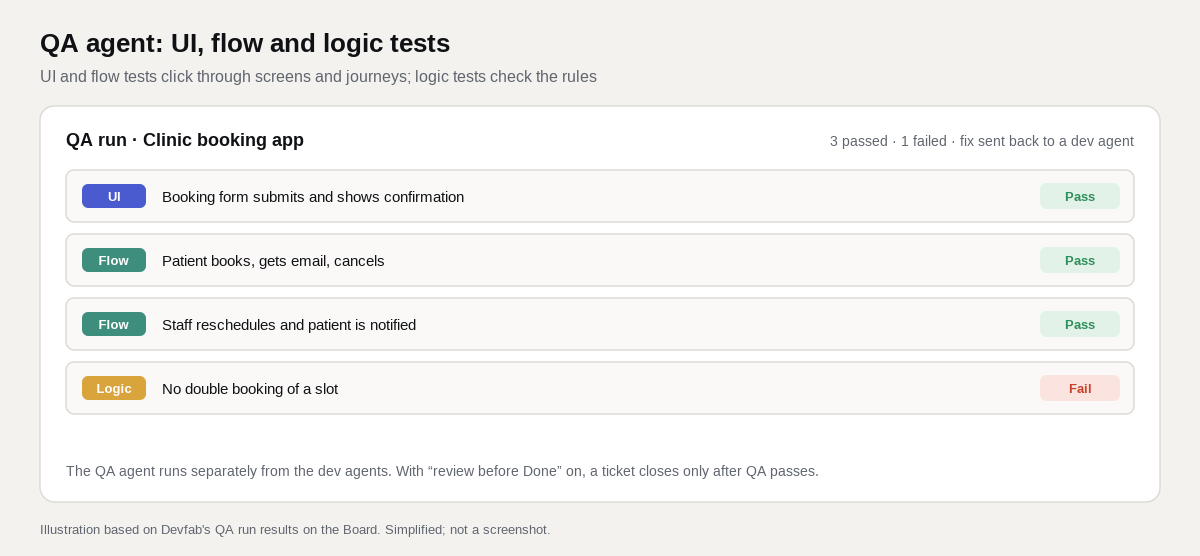
Coding agents automate the developer. Devfab automates the development lifecycle. Devfab researches the domain before planning, a person approves the plan, and the Coordinator splits it into tickets for dev agents. Those agents use ChainFlow to see what a change touches. Unlike a review that only reads the diff, Devfab's QA agent runs UI and flow tests that click through screens and user journeys, plus logic tests. You can require QA review before a ticket is marked Done.
Honest limits: Devfab is new and in Beta, with a smaller community and fewer integrations. It is not an editor, and it needs a GitHub account. See Devfab vs Claude Code and Devfab vs Cline.
FAQ
Can Cline use Claude models?
Yes. Cline lets you bring your own key for cloud providers or local runtimes, or pay through Cline's usage billing, so you can point it at Claude models. Claude Code, by contrast, runs only Claude models, switchable with the /model command.
Is Claude Code free?
No. Claude Code is included in paid Claude plans (Pro, Max, Team and Enterprise) and not in the Free plan. You can also pay per token through the Console or a cloud provider. Cline's extension is free and open source; you pay only for the model you use.
Which one asks before it changes my code?
Both can. Cline's docs say every action requires your approval, and its Plan mode reads and discusses without editing. Claude Code's plan mode explores the codebase and proposes an approach for approval before editing, and security teams can set managed permissions.
Which is safer for an enterprise?
Claude Code has more documented enterprise controls: SSO, server-managed settings, spend limits, OpenTelemetry export and inference through Amazon Bedrock, Google Cloud or Microsoft Foundry. Cline Enterprise adds SSO, RBAC and provider restrictions, and its FAQ mentions VPC and self-hosted deployments.
Read next
- What is an AI software factory?
- Devfab vs Claude Code: which fits a team that ships client work?
- Devfab vs Cline: which fits a team that ships client work?
- Claude Code alternatives for teams that ship to production (2026)
- Cline alternatives for teams that ship to production (2026)
Give your agent a plan, QA and a deploy step. Try Devfab Beta
Sources (checked November 13, 2026): Claude Code docs: Overview; Claude Code docs: Enterprise deployment; Claude Code docs: Code Review; Claude Code docs: Manage costs; Claude pricing; Cline docs overview; Cline Plan & Act; Cline rules; Cline pricing; Cline blog archive; Cline: migrating 11 million users to the new harness (Sep 2, 2026); Cline Desktop announcement (Sep 14, 2026); TEXXR: OpenAI hires seven employees from Cline (Jan 29, 2026).
Frequently asked questions
Can Cline use Claude models?
Yes. Cline lets you bring your own key for cloud providers or local runtimes, or pay through Cline's usage billing, so you can point it at Claude models. Claude Code, by contrast, runs only Claude models, switchable with the /model command.
Is Claude Code free?
No. Claude Code is included in paid Claude plans (Pro, Max, Team and Enterprise) and not in the Free plan. You can also pay per token through the Console or a cloud provider. Cline's extension is free and open source; you pay only for the model you use.
Which one asks before it changes my code?
Both can. Cline's docs say every action requires your approval, and its Plan mode reads and discusses without editing. Claude Code's plan mode explores the codebase and proposes an approach for approval before editing, and security teams can set managed permissions.
Which is safer for an enterprise?
Claude Code has more documented enterprise controls: SSO, server-managed settings, spend limits, OpenTelemetry export and inference through Amazon Bedrock, Google Cloud or Microsoft Foundry. Cline Enterprise adds SSO, RBAC and provider restrictions, and its FAQ mentions VPC and self-hosted deployments.