Short answer: OpenCode wins when you want a free, MIT-licensed agent that works with 200+ model providers, local models or an existing ChatGPT or Copilot plan. Claude Code wins when you want one supported agent across terminal, IDEs, desktop, web and CI, with managed PR review, enterprise controls and inference that can stay in your cloud.
You live in the terminal and want an agent you can trust. One side says Claude Code is the polished choice. The other says OpenCode gives you the same workflow without vendor lock-in. Both are partly right, and the two tools overlap more than most comparisons admit: OpenCode even reads your CLAUDE.md. This page referees the choice with sources checked on November 13, 2026.
In this comparison:
- OpenCode and Claude Code at a glance
- Feature comparison
- Cost model by team size
- Where OpenCode wins and where Claude Code wins
- Where Devfab fits
Here's how each one compares.
OpenCode and Claude Code at a glance
Status changes in 2026. OpenCode's GitHub repository moved from sst/opencode to anomalyco/opencode (GitHub). In January 2026, OpenCode added ChatGPT login after Anthropic blocked third-party tools from using Claude subscription credentials, according to a June 2026 review (rywalker.com). Kilo Code's VS Code extension is now built on the OpenCode server (Kilo blog). On the Claude Code side, "routines" were renamed cloud scheduled tasks, and Remote Control, Dispatch and claude --teleport move sessions between phone, web, desktop and terminal (Claude Code docs).
OpenCode is an open-source (MIT) coding agent from Anomaly, the team behind SST. It runs as a terminal UI, a desktop app for macOS, Windows and Linux, a mobile app and an SDK for scripts and CI (OpenCode). It ships two main agents: "build" with full access and "plan", which is read-only and asks before bash commands (GitHub). The project claims 22 million monthly developers (vendor claim).
Claude Code is Anthropic's agentic coding tool. It reads your codebase, edits files, runs commands and opens pull requests from the terminal, VS Code and Cursor, JetBrains, a desktop app, the web and mobile (Claude Code docs). It also plugs into GitHub Actions, GitLab CI/CD and Slack.
Feature comparison
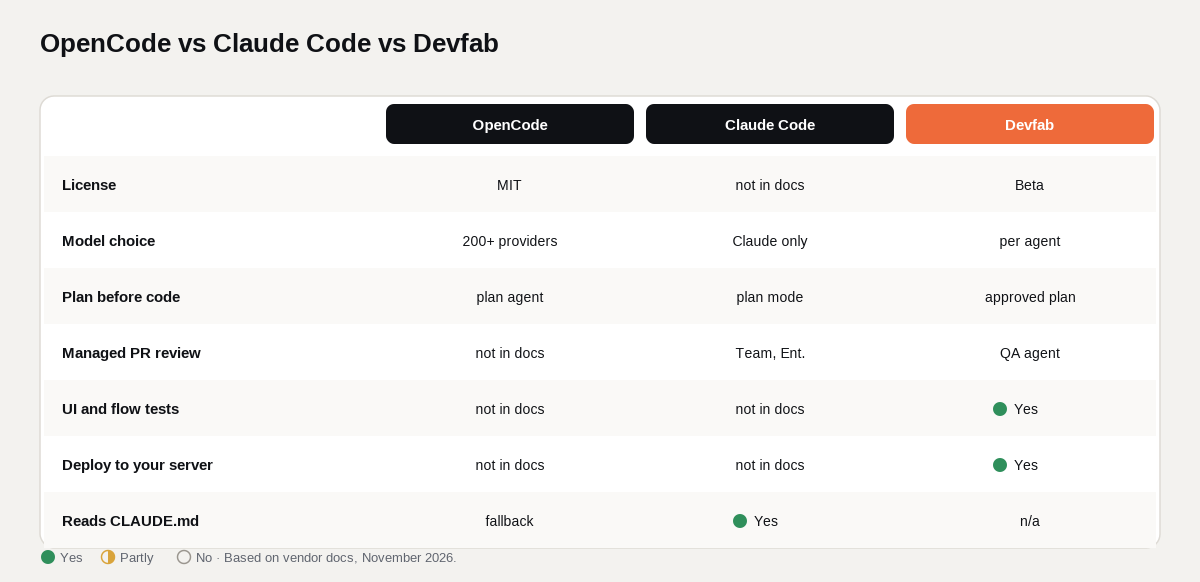
| Aspect | OpenCode | Claude Code | Source |
|---|---|---|---|
| Where it runs | Terminal UI, desktop app (beta), mobile, SDK | Terminal, VS Code and Cursor, JetBrains, desktop, web, iOS and Android; GitHub Actions, GitLab CI/CD | OpenCode; Claude Code docs |
| Planning | Read-only "plan" agent that asks before bash | Plan mode explores the code and proposes an approach for approval | GitHub; Claude Code costs |
| Agent autonomy | Parallel agents on one project; custom agents, skills, permissions, undo and redo | Subagents, background agents, cloud scheduled tasks that run when your computer is off | OpenCode; Claude Code docs |
| Review and testing | Not covered in the docs we checked | Managed Code Review on GitHub PRs (Team and Enterprise); reads the diff without running it | Claude Code: Code Review |
| Deploy and hosting | Not covered in the docs we checked | Not covered in the docs we checked | — |
| Open source | MIT license | Not covered in the docs we checked | GitHub |
| Team and admin | Zen workspaces: invites, model enablement, per-member budgets | Team: SSO, admin tools, managed settings; Enterprise: role-based permissions, compliance API | OpenCode Zen; Enterprise deployment |
| Model choice | 200+ providers via Models.dev, local models, ChatGPT or Copilot login | Claude models only; inference via Anthropic, Bedrock, Google Cloud or Foundry | OpenCode; Claude Code costs |
| Pricing model | Free agent; free models, BYOK, OpenCode Go subscription, Zen pay-as-you-go | Included in paid Claude plans with rolling and weekly limits; Enterprise seat plus API usage | OpenCode; Claude pricing |
Cost model by team size
| Team size | OpenCode | Claude Code | Devfab |
|---|---|---|---|
| 1 person | Free; use free models, your own keys, or a ChatGPT or Copilot login; OpenCode Go from USD 10 a month | Pro USD 20 a month (USD 17 billed annually); Max USD 100 | Cost logged per task and per project (Beta) |
| 5 people | Same, plus a Zen workspace with prepaid credits and per-member budgets | Team Standard seat USD 25 (USD 20 annually); Premium seat USD 125 (USD 100 annually) | Cost logged per task and per project (Beta) |
| 25 people | Zen or your own providers; no enterprise plan described in the pages we checked | Enterprise USD 20 per seat a month billed annually, 20-seat minimum, plus usage at API rates | Cost logged per task and per project (Beta) |
Prices as of November 2026 from OpenCode, OpenCode Zen docs and Claude pricing. Anthropic states an enterprise average of around USD 13 per developer per active day (Claude Code docs). Devfab is in Beta and offers predictable cost: cost is logged after each run, per task and per project.
Where OpenCode wins
- You want any model. Over 200 providers, local models, and logins with ChatGPT Plus or Pro or GitHub Copilot, so you can reuse a plan you already pay for.
- Open source matters. MIT license, a large contributor base, and code you can audit or fork.
- Budget is tight. The agent is free, and free models need no account.
- You want per-member budgets on hosted models. Zen workspaces set budgets per member, with models hosted in the US and EU.
- You already wrote a CLAUDE.md. OpenCode uses it as a fallback, so trying it costs little.
Where Claude Code wins
- You want one agent everywhere. Terminal, IDE extensions, desktop, web, mobile and CI, with sessions that move between them.
- You want managed PR review. Code Review runs several agents per GitHub pull request and verifies findings before posting.
- Inference must stay in your cloud. Bedrock, Google Cloud and Microsoft Foundry are supported, plus your own LLM gateway.
- You need enterprise controls. SSO, managed permissions that local config cannot override, spend limits and OpenTelemetry export.
- Stability over speed of change. A June 2026 review reports OpenCode releases that sometimes break features and permissive default permissions (rywalker.com).
Switching from one to the other
From Claude Code to OpenCode. OpenCode reads AGENTS.md first and falls back to CLAUDE.md, ~/.claude/CLAUDE.md and ~/.claude/skills/ (OpenCode docs: rules). Install it, connect a provider, and your project instructions already apply. Re-add MCP servers, and review the default permissions before you let it run commands.
From OpenCode to Claude Code. Claude Code reads project instructions from CLAUDE.md or AGENTS.md (Claude Code docs), so your AGENTS.md carries over. You need a paid Claude plan, and you can only use Claude models.
Where Devfab fits
OpenCode and Claude Code are both strong agents for a developer working in a codebase. In the docs we checked, neither researches the domain before planning, runs a separate QA step with UI and flow tests, or deploys the app to your server.
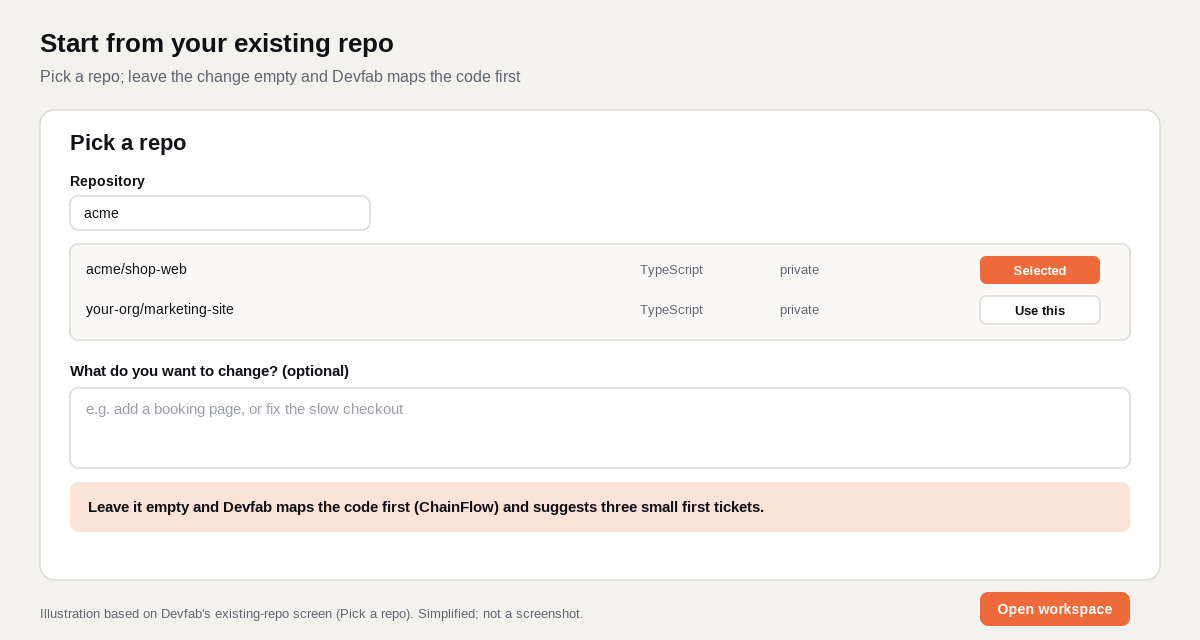
Coding agents automate the developer. Devfab automates the development lifecycle. Choose "Work on an existing project", pick the repo and leave the change box empty: ChainFlow maps which functions and APIs call each other and suggests three small first tickets. A person approves the plan, and the QA agent runs UI, flow and logic tests before Deploy. You can choose the model for each agent or keep Devfab's default.
Honest limits: Devfab is new and in Beta, with a smaller community and fewer integrations. It is not an editor or terminal for hands-on coding, and it needs a GitHub account. See Devfab vs OpenCode and Devfab vs Claude Code.
FAQ
Can I use my Claude subscription inside OpenCode?
Not as a login. A June 2026 review reports that OpenCode added ChatGPT login in January 2026 after Anthropic blocked third-party tools from using Claude subscription credentials. OpenCode's homepage lists ChatGPT Plus or Pro and GitHub Copilot logins. You can still reach Claude models through an API key or another provider.
Does OpenCode read my CLAUDE.md?
Yes, as a fallback. OpenCode reads AGENTS.md first; if there is none, it uses CLAUDE.md in the project and ~/.claude/CLAUDE.md globally, and it can load skills from ~/.claude/skills. Environment variables turn this off.
Which is cheaper for one developer?
OpenCode itself is free, and you can use free models, your own keys or an existing ChatGPT or Copilot plan; OpenCode Go starts at USD 10 a month. Claude Code needs a paid Claude plan: Pro is USD 20 a month (USD 17 billed annually) and Max is USD 100, as of November 2026.
Is OpenCode ready for enterprise teams?
It depends on your bar. OpenCode Zen workspaces offer member invites, model enablement and per-member budgets. A June 2026 review calls its enterprise compliance features immature and notes permissive default permissions. Claude Code offers SSO, managed settings, role-based permissions and a compliance API on Team and Enterprise.
Read next
Want research, an approved plan and QA around your agent's code? Try Beta
Sources (checked November 13, 2026): OpenCode homepage; anomalyco/opencode on GitHub; OpenCode docs: Rules; OpenCode docs: Zen; OpenCode research note (rywalker.com, Jun 2026); Kilo blog: New Kilo for VS Code (Apr 2, 2026); Claude Code docs: Overview; Claude Code docs: Enterprise deployment; Claude Code docs: Code Review; Claude Code docs: Manage costs; Claude pricing.
Frequently asked questions
Can I use my Claude subscription inside OpenCode?
Not as a login. A June 2026 review reports that OpenCode added ChatGPT login in January 2026 after Anthropic blocked third-party tools from using Claude subscription credentials. OpenCode's homepage lists ChatGPT Plus or Pro and GitHub Copilot logins. You can still reach Claude models through an API key or another provider.
Does OpenCode read my CLAUDE.md?
Yes, as a fallback. OpenCode reads AGENTS.md first; if there is none, it uses CLAUDE.md in the project and ~/.claude/CLAUDE.md globally, and it can load skills from ~/.claude/skills. Environment variables turn this off.
Which is cheaper for one developer?
OpenCode itself is free, and you can use free models, your own keys or an existing ChatGPT or Copilot plan; OpenCode Go starts at USD 10 a month. Claude Code needs a paid Claude plan: Pro is USD 20 a month (USD 17 billed annually) and Max is USD 100, as of November 2026.
Is OpenCode ready for enterprise teams?
It depends on your bar. OpenCode Zen workspaces offer member invites, model enablement and per-member budgets. A June 2026 review calls its enterprise compliance features immature and notes permissive default permissions. Claude Code offers SSO, managed settings, role-based permissions and a compliance API on Team and Enterprise.