Short answer: Claude Code wins when developers want one flexible agent in the terminal, IDE, desktop and web, with plan mode, skills, hooks and managed PR review on GitHub. Factory wins when an enterprise wants model-agnostic Droids that run parallel Missions, take work from Slack, Jira or Teams, and can deploy on-prem or airgapped.
Your platform team has been asked to "pick our AI coding standard." Developers already like Claude Code. A vendor deck says Factory is "a software factory," with customers like banks and telcos. Both claims can be true. They solve different problems for different buyers.
One side says give developers the best agent and get out of the way. The other says enterprises need a governed platform with many agents. This page referees with vendor docs checked on November 20, 2026.
In this comparison:
- Claude Code and Factory at a glance
- Feature comparison
- Cost model by team size
- Where Claude Code wins
- Where Factory wins
Read it with your security and finance leads in the room.
Claude Code and Factory at a glance
Factory repositioned and moved domains. On June 15, 2026, Factory announced "Factory 2.0," moving from coding agents to "software factories," with Droid Computers, Missions, Automations, Skills and a model Router (Factory news). Its canonical domain is now factory.com; factory.ai redirects there, and sign-in stays at app.factory.ai (Factory).
Factory is an enterprise platform of coding agents called Droids that plan, build, review and ship code. Named customers include RBC, T-Mobile, Blackstone, Adyen, HP, DoorDash and Chainguard (Factory).
Claude Code is Anthropic's agentic coding tool. It reads a codebase, edits files, runs commands and opens pull requests from the terminal, IDEs, a desktop app, the web and mobile (Claude Code docs). Anthropic recommends Claude for Teams or Enterprise for most organizations (Enterprise deployment).
Feature comparison
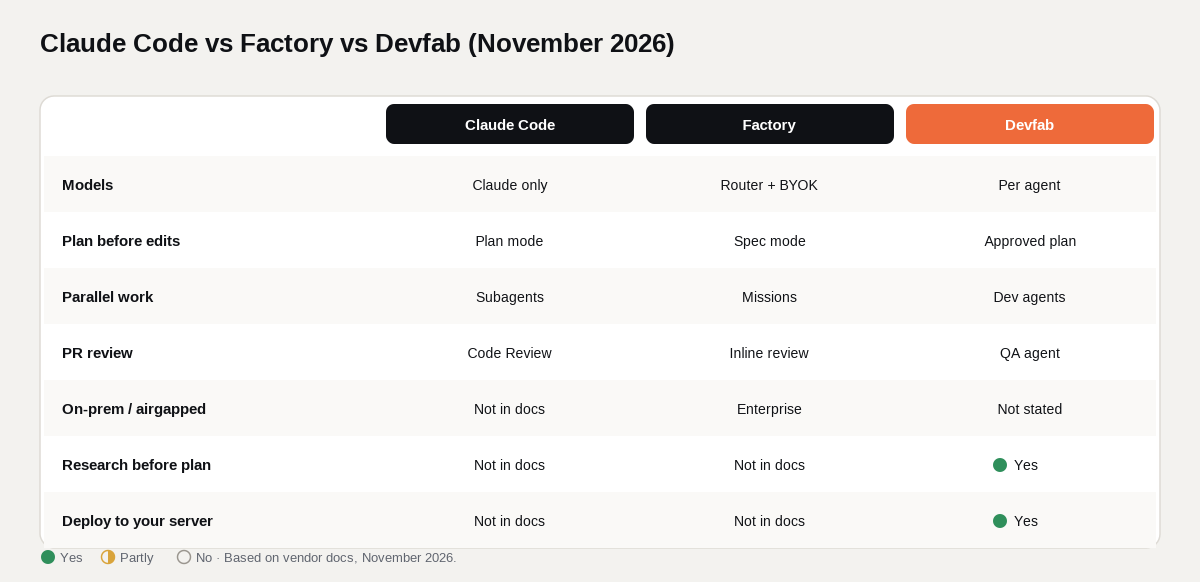
| Aspect | Claude Code | Factory | Source |
|---|---|---|---|
| Where it runs | Terminal, VS Code, JetBrains, desktop, web, mobile | Droid CLI (headless droid exec for CI), Factory App desktop, IDEs, web Remote Control | Claude Code docs; Factory docs |
| Work intake | Slack, GitHub Actions, GitLab CI/CD, channels | Slack, Linear, Jira, Microsoft Teams, Google Chat | Claude Code docs; Factory docs |
| Planning and autonomy | Plan mode; managed permissions | Normal, Spec and Mission modes; autonomy Off, Low, Medium, High; allow, approve or block shell commands | Claude Code costs; Factory docs |
| Parallel work | Subagents, background agents, experimental agent teams | Missions split work into parallel tracks; Droid Computers give persistent remote execution | Claude Code docs; Factory news |
| Review | Managed Code Review on GitHub PRs | Inline PR review; AutoWiki repo wikis; Agent Readiness scoring | Code Review; Factory |
| Safety | Hooks; managed permissions that local config cannot override | Sandboxing, Droid Shield secret detection, hooks | Enterprise deployment; Factory docs |
| Model choice | Claude models only | Model-agnostic Router; BYOK incl. open-source or local models | Claude Code costs; Factory docs |
| Deployment options | Inference via Anthropic, Bedrock, Google Cloud or Foundry; self-hosted cloud-session environments | Enterprise: on-prem, dedicated compute, data residency; docs cover airgapped deployment | Enterprise deployment; Factory pricing |
| Pricing model | Included in paid Claude plans | Free with your own inference; usage-tiered paid plans; per-team plus per-seat Teams | Claude pricing; Factory pricing |
Cost model by team size
| Team size | Claude Code | Factory |
|---|---|---|
| 1 person | Pro USD 20 per month (USD 17 billed annually); Max USD 100; Ultra USD 200 | Free (bring your own inference); Pro USD 20 per user per month; Plus USD 100; Max USD 200 |
| 5 people | Team Standard USD 25 per user per month (USD 20 annual) | Teams USD 60 per team per month plus USD 40 per user per month (up to 10 seats) |
| 25 people | Team, or Enterprise at USD 20 per seat per month billed annually (20-seat minimum) plus API-rate usage | Business or Enterprise (contact sales) |
Prices as of November 2026 from Claude pricing and Factory pricing. Factory's page shows usage only relative to Pro (Plus about five times Pro, Max about ten times) and gives no token or credit amounts.
Where Claude Code wins
- Developers want to shape the agent. CLAUDE.md, skills, hooks, MCP and the Agent SDK let teams build their own workflows.
- You want managed PR review that runs several agents per GitHub PR and filters false positives.
- Clear usage visibility. Admins get spend limits, an analytics dashboard, OpenTelemetry export and per-user reporting.
- One plan covers chat and code. Paid Claude plans include Claude Code alongside chat on web, desktop and mobile.
- You want published team prices for larger teams. Claude lists Team and Enterprise seat prices; Factory's Business and Enterprise are contact-sales.
Where Factory wins
- You need on-prem, airgapped or data-residency deployment, with self-hosted GitHub Enterprise Server or GitLab.
- You want model freedom. The Router picks a model per task, and BYOK allows open-source or local models.
- Work starts in business chat. Delegate from Microsoft Teams or Google Chat as well as Slack, Linear and Jira.
- Large jobs need parallel tracks. Missions split complex work, and Droid Computers keep execution running remotely.
- You want to grade repos for agents. Agent Readiness scoring and AutoWiki document and score repositories.
Switching from one to the other
Both work in your existing repositories, so no code moves.
From Claude Code to Factory. Install the Droid CLI or the Factory App, connect your Git host, and choose an autonomy level and command rules before turning on Missions (Factory docs). Rebuild your Claude Code skills and hooks as Factory skills and hooks.
From Factory to Claude Code. Write project rules into CLAUDE.md or AGENTS.md, set managed permissions for your org, and move recurring Automations to cloud scheduled tasks triggered by schedules or GitHub events (Claude Code docs).
Where Devfab fits
Factory and Devfab both call themselves software factories, so the difference is worth stating. Factory's Droids work inside existing repos, from tickets and chat. Devfab runs a project from an idea or a repo through research, an approved plan, build, QA and deploy.
Coding agents automate the developer. Devfab automates the development lifecycle. Picture an inventory app for a small distributor. Devfab's Researcher maps stock terms, reorder practices and competing tools, then suggests a prototype. A person approves the plan. ChainFlow maps which functions and APIs depend on each other, so changing stock reservation shows its impact on picking, invoicing and alerts. The QA agent runs UI, flow and logic tests, and Deploy ships to your own server.
Devfab is in Beta, has a smaller community, fewer integrations and no on-prem package stated, is not an editor and needs a GitHub account. See Devfab vs Claude Code and Factory AI alternatives.
FAQ
Is Factory the same as factory.ai?
Yes. Factory's canonical domain is now factory.com. As of November 2026, factory.ai and docs.factory.ai redirect to factory.com and docs.factory.com, while sign-in remains at app.factory.ai.
What are Factory Droids?
Droids are Factory's coding agents. They run in the Droid CLI, including a headless mode for CI/CD, the Factory App desktop workspace, IDEs and the web, and they take work from Slack, Linear, Jira, Microsoft Teams and Google Chat.
Can Factory use Claude models?
Factory is model-agnostic. Its Router picks a model per task, and bring-your-own-key supports your own API keys and open-source or local models. Claude Code, by contrast, runs Claude models only.
Which is better for regulated enterprises?
Factory lists on-prem deployment, dedicated compute and data residency on Enterprise, and its docs cover airgapped deployment. Claude Code lets inference run through Amazon Bedrock, Google Cloud or Microsoft Foundry and supports gateways and self-hosted cloud-session environments. Check both against your controls.
Read next
Want a factory that starts with research and a plan your client approves? Try Beta
Sources (checked November 2026): Claude Code docs: Overview; Claude Code docs: Manage costs; Claude Code docs: Code Review; Claude Code docs: Enterprise deployment; Claude pricing; Factory homepage; Factory pricing; Factory 2.0 announcement (Jun 15, 2026); Factory docs index.
Frequently asked questions
Is Factory the same as factory.ai?
Yes. Factory's canonical domain is now factory.com. As of November 2026, factory.ai and docs.factory.ai redirect to factory.com and docs.factory.com, while sign-in remains at app.factory.ai.
What are Factory Droids?
Droids are Factory's coding agents. They run in the Droid CLI, including a headless mode for CI/CD, the Factory App desktop workspace, IDEs and the web, and they take work from Slack, Linear, Jira, Microsoft Teams and Google Chat.
Can Factory use Claude models?
Factory is model-agnostic. Its Router picks a model per task, and bring-your-own-key supports your own API keys and open-source or local models. Claude Code, by contrast, runs Claude models only.
Which is better for regulated enterprises?
Factory lists on-prem deployment, dedicated compute and data residency on Enterprise, and its docs cover airgapped deployment. Claude Code lets inference run through Amazon Bedrock, Google Cloud or Microsoft Foundry and supports gateways and self-hosted cloud-session environments. Check both against your controls.