Short answer: The main Factory.ai alternatives are Devin (a cloud agent that works through your backlog), OpenAI Codex and Claude Code (coding agents for terminal, IDE and cloud), GitHub Copilot's cloud agent (agents inside GitHub), Cursor (an agent-first editor) and Devfab (an AI software factory that plans, builds, tests and deploys whole projects with a person approving the plan).
You're evaluating Factory, and every vendor now says "software factory". Underneath that label, the tools work very differently. Some take tickets and return pull requests for your team to review. Others plan, test and deploy a whole project with a person approving the plan. Choosing on the label alone can leave your team with the wrong kind of help.
In this guide, you'll learn:
- What Factory does well
- Six alternatives in one table
- Where Factory is still the better choice
- Where Devfab fits
- How to choose
Compare them on the work they do, not on the label.
What Factory does well
Factory builds AI agents for software engineering called Droids. You can run them from a command-line tool, a desktop app for macOS and Windows (added in April 2026), IDE plugins or an API. Droids also take work from GitHub issues, Linear tickets, Slack messages and Sentry errors, then return a pull request for normal review.
In June 2026 Factory described its platform as a "software factory": signals such as bug reports and customer feedback are triaged, planned, built, tested, reviewed, secured, shipped and monitored by agents. It offers three levels of autonomy: single Droids or skills for well-defined tasks, Automations for recurring workflows, and Missions for multi-agent work that runs over long stretches. Organizations can pick models or let a router choose. Deployment options include fully hosted, bring-your-own-key, a self-hosted data plane, EU hosting and air-gapped setups. Factory lists NVIDIA, EY, Adobe and Palo Alto Networks among its production users.
That is a strong offer for a large engineering organization with many repositories and strict data rules.
Why teams look for alternatives
- Cost under heavy use. A 2026 review of Droids notes that token costs run high because agents read widely and retry after failed test runs. Factory's individual plans are usage-based with rolling rate limits and prepaid extra usage, so heavy weeks cost more.
- Ticket-shaped work. The same review finds Droids strongest on bounded, verifiable tasks such as dependency bumps, missing tests or a bug with a stack trace. Vague requirements lead to assumptions.
- Review still lands on people. Large refactors can take almost as much reviewer attention as writing them by hand. Teams without senior reviewers feel this most.
- Who it's built for. Factory is built for enterprise engineering teams, and its software-factory offer starts with a call to sales. Agencies, SMEs and founders who want a working app, not a stream of pull requests, often want something that starts earlier in the process.
- Preference for an editor or for GitHub. Some developers want agents inside the editor they already use, or inside GitHub itself.
How we compared
We compared tools on what each is built for, using vendor documentation and independent reviews as of November 2026. We did not run hands-on tests for this page. We describe pricing models (seats, credits, usage), not prices, because prices change often.
Shortlist with a feature table
| Tool | Type | Where you work | Pricing model | Data control | Beyond code |
|---|---|---|---|---|---|
| Factory (baseline) | Agents for engineering orgs | CLI, desktop app, IDE, tickets, Slack | Usage-based individual plans; Teams, Business, Enterprise | Hosted, BYOK, self-hosted data plane, air-gapped | Review, security, docs, incident work |
| Devin | Cloud agent + desktop app | Web, Slack, Teams, CLI, Devin Desktop | Usage-based; ACUs on Enterprise | Cloud-managed | PR review, codebase Q&A |
| OpenAI Codex | Coding agent | CLI, IDE, desktop app, cloud | Included in ChatGPT plans with limits | OpenAI-managed cloud or local | Up to you |
| Claude Code | Coding agent | Terminal, IDE, desktop, web, Slack | Claude subscription or API account | Local or cloud sessions | Code review, CI automation |
| GitHub Copilot cloud agent | Agent inside GitHub | GitHub, IDEs | Copilot plans; AI credits plus compute allowance | GitHub-hosted repos only | Code review on PRs |
| Cursor | Agent-first editor | Editor, cloud agents | Credits | Cloud VMs or local | PR review agent |
| Devfab | AI software factory | Web workspace + your GitHub | Cost logged per task and per project | Code in your GitHub, app on your server | Research, plan approval, QA agent, deploy, docs |
Devin
Cognition's Devin is an autonomous agent for working through a backlog: Linear and Jira tickets, bug reports, migrations, refactors, tests and docs, often in parallel. You start sessions in the web app, by tagging Devin in Slack or Microsoft Teams, from the Devin CLI or through the API. Devin's own docs say it works best on well-scoped tasks with clear completion criteria. Since June 2026 the Windsurf editor is called Devin Desktop and includes a local agent.
Best for teams that want the same "hand it a ticket" model as Droids with a single vendor for cloud agent and editor. Limits: closed and cloud-managed; Enterprise billing is in Agent Compute Units, which takes effort to forecast. See Devfab vs Devin.
OpenAI Codex
OpenAI's coding agent runs as a CLI, a VS Code extension, inside the ChatGPT desktop app, and in Codex Cloud, where tasks run on OpenAI-managed machines and keep going while your computer sleeps. Codex is included in all ChatGPT plans with usage limits; the cloud part needs Plus or a higher plan.
Best for teams already paying for ChatGPT who want an agent with no new contract. Limits: planning, QA evidence and deployment are up to you; long tasks draw down a shared allowance.
Claude Code
Anthropic's agent runs in the terminal, VS Code, JetBrains, a desktop app and the browser. It can open pull requests, run in GitHub Actions or GitLab CI for review and triage, take bug reports from Slack, and connect to tools like Jira through MCP. Teams can add project instructions, skills and hooks, and run several agents in parallel.
Best for developers who want a scriptable agent they can shape to their own workflow. Limits: it's a developer tool; plan sign-off, delivery reports and hosting are your job.
GitHub Copilot cloud agent
Copilot's cloud agent researches a repository, plans changes and implements them in the background, then opens a pull request. You start it from GitHub, an issue, a pull request or the Agents tab. GitHub's docs list clear limits: one branch and one pull request per task, a 59-minute cap on GitHub Actions-based sessions, and repositories must be hosted on GitHub.
Best for teams who live in GitHub and want agents without another vendor. Limits: scoped to GitHub; not a project-level planner. See Devfab vs GitHub Copilot.
Cursor
Cursor 3, released in April 2026, puts an Agents Window at the center of a VS Code-based editor. Agents run locally or in cloud VMs that clone your GitHub repo, work on a branch and can check UI changes in a browser. Billing has been credit-based since 2025. Cursor said in an August 14, 2026 post that it has officially been acquired by SpaceX (Cursor blog).
Best for developers who want to watch and steer agents from an editor. Limits: reviewers report credit use is hard to predict, and cloud agents need the repo on GitHub.
Devfab
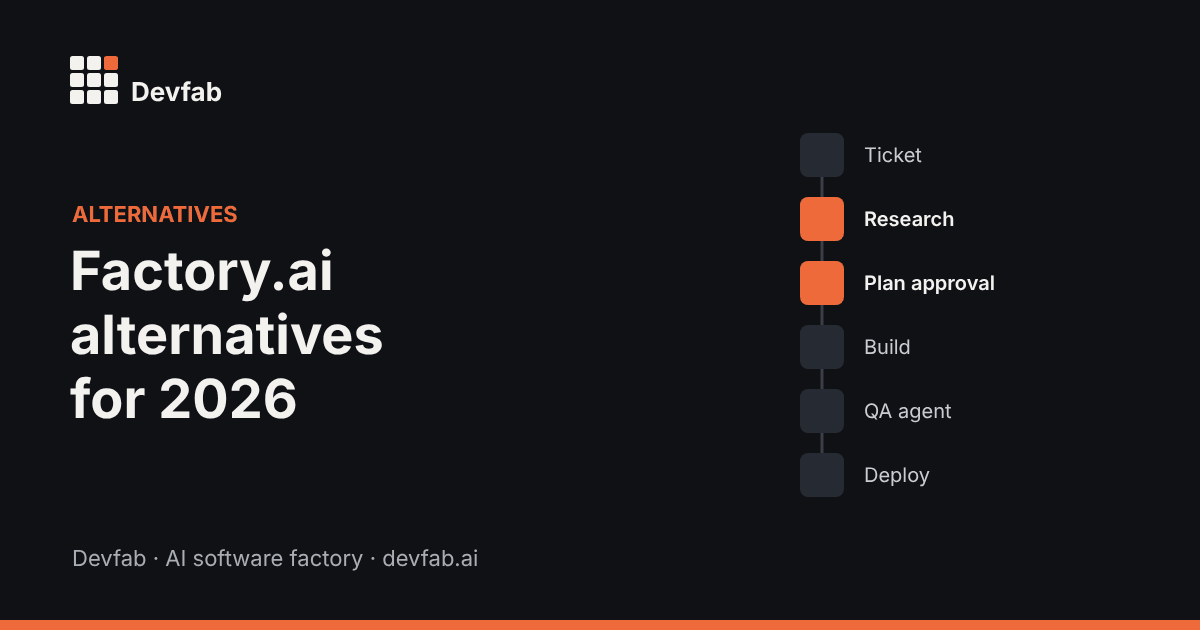
Devfab is an AI software factory. You describe an app or connect an existing GitHub repo. A Researcher maps your domain first, a Planner writes the plan, and a person approves it. Then a Coordinator turns it into tickets for developer agents, a QA agent tests screens, flows and logic, and the app deploys to your own server. Details are in Where Devfab fits.
Where Factory is still the better choice
Be honest about this: for many enterprise engineering teams, Factory is the right tool.
- Large engineering organizations with many repositories, an existing ticket flow and senior reviewers. Droids fit into GitHub, Linear, Slack and Sentry the way your team already works.
- Strict data rules. Factory's self-hosted data plane, EU hosting and air-gapped options go further than most tools on this list, including Devfab.
- Model routing at scale. If you want a router choosing models by cost and speed across thousands of tasks, Factory is built for that.
- Incident and maintenance loops. Factory explicitly covers security analysis and incident response on the same platform.
- Proven at scale. Factory names large production customers. Devfab is new and in Beta.
Where Devfab fits
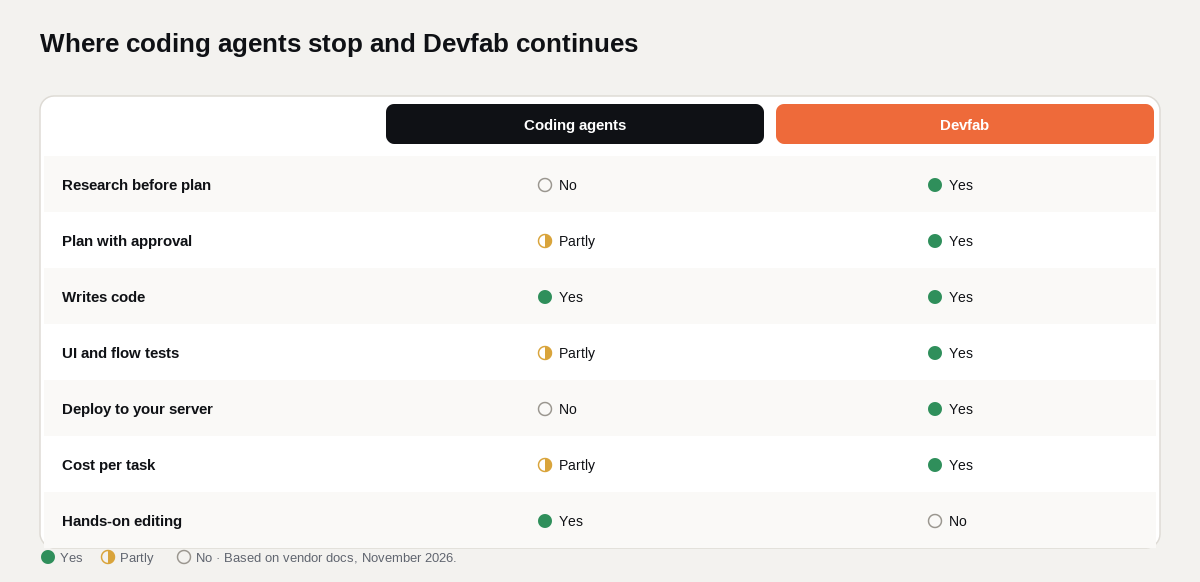
Factory and Devfab both use the word "factory", but they start at different points. Factory gives an engineering team agents that pick up tickets. Devfab starts before there are tickets. Coding agents automate the developer. Devfab automates the development lifecycle.
Three things set Devfab apart:
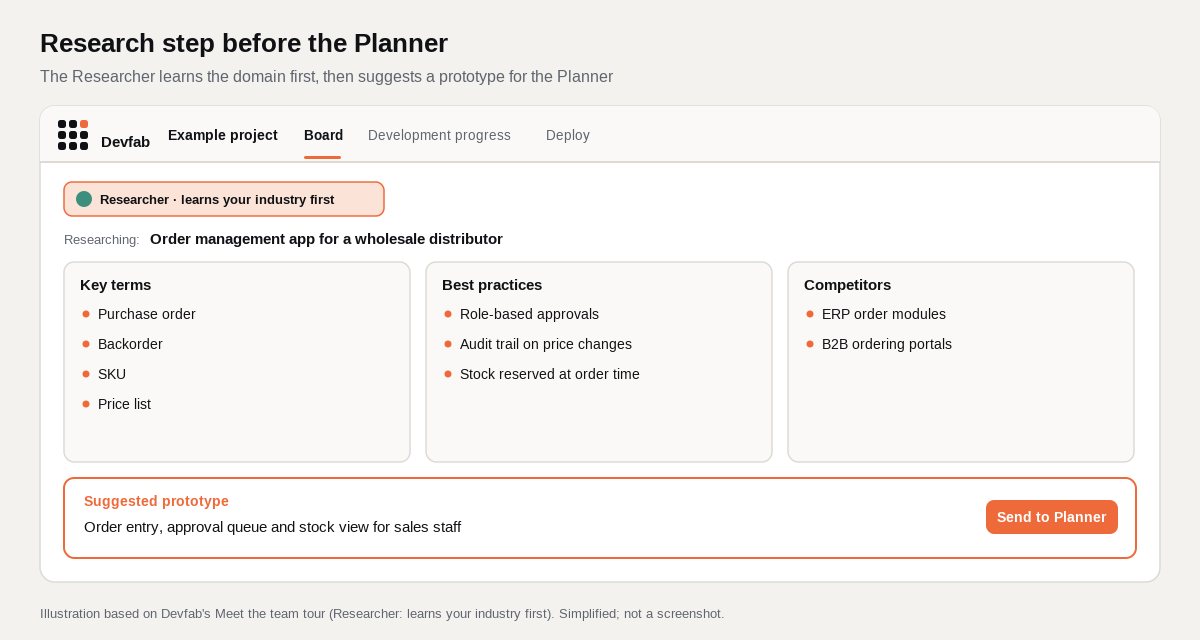
- Research before the plan. Before the Planner writes anything, Devfab's research step maps the domain: key terms, best practices for that kind of app, and competitors, then suggests a prototype. The Researcher learns your industry first, so the plan reflects how the business works.
- ChainFlow. Devfab's code-intelligence layer maps which functions and APIs call each other and what is deployed. Developer agents see the impact of a change before making it. Changing checkout, for example, can affect payments, inventory, order confirmation and notifications. On an existing repo, leave the change box empty and Devfab maps the code first and suggests three small first tickets.
- A QA agent that clicks through the app. It runs UI and flow tests (screens, buttons and user journeys clicked end to end) plus logic tests. With "QA agent · review before Done" switched on, nothing is marked Done until it passes review.
The default run mode is Human in the loop: a person approves the plan before the Coordinator creates tickets, and each stage waits for your review. You can switch to Auto in workspace settings, where Devfab asks only when it needs you. You can choose the model for each agent or keep Devfab's default. Code lives in your own GitHub account (or your organization's), and you deploy to your own server, so there is no lock-in. Cost is predictable and visible: it's logged after each run, per task and per project.
Devfab's honest limits:
- It's new and in Beta, with a smaller community than any tool above.
- It has fewer integrations than Factory, Devin or Copilot.
- It isn't an editor for hands-on coding. Developers open the repo in their own editor for that.
- It needs a GitHub account.
- If you need air-gapped or region-specific hosting, ask the Devfab team what is available before you commit; Factory documents more deployment options today.
How to choose
- Large engineering org, tickets already flowing, strict data rules? Stay with Factory, or compare it with Devin.
- One vendor for cloud agent and editor? Devin.
- Already on ChatGPT or Claude plans? Codex or Claude Code.
- Everything on GitHub? Copilot's cloud agent.
- Want to steer agents from an editor? Cursor.
- Need a whole app planned, approved, tested and deployed to your own server, with cost per task and per project? Devfab. Read AI software factory vs AI coding tools for the difference in more depth.
FAQ
What is the closest alternative to Factory's Droids?
Devin is the closest. Both are agents you hand tickets to, both run in the cloud or locally, and both report back with pull requests. Devin is a closed, cloud-managed product; Factory offers more deployment options for regulated companies.
Is Factory.ai the same as an AI software factory like Devfab?
Both use the word factory, but they start in different places. Factory gives engineering teams agents (Droids) that take tickets and open pull requests. Devfab runs a project from research and an approved plan through build, QA and deploy to your own server.
Can I use Factory and Devfab together?
Yes. Devfab keeps the code in your own GitHub account, so a developer can point a Droid or any other agent at the same repository for one-off tasks.
Why do teams look for Factory.ai alternatives?
The common reasons are cost that rises with heavy agent use, a product built around engineering tickets rather than whole projects, and the wish for a tool that also plans, tests the UI and deploys.
Read next
- What is an AI software factory?
- AI software factory vs AI coding tools
- Devin alternatives
- Best AI coding agents for software agencies
- Factory vs Devin: which should your team use in 2026?
Want agents to run the whole project, not just the ticket? Try the Devfab Beta
Sources (checked November 2026): Factory: The software factory; Factory docs: Individual plans; Tessl: Factory brings Droids out of the terminal with a desktop app; Pickuma on DEV: Factory AI Droids review; Devin docs: Introduction; Devin docs: Devin Desktop FAQ; Devin docs: Usage and billing; OpenAI Help: Codex; Claude Code overview; GitHub Docs: About Copilot coding agent; DEV: Cursor 3 review; Cursor blog: Joining SpaceX.
Frequently asked questions
What is the closest alternative to Factory's Droids?
Devin is the closest. Both are agents you hand tickets to, both run in the cloud or locally, and both report back with pull requests. Devin is a closed, cloud-managed product; Factory offers more deployment options for regulated companies.
Is Factory.ai the same as an AI software factory like Devfab?
Both use the word factory, but they start in different places. Factory gives engineering teams agents (Droids) that take tickets and open pull requests. Devfab runs a project from research and an approved plan through build, QA and deploy to your own server.
Can I use Factory and Devfab together?
Yes. Devfab keeps the code in your own GitHub account, so a developer can point a Droid or any other agent at the same repository for one-off tasks.
Why do teams look for Factory.ai alternatives?
The common reasons are cost that rises with heavy agent use, a product built around engineering tickets rather than whole projects, and the wish for a tool that also plans, tests the UI and deploys.