Short answer: Choose Kiro if you want each feature to move through written requirements, design and tasks, with property-based tests and a choice of Claude, GPT or open-weight models. Choose Claude Code if your developers want a scriptable agent for the terminal and CI, built on Claude models, with inference in your own cloud account.
Here is the confusing part. You can run Claude models in both tools. And both can run on AWS: Kiro is built by AWS, and Claude Code can send inference through Amazon Bedrock. So model and cloud do not decide this choice. Workflow does. Kiro gives you a fixed path from requirements to tasks. Claude Code gives you a harness you shape with hooks, skills and scripts. This page compares the two with sources checked on November 13, 2026.
In this comparison:
- Kiro and Claude Code at a glance
- Feature comparison
- Cost model by team size
- Where Kiro wins and where Claude Code wins
- Where Devfab fits
The verdicts follow the facts.
Kiro and Claude Code at a glance
Kiro is AWS's agentic coding system, offered as Crew (persistent background agents), Web, Mobile, an IDE and a CLI. Its spec workflow generates requirements.md with EARS-format acceptance criteria, design.md with architecture and sequence diagrams, and tasks.md. Each phase completes before the next. In November 2026 Kiro added Kiro Crew LTS, an Enterprise Management preview and an "Approve for me" permission mode.
Claude Code is Anthropic's agentic coding tool. It reads your codebase, edits files, runs commands and opens pull requests. It runs in the terminal, VS Code and JetBrains, a desktop app, the web and mobile. Plan mode proposes an approach for your approval before editing. You can extend it with CLAUDE.md or AGENTS.md instructions, skills, hooks, MCP servers and the Agent SDK.
The shared ground. Both support MCP, AGENTS.md and skills. Both have a CLI and an IDE option. Both can run background or parallel agents.
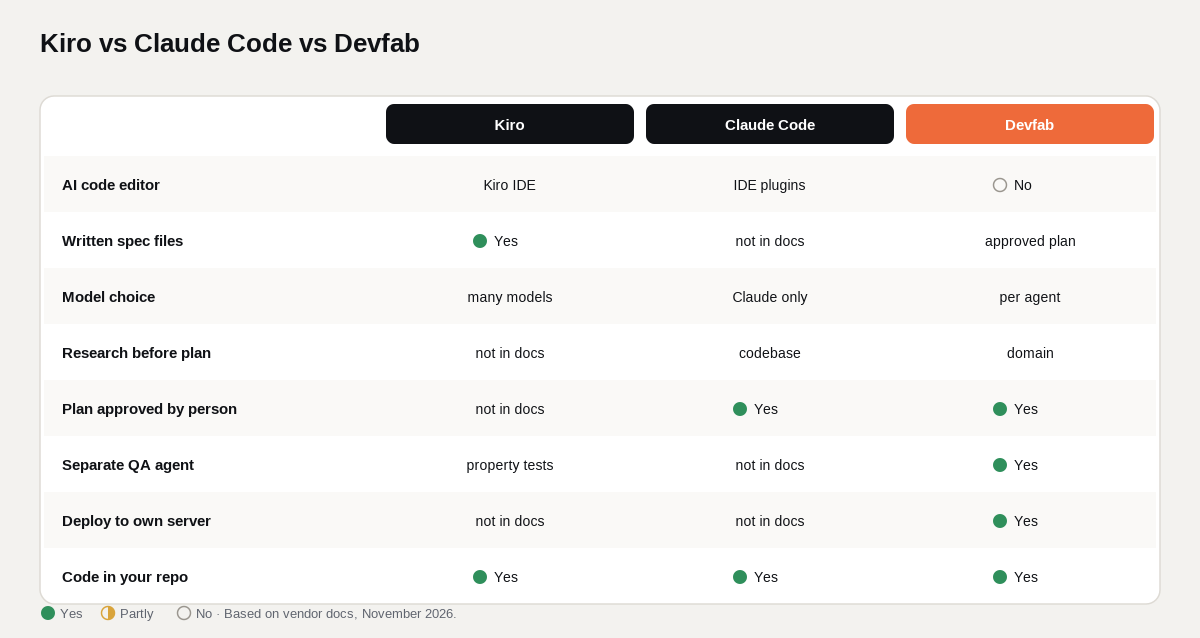
Feature comparison
| Aspect | Kiro | Claude Code | Source |
|---|---|---|---|
| Where it runs | Crew, Web, Mobile, IDE, CLI | Terminal, VS Code, JetBrains, desktop, web, mobile; GitHub Actions, GitLab CI/CD, Slack | Kiro; Claude Code overview |
| Planning | Spec phases: requirements, design, tasks | Plan mode proposes an approach for approval | Kiro specs; Claude Code costs |
| Agent autonomy | Parallel agents in cloud sessions; "Approve for me" mode | Subagents, background agents, experimental agent teams; cloud scheduled tasks | Kiro changelog; Claude Code overview |
| Testing and review | Property-based tests tied to specs; event hooks | Managed Code Review on GitHub PRs; it does not build or run code | Kiro; Claude Code Review |
| Hosting and data | Built and run by AWS; Enterprise uses IAM Identity Center | Inference via Anthropic, Bedrock, Claude Platform on AWS, Google Cloud or Foundry | Kiro pricing; Claude Code enterprise |
| Code ownership | Works in your repository | Commits, branches and PRs in your repository | Kiro; Claude Code overview |
| Team and admin | SSO, pooled credits, groups, per-user limits, dashboards | Team: SSO, managed settings; Enterprise: roles, compliance API; org spend limits | Kiro pricing; Claude Code costs |
| Model choice | Claude, GPT, DeepSeek, Qwen, or Auto | Claude models only | Kiro; Claude Code costs |
| Pricing model | Free tier with credits; paid tiers; Teams per seat | Included in paid Claude plans; API pay-as-you-go | Kiro pricing; Claude pricing |
Cost model by team size
| Team size | Kiro | Claude Code | Devfab |
|---|---|---|---|
| 1 person | Perpetual free tier with 50 credits a month, or a paid tier with more credits | Pro or Max plan (not Free); usage limits shared with Claude chat; credits at API rates after that | Cost logged per task and per project (Beta) |
| 5 people | Teams, per seat, with pooled credits and SSO | Team plan with Standard or Premium seats | Cost logged per task and per project (Beta) |
| 25 people | Teams or Enterprise with groups and per-group limits | Team or Enterprise (seat fee plus usage at API rates), or pay-as-you-go via Bedrock or another cloud | Cost logged per task and per project (Beta) |
Pricing models as of November 13, 2026, from Kiro's pricing page and Claude's pricing page. Kiro says spec tasks usually cost more credits than simple prompts. Anthropic says agent teams use roughly 7x more tokens than standard sessions when teammates run in plan mode.
Where Kiro wins
- Requirements you can hand to a reviewer. EARS-format acceptance criteria and a design doc exist before code.
- Model freedom. Pick Claude, GPT or open-weight models, or let Auto route each task.
- Tests tied to intent. Property-based tests check the spec.
- AWS-native admin. IAM Identity Center and AWS-console policy across the IDE, CLI, Web and Crew (preview).
Where Claude Code wins
- Scripting and CI. Pipe it, run it in GitHub Actions or GitLab CI/CD, or build your own agents with the Agent SDK.
- Your inference, your account. Bedrock, Google Cloud, Foundry, LLM gateways and corporate proxies.
- Locked-down settings. Security teams can set managed permissions that local config cannot override.
- Reviewed pull requests. Code Review runs several agents per PR and filters false positives before posting comments.
- More surfaces. Desktop, web, mobile and Slack, plus Remote Control and
--teleportto move sessions between devices.
Switching from one to the other
The code stays in your repository either way. Move the instructions and the habits.
- Make AGENTS.md the shared file. Kiro supports AGENTS.md in the workspace root and subdirectories. Claude Code reads CLAUDE.md or AGENTS.md.
- Carry over steering. Kiro's steering files sit in
.kiro/steering/(product.md, tech.md, structure.md). Fold the parts every tool needs into AGENTS.md. - Keep the specs as docs. Kiro's requirements, design and task files are markdown, so Claude Code can read them as context in plan mode.
- Rebuild automation. Kiro hooks and Claude Code hooks are separate systems; recreate the ones you rely on.
- Pilot on one feature before moving the team.
Where Devfab fits
Kiro and Claude Code are both built for developers. Kiro adds structure, and Claude Code adds control. Neither is built to give a non-technical client an approved plan, a QA report and an app running on their own server.
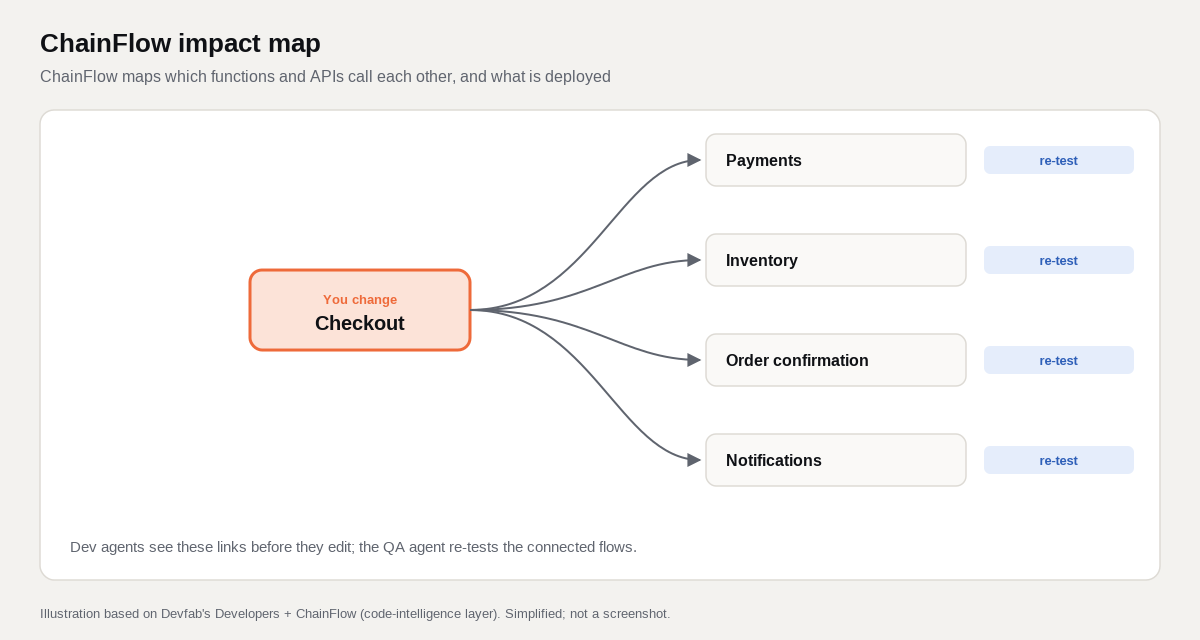
Coding agents automate the developer. Devfab automates the development lifecycle. A person approves Devfab's plan before tickets exist. Dev agents then work with ChainFlow, Devfab's code-intelligence layer. It maps which functions and APIs call each other and what is deployed. A change to checkout, for example, shows its impact on payments, inventory, order confirmation and notifications before it ships. The QA agent then runs UI, flow and logic tests.
Honest limits: Devfab is new and in Beta, with a smaller community and fewer integrations. It is not an editor or a CLI, and it needs a GitHub account. See Devfab vs Kiro and Devfab vs Claude Code.
FAQ
Can I use Claude models in Kiro?
Yes. Kiro lists Claude, GPT and open-weight models such as DeepSeek and Qwen, plus an Auto mode that routes each task. Claude Code uses Claude models only, switchable with the /model command. If your team wants Claude models with a spec workflow, Kiro offers both.
Does Claude Code have a spec mode like Kiro?
Not as a fixed document set. Claude Code's plan mode has Claude explore the codebase and propose an approach for your approval before it edits. Kiro's specs generate requirements.md, design.md and tasks.md and complete each phase before the next.
Which one fits a company on AWS?
Both can. Kiro is built and run by AWS, and Kiro Enterprise uses AWS IAM Identity Center or an external identity provider. Claude Code can send model inference through Amazon Bedrock or Claude Platform on AWS. The difference is workflow, not cloud.
Which is better for automation in CI?
Claude Code. Anthropic documents GitHub Actions and GitLab CI/CD integrations, cloud scheduled tasks that trigger on API calls or GitHub events, and an Agent SDK for custom agents. Kiro offers a CLI and agent hooks that run on events such as file save.
Read next
- What is an AI software factory?
- AI IDE vs CLI coding agent: which fits how you work?
- Kiro alternatives for teams that ship to production (2026)
- Devfab vs Kiro: which fits a team that ships client work?
- Devfab vs Claude Code: which fits a team that ships client work?
Want to see what a change breaks before it ships? Try Devfab Beta
Sources (checked November 13, 2026): Kiro; Kiro Pricing; Kiro Docs: Specs; Kiro Docs: Hooks; Kiro Docs: Steering; Kiro Changelog; Claude Code Docs: Overview; Claude Code Docs: Enterprise deployment; Claude Code Docs: Code Review; Claude Code Docs: Manage costs; Claude Pricing.
Frequently asked questions
Can I use Claude models in Kiro?
Yes. Kiro lists Claude, GPT and open-weight models such as DeepSeek and Qwen, plus an Auto mode that routes each task. Claude Code uses Claude models only, switchable with the /model command. If your team wants Claude models with a spec workflow, Kiro offers both.
Does Claude Code have a spec mode like Kiro?
Not as a fixed document set. Claude Code's plan mode has Claude explore the codebase and propose an approach for your approval before it edits. Kiro's specs generate requirements.md, design.md and tasks.md and complete each phase before the next.
Which one fits a company on AWS?
Both can. Kiro is built and run by AWS, and Kiro Enterprise uses AWS IAM Identity Center or an external identity provider. Claude Code can send model inference through Amazon Bedrock or Claude Platform on AWS. The difference is workflow, not cloud.
Which is better for automation in CI?
Claude Code. Anthropic documents GitHub Actions and GitLab CI/CD integrations, cloud scheduled tasks that trigger on API calls or GitHub events, and an Agent SDK for custom agents. Kiro offers a CLI and agent hooks that run on events such as file save.