Short answer: Pick Factory when you need on-premises or air-gapped deployment, a terminal agent you can also run in CI, and Missions that plan, build and test multi-feature work after you approve the plan. Pick Devin when you want to hand well-scoped tickets to a cloud AI engineer from Slack, Teams, Linear or Jira and review its pull requests.
You run an engineering team with a backlog that never shrinks. One vendor says hire an AI engineer. Another says build a software factory. Both pitches sound alike, and both tools changed a lot in 2026. Picking the wrong one costs you a quarter of setup work.
In this comparison:
The sections below act as referee, with a source for every claim.
Factory and Devin at a glance
Status changes in 2026
- Factory announced Factory 2.0 on June 15, 2026. It moved from "coding agents" to "software factories", adding Droid Computers, Missions, Automations, Skills, a model Router and factory-management views in its desktop app. Its main domain is now factory.com; factory.ai redirects there.
- Devin grew into a product family. On June 2, 2026, Windsurf was renamed Devin Desktop and joined it. Cognition also introduced usage-based self-serve plans in March 2026.
Factory
Factory sells autonomous coding agents called Droids to startups and enterprises. Named customers include RBC, T-Mobile and DoorDash. Droids run in the Droid CLI, including headless droid exec for CI/CD, in the Factory App desktop workspace and in IDEs such as VS Code, JetBrains and Zed. You can also delegate work from Slack, Linear, Jira, Microsoft Teams and Google Chat.
You work in Normal, Spec or Mission mode, with autonomy levels from Off to High. Rules can allow a shell command, ask first, or block it. In a Mission, Droid asks clarifying questions, groups features into milestones, and starts only after you approve the plan. Missions include user-facing QA that checks each feature against the running app. Factory's own docs say whether parallel workers beat a single sequential worker is still being tested.
Devin
Cognition calls Devin "an autonomous AI software engineer that can write, run and test code". Each session has a shell, an IDE and a browser, and you can watch or take over. You reach it from the web app, Slack, Microsoft Teams, the Devin for Terminal CLI, the API and Devin Desktop.
Cognition lists its best fits: parallel tickets from Linear or Jira, migrations and refactors, PR review, codebase questions, bug reproduction, unit tests and docs. Its rule of thumb: "if you can do it in three hours, Devin can most likely do it." Long tasks can be split across subagents, each opening its own pull requests, and Devin Review checks diffs.
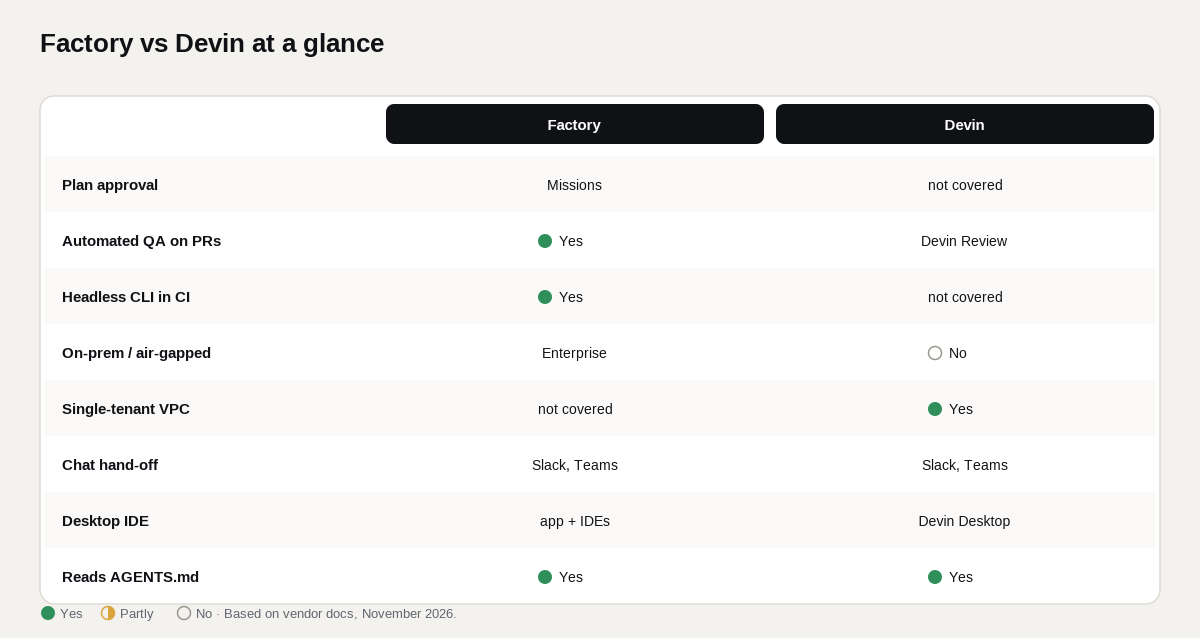
Feature comparison
| Aspect | Factory | Devin | Source |
|---|---|---|---|
| Where it runs | Droid CLI (also headless in CI), desktop app, IDEs, web; Slack, Linear, Jira, Teams, Google Chat | Web app, Slack, Teams, CLI with handoff to cloud, API, Devin Desktop | Factory docs; Devin intro |
| Planning / spec | Normal, Spec and Mission modes; Missions start after you approve the plan | Works best with clear prompts and explicit completion criteria | Factory Missions; Devin intro |
| Agent autonomy | Autonomy levels Off to High; allow, ask or block shell commands | Runs in its own workspace; you can watch and take over | Factory docs; Devin intro |
| Testing | Automated QA for web, CLI and API; report on the PR | Writes, runs and tests code; Devin Review on diffs | Factory QA; Devin Desktop |
| Deploy / hosting | On-prem and air-gapped options on Enterprise | Cloud, single-tenant VPC hosted by Cognition, customer-managed keys | Factory pricing; Devin deployment |
| Code and repos | Self-hosted GitHub Enterprise Server and GitLab supported | Opens pull requests in your repos | Factory docs; Devin intro |
| Team / admin | SSO, SAML/SCIM, audit logs, Zero Data Retention on Business | Teams up to 100 users with SSO; SCIM and RBAC on Enterprise | Factory pricing; Devin pricing |
| Model choice | Model-agnostic Router; bring your own keys or local models | Devin Desktop runs several agents and frontier models via ACP | Factory; Devin Desktop |
| Pricing model | Free tier with your own inference; usage-multiple tiers; Teams base fee plus seats | Free, Pro, Max; Teams fee plus seats; Enterprise in Agent Compute Units | Factory pricing; Devin usage |
Cost model by team size
| Team size | Factory | Devin |
|---|---|---|
| 1 person | Free tier if you bring your own inference; or Pro, Plus (about five times Pro usage) or Max (about ten times) | Free tier with a light agent quota; Pro or Max with higher quotas and cloud agents; extra use at API rates |
| 5 people | Teams: a base fee plus a per-seat fee, up to 10 seats | Teams: a team fee plus a per-seat fee, with centralized billing and cost controls |
| 25 people | Business (SSO, SCIM, audit logs) or Enterprise; contact sales | Teams covers up to 100 users; Enterprise usage is measured in Agent Compute Units that include compute |
Check Factory's pricing page and Devin's pricing page for current amounts. Factory's page gives usage only relative to Pro, with no token or credit amounts. For reference, Devfab (Beta) logs cost after each run, per task and per project.
Where Factory wins
- Your code can't leave your network. Enterprise lists on-premises deployment and data residency, and the docs cover air-gapped installs and self-hosted GitHub Enterprise Server or GitLab.
- You live in the terminal and CI. The Droid CLI runs interactively or headless with
droid exec. - You want a plan before a large build. Missions ask questions, group features into milestones, and wait for your approval.
- You want QA evidence on pull requests. The automated QA setup posts pass, fail and blocked results with screenshots.
- You want to pick models. The Router chooses per task, or you bring your own keys and local models.
Where Devin wins
- You have many small, well-defined tickets. Cognition lists parallel tickets, migrations, bug reproduction and unit tests as good fits.
- Your team asks for work in chat. Tag Devin in a Slack or Teams thread and get a pull request back.
- You want to watch and take over. Every session has a shell, IDE and browser you can step into.
- You want a desktop IDE too. Devin Desktop, the former Windsurf, adds a local agent and moves sessions between your machine and the cloud.
Switching from one to the other
Both tools read AGENTS.md, so keep your project rules there first.
From Devin to Factory: connect your source control, as Factory's environment prerequisites describe. Droid loads AGENTS.md, and CLAUDE.md for compatibility. Set an autonomy level, then run /install-qa if you want QA on pull requests.
From Factory to Devin: connect your repositories. Devin reads up to 16 KiB of each AGENTS.md, and its docs offer a migration prompt for rules written for another agent. Then hand Devin a few small tickets from Linear, Jira or Slack before larger work.
Where Devfab fits
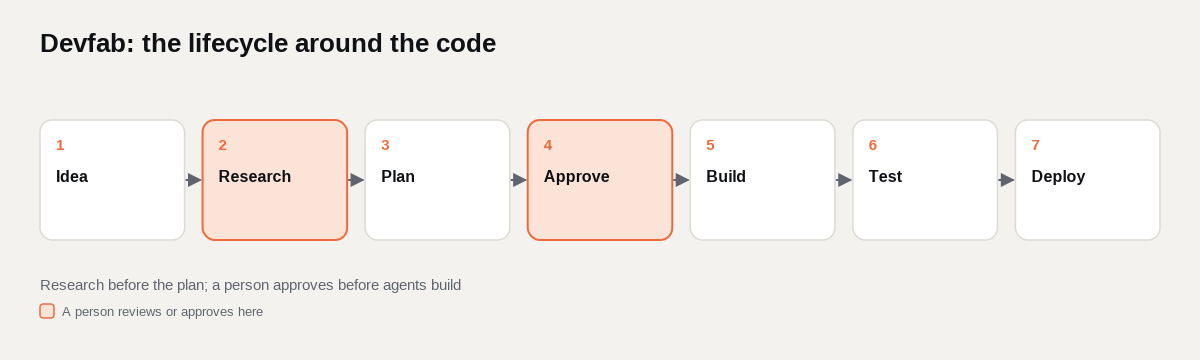
Factory now calls itself a software factory, and so does Devfab, so the difference deserves care. Factory and Devin are built for engineering teams that already run their own process. Devfab is built for delivery teams that ship apps for clients or their own business. Product owners and clients take part, not only developers.
Coding agents automate the developer. Devfab automates the development lifecycle. Before the Planner writes anything, Devfab's Researcher maps the domain: key terms, best practices and competitors. A person approves the plan. Dev agents work with ChainFlow, which maps which functions and APIs call each other, so a change to checkout shows its effect on payments and notifications. The QA agent runs UI, flow and logic tests. Deploy ships to your own server, and Blueprint and docs produce screens and user manuals.
Honest limits: Devfab is new and in Beta. It has a smaller community and fewer integrations than either tool, it is not an editor, and it needs a GitHub account. Read Devfab vs Devin for a direct comparison.
FAQ
Is Factory the same as Factory.ai?
Yes. The canonical domain is now factory.com, and factory.ai and docs.factory.ai redirect there, while sign-in stays at app.factory.ai. In June 2026 Factory announced Factory 2.0 and now describes its product as a software factory.
Can Factory or Devin run fully on our own servers?
Factory's Enterprise plan lists on-prem deployment, and its docs cover air-gapped setups and self-hosted GitHub Enterprise Server or GitLab. Devin offers a single-tenant VPC hosted by Cognition, but its docs say Devin's 'brain' always runs in Cognition's cloud.
Which is better for a backlog of small tickets?
Devin. Cognition lists parallel tickets from Linear or Jira, migrations, bug reproduction and unit tests as good fits, and gives a rule of thumb: if a person could do it in about three hours, Devin can most likely do it.
Do both tools test their own work?
Both do some testing. Devin's sessions include a shell, IDE and browser, and it is described as writing, running and testing code. Factory documents an automated QA setup that clicks through web apps, drives CLIs and calls APIs, then posts a pass or fail report on the pull request.
Where does Devfab fit next to Factory and Devin?
Devfab is a software factory aimed at delivery teams and their clients, not only developers. It researches the domain before planning, a person approves the plan, ChainFlow maps the impact of changes, a QA agent runs UI, flow and logic tests, and the app deploys to your own server.
Read next
- What is an AI software factory?
- Devfab vs Devin: which fits a team that ships client work?
- Factory.ai alternatives for teams that ship to production (2026)
- Devin alternatives for teams that ship to production (2026)
See a software factory built for delivery teams. Try Devfab Beta
Sources (checked November 13, 2026): Factory homepage; Factory pricing; Factory 2.0: software factory announcement (Jun 15, 2026); Factory docs index; Factory docs: Missions; Factory docs: Automated QA; Factory docs: AGENTS.md; Devin docs: Introducing Devin; Devin pricing; Devin docs: Enterprise deployment; Devin docs: Usage and billing; Devin docs: Devin Desktop FAQ; Devin Desktop; Devin docs: AGENTS.md.
Frequently asked questions
Is Factory the same as Factory.ai?
Yes. The canonical domain is now factory.com, and factory.ai and docs.factory.ai redirect there, while sign-in stays at app.factory.ai. In June 2026 Factory announced Factory 2.0 and now describes its product as a software factory.
Can Factory or Devin run fully on our own servers?
Factory's Enterprise plan lists on-prem deployment, and its docs cover air-gapped setups and self-hosted GitHub Enterprise Server or GitLab. Devin offers a single-tenant VPC hosted by Cognition, but its docs say Devin's 'brain' always runs in Cognition's cloud.
Which is better for a backlog of small tickets?
Devin. Cognition lists parallel tickets from Linear or Jira, migrations, bug reproduction and unit tests as good fits, and gives a rule of thumb: if a person could do it in about three hours, Devin can most likely do it.
Do both tools test their own work?
Both do some testing. Devin's sessions include a shell, IDE and browser, and it is described as writing, running and testing code. Factory documents an automated QA setup that clicks through web apps, drives CLIs and calls APIs, then posts a pass or fail report on the pull request.
Where does Devfab fit next to Factory and Devin?
Devfab is a software factory aimed at delivery teams and their clients, not only developers. It researches the domain before planning, a person approves the plan, ChainFlow maps the impact of changes, a QA agent runs UI, flow and logic tests, and the app deploys to your own server.