Short answer: OpenHands wins when a platform team wants open-source agents it can self-host in its own VPC, with open-weight models and automations it designs itself. Devfab wins when an agency wants a ready delivery process for client projects: domain research, an approved plan, tickets, a QA agent, deployment to your server and cost per project.
You can build almost anything on OpenHands. That is the appeal, and the work. Someone has to pick the models, wire the sandboxes, write the automations and decide where a person signs off. For a platform team, that is the job. For an agency with client deadlines, it can be a second product to maintain.
Open-source fans say own the stack. Delivery leads say own the outcome. This page compares both paths on facts.
In this comparison:
- What each tool is built for
- Switching triggers
- Cost model by team size
- Where OpenHands is the better choice
- Where Devfab is the better choice
Here is how they compare.
What each tool is built for
OpenHands
OpenHands is an open-source (MIT) platform for running AI coding agents and automations, with about 92,000 GitHub stars (GitHub). Status, November 2026: the main interface is now Agent Canvas, a self-hostable workspace launched on June 16, 2026, and the repository moved to OpenHands/OpenHands (OpenHands blog).
What it offers:
- Run anywhere: install Agent Canvas through npm, Docker or source, on local, Docker, remote VM, Kubernetes, Modal or enterprise VPC backends (OpenHands blog).
- Automations: scheduled and event-triggered jobs such as PR reviews, issue triage, issue-to-PR and weekly repo summaries, with several agent sessions in one workspace (OpenHands blog).
- Plan and code modes:
/planand/codemode switching arrived in the September 2026 releases (OpenHands, Oct 2026). - Bring other harnesses: run Claude Code and Codex through the Agent Client Protocol; the homepage also lists Gemini CLI (OpenHands).
- Model freedom: closed models and open-weight models run locally, in the cloud or in a VPC, with LLM Profiles to switch per task and bring-your-own-key (OpenHands).
- Integrations: GitHub, Slack, Jira, Linear, Notion, Atlassian and MCP; apps install from GitHub, GitLab, Bitbucket, Gitea or Forgejo repo URLs (OpenHands, Oct 2026).
- Team controls: Teams adds multi-user identity, RBAC, SSO/SAML and budgeting controls; Enterprise adds VPC deployment, auditing of every action and an SLA (OpenHands pricing).
OpenHands' main user is an engineering or platform team that wants to run and govern agents in its own environment.
Devfab
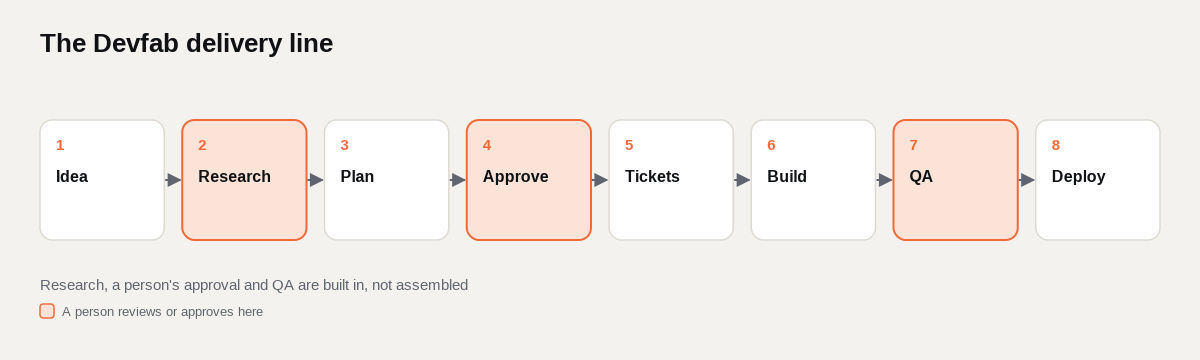
Devfab is an AI software factory with the process already built in. A Researcher maps the domain, best practices and competitors before planning. A Planner publishes the plan and a person approves it. A Coordinator creates tickets, and Developers work with ChainFlow, which maps which functions and APIs call each other and what is deployed. A QA agent runs UI, flow and logic tests. Deploy ships to your own server. You choose the model for each agent or keep Devfab's default.
Coding agents automate the developer. Devfab automates the development lifecycle.
Switching triggers
| Trigger | OpenHands | Devfab | Source |
|---|---|---|---|
| Running agents is a job of its own | You run and govern the agents yourself: models, keys and sandboxes | Agents, roles and run mode come preset; Human in the loop or Auto | OpenHands, Oct 2026 |
| Session volume hits a cap | Teams plan "is capped at 5,000 sessions per month" | Cost logged per task and per project | OpenHands pricing |
| Sandboxing still maturing | Docker isolation described as a "first major step"; other options still explored | Not applicable | OpenHands, Oct 2026 |
| Automations stop on their own | Can be disabled automatically after repeated dispatch failures | Coordinator assigns tickets from the approved plan | OpenHands, Oct 2026 |
| Client needs UI tests and a deployed app | Not covered in the docs we checked | QA agent runs UI and flow tests; deploy to your own server | OpenHands |
Cost model by team size
| Team size | OpenHands | Devfab |
|---|---|---|
| 1 person | Free to self-host (MIT), single user, with your own model key | Cost logged per task and per project (Beta) |
| 5 people | Teams: flat monthly fee covering up to 10 users, self-hosted, 30-day trial, 5,000 sessions per month; or free self-host with a shared identity | Cost logged per task and per project (Beta) |
| 25 people | Teams flat fee plus a per-seat add-on for each user beyond 10, or Enterprise on custom pricing with unlimited seats and sessions | Cost logged per task and per project (Beta) |
OpenHands' pricing model as of November 2026, from OpenHands' pricing page. Model costs come on top, through your own keys. Devfab: predictable cost; cost is logged after each run, per task and per project; Devfab is in Beta.
Moving from OpenHands to Devfab
OpenHands already works on your repositories, so there is no code to export.
- Use a GitHub repository. OpenHands supports several Git hosts; Devfab needs a repo in your own GitHub account or your organization's.
- In Devfab, choose "Work on an existing project" and pick it.
- Leave the change box empty. ChainFlow maps the code and suggests three small first tickets.
- Approve the plan. The Coordinator creates tickets and assigns dev agents once a person approves.
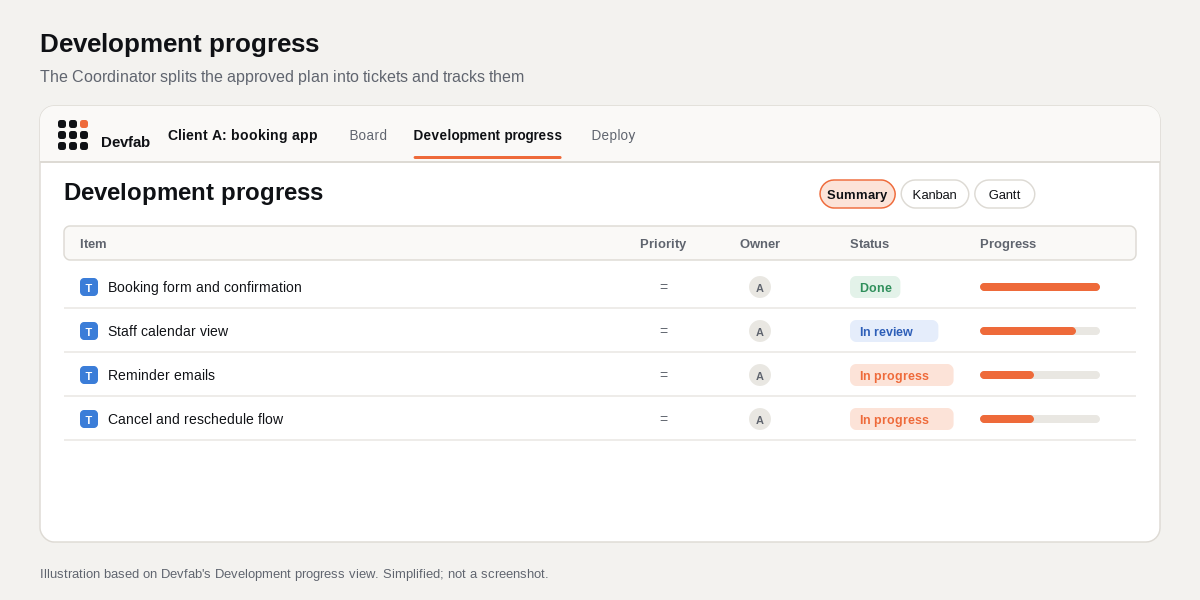
- Let the QA agent test each ticket with UI, flow and logic tests, and track progress in Summary, Kanban or Gantt.
- Keep OpenHands automations you rely on, such as weekly repo summaries or issue triage, if they still help.
Where OpenHands is the better choice
- Open source and self-hosting are requirements: MIT license, your VPC, your keys.
- You want open-weight or local models for cost or data-residency reasons.
- A platform team wants to build its own workflows, orchestrating OpenHands, Claude Code and Codex with custom automations.
- You need broad Git host support: GitHub, GitLab, Bitbucket, Gitea and Forgejo.
- Every action must be audited inside your own infrastructure (Enterprise).
Where Devfab is the better choice
- You want the process, not the parts. Research, plan approval, tickets, QA and deploy are already wired together.
- Research before the plan. The Researcher maps the client's domain so the plan fits the industry.
- A person approves the plan in a workspace a client or project manager can use.
- Existing apps need impact checks. ChainFlow shows which connected features a change can affect.
- QA that clients understand: screens, buttons and user journeys clicked end to end, plus logic tests.
- Handover and cost: deployment to your own server, user manuals, and cost logged per task and per project.
Devfab's honest limits: it is new and in Beta, with a much smaller community than OpenHands and fewer integrations. It is not open source or self-hostable as a platform. It is not an editor for hands-on coding, and it needs a GitHub account.
FAQ
What is OpenHands Agent Canvas?
Agent Canvas is the self-hostable workspace OpenHands introduced on June 16, 2026 and calls its main interface going forward. It runs agents on local, Docker, remote VM, Kubernetes, Modal or enterprise VPC backends, supports scheduled and event-triggered automations, and can run third-party harnesses such as Claude Code and Codex.
Can I self-host Devfab like OpenHands?
OpenHands is MIT-licensed and free to self-host with your own model keys. Devfab is not open source. What Devfab gives you is ownership of the output: the code lives in your own GitHub account or your organization's, and the app deploys to your own server.
OpenHands can turn issues into pull requests. How is Devfab different?
OpenHands automations handle jobs like PR reviews, issue triage and issue-to-PR, which you configure and govern. Devfab starts earlier and ends later: research on the domain, a plan a person approves, tickets from a Coordinator, a QA agent running UI, flow and logic tests, and deployment.
Which is better for an agency with a platform team?
If you have engineers who want to build your own agent workflows on open source, in your own VPC, with open-weight models, OpenHands is the stronger base. If you want a ready delivery process for client projects with plan approval, QA reports and cost per project, Devfab fits better.
Read next
- What is an AI software factory?
- OpenHands vs Devin: which should your team use in 2026?
- Open-source vs commercial AI coding agents: how to choose
- How to deploy an AI-built app to your own server
See the delivery line on a real client brief. Book a Devfab demo
Sources (checked November 13, 2026): OpenHands homepage; OpenHands pricing; OpenHands GitHub repository; Introducing Agent Canvas (OpenHands blog, Jun 16, 2026); OpenHands in September (OpenHands blog, Oct 7, 2026).
Frequently asked questions
What is OpenHands Agent Canvas?
Agent Canvas is the self-hostable workspace OpenHands introduced on June 16, 2026 and calls its main interface going forward. It runs agents on local, Docker, remote VM, Kubernetes, Modal or enterprise VPC backends, supports scheduled and event-triggered automations, and can run third-party harnesses such as Claude Code and Codex.
Can I self-host Devfab like OpenHands?
OpenHands is MIT-licensed and free to self-host with your own model keys. Devfab is not open source. What Devfab gives you is ownership of the output: the code lives in your own GitHub account or your organization's, and the app deploys to your own server.
OpenHands can turn issues into pull requests. How is Devfab different?
OpenHands automations handle jobs like PR reviews, issue triage and issue-to-PR, which you configure and govern. Devfab starts earlier and ends later: research on the domain, a plan a person approves, tickets from a Coordinator, a QA agent running UI, flow and logic tests, and deployment.
Which is better for an agency with a platform team?
If you have engineers who want to build your own agent workflows on open source, in your own VPC, with open-weight models, OpenHands is the stronger base. If you want a ready delivery process for client projects with plan approval, QA reports and cost per project, Devfab fits better.