Short answer: Pick OpenCode if you want an open-source agent with less to run. Pick Claude Code or Devin if you'd rather buy a managed agent with team controls. Pick Devfab if the real gap is the lifecycle around the code: research, an approved plan, QA on user flows and deploy to your own server.
You adopted OpenHands because you wanted agents you control. Then you found out what control costs: models, keys, sandboxes and automations to run yourself. Some teams also hit the Teams plan's session cap. Others like the platform but still lack a test step and a deploy path. This list covers seven alternatives and who each one suits, sourced from vendor pages.
In this guide, you'll learn:
- Why teams leave OpenHands
- All seven in one table
- Each alternative, with a verdict
- Where OpenHands is still the better choice
- How to choose
Use the sections below as your shortlist.
Why teams leave OpenHands
First, the status. OpenHands is active. Its main interface is now Agent Canvas, a self-hostable workspace introduced on June 16, 2026, and the GitHub repo moved to OpenHands/OpenHands (OpenHands blog). It is MIT-licensed and can run locally, in Docker, on remote VMs, Kubernetes, Modal or an enterprise VPC.
Three switching triggers show up in OpenHands' own pages:
- You run and govern the agents yourself. Models, keys and sandboxes are your job. OpenHands calls Docker isolation a "first major step," with other container options still being explored (OpenHands blog, Oct 2026).
- The Teams plan has a ceiling. It "is capped at 5,000 sessions per month," at a flat USD 500 per month for up to 10 users plus USD 50 per extra seat, as of November 2026 (OpenHands pricing).
- Automations can switch off. They can be disabled automatically after repeated dispatch failures (OpenHands blog, Oct 2026).
Status changes matter among the alternatives too. goose moved from Block to the Linux Foundation's Agentic AI Foundation in April 2026 (goose blog). OpenAI folded the Codex desktop app into the ChatGPT desktop app on July 9, 2026 (The New Stack). Windsurf became Devin Desktop on June 2, 2026 (Devin FAQ).
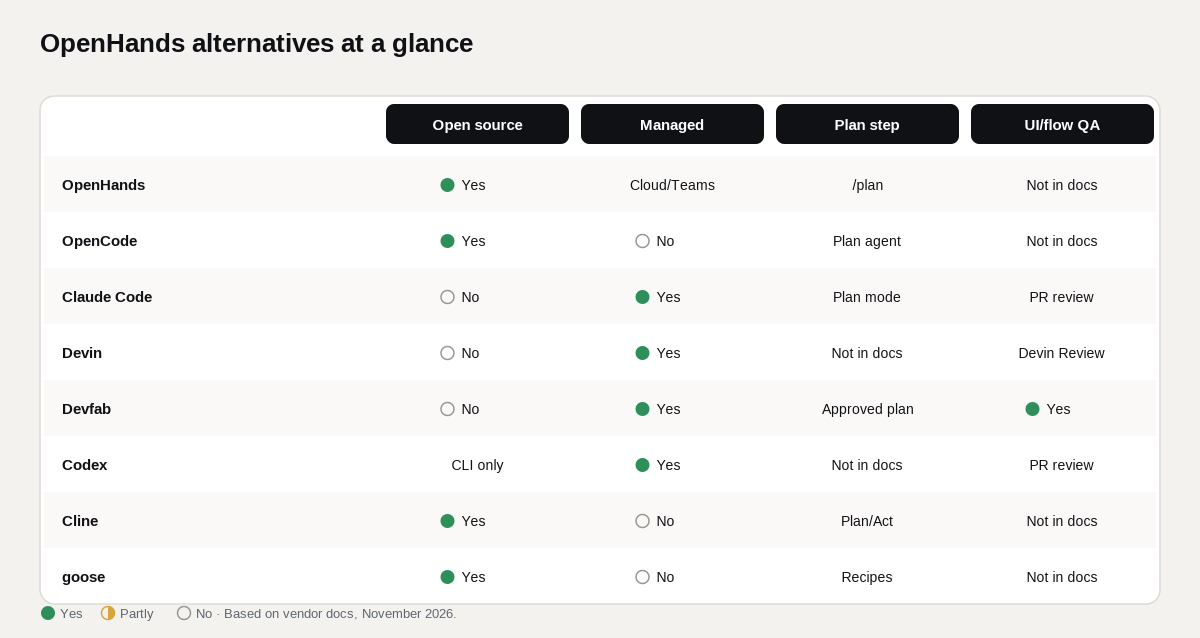
Quick comparison
| Tool | Type | Open source / self-host | Planning | Team controls | Pricing model |
|---|---|---|---|---|---|
| OpenHands (baseline) | Agent platform | MIT; self-host or VPC | /plan mode | RBAC, SSO on Teams | Free self-host; Teams flat fee plus seats |
| OpenCode | CLI and desktop agent | MIT; runs on your machine | Read-only plan agent | Workspaces with per-member budgets (Zen) | Free agent; optional model subscriptions |
| Claude Code | CLI, IDE and web agent | No; cloud sessions can run on self-hosted environments | Plan mode | SSO, managed settings, spend limits | Included in paid Claude plans |
| Devin | Managed cloud agent | No; dedicated VPC hosted by Cognition | Not covered here | SSO, RBAC, SCIM on Enterprise | Plans plus usage; team fee plus seats |
| Devfab | AI software factory | Deploy to your own server; code in your GitHub | Researcher, then Planner; a person approves | Roles, workspace permissions | Cost logged per task and per project (Beta) |
| OpenAI Codex | Agent in ChatGPT apps, CLI, cloud | CLI is Apache 2.0 | Not covered here | SSO, SCIM, RBAC, audit logs on Enterprise | Included in ChatGPT plans |
| Cline | IDE and CLI agent | Open source; VPC and self-host per FAQ | Plan and Act modes | SSO, RBAC on Enterprise | Free; pay for inference |
| goose | Desktop and CLI agent | Apache 2.0 | Recipes and subagents | Custom distributions | Free; pay your model provider |
The alternatives
1. OpenCode
Verdict: the closest open-source swap, with far less infrastructure to run. Best for: developers who want an MIT agent on their own machine with any model. Trade-off: a June 2026 review reports 1GB+ RAM use, releases that sometimes break features and immature enterprise compliance (Ry Walker). Pricing: the agent is free; OpenCode Go starts at USD 10 per month, as of November 2026 (OpenCode).
- Runs as a terminal UI, desktop app (beta) and mobile client, plus an SDK for CI.
- Built-in "build" and read-only "plan" agents, with parallel agents on one project.
- 200+ model providers via Models.dev, including local models.
- The repo moved from sst/opencode to anomalyco/opencode (GitHub).
2. Claude Code
Verdict: the strongest managed agent if your developers live in the terminal or IDE. Best for: engineering teams that want plan mode, PR review and org-level controls. Trade-off: Claude models only, and usage limits are shared across Claude apps. Pricing: included in paid Claude plans; Pro USD 20 per month, Team Standard USD 25 per user per month billed monthly, as of November 2026 (Claude pricing).
- Runs in the terminal, VS Code, JetBrains, a desktop app, the web and mobile (Claude Code docs).
- Plan mode proposes an approach for approval before editing.
- Managed Code Review posts ranked inline comments on GitHub PRs, but it never approves or blocks a PR (Code Review docs).
- Inference can run through Amazon Bedrock, Google Cloud or Microsoft Foundry (Claude Code docs).
3. Devin
Verdict: the hands-off option for teams that want to hand over tickets, not run agents. Best for: backlogs of scoped tickets from Linear or Jira, migrations and refactors. Trade-off: no fully customer-hosted option; Devin's "brain" always runs in Cognition's cloud (Devin docs). Pricing: Free; Pro USD 20 per month; Teams USD 80 per month plus USD 40 per dev seat; Enterprise custom, as of November 2026 (Devin pricing).
- Each session has its own shell, IDE and browser on an isolated machine.
- Subagents split long tasks, each opening its own PRs, with built-in Devin Review.
- Since June 2, 2026, the family includes Devin Desktop (formerly Windsurf).
4. Devfab
Verdict: the pick when your gap is not the agent but the lifecycle around it. Best for: agencies and product teams that ship apps to production and need a plan someone approves, QA and deploy in one place. Trade-off: in Beta, smaller community, fewer integrations, not an editor for hands-on coding, and needs a GitHub account. Not open source. Pricing: predictable cost; cost is logged after each run, per task and per project.
OpenHands gives you agents to assemble. Coding agents automate the developer. Devfab automates the development lifecycle. Its Researcher maps the domain, key terms, best practices and competitors before the Planner writes a plan, and a person approves the plan. On an existing repo, leave the change box empty and ChainFlow maps which functions and APIs call each other, then suggests three small first tickets. The QA agent runs UI and flow tests plus logic tests, and Deploy ships to your own server. You can choose the model for each agent or keep Devfab's default.
5. OpenAI Codex
Verdict: a solid choice if your company already pays for ChatGPT. Best for: teams that want one agent across the ChatGPT apps, a CLI, IDE, cloud and GitHub. Trade-off: OpenAI GPT models only; with an API key, cloud features like GitHub code review and Slack aren't available (Codex pricing). Pricing: included in ChatGPT plans; Business USD 25 per user per month billed monthly, as of November 2026 (same source).
- Cloud tasks keep running after you close your laptop (Codex).
- Automatic PR review, sandboxing, approvals and AGENTS.md are documented.
- The Codex CLI is open source under Apache 2.0 (GitHub).
6. Cline
Verdict: for developers who want to approve every single action. Best for: VS Code and JetBrains users who want Plan and Act modes with bring-your-own-key. Trade-off: in January 2026 OpenAI hired at least seven Cline employees, reported as a continuity challenge (Texxr). Pricing: free for individuals, with inference billed separately; Enterprise custom (Cline pricing).
- Every action requires your approval (Cline docs).
- Kanban runs many agents in parallel from a web task board.
- Enterprise adds SSO, RBAC, a team dashboard and authentication logs; the FAQ mentions VPC deployments and self-hosting.
7. goose
Verdict: the neutral, foundation-governed open-source agent. Best for: teams that want a general-purpose agent with portable workflows, not only coding. Trade-off: a September 2026 review notes no default sandbox per run and community-only support (PromptQuorum). Pricing: open source; you pay your model provider or run local models.
- Apache 2.0, with a desktop app, CLI and API, built in Rust (goose README).
- 15+ model providers and 70+ extensions via MCP.
- Workflows saved as YAML recipes that run in CI; can use Claude Code and Codex as providers via ACP (goose docs).
Where OpenHands is still the better choice
- Open source and full self-hosting are requirements, including your own VPC and your own model keys.
- You want to orchestrate several harnesses. OpenHands runs Claude Code and Codex via the Agent Client Protocol from one workspace.
- You run open-weight or local models such as Kimi, DeepSeek or Qwen, with LLM Profiles per task.
- Your platform team builds its own automations, such as issue-to-PR and PR review, on top of the platform.
- You want many Git hosts. Apps install from GitHub, GitLab, Bitbucket, Gitea or Forgejo URLs.
How to choose
- Must the agent be open source? OpenCode, Cline or goose. Stay on OpenHands if you also need a central platform.
- Do you want to stop running infrastructure? Claude Code, Codex or Devin.
- Do you hand over whole tickets? Devin.
- Is the bottleneck planning, QA and release, not coding? Devfab.
For a team building, say, a warehouse picking app for a client, the deciding question is usually the last one.
FAQ
What is the best open-source alternative to OpenHands?
OpenCode is the closest: an MIT-licensed agent with build and plan agents, parallel agents and 200+ model providers. goose (Apache 2.0, now under the Linux Foundation's Agentic AI Foundation) suits general agent work with recipes, and Cline (open source) suits developers who want to approve every action in the editor.
Is OpenHands still active in 2026?
Yes. OpenHands launched Agent Canvas on June 16, 2026 as its main interface, shipped monthly releases after that, and its repo now lives at OpenHands/OpenHands. Its homepage showed 93.8K GitHub stars on November 20, 2026.
How much does OpenHands cost compared to the alternatives?
As of November 2026, OpenHands is free to self-host, Teams is USD 500 per month for up to 10 users plus USD 50 per extra seat, and Enterprise is custom. Claude Code comes with paid Claude plans from USD 20 per month, and Devin Teams is USD 80 per month plus USD 40 per dev seat.
Which alternative runs inside my own VPC?
OpenHands itself runs in your VPC on Enterprise. Among the alternatives, Claude Code can run inference through Amazon Bedrock, Google Cloud or Microsoft Foundry, and Cline's FAQ mentions VPC deployments and self-hosting. Devin offers a single-tenant VPC hosted by Cognition, but its brain always runs in Cognition's cloud.
Read next
- Devfab vs OpenHands
- Claude Code vs OpenHands
- OpenHands vs Devin
- OpenHands vs OpenCode
- AI software factory vs AI coding tools
Stop assembling agents and run the whole lifecycle. Try Beta
Sources (checked November 2026): OpenHands homepage; OpenHands pricing; OpenHands GitHub; Introducing Agent Canvas (Jun 16, 2026); OpenHands in September (Oct 7, 2026); OpenCode; OpenCode on GitHub; Ry Walker: OpenCode research (Jun 2026); Claude Code overview; Claude Code enterprise deployment; Claude Code Code Review; Claude pricing; Devin pricing; Devin deployment overview; Devin Desktop FAQ; OpenAI Codex; Codex pricing; openai/codex on GitHub; The New Stack: Codex and ChatGPT desktop; Cline docs; Cline pricing; Texxr: OpenAI hires Cline employees; goose README; goose docs; goose moves to AAIF (Apr 7, 2026); PromptQuorum: goose review (Sep 12, 2026).
Frequently asked questions
What is the best open-source alternative to OpenHands?
OpenCode is the closest: an MIT-licensed agent with build and plan agents, parallel agents and 200+ model providers. goose (Apache 2.0, now under the Linux Foundation's Agentic AI Foundation) suits general agent work with recipes, and Cline (open source) suits developers who want to approve every action in the editor.
Is OpenHands still active in 2026?
Yes. OpenHands launched Agent Canvas on June 16, 2026 as its main interface, shipped monthly releases after that, and its repo now lives at OpenHands/OpenHands. Its homepage showed 93.8K GitHub stars on November 20, 2026.
How much does OpenHands cost compared to the alternatives?
As of November 2026, OpenHands is free to self-host, Teams is USD 500 per month for up to 10 users plus USD 50 per extra seat, and Enterprise is custom. Claude Code comes with paid Claude plans from USD 20 per month, and Devin Teams is USD 80 per month plus USD 40 per dev seat.
Which alternative runs inside my own VPC?
OpenHands itself runs in your VPC on Enterprise. Among the alternatives, Claude Code can run inference through Amazon Bedrock, Google Cloud or Microsoft Foundry, and Cline's FAQ mentions VPC deployments and self-hosting. Devin offers a single-tenant VPC hosted by Cognition, but its brain always runs in Cognition's cloud.