Short answer: Amp wins when a team wants agents that run unsupervised in cloud sandboxes, wake on CI failures, share sessions, and sit behind SSO and audit logs. OpenCode wins when a developer wants a free, MIT-licensed agent on their own machine that works with 200+ model providers, local models, or an existing ChatGPT or Copilot plan.
You already like agents in the terminal. Now finance wants one line item and security wants SSO. A developer on your team says the free open-source tool does the same job. Is the paid one worth it?
That is the Amp vs OpenCode argument in one paragraph. The answer turns on where agents run, who controls models, and what admin features you need. Facts below come from vendor pages and a dated review, checked in November 2026.
In this comparison:
- Amp and OpenCode at a glance
- Feature comparison
- Cost model by team size
- Where Amp wins
- Where OpenCode wins
Use the tables to settle it for your own team.
Amp and OpenCode at a glance
Amp split from Sourcegraph into its own company, announced on December 2, 2025 (Sourcegraph blog). You use it on the web, in desktop and mobile apps, or as a CLI (Amp manual). Its orbs are cloud sandboxes where agents keep working after you close your laptop (Amp). Amp added monthly subscriptions in beta on July 18, 2026 (Amp news).
OpenCode changed homes too. Its GitHub repository moved from sst/opencode to anomalyco/opencode, under Anomaly, the team behind SST (GitHub). It is MIT-licensed with about 225.7k stars. It runs as a terminal UI, a desktop app (marked beta), a mobile app and an SDK (OpenCode). In January 2026 it added Codex and ChatGPT login after Anthropic blocked third-party tools from using Claude subscription credentials (rywalker.com, Jun 2026). Kilo Code's VS Code extension is now built on the OpenCode server (Kilo blog).
In one line: Amp sells a managed agent platform. OpenCode gives you the agent and lets you bring the rest.
Feature comparison
| Aspect | Amp | OpenCode | Source |
|---|---|---|---|
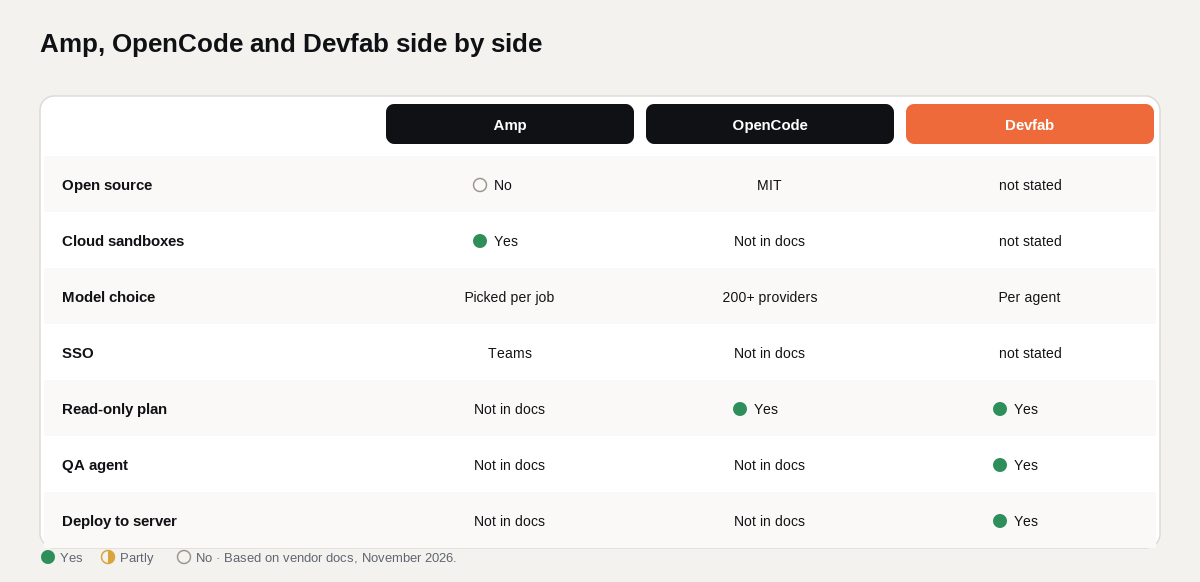
| Where it runs | Web, desktop and mobile apps, CLI, cloud orbs | Terminal UI, desktop app (beta), mobile app, SDK for scripts and CI | Amp manual; OpenCode |
| Planning | Not covered in the docs we checked | Built-in "plan" agent is read-only and asks before bash commands | GitHub |
| Unattended work | Orbs run unsupervised; Automations fire on schedules, Linear issues or failing CI | Multiple parallel agents on one project, on your machine | Amp; OpenCode |
| Collaboration | Multiplayer and Spaces share agents, code and the running app | Not covered in the docs we checked | Amp |
| Model choice | Amp picks models per job; OpenAI models on a linked ChatGPT plan | 200+ providers via Models.dev, local models, ChatGPT Plus/Pro or GitHub Copilot subscriptions | Amp manual; OpenCode |
| Extensibility | MCP, plugins, AGENTS.md | MCP, plugins, custom agents, skills, commands, permissions, undo/redo | Amp manual; OpenCode |
| Open source | Agent not described as open source; self-hosted orbs offered | MIT license | Amp pricing; GitHub |
| Team and admin | Teams: SSO, permissions, analytics; Enterprise: SCIM, audit logs, IP allowlisting | Zen workspaces: member invites, model enablement, per-member budgets | Amp pricing; OpenCode Zen |
| Deploy and hosting | Not covered in the docs we checked | Not covered in the docs we checked | — |
Cost model by team size
| Team size | Amp | OpenCode | Devfab |
|---|---|---|---|
| 1 person | Hobby free (your own key); Individual USD 20 per month | Agent free; free models, your own key or an existing subscription; OpenCode Go from USD 10 per month | Cost logged per task and per project (Beta) |
| 5 people | Teams workspace at no extra charge; pooled credits | Agent free per seat; optional Zen workspace with prepaid credits and per-member budgets | Cost logged per task and per project (Beta) |
| 25 people | Enterprise (custom) with SCIM, spend limits and audit logs | Same free agent; Zen pay-as-you-go with a per-purchase processing fee | Cost logged per task and per project (Beta) |
Prices as of November 2026 from Amp pricing and the OpenCode homepage; no separate OpenCode pricing page was opened. See OpenCode Zen docs for the credit model. Devfab is in Beta with predictable cost: cost is logged after each run, per task and per project.
Where Amp wins
- Agents keep working while you sleep. Orbs run in the cloud, and
amp syncbrings their changes back to your checkout. - Your pipeline can call the agent. Automations wake agents on failing CI or new Linear issues.
- People share one session. Multiplayer lets teammates drive the same agent and see the running app.
- Security wants SSO and audit logs. Teams has SAML/OIDC SSO; Enterprise adds SCIM, audit logs and IP allowlisting.
- You don't want to pick models. Amp chooses a model for each job.
Where OpenCode wins
- You want MIT-licensed code. You can read, fork and run the whole agent.
- You want the widest model choice. 200+ providers, local models, and existing ChatGPT or Copilot plans.
- You want zero agent cost. The agent is free; you pay only for models, or nothing with free models.
- You want a read-only planning mode. The plan agent denies edits by default and asks before bash commands.
- Your data rules are strict. Zen models are hosted in the US and EU, and most providers have zero retention, with listed exceptions.
A fair warning from a dated June 2026 review: OpenCode's TUI can use over 1GB of RAM, frequent releases sometimes break features, default permissions are permissive, and enterprise compliance features are immature (rywalker.com).
Switching from one to the other
There is no code to export; both work in your repository.
From Amp to OpenCode. OpenCode reads AGENTS.md as its main instruction file and falls back to CLAUDE.md (OpenCode rules), so Amp's project instructions carry over. Re-add MCP servers and set permissions, since defaults are permissive.
From OpenCode to Amp. Amp also reads AGENTS.md (Amp manual). Sign in, link a ChatGPT plan if you have one, and move long-running work to orbs.
Where Devfab fits
Take a B2B quote tool. Sales reps build quotes, managers approve discounts, and approved quotes turn into orders. Amp or OpenCode can write that code. In the docs we checked, neither researches how quoting works in your industry, asks a person to approve a whole project plan, runs a separate QA agent on user journeys, or deploys the result.
Coding agents automate the developer. Devfab automates the development lifecycle. The Researcher maps terms such as price books and discount approval before the Planner writes a plan, and a person approves it. ChainFlow maps which functions and APIs call each other, so a change to discount rules shows its impact on approvals, order creation and quote emails. The QA agent runs UI, flow and logic tests, and Deploy ships to your own server.
Devfab is in Beta, has a smaller community and fewer integrations, needs a GitHub account, and is not an editor or terminal tool for hands-on coding. Compare it in Devfab vs OpenCode and Devfab vs Amp.
FAQ
Is OpenCode free?
The agent is free and MIT-licensed. You can use free models, your own API keys, or existing ChatGPT Plus/Pro or GitHub Copilot subscriptions. Optional paid options are OpenCode Go, which starts at USD 10 per month as of November 2026, and Zen, a pay-as-you-go catalog of tested models.
Who makes OpenCode now?
OpenCode is built by Anomaly, the team behind SST. Its GitHub repository moved from sst/opencode to anomalyco/opencode, where it has about 225.7k stars and is still under the MIT license.
Can OpenCode run agents in the cloud like Amp's orbs?
OpenCode runs on your machine in a terminal UI, desktop app or mobile client, and its SDK works in scripts and CI. Hosted cloud sandboxes that keep working while your laptop is closed are not covered in the OpenCode pages we checked; that is a core Amp feature.
Which is better for a team that needs SSO?
Amp. Its Teams plan includes SAML/OIDC SSO, permissions and admin analytics, and Enterprise adds SCIM and audit logs. OpenCode's Zen workspaces offer member invites, model enablement and per-member budgets, and a June 2026 review called its enterprise compliance features immature.
Read next
- What is an AI software factory?
- OpenCode alternatives
- Amp alternatives
- Best open-source AI coding agents
Want research, an approved plan and QA around the code? Try Beta
Sources (checked November 2026): Amp; Amp manual; Amp pricing; Amp news: Subscriptions, at last (Jul 18, 2026); Sourcegraph blog: Why Sourcegraph and Amp are becoming independent companies; OpenCode; anomalyco/opencode on GitHub; OpenCode Zen docs; OpenCode rules docs; OpenCode research note (rywalker.com, Jun 2026); Kilo blog: The new Kilo Code for VS Code.
Frequently asked questions
Is OpenCode free?
The agent is free and MIT-licensed. You can use free models, your own API keys, or existing ChatGPT Plus/Pro or GitHub Copilot subscriptions. Optional paid options are OpenCode Go, which starts at USD 10 per month as of November 2026, and Zen, a pay-as-you-go catalog of tested models.
Who makes OpenCode now?
OpenCode is built by Anomaly, the team behind SST. Its GitHub repository moved from sst/opencode to anomalyco/opencode, where it has about 225.7k stars and is still under the MIT license.
Can OpenCode run agents in the cloud like Amp's orbs?
OpenCode runs on your machine in a terminal UI, desktop app or mobile client, and its SDK works in scripts and CI. Hosted cloud sandboxes that keep working while your laptop is closed are not covered in the OpenCode pages we checked; that is a core Amp feature.
Which is better for a team that needs SSO?
Amp. Its Teams plan includes SAML/OIDC SSO, permissions and admin analytics, and Enterprise adds SCIM and audit logs. OpenCode's Zen workspaces offer member invites, model enablement and per-member budgets, and a June 2026 review called its enterprise compliance features immature.