Short answer: Buy off-the-shelf SaaS when the process is standard (email, accounting, payroll, CRM basics) and a product fits most of your needs. Build custom software when the workflow is what sets you apart, when no product fits without workarounds, or when you must own the code, the data and where it runs.
You run operations for a company, a clinic or a city office. Every year the renewal quotes go up, and every year the team still runs half its process in spreadsheets around the tool. Building your own used to be a big, risky project. AI agents have changed the cost of starting, but not the cost of owning.
In this guide, you'll learn:
- Definitions
- Side by side
- When to choose off-the-shelf SaaS
- When to choose custom software
- Where an AI software factory fits
Each section answers one part of the buy-or-build question.
Definitions
Off-the-shelf software is a ready-made product sold to many customers. Today it is mostly SaaS: you rent access by seat, by usage or both, and the vendor runs it. You configure it, but you don't change its core.
Custom software is built for one organization's process. You own or control the code, the data model and the hosting. It may be built by your own developers, an agency, or now by AI agents. It can still use SaaS parts, such as a payment API or a login service.
There is a middle ground. Low-code and no-code platforms let you build your own apps on a vendor's platform. You get custom screens and logic, but the runtime, data layer and licensing stay with the vendor (see low-code vs AI software factory).
What changed in 2026
SaaS keeps getting more expensive. Zylo's annual report found that the average organization spends USD 55.7 million a year on SaaS, and that spending rose nearly 8% in 2025 while the number of apps stayed flat at about 305 (CFO Dive, Jan 29, 2026). Zylo said that "the number of applications organizations have has effectively flattened, yet spend continues to rise," and ranked pricing mechanics and AI feature charges above app sprawl as cost drivers. Slack's Business+ plan rose 20%, and Microsoft announced Microsoft 365 commercial price rises, citing expanded AI and security features (same source).
Vertice's SaaS Inflation Index put SaaS inflation at a record 16.4% in June 2026, easing to 12.7% in August and rising again to 14.3% in early September data (Vertice). Even the lowest point in the third quarter stayed above 12%.
Products change hands or close. This year, Bending Spoons bought Airtable and announced layoffs of much of its pre-acquisition team (Airtable newsroom). Google set Firebase Studio to shut down on March 22, 2027, after which remaining data "is permanently deleted" (Firebase docs). Google Jules stops on December 31, 2026 (Jules changelog).
Building got cheaper to start. AI agents can now research a domain, write a plan, generate code, test it and deploy it. That lowers the cost of a first working version. It does not remove the cost of owning software: hosting, security fixes, changes and support.
Side by side
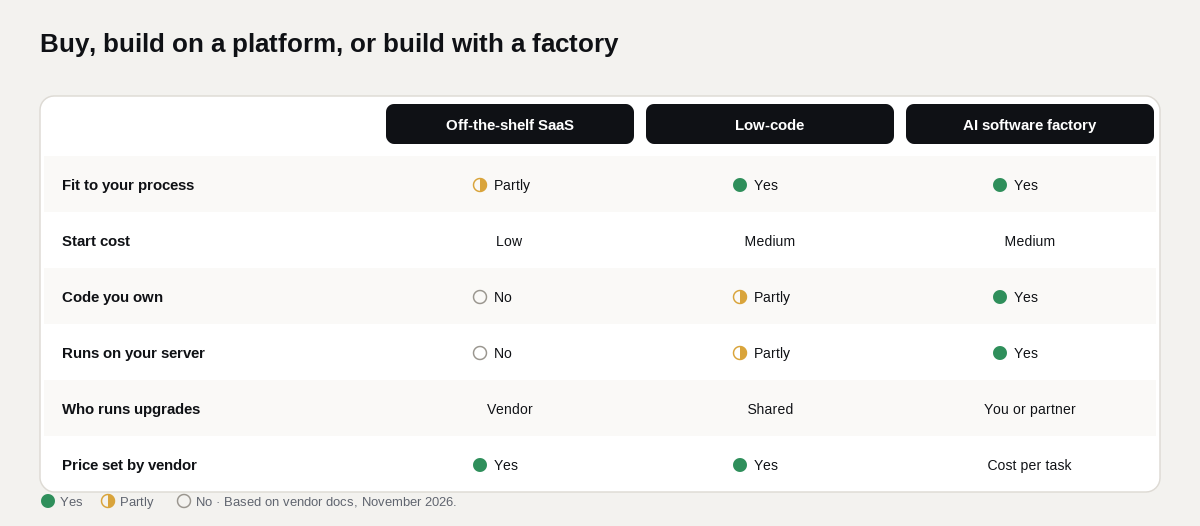
| Aspect | Off-the-shelf SaaS | Custom software |
|---|---|---|
| Fit to your process | You adapt to the product | Built around your process |
| Start cost | Low: sign up and configure | Higher: requirements, build, test |
| Ongoing cost | Recurring subscription; rises with seats and price changes | Hosting, maintenance and changes |
| Who controls the roadmap | The vendor | You |
| Data and code ownership | Vendor's platform; export depends on the product | Your repository and your servers |
| Vendor risk | Price rises, acquisitions, removed features, shutdowns | Depends on who built it and whether the code is documented |
| Upgrades and security | Vendor handles them | You or your partner handle them |
| Integration | Whatever the product's APIs allow | Built to the systems you have |
| Time to first use | Usually fast | Slower; AI agents shorten the path to a prototype |
When to choose off-the-shelf SaaS
- The process is standard. Email, accounting, payroll, HR records and basic CRM work the same way in most organizations. Buying is almost always right.
- A product fits most of what you need without a pile of spreadsheets and workarounds around it.
- Compliance is the product's job. Many SaaS vendors carry certifications, audits and data-residency options that would be costly to match yourself.
- You have no one to own an app. If nobody will look after hosting, updates and user questions, rent from someone who will.
- You need it running now and can live with the product's way of working.
When to choose custom software
- The workflow is your edge. A logistics firm's dispatch rules, an agency's quoting method, a council's permit process: if a product forces you to change it, you lose what makes you different.
- You're paying for seats to work around the tool. If staff keep parallel spreadsheets, the product doesn't fit.
- Per-user prices don't match your audience. Large groups of occasional users, such as residents, parents or field staff, make per-seat SaaS costly.
- You must own data, code and hosting. Public bodies and regulated firms often need apps on their own servers.
- You need to connect systems no product connects, such as a legacy database and a modern portal.
The honest cost of custom: someone must maintain it. Ask before you build who will fix it, who will change it and where it will run. If you're replacing spreadsheets, our guide on replacing spreadsheets with a custom app walks through the first steps.
Where an AI software factory fits
An AI software factory sits between hiring a development team and buying a product. Agents run the lifecycle, and the output is custom code you own.
Coding agents automate the developer. Devfab automates the development lifecycle. Here is how that maps to the custom-software risks above:
- Unclear requirements. Devfab's Researcher maps the domain before the Planner writes a plan: key terms, best practices and competing products. For a clinic booking app, that means terms like slots and no-shows, practices like reminder messages, and a look at existing booking products. Then it suggests a prototype, so you can see the app before you commit.
- Control over scope. A person approves the plan before the Coordinator creates tickets.
- Breaking what already works. ChainFlow maps which functions and APIs call each other and what is deployed, so a change shows its impact on connected features before it ships.
- Quality. The QA agent runs UI and flow tests, clicking screens, buttons and user journeys end to end, plus logic tests.
- Ownership. Code lives in your own GitHub account or your organization's, and Deploy ships to your own server.
- Cost. Predictable cost: cost is logged after each run, per task and per project.
Devfab is new and in Beta, with a smaller community and fewer integrations than mature platforms. It needs a GitHub account, and it is not an editor for hands-on coding. For standard functions, buying SaaS is still the better call. For a structured way to decide on internal apps, see build vs buy for internal tools.
FAQ
What is the difference between custom software and off-the-shelf software?
Off-the-shelf software is a ready-made product sold to many customers, usually as a SaaS subscription you rent. Custom software is built for one organization's own process, and the organization owns or controls the code, the data model and where it runs.
Is custom software always more expensive than SaaS?
Not over its whole life. SaaS has a low start cost but a recurring bill that grows with users and price rises; Vertice measured SaaS inflation at between about 12% and 16% from June to September 2026. Custom software costs more to start and to maintain, but you control both.
How has AI changed the build vs buy decision?
AI agents now research, plan, write, test and deploy code, so a custom app can reach a working prototype with less upfront effort. At the same time, SaaS vendors are adding AI features and charging for them, which raises the cost of buying.
Can I combine custom software and SaaS?
Yes, and most organizations do. Buy SaaS for standard functions like email, accounting and payroll, and build custom apps for the workflows that set you apart or that no product fits, connected to your SaaS tools through their APIs.
What are the risks of relying on a SaaS product?
Price rises at renewal, changes of ownership, features you need being removed, and shutdowns. In 2026, Google set Firebase Studio to shut down on March 22, 2027, with remaining data permanently deleted, and Jules to close on December 31, 2026.
Read next
Have a process no product fits? See it as a working prototype first. Try Beta
Sources (checked November 2026): CFO Dive: Enterprise software bills climb amid AI pricing volatility (Jan 29, 2026); Vertice: SaaS inflation rate (updated Oct 2026); Airtable newsroom: Back to bases (Oct 12, 2026); Firebase Studio sunset and project migration; Jules changelog.
Frequently asked questions
What is the difference between custom software and off-the-shelf software?
Off-the-shelf software is a ready-made product sold to many customers, usually as a SaaS subscription you rent. Custom software is built for one organization's own process, and the organization owns or controls the code, the data model and where it runs.
Is custom software always more expensive than SaaS?
Not over its whole life. SaaS has a low start cost but a recurring bill that grows with users and price rises; Vertice measured SaaS inflation at between about 12% and 16% from June to September 2026. Custom software costs more to start and to maintain, but you control both.
How has AI changed the build vs buy decision?
AI agents now research, plan, write, test and deploy code, so a custom app can reach a working prototype with less upfront effort. At the same time, SaaS vendors are adding AI features and charging for them, which raises the cost of buying.
Can I combine custom software and SaaS?
Yes, and most organizations do. Buy SaaS for standard functions like email, accounting and payroll, and build custom apps for the workflows that set you apart or that no product fits, connected to your SaaS tools through their APIs.
What are the risks of relying on a SaaS product?
Price rises at renewal, changes of ownership, features you need being removed, and shutdowns. In 2026, Google set Firebase Studio to shut down on March 22, 2027, with remaining data permanently deleted, and Jules to close on December 31, 2026.