Short answer: Choose RPA when the work is repetitive and rule-based, the systems are stable, and you cannot change them or reach an API. Choose custom software when the process itself is the problem, when screens change often, when exceptions are common, or when you want the data and logic in a system you own.
Your finance team copies invoice data from a supplier portal into the ERP every morning. A vendor offers a bot that does it for them. An engineer says the real fix is an integration, or a new app. Both are right, about different things.
RPA automates the person at the screen. Custom software changes what is behind the screen. Picking wrong means paying to maintain bots that keep breaking, or paying to rebuild a system that only needed a bot.
In this guide, you'll learn:
- Definitions
- RPA and custom software side by side
- When to choose RPA
- When to choose custom software
- Where an AI software factory fits
Use the decision table near the end if you only have a minute.
Definitions
Robotic process automation (RPA). IBM defines RPA as "a form of business process automation technology that uses software robots to automate tasks performed by humans" (IBM). SAP puts it more plainly: software "that automates repetitive, rule-based tasks" (SAP). The key point is where it works. RPA "operates at the user interface level" and does not change the underlying systems (SAP). Bots log in, enter data and copy it between applications, mimicking "the way humans interact with software" (TechTarget).
Bots come in two kinds. Unattended bots run on their own, on a schedule or trigger. Attended bots work alongside people, who start the workflow (SAP).
Custom software. An application built for one organization's process, with its own data model, business rules, screens and APIs. Instead of a robot reading the old screen, the new system holds the data and the logic. It can replace the old screen, or connect systems directly through their APIs.
A simple test: RPA leaves the process as it is and does the clicking for you. Custom software changes the process and removes the clicking.
RPA and custom software side by side
| Aspect | RPA | Custom software |
|---|---|---|
| Where it works | The user interface of existing apps | The data, logic and APIs of a new or rebuilt system |
| Changes to existing systems | None; works at the presentation layer | Replaces or extends them |
| Best input | Structured, rule-based steps | Any process you can specify |
| Exceptions | Missing data and rule violations often need a person | Can be designed into the app's rules and screens |
| When screens change | Bots can break and need fixing | The app owns its screens |
| Starting cost | Low: a bot license plus setup | Higher: design, build and test |
| Ongoing cost | Licenses per user or bot, plus bot maintenance | Hosting and maintenance of the code |
| Ownership | Bots live in the RPA vendor's platform | Code and data you own |
| Security | Bots hold credentials and can reach sensitive data | Access defined in the app's own roles |
Sources for the RPA column: SAP, IBM and TechTarget.
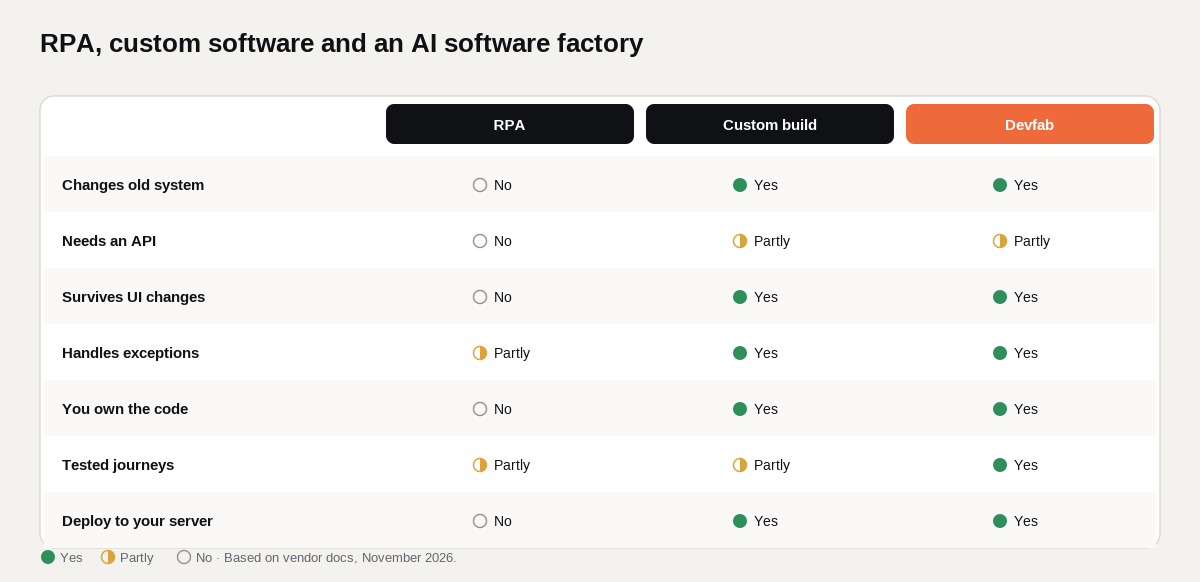
What RPA costs, as of November 2026
RPA is sold by user and by bot. Two list prices from official pages:
- Microsoft Power Automate: Premium, which includes attended desktop flows (RPA), is USD 15 per user per month paid yearly. Process, for unattended RPA, is USD 150 per bot per month paid yearly. Hosted Process, which adds a Microsoft-hosted virtual machine, is USD 215 per bot per month paid yearly. A bot "can execute one unattended desktop flow run at a time," so parallel runs need more bots (Power Automate pricing).
- UiPath: a free Community plan; Basic "starting at" USD 25 per month with 2 robots; Standard and Enterprise through sales. The page notes that users and robots "may require additional license purchases" (UiPath pricing).
The license is rarely the big number. The cost to plan for is upkeep, which is the next section.
Where bots break
The weak spots are well documented:
- Screen changes. "Bots can break when application interfaces or process workflows change" (TechTarget). SAP calls maintenance "demanding" for the same reason.
- Too many decisions. TechTarget cites a "rule of five": bots tend to break when they must make more than five decisions.
- Exceptions. Missing data, rule violations and system errors often need a person (SAP).
- Scale. IBM says 52% of customers struggle to scale their RPA programs (IBM).
- Efficiency. TechTarget notes that screen automation "might not be as efficient as automating applications through APIs."
- Security. Bots can reach sensitive data and, if compromised, "pose an additional security risk" (TechTarget).
When to choose RPA
- The system cannot change and has no API. IBM notes bots work at the presentation layer, so they fit where "you don't have an application programming interface."
- The task is high-volume, stable and rule-based. Copying fields between two screens that rarely change is RPA's best case.
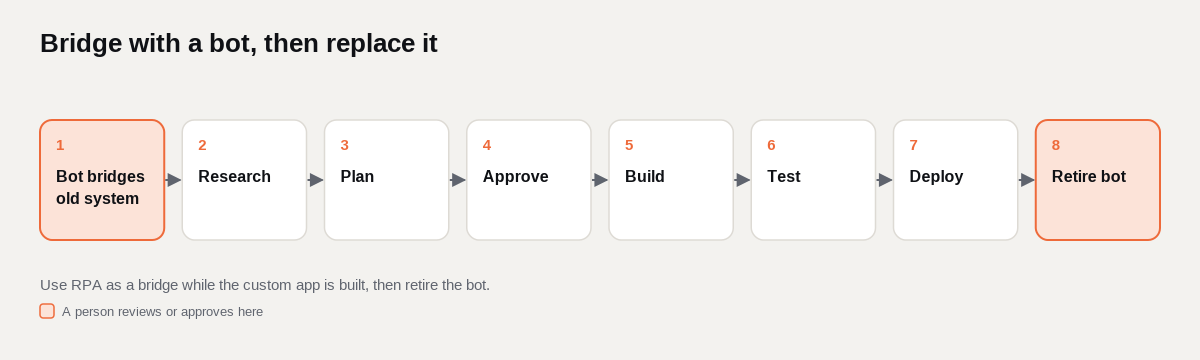
- You need a bridge, not a destination. A bot can move data out of an old system while its replacement is being built.
- You need results this quarter with no developers. Attended bots let staff automate their own repetitive steps.
- You already pay for it. If your Microsoft agreement covers Power Automate Premium, attended RPA is already in the bill.
When to choose custom software
- The process is the problem, not the typing. If staff work around the system, a bot automates the workaround. A new app fixes it.
- Screens change often. Every change to a vendor portal can break a bot. Your own app changes only when you change it.
- Exceptions are the norm. When half the cases need judgment, build the rules and the review screens into an app.
- You want to own the data and logic. Custom code in your own repository, on your own server, does not depend on a bot platform's license.
- Many bots touch the same systems. At some point, maintaining a web of bots costs more than building the integration once.
- Security reviews flag bot credentials. An app with its own roles and APIs avoids bots holding shared logins.
A middle path
It is not always one or the other. TechTarget notes that legacy systems may need front-end integration when back-end access is not available, so RPA fills gaps that direct integration cannot. A common plan: use a bot as a bridge, build the custom app or API integration, then retire the bot.
Low-code workflow tools sit in between too; see low-code vs an AI software factory.
Where an AI software factory fits
The classic case for RPA was cost: bots were cheap, custom builds were slow and expensive. AI agents change the building side of that trade.
Coding agents automate the developer. Devfab automates the development lifecycle. You describe the process, for example "supplier invoices arrive by email and portal; match them to purchase orders; route mismatches to a clerk." Before any plan, Devfab's Researcher maps the domain: terms such as three-way match and tolerance rules, best practices, and similar products. Then it suggests a prototype. A person approves the plan. Developer agents build it, and ChainFlow maps which functions and APIs call each other, so a change to matching rules shows its impact on approvals, payments and supplier notices.
The QA agent runs UI and flow tests, clicking screens, buttons and journeys end to end, plus logic tests such as "an invoice over tolerance never auto-approves." The code lives in your own GitHub account, and Deploy ships to your own server. Cost is logged after each run, per task and per project.
Devfab is in Beta. It has a smaller community and fewer integrations than mature platforms, needs a GitHub account, and is not an RPA tool: it does not drive other vendors' screens. If you cannot change the old system and it has no API, a bot may still be the right answer.
FAQ
What is the main difference between RPA and custom software?
RPA uses software robots that work through an application's user interface the way a person would, without changing the systems underneath. Custom software changes the system itself: it is a new or rebuilt application, with its own data model and APIs, designed around the process.
Is RPA cheaper than custom software?
Usually at the start. As of November 2026, Microsoft lists Power Automate Premium with attended RPA at USD 15 per user per month and unattended bots at USD 150 per bot per month, both paid yearly. But bots need upkeep whenever screens change, and that cost grows with the number of bots.
When does RPA break?
When the screens or steps it relies on change. SAP notes that maintenance can be demanding because bots rely on user interface elements, and TechTarget writes that bots can break when application interfaces or process workflows change. Exceptions such as missing data usually need a person.
Can AI agents replace RPA?
For some work. AI coding agents can now build the custom app or the API integration that removes the need for a bot. RPA still fits when you cannot change the old system and it has no API, because bots work at the presentation layer.
Should we use RPA on a legacy system we plan to replace?
Often yes, as a bridge. A bot can move data out of an old system with no API while the replacement is built. Plan to retire the bot when the new system goes live, so you do not maintain both.
Read next
- What is an AI software factory?
- Custom software vs off-the-shelf SaaS
- Build vs buy for internal tools
- How to modernize a legacy system
Ready to replace the bot with the system? Try Beta
Sources (checked November 2026): IBM: What is robotic process automation (RPA)?; SAP: What is robotic process automation (RPA)?; TechTarget: robotic process automation (RPA), Feb 12, 2024; Microsoft Power Automate pricing; UiPath pricing.
Frequently asked questions
What is the main difference between RPA and custom software?
RPA uses software robots that work through an application's user interface the way a person would, without changing the systems underneath. Custom software changes the system itself: it is a new or rebuilt application, with its own data model and APIs, designed around the process.
Is RPA cheaper than custom software?
Usually at the start. As of November 2026, Microsoft lists Power Automate Premium with attended RPA at USD 15 per user per month and unattended bots at USD 150 per bot per month, both paid yearly. But bots need upkeep whenever screens change, and that cost grows with the number of bots.
When does RPA break?
When the screens or steps it relies on change. SAP notes that maintenance can be demanding because bots rely on user interface elements, and TechTarget writes that bots can break when application interfaces or process workflows change. Exceptions such as missing data usually need a person.
Can AI agents replace RPA?
For some work. AI coding agents can now build the custom app or the API integration that removes the need for a bot. RPA still fits when you cannot change the old system and it has no API, because bots work at the presentation layer.
Should we use RPA on a legacy system we plan to replace?
Often yes, as a bridge. A bot can move data out of an old system with no API while the replacement is built. Plan to retire the bot when the new system goes live, so you do not maintain both.