Short answer: Choose a SaaS AI coding tool when speed of rollout, new features and low operations work matter more than where code travels. Choose a self-hosted AI coding assistant when contracts or regulators say source code can't leave your network, and you have people to run models and upgrades. Many teams end up with a hybrid.
You run engineering at a medical device maker. The security review form for any new AI tool has one question at the top: where does our source code go?
The developers want the newest agent on the market. Compliance wants an answer it can sign. Both are doing their jobs. This page explains the real options between "all SaaS" and "all on our hardware", with vendor facts checked on November 23, 2026.
In this guide, you'll learn:
- Definitions
- SaaS vs self-hosted at a glance
- When to choose SaaS
- When to choose self-hosted
- Where an AI software factory fits
Two status changes first, because they shape the self-hosted shortlist. Tabnine, the best-known private assistant, was acquired by Tricentis on July 30, 2026, and the announcement does not say whether the standalone assistant will continue (Tricentis). Continue, a popular open-source assistant often run with local models, was acquired by Cursor and discontinued (continue.dev).
Definitions
SaaS AI coding tool. The vendor runs the agent, the model calls and usually the sandbox where code executes. You install a client or open a web app. GitHub Copilot's cloud agent, for example, works "in a cloud development environment, rather than your local IDE," in a GitHub Actions-based environment (GitHub Docs).
Self-hosted AI coding tool. The server, the execution environment and often the model run on infrastructure you control. Tabby calls itself "an open-source and on-premises alternative to GitHub Copilot" and says it is "self-contained, with no need for a DBMS or cloud service" (Tabby on GitHub).
Hybrid. Something in the middle, and the most common enterprise answer in 2026. Three patterns show up:
- Your cloud account for the model. Claude Code can route inference through Amazon Bedrock, Google Cloud's Agent Platform or Microsoft Foundry, through LLM gateways and corporate proxies, and cloud sessions can run on self-hosted environments (Claude Code enterprise deployment).
- Your machines for execution. Cursor's "Self-Hosted Machines" let cloud-agent tool execution run on hardware you manage (Cursor Docs).
- A single-tenant vendor VPC. Devin offers a Customer Dedicated Deployment in a VPC hosted by Cognition, connected by AWS PrivateLink or IPSec. Its docs are clear that there is no fully customer-hosted option: Devin's "brain" always runs in Cognition's cloud (Devin enterprise deployment).
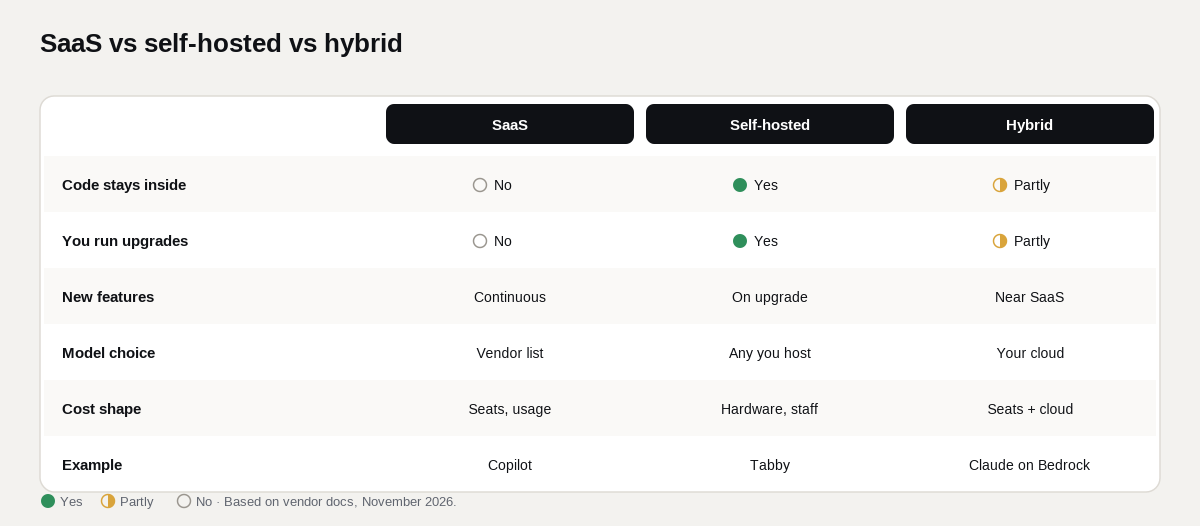
SaaS vs self-hosted at a glance
| Aspect | SaaS | Self-hosted | Hybrid |
|---|---|---|---|
| Where code goes | Vendor cloud and model provider | Stays in your network | Model traffic or execution stays in your accounts |
| Setup and upgrades | Vendor's job | Your job (servers, GPUs, patches) | Shared |
| New features | Arrive continuously | Arrive when you upgrade; some tools move slowly | Usually close to SaaS |
| Model choice | Vendor's catalog | Any open-weight model you can run | Your cloud's catalog |
| Cost shape | Seats, credits or usage | Hardware, API keys and staff time | Seats plus your cloud bill |
| Compliance story | Vendor attestations and retention terms | You own the evidence | Split between both |
| Examples (Nov 2026) | GitHub Copilot, Cursor, Devin | Tabby, OpenHands self-hosted, Aider with local models, Tabnine air-gapped | Claude Code on Bedrock, Cursor Self-Hosted Machines, Devin VPC |
Sources: GitHub Docs; Tabby; OpenHands pricing; Aider docs; Tabnine review, Jun 2026; Claude Code enterprise deployment; Cursor Docs; Devin enterprise deployment.
When to choose SaaS
- You want the newest agent features without running them. Copilot's agent control plane went GA on February 26, 2026, with agent activity in audit logs, and you got it without an upgrade project (GitHub changelog).
- Your repos already live in a vendor's cloud. Copilot's cloud agent "only works with repositories hosted on GitHub," which is a non-issue if that is where your code sits.
- The vendor's retention terms satisfy your reviewers. Factory's Business plan lists Zero Data Retention with SSO and audit logs (Factory pricing); Cursor's Privacy Mode can be enforced org-wide (Cursor enterprise docs).
- You don't have GPU or platform staff. Self-hosting moves model serving, patching and capacity planning onto your team.
- Cost should follow use. Seats and credits scale up and down; a GPU cluster does not.
When to choose self-hosted
- Code must not leave the building. Tabnine lists SaaS, VPC, on-premises and fully air-gapped deployment (Tabnine review, Jun 2026). Factory's Enterprise plan adds on-prem deployment and data residency, and its docs cover air-gapped setups and self-hosted GitHub Enterprise Server or GitLab (Factory docs).
- You want to read and change the code. OpenHands is MIT-licensed and free to self-host with your own keys; it runs on local Docker, remote VMs, Kubernetes or an enterprise VPC (OpenHands; Agent Canvas).
- You want open-weight models on your own GPUs. OpenHands supports open-weight models run locally or in a VPC. Aider works with Ollama, LM Studio and any OpenAI-compatible API (Aider docs). Tabby supports consumer-grade GPUs.
- Code review must run inside, too. Qodo offers single-tenant SaaS or on-prem and air-gapped deployment, zero data retention and SOC 2 Type II (Qodo pricing).
Self-hosting has a maintenance cost that marketing pages skip. Aider's latest PyPI release is still 0.86.2 from February 2026, and a review flags a solo-maintainer bus-factor risk (PyPI; CodeMySpec). The newest Tabby release named in its README is v0.30 from July 2025 (Tabby). And after Tricentis bought Tabnine, analysts flagged roadmap risk for the air-gapped assistant (BERI). Ask every self-hosted vendor who patches it next year.
How to decide in practice
- Classify the code. Not all repos need the same rule. A marketing site and a device firmware repo can sit under different policies.
- Write down what may leave. Prompts, code snippets, telemetry, embeddings. A tool can be "self-hosted" and still send prompts to a model API.
- Pick the lightest option that passes review. Often that is SaaS with zero retention, or a hybrid with your own model account.
- Price the full stack. Include GPUs or API spend, staff time for upgrades, and the cost of falling behind on features.
- Check status before you sign. 2026 saw acquisitions and shutdowns across this market. Prefer tools with a clear owner and release history.
Where an AI software factory fits
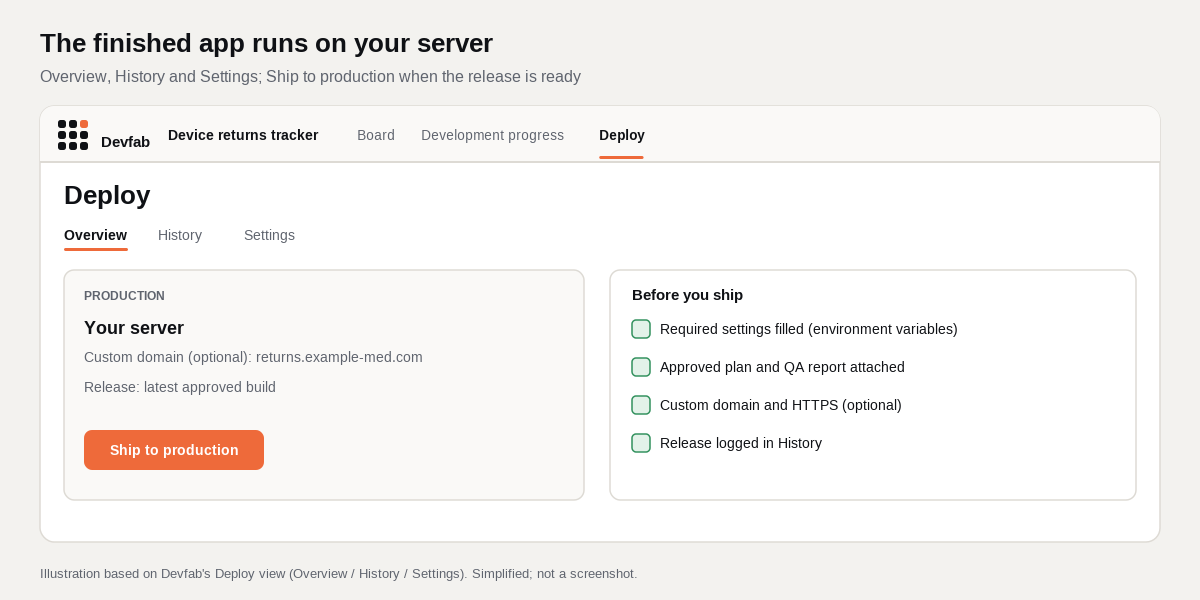
Most of this debate is about one developer's assistant: where its prompts go and who runs its server. An AI software factory raises a second question: where does the finished app run, and who owns its code?
Coding agents automate the developer. Devfab automates the development lifecycle. Its agents research the domain, write a plan a person approves, split it into tickets, build, run QA and deploy. The output lands where a compliance team can see it: code in your own GitHub account (or your organization's) and an app deployed to your own server. ChainFlow maps which functions and APIs call each other and what is deployed, so a change to, say, a device-return workflow shows its impact on serial tracking, notifications and audit logs before agents touch it. You can choose the model for each agent or keep Devfab's default. Cost is logged after each run, per task and per project.
Honest limits: Devfab is in Beta, and a self-hosted or air-gapped edition of Devfab itself is not stated. It has a smaller community and fewer integrations than mature tools, is not an editor for hands-on coding, and needs a GitHub account. If your rule is that no code may reach any outside service, a self-hosted assistant is the better fit today.
FAQ
What is a self-hosted AI coding assistant?
It is a coding assistant or agent whose server, and often its model, runs on infrastructure you control: your data center, your cloud account or an air-gapped network. Examples include Tabby, which says it needs no database or cloud service, OpenHands, which is MIT-licensed and free to self-host, and Tabnine's on-premises and air-gapped options.
Is self-hosting an AI coding tool cheaper than SaaS?
Not by default. Open-source tools like OpenHands and Aider charge nothing for the software, but you pay for GPUs or model API usage, plus the people who install, patch and upgrade the stack. SaaS bundles those costs into a seat or usage price. Compare total cost, not license price.
Does running a model through my own cloud account count as self-hosted?
Partly. Claude Code can route inference through Amazon Bedrock, Google Cloud or Microsoft Foundry and through LLM gateways, which keeps model traffic inside cloud agreements you control. You still use Anthropic's tool and models. Devin's single-tenant VPC is hosted by Cognition, and its docs say Devin's brain always runs in Cognition's cloud.
Which AI coding tools can run fully air-gapped?
In the pages we checked: Tabnine lists fully air-gapped deployment, Factory's docs cover air-gapped deployment on Enterprise, and Qodo offers on-prem or air-gapped deployment for code review. Aider and OpenHands can use local models. Check each vendor's current terms, since Tabnine was acquired by Tricentis in July 2026.
Read next
- What is an AI software factory?
- AI software factory vs AI coding tools
- Tabnine alternatives
- Best open-source AI coding agents
- Cloud IDE vs local IDE for AI coding
Want the code and the running app on your side of the line? Try Beta
Sources (checked November 2026): Tricentis acquires Tabnine (Jul 30, 2026); DEV: Tabnine review (Jun 2026); BERI: Tricentis and Tabnine roadmap risk (Aug 2026); continue.dev; TabbyML/tabby on GitHub; OpenHands; OpenHands pricing; OpenHands: Introducing Agent Canvas (Jun 16, 2026); Factory pricing; Factory docs index; Devin Docs: enterprise deployment; Claude Code: enterprise deployment; GitHub Docs: Copilot cloud agent; GitHub changelog: agent control plane GA (Feb 26, 2026); Cursor Docs: Cloud Agents; Cursor Docs: Enterprise; Aider docs; aider-chat on PyPI; CodeMySpec: Aider review (Jul 2026); Qodo pricing.
Frequently asked questions
What is a self-hosted AI coding assistant?
It is a coding assistant or agent whose server, and often its model, runs on infrastructure you control: your data center, your cloud account or an air-gapped network. Examples include Tabby, which says it needs no database or cloud service, OpenHands, which is MIT-licensed and free to self-host, and Tabnine's on-premises and air-gapped options.
Is self-hosting an AI coding tool cheaper than SaaS?
Not by default. Open-source tools like OpenHands and Aider charge nothing for the software, but you pay for GPUs or model API usage, plus the people who install, patch and upgrade the stack. SaaS bundles those costs into a seat or usage price. Compare total cost, not license price.
Does running a model through my own cloud account count as self-hosted?
Partly. Claude Code can route inference through Amazon Bedrock, Google Cloud or Microsoft Foundry and through LLM gateways, which keeps model traffic inside cloud agreements you control. You still use Anthropic's tool and models. Devin's single-tenant VPC is hosted by Cognition, and its docs say Devin's brain always runs in Cognition's cloud.
Which AI coding tools can run fully air-gapped?
In the pages we checked: Tabnine lists fully air-gapped deployment, Factory's docs cover air-gapped deployment on Enterprise, and Qodo offers on-prem or air-gapped deployment for code review. Aider and OpenHands can use local models. Check each vendor's current terms, since Tabnine was acquired by Tricentis in July 2026.