Short answer: Appian wins when a large, regulated organization needs auditable processes, case management, RPA and governed AI agents on one platform with a vendor SLA. Devfab wins when you want a custom app built as normal code in your own GitHub, researched and planned with your approval, tested by a QA agent and deployed to your own server.
Your organization runs dozens of workflows on Appian. It works. Then a department asks for something that doesn't look like a workflow: a citizen-facing portal, a client app, a tool with its own design. Someone asks whether it should live on the platform at all.
Platform teams say keep everything governed in one place. Product teams say a custom app should be a codebase you own. This page weighs both sides fairly, using Appian's own pages checked in November 2026.
In this comparison:
- What each tool is built for
- Switching triggers
- Cost model by team size
- Where Appian is the better choice
- Where Devfab is the better choice
Read them in order, or jump to your deciding question.
What each tool is built for
Appian
Appian is an enterprise low-code platform for process automation, case management and data fabric, now with AI agents. It is active: release 26.6 notes and Q3 2026 highlights are on its What's New page (Appian What's New).
- Plans: Standard, Advanced and Premium, "priced per user, per month, per app." Standard has low-code development, one data source and 5 RPA bots; Advanced adds Process HQ and Case Management Studio; Premium removes row limits (Appian pricing).
- AI agents: Agent Studio added multi-agent communication and an audit view of the exact steps an agent took in release 26.3 (Q1 2026 highlights). In July 2026 Appian added parallel tool calls, connections to systems like GitHub and Snowflake, and bulk agent evaluations (Q2 2026 highlights).
- Composer: turns legacy requirements or user stories into a visual application plan and then an implementation. It is listed as a preview feature (Appian What's New).
- Governance: customers can connect their own Azure OpenAI accounts, route through a custom LLM gateway, disable model families per environment, and screen prompts with AI Guardrails (Q2 2026 highlights).
- Deployment: AI capabilities can run fully self-managed on air-gapped infrastructure, and the cloud SLA is listed as 99.8 to 99.99% (Appian What's New; Appian pricing).
- Outside agents: the Appian MCP Server exposes data fabric, process models and expression rules as tools for external agents (Q2 2026 highlights).
Appian's main user is an enterprise team that wants processes and agents governed on one platform.
Devfab
Devfab is an AI software factory in the Autonomous Software Lifecycle category. Its output is not a platform app. It is a normal codebase in your own GitHub account (or your organization's), deployed to your own server.
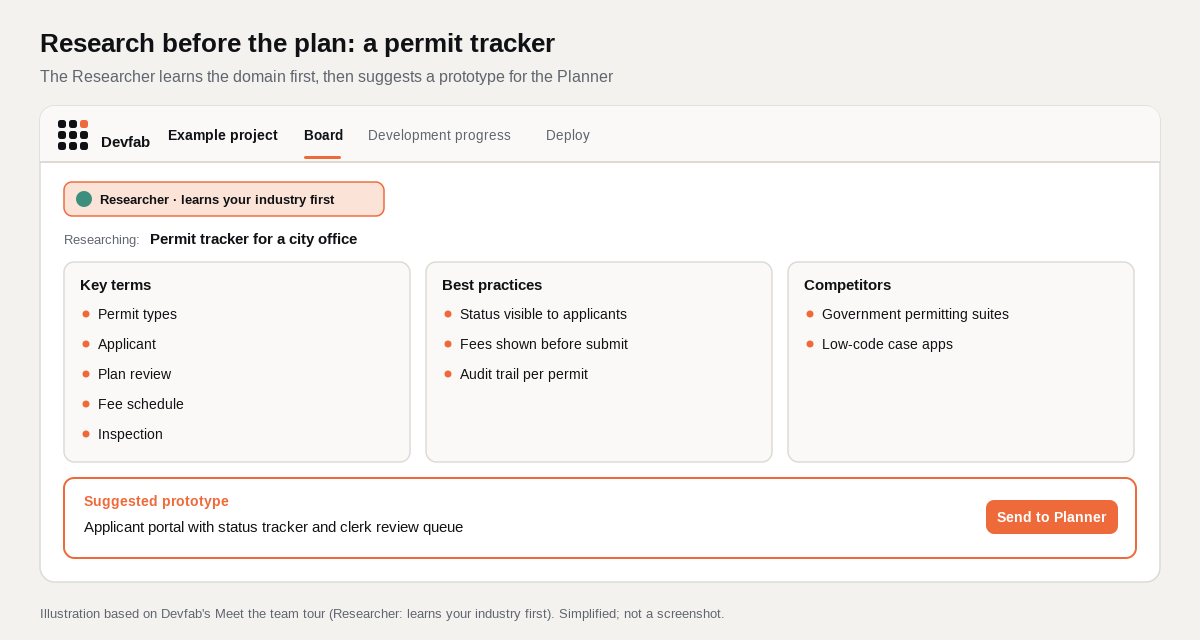
- The Researcher maps the domain before any plan: key terms, best practices for that kind of app, and competitors. Then it suggests a prototype.
- The Planner publishes the plan, and a person approves it. The Coordinator splits it into tickets for dev agents.
- Developers work with ChainFlow, which maps which functions and APIs call each other and what is deployed, so a change to one feature doesn't break the ones tied to it.
- The QA agent runs UI and flow tests (screens, buttons and user journeys clicked end to end) plus logic tests. Deploy ships to your own server.
Coding agents automate the developer. Devfab automates the development lifecycle. A low-code platform like Appian hosts your processes; Devfab delivers the software itself, as code you keep.
Switching triggers
| Trigger | Appian | Devfab | Source |
|---|---|---|---|
| License cost grows with users and apps | Priced per user, per month, per app; a review cites high per-user pricing for smaller businesses | No platform license; predictable cost, logged per task and per project (Beta) | Appian pricing; Blaze review, Feb 2026 |
| AI features locked to higher tiers | AI Agents, Composer, DocCenter and AI Skills are not on Standard | Researcher, Planner, QA agent and Deploy are part of the Devfab team | Appian pricing |
| Steep learning curve for new builders | A review cites a steep learning curve and a dated-looking interface | Describe the app in plain words; a person approves the plan | Blaze review |
| Coding still needed at the edges | A review says coding is sometimes still needed for fixes and integrations | Output is code, so edges are handled in the same codebase | Blaze review |
| App should be code the client owns | Apps run on the Appian platform | Code in your own GitHub; deploy to your own server | Appian pricing |
| Requirements-to-app planning must be production-ready | Composer is a preview feature | Plan approval is a standard step | Appian What's New |
Appian is not "missing" anything here. These are the points where some teams decide a custom codebase fits better.
Cost model by team size
| Team size | Appian | Devfab |
|---|---|---|
| 1 person | Free Community Edition instance to learn and try | Cost logged per task and per project (Beta) |
| 5 people | Standard, Advanced or Premium, priced per user, per month, per app; AI Actions quota of 200K, 500K or 1M per month by plan | Cost logged per task and per project (Beta) |
| 25 people | Same model, rising with users and apps; contact sales | Cost logged per task and per project (Beta) |
Appian's pricing page shows no dollar amounts as of November 2026; check it or ask Appian sales for a quote. Devfab: predictable cost, with cost logged after each run, per task and per project. Devfab is in Beta.
Moving from Appian to Devfab
Appian apps run on Appian. The pages we checked don't describe exporting an Appian app as standalone source code, so treat a move as a rebuild of one app, not a migration of the platform.
- Pick one app to move. Start with one that is outgrowing "internal," such as a permit tracker the public will use.
- Write down what it does. List record types, process steps, rules, user roles and integrations from the Appian designer. This becomes your spec.
- In Devfab, choose "Start a new project." Describe the app, attach the spec, and choose Human in the loop mode.
- Review the research. The Researcher maps permit terms, best practices and similar products, then suggests a prototype.
- Approve the plan. The Coordinator creates tickets only after a person approves.
- Let the QA agent test it. It runs UI, flow and logic tests: an applicant files, a clerk reviews, a fee is due, a notice goes out.
- Deploy to your own server, then run both apps side by side until users and data have moved.
If your team already keeps code for other apps in GitHub, use "Work on an existing project" instead. Leave the change box empty, and ChainFlow maps the code and suggests three small first tickets.
Where Appian is the better choice
- You need governed, long-running processes, case management and RPA bots on one platform with audit trails.
- You want AI agents inside your processes, with guardrails, bulk evaluations and per-environment model controls.
- You require self-managed or air-gapped AI and a vendor SLA with enterprise support.
- You have many internal apps and a platform team trained on Appian already.
- You need document AI, such as DocCenter's compliance-check agents added in release 26.6 (Appian What's New).
Where Devfab is the better choice
- You want research before the plan. The Researcher maps the domain, best practices and competitors before anyone writes a ticket.
- You want the app as code you own, in your GitHub account or your client's, with no platform license per user.
- Changes must not break connected features. ChainFlow shows which functions, APIs and deployed parts a change touches.
- You need proof of testing. The QA agent clicks through screens and user journeys and runs logic tests.
- The app must run on your own server, with docs such as blueprints and user manuals.
- You want cost you can trace. Cost is logged after each run, per task and per project.
Devfab's honest limits: it is new and in Beta, with a smaller community and far fewer integrations than a mature platform like Appian. It has no RPA, case-management suite or vendor SLA of the kind Appian lists. It is not an editor for hands-on coding, and it needs a GitHub account.
FAQ
Is Devfab a low-code platform like Appian?
No. Appian is a low-code platform where apps, processes and AI agents run on Appian. Devfab is a software factory: its agents research, plan, build, test and deploy a normal codebase that lives in your own GitHub account and runs on your own server.
How much does Appian cost compared with Devfab?
Appian's pricing page shows no dollar amounts as of November 2026. It prices per user, per month, per app across Standard, Advanced and Premium plans with AI Action quotas, and offers a free Community Edition. Devfab gives predictable cost: cost is logged after each run, per task and per project, and Devfab is in Beta.
Appian has Composer for planning apps. How is Devfab's planning different?
Appian's Composer turns requirements or user stories into a visual application plan and then an implementation, and it is listed as a preview feature. Devfab's Researcher first maps the domain, key terms, best practices and competitors, then the Planner writes a plan that a person approves before tickets are created.
Can Devfab replace Appian for regulated case management?
Usually not as a direct swap. Appian offers case management, RPA, agent guardrails, self-managed and air-gapped AI, and a cloud SLA on one governed platform. Devfab fits when you want a custom app with its own code, tests and deployment rather than a platform license.
Read next
- What is an AI software factory?
- Appian alternatives for teams that ship to production (2026)
- Low-code vs AI software factory: what's the difference?
- Best low-code platforms for enterprises (2026)
See Devfab plan, test and deploy one of your apps. Book a Devfab demo
Sources (checked November 2026): Appian pricing; Appian What's New; Appian Q1 2026 release highlights; Appian Q2 2026 product highlights; Blaze: Appian reviews (competitor, updated Feb 19, 2026).
Frequently asked questions
Is Devfab a low-code platform like Appian?
No. Appian is a low-code platform where apps, processes and AI agents run on Appian. Devfab is a software factory: its agents research, plan, build, test and deploy a normal codebase that lives in your own GitHub account and runs on your own server.
How much does Appian cost compared with Devfab?
Appian's pricing page shows no dollar amounts as of November 2026. It prices per user, per month, per app across Standard, Advanced and Premium plans with AI Action quotas, and offers a free Community Edition. Devfab gives predictable cost: cost is logged after each run, per task and per project, and Devfab is in Beta.
Appian has Composer for planning apps. How is Devfab's planning different?
Appian's Composer turns requirements or user stories into a visual application plan and then an implementation, and it is listed as a preview feature. Devfab's Researcher first maps the domain, key terms, best practices and competitors, then the Planner writes a plan that a person approves before tickets are created.
Can Devfab replace Appian for regulated case management?
Usually not as a direct swap. Appian offers case management, RPA, agent guardrails, self-managed and air-gapped AI, and a cloud SLA on one governed platform. Devfab fits when you want a custom app with its own code, tests and deployment rather than a platform license.