Short answer: DronaHQ wins when an enterprise needs governed internal apps and AI agents on company data, with offline mobile, approvals and tracing on one self-hostable platform. Devfab wins when an agency or IT team must ship a client product as a codebase it owns, with research, an approved plan, UI and flow tests and deployment to its own server.
A furniture retailer runs two warehouses and a busy returns desk. Pickers need a phone app that works where Wi-Fi drops. Customers need a returns portal where they book a pickup, upload photos and track a refund.
The IT director hears "DronaHQ can do both." The agency hears "we should own the portal code." Each side has a point. One app lives inside the company and changes with operations. The other is a product the public uses, and the retailer may want it outside any platform. This page lays out which tool fits which job, with DronaHQ facts taken from its own pages in November 2026.
In this comparison:
- What each tool is built for
- Switching triggers
- Cost model by team size
- Where DronaHQ is the better choice
- Where Devfab is the better choice
The sections below follow that split.
What each tool is built for
DronaHQ
Status, November 2026: active. DronaHQ now positions itself as a platform for internal apps and AI agents; its homepage was last modified on November 18, 2026 (DronaHQ).
- Who it's for. Ops leads, staff engineers, product managers and internal tools developers, from startups to enterprises in BFSI, retail, manufacturing and healthcare (DronaHQ).
- Many ways to build. Prompts, a visual builder, JavaScript, or AI coding tools such as Claude Code and Cursor through the DronaHQ MCP (DronaHQ).
- AI agents. Sub-agents, retrieval over documents, guardrails, tracing and human approval for sensitive steps. Agents work over chat, voice, WhatsApp, email or a headless API, with models from several providers, and agent pricing is usage-based (DronaHQ).
- AI app building. Prompt-based app generation. A "Vibe code SWE Agent" is in beta, with access on request (DronaHQ).
- Web and mobile from one build. Offline mobile access is on Enterprise (DronaHQ pricing).
- Where it runs. Cloud, a dedicated cloud with data residency, or self-hosted in your own cloud or data center (DronaHQ).
- Security. SOC 2 Type II, ISO 27001, SSO/SAML, RBAC, a secrets vault, audit trails and environments. HIPAA is via the self-hosted version, and Git source control is self-hosted only (DronaHQ; DronaHQ pricing).
Devfab
Devfab is an AI software factory. Its category is the Autonomous Software Lifecycle. Coding agents automate the developer. Devfab automates the development lifecycle.
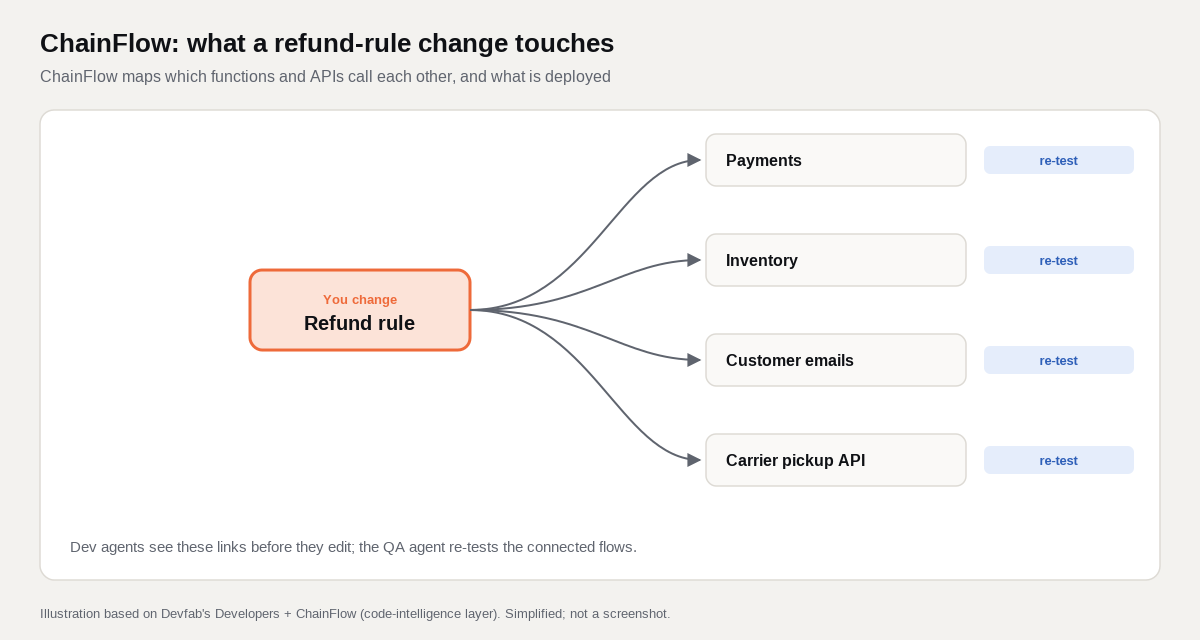
Seven agents carry a project: Researcher, Planner, Coordinator, Developers, Blueprint, QA agent and Deploy. For the returns portal, the Researcher first maps return reasons, refund rules, carrier pickups and how other retailers run returns, then suggests a prototype. The Planner writes the plan and a person approves it. Developers work with ChainFlow, which maps which functions and APIs call each other, so a change to refund rules shows its impact on payments, stock levels and customer emails before code changes. The QA agent runs UI and flow tests plus logic tests. Deploy ships to your own server, and the repository sits in your own GitHub account.
Switching triggers
| Trigger | DronaHQ | Devfab | Source |
|---|---|---|---|
| No permanent free plan | One-month Business trial, then paid | Beta | DronaHQ pricing |
| SSO on the entry plan | Starter has Sign in with Google only; SAML/OpenID SSO starts at Business | Not stated | DronaHQ pricing |
| Audit logs and granular permissions | Enterprise only | Roles and workspace permissions | DronaHQ pricing |
| Git source control | Self-hosted version only | Code in your GitHub from the first commit | DronaHQ pricing |
| Billing clarity | Pricing page does not clearly label which user-based prices are monthly vs annual | Cost logged per task and per project | DronaHQ pricing |
| AI coding agent maturity | "Vibe code SWE Agent" is in beta, access on request | Seven-agent lifecycle (also Beta) | DronaHQ |
| Usage metering | Task quotas, pay-as-you-go tasks at USD 0.002 per task, AI credits USD 10 per 5,000 | Cost logged after each run | DronaHQ pricing |
Cost model by team size
| Team size | DronaHQ | Devfab |
|---|---|---|
| 1 person | Cloud Starter USD 140 per month (USD 100 per month billed annually), with task quotas | Cost logged per task and per project (Beta) |
| 5 people | Cloud Business USD 700 per month (USD 500 per month billed annually), or user-based plans (labels unclear on the page) | Cost logged per task and per project (Beta) |
| 25 people | Self-hosted Business USD 1,500 per month billed annually, or Enterprise (custom) for audit logs and offline mobile | Cost logged per task and per project (Beta) |
DronaHQ prices as of November 2026 from DronaHQ pricing. Cloud plans include 300 AI credits. Plans are priced per month with task quotas, not only per seat, so your cost depends on how many automated tasks run. Devfab gives no price: cost is predictable and logged after each run.
Moving from DronaHQ to Devfab
There is no direct import. A DronaHQ app is platform configuration, not a repository, so the move is a rebuild that uses the live app as the spec.
- Write down what the DronaHQ app does: screens, data sources, roles and the automations it runs. Screenshots help. If you run the self-hosted version with Git source control, keep that history as reference.
- In Devfab, choose Start a new project and describe the app. Attach the screenshots and any spec. Pick Human in the loop so you review each stage.
- The Researcher maps the domain and suggests a prototype. Check it against how your team works today.
- Approve the plan. The Coordinator splits it into tickets and dev agents build in your GitHub repository.
- The QA agent runs UI, flow and logic tests. Deploy ships to your own server.
Later changes go through Work on an existing project: leave the change box empty and ChainFlow maps the code and suggests three small first tickets.
Where DronaHQ is the better choice
- You need AI agents with governance. Approvals for sensitive steps, guardrails, tracing and channels such as WhatsApp and voice are part of the platform.
- Field staff work offline. One build serves web and mobile, and offline mobile access is available on Enterprise. That suits warehouse pickers and field teams.
- Compliance must stay in-house. HIPAA via self-hosting, data residency in a dedicated cloud, SOC 2 Type II and ISO 27001.
- Many internal apps, one platform. Ops and IT build and govern dozens of tools on shared data with environments and a secrets vault.
- Developers already use AI coding tools. The MCP lets them build DronaHQ apps from Claude Code or Cursor.
Where Devfab is the better choice
- The app is a product, not a tool. Customer-facing portals benefit from Devfab's research step before the plan: domain terms, best practices and competitors, then a suggested prototype.
- The client wants to own it. Code in the client's own GitHub, deployment to its own server, and no platform subscription for the app to keep running.
- Journeys must be proven. The QA agent clicks screens, buttons and full user journeys end to end, plus logic tests, so a refund flow is checked as a customer would use it.
- Change without collateral damage. ChainFlow shows dev agents what each change touches, from checkout to payments, inventory, order confirmation and notifications.
- Clear hand-off. A person approves the plan; Devfab produces blueprints, sequence flows and user manuals; cost is logged per task and per project.
Honest limits. Devfab is in Beta, with a smaller community and fewer integrations than DronaHQ. It is not a visual builder for business users or an editor for hands-on coding, and it does not offer DronaHQ-style conversational agents for WhatsApp or voice. It needs a GitHub account.
FAQ
What is DronaHQ used for?
DronaHQ is an enterprise low-code platform for building internal web and mobile apps and AI agents on company data. It runs in the cloud, in a dedicated cloud with data residency, or self-hosted. Users include ops leads, internal tools developers and product managers.
Does DronaHQ have an AI coding agent?
DronaHQ offers prompt-based app generation, and its 'Vibe code SWE Agent' is in beta with access on request. Developers can also build with Claude Code or Cursor through the DronaHQ MCP. Its separate AI agents product handles chat, voice, WhatsApp and email workflows with guardrails and tracing.
Is DronaHQ cheaper than building a custom app?
It depends on how long the app lives on the platform. As of November 2026, DronaHQ Cloud Starter is USD 140 per month and Cloud Business USD 700 per month, ongoing. Devfab is in Beta with predictable cost logged per task and per project, and the finished code runs on your own server.
Can I keep my code if I leave DronaHQ?
The pages we checked do not describe a code export. They state that Git source control is available only on the self-hosted version. Devfab writes all code to your own GitHub account or your organization's from the start.
Read next
- What is an AI software factory?
- DronaHQ alternatives
- DronaHQ vs Retool
- Low-code vs an AI software factory
- Devfab vs UI Bakery
Keep internal tools on the platform. Give the customer product its own codebase. Try Beta
Sources (checked November 2026): DronaHQ homepage; DronaHQ pricing.
Frequently asked questions
What is DronaHQ used for?
DronaHQ is an enterprise low-code platform for building internal web and mobile apps and AI agents on company data. It runs in the cloud, in a dedicated cloud with data residency, or self-hosted. Users include ops leads, internal tools developers and product managers.
Does DronaHQ have an AI coding agent?
DronaHQ offers prompt-based app generation, and its 'Vibe code SWE Agent' is in beta with access on request. Developers can also build with Claude Code or Cursor through the DronaHQ MCP. Its separate AI agents product handles chat, voice, WhatsApp and email workflows with guardrails and tracing.
Is DronaHQ cheaper than building a custom app?
It depends on how long the app lives on the platform. As of November 2026, DronaHQ Cloud Starter is USD 140 per month and Cloud Business USD 700 per month, ongoing. Devfab is in Beta with predictable cost logged per task and per project, and the finished code runs on your own server.
Can I keep my code if I leave DronaHQ?
The pages we checked do not describe a code export. They state that Git source control is available only on the self-hosted version. Devfab writes all code to your own GitHub account or your organization's from the start.