Short answer: Knack wins when a business wants a database app or customer portal it can edit itself, with unlimited users on one flat plan and no code to maintain. Devfab wins when an agency must hand a client tested code in the client's GitHub, deployed to the client's server, after research and a plan the client approves.
A food distributor wants a vendor onboarding portal. Suppliers log in, upload certificates, and buyers approve them. You could build it on Knack in a few sessions. Then the client's IT lead asks the question that ends many no-code proposals: "Where does the code live when your contract ends?"
That question decides more than the build. It decides who pays for the platform, who can change the app and what you can prove about quality. This page compares both options using Knack's own pages, checked in November 2026.
In this comparison:
- What each tool is built for
- Switching triggers
- Cost model by team size
- Where Knack is the better choice
- Where Devfab is the better choice
Here is how the two compare, section by section.
What each tool is built for
Knack
Status, November 2026: active and adding AI. Knack's homepage announces a Knack MCP Server and "Knack Next-Gen" as just launched, without dates (Knack).
Knack is a no-code platform for online databases, customer and vendor portals and internal tools. Its stated audiences are business leaders and founders, operations teams, technical teams offloading internal apps, and agencies delivering white-labeled apps (Knack).
What it gives you:
- An AI app builder. Describe the app and Knack builds a first version, then you edit with AI. It is included on all plans (Knack pricing).
- A relational database with one-to-many and many-to-many links, custom fields and validation (Knack).
- Branded portals with secure login, Stripe and PayPal payments, user roles, permissions and SSO (Knack).
- No per-seat pricing. Every plan allows unlimited app users (Knack pricing).
- AI in workflows. Knack Flows connects to OpenAI, Perplexity, Anthropic Claude and Google Gemini, with monthly AI credits per plan (Knack pricing).
- Compliance claims. The homepage cites HIPAA, GDPR and SOC 2 Type II; HIPAA and GovCloud-based options are Enterprise or contact-sales (Knack; Knack pricing).
Devfab
Devfab is an AI software factory, in the category we call the Autonomous Software Lifecycle. Seven agents run a project: Researcher, Planner, Coordinator, Developers, Blueprint, QA agent and Deploy.
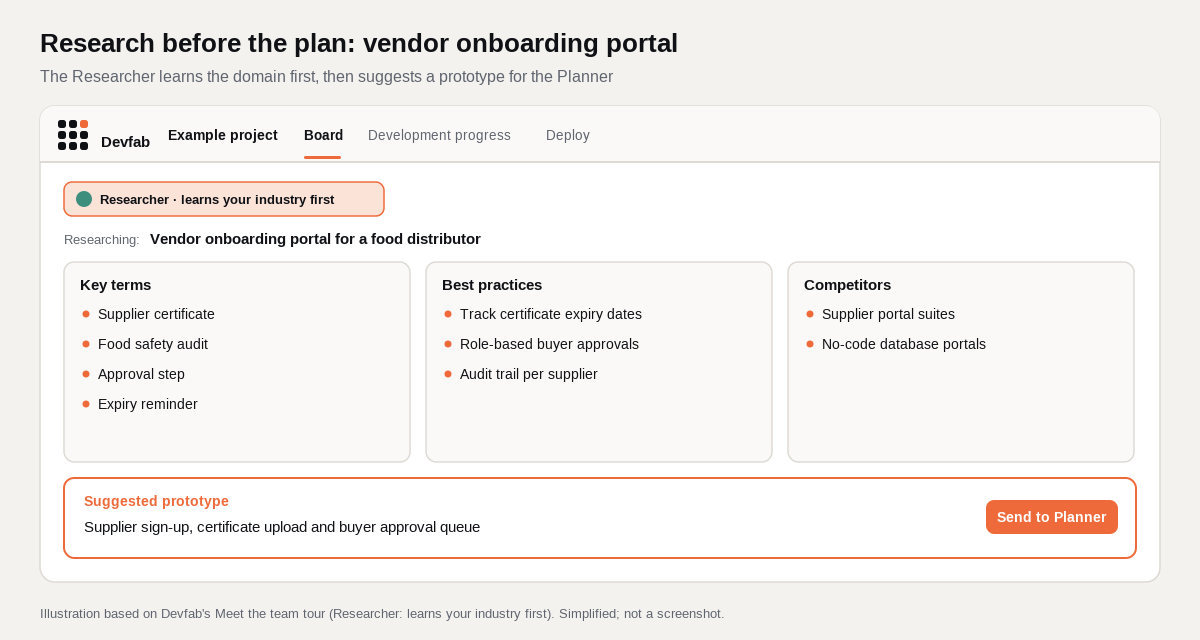
For the vendor portal, the Researcher maps the domain first: terms like supplier certificates, food safety audits and approval steps, best practices for supplier portals, and competing products. Then it suggests a prototype. The Planner writes a plan, and a person approves it before the Coordinator creates tickets. ChainFlow maps which functions and APIs call each other and what is deployed, so changing the approval step doesn't break buyer notifications or certificate expiry reminders. The QA agent runs UI and flow tests (screens, buttons and user journeys clicked end to end) plus logic tests. Deploy ships to your own server.
App builders automate the first version. Devfab automates the development lifecycle.
Switching triggers
| Trigger | Knack | Devfab | Source |
|---|---|---|---|
| Client wants the code | The app runs on Knack; code export is not covered in the pages we checked | Code lives in your GitHub account or your organization's | Knack |
| Record growth | Starter caps 20,000 records and 3 apps; Pro caps 50,000 records | Your own database on your own server | Knack pricing |
| AI budget per month | Starter includes 25 AI credits, Pro 50 | Cost logged per task and per project (Beta) | Knack pricing |
| API-heavy integrations | Starter allows 1,000 API calls a day | APIs are part of the codebase you own | Knack pricing |
| Regulated data | HIPAA and GovCloud options sit on Enterprise or contact-sales plans | Deploy to the client's own server | Knack pricing |
| Proof of testing for the client | Not covered in the pages we checked | QA agent runs UI, flow and logic tests | Knack |
Cost model by team size
| Team size | Knack | Devfab |
|---|---|---|
| 1 person | Starter USD 59 per month (USD 49 per month billed annually), unlimited app users | Cost logged per task and per project (Beta) |
| 5 people | Pro USD 130 per month (USD 110 per month billed annually); price does not change with users | Cost logged per task and per project (Beta) |
| 25 people | Pro, or Corporate from USD 300 per month (from USD 250 billed annually), usage-dependent; Enterprise custom | Cost logged per task and per project (Beta) |
Prices as of November 2026 from Knack pricing. Knack plans scale by records, storage, apps, AI credits, Flows transactions and API calls, not by user count, and new customers get a lower price for the first three months. There is a 14-day free trial with no credit card. Devfab is in Beta and offers predictable cost: cost is logged after each run, per task and per project.
Moving from Knack to Devfab
A Knack app is not a Git repository, so the move is a rebuild from a clear spec.
- Write down what the app does today. List tables and their links, roles, Flows and the pages each role uses. Take screenshots.
- Export the data through Knack's API, which every plan includes within its daily call limit (Knack pricing).
- In Devfab, choose "Start a new project". Describe the app under "What should we build?" and attach the spec and screenshots.
- Review the Researcher's output and the suggested prototype.
- Approve the plan. The Coordinator creates tickets only after a person approves.
- Turn on "QA agent · review before Done" so tickets get UI, flow and logic tests, then deploy to the client's server.
Once the code sits in GitHub, later changes use "Work on an existing project". Leave the change box empty, and ChainFlow maps the code and suggests three small first tickets.
Where Knack is the better choice
- The client wants to edit the app itself. Non-technical owners can keep changing fields, pages and roles without touching code.
- Many users, one price. Unlimited app users on every plan suits a portal with hundreds of suppliers or members.
- Many similar client apps. Agencies can run white-labeled apps without maintaining a codebase for each.
- Payments and logins out of the box. Stripe, PayPal, roles and SSO are built in.
- A quick, low-risk trial. A 14-day free trial with no credit card lets a client try the idea first.
Where Devfab is the better choice
- Research before the plan. The Researcher learns the client's domain, so the plan starts with the right terms and rules.
- A plan the client can approve. A person approves the plan before any tickets exist, which gives the client a clear sign-off point.
- Changes that don't break connected features. ChainFlow shows the impact of a change across functions, APIs and deployed code.
- Proof of testing. The QA agent clicks through screens and journeys and runs logic tests.
- Handover without lock-in. Code in the client's GitHub, deployed to the client's server, with blueprints, sequence flows and user manuals.
- Cost per project. Cost is logged after each run, per task and per project, so you can see what each client build used.
Devfab's honest limits: it is new and in Beta, with a smaller community and fewer integrations than Knack's catalog. It is not a drag-and-drop editor for staff, and it is not an editor for hands-on coding. It needs a GitHub account.
FAQ
Can an agency resell Knack apps to clients?
Yes. Knack names agencies delivering white-labeled apps as one of its audiences, and every plan allows unlimited app users. The app and its data stay on Knack, so the client keeps paying for a Knack plan. If the client wants its own code and server, Devfab fits better.
Does Knack's AI app builder write code I can export?
Not in the pages we checked. Knack's AI app builder creates a first version of a Knack app from a chat prompt, and you keep editing it inside Knack. Code export is not covered on Knack's homepage or pricing page.
What are Knack's limits on the entry plan?
As of November 2026, Starter caps an account at 20,000 records, 2 GB of storage, 3 apps, 25 AI credits and 1,000 API calls a day. Pro raises records to 50,000 and AI credits to 50. Corporate and Enterprise go higher.
Is Devfab a no-code tool like Knack?
No. Devfab is an AI software factory. Its agents research, plan, build, test and deploy a normal codebase in your GitHub account. A person approves the plan. Staff don't drag and drop screens; they describe the change, and the agents carry it through.
Read next
Handing a client app over as code? Book a Devfab demo
Sources (checked November 2026): Knack homepage; Knack pricing.
Frequently asked questions
Can an agency resell Knack apps to clients?
Yes. Knack names agencies delivering white-labeled apps as one of its audiences, and every plan allows unlimited app users. The app and its data stay on Knack, so the client keeps paying for a Knack plan. If the client wants its own code and server, Devfab fits better.
Does Knack's AI app builder write code I can export?
Not in the pages we checked. Knack's AI app builder creates a first version of a Knack app from a chat prompt, and you keep editing it inside Knack. Code export is not covered on Knack's homepage or pricing page.
What are Knack's limits on the entry plan?
As of November 2026, Starter caps an account at 20,000 records, 2 GB of storage, 3 apps, 25 AI credits and 1,000 API calls a day. Pro raises records to 50,000 and AI credits to 50. Corporate and Enterprise go higher.
Is Devfab a no-code tool like Knack?
No. Devfab is an AI software factory. Its agents research, plan, build, test and deploy a normal codebase in your GitHub account. A person approves the plan. Staff don't drag and drop screens; they describe the change, and the agents carry it through.