Short answer: For regulated data apps with unlimited users, pick Caspio. For teams that think in spreadsheets, Airtable. For client portals, the new Softr or Noloco, and for operations apps on a flat platform price, Quickbase. Pick Devfab when the app must become code you own, tested and deployed to your own server.
Your Knack app worked. Then the volunteer list grew, a second program wanted its own copy, and the plan page started to matter more than the app.
That's the usual story. Knack's entry plan caps records, apps and API calls, compliance options sit on separate plans, and the app lives on Knack's platform. None of that is a flaw. It just sets a ceiling. This list compares six ways past it, with prices checked on official pages in November 2026.
In this guide, you'll learn:
- Why teams leave Knack
- Quick comparison
- The alternatives
- Where Knack is still the better choice
- How to choose
Pick the section that matches your ceiling.
Why teams leave Knack
Knack is active. Its homepage announces a Knack MCP Server and "Knack Next-Gen" as just launched, without dates (Knack). It builds online databases, customer and vendor portals and internal tools, with an AI app builder on all plans. These are the triggers we see in its own documents:
- Record and app caps. Starter allows 20,000 records, 2 GB, 3 apps, 25 AI credits and 1,000 API calls a day. Pro raises records to 50,000 and AI credits to 50 (Knack pricing).
- Price steps with usage. Plans are priced by records, storage, apps, AI credits, Flows transactions and API calls. Corporate starts at USD 300 per month and is "usage-dependent," as of November 2026 (same source).
- Compliance on separate plans. HIPAA and GovCloud-based options are Enterprise or contact-sales, and the pricing page points HIPAA to a separate "Knack Health" plan (same source).
- Unclear integration count. The homepage gives both 700+ and 500+ integrations (Knack).
- Code ownership. Exporting an app as a codebase is not covered in the pages we checked.
Quick comparison
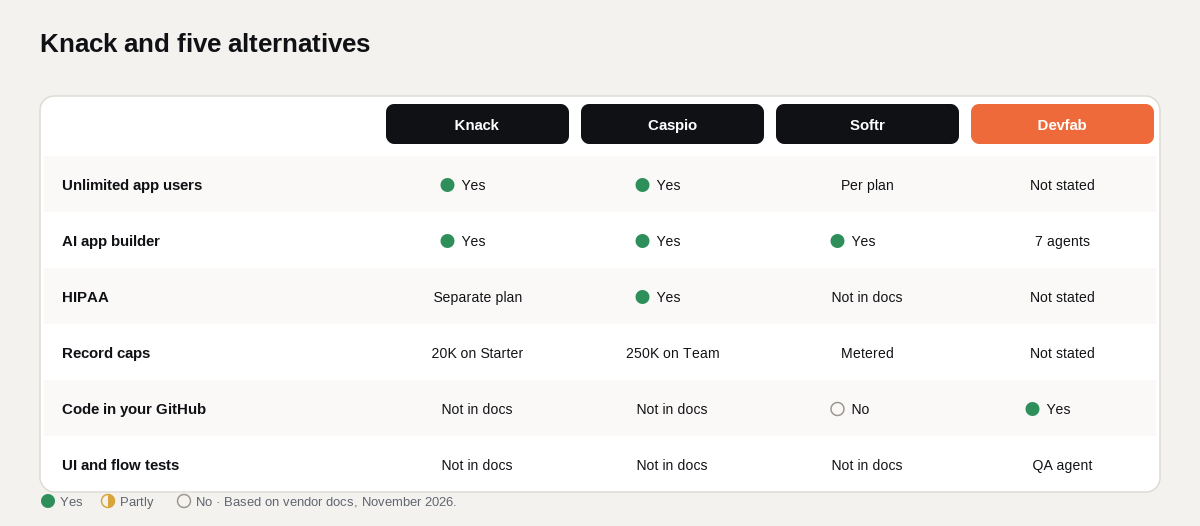
| Tool | Best for | Users | AI building | Starting price (as of Nov 2026) | Code you own |
|---|---|---|---|---|---|
| Caspio | Regulated database apps | Unlimited app users | Caspi builds data model, UI and roles | USD 300 per month (Team) | Not covered in pages checked |
| Airtable | Spreadsheet-minded teams | Per billable collaborator | Omni builds bases, interfaces, automations | Free; Team USD 20 per user per month (annual) | Custom element code only |
| Softr | Client portals on existing data | Set per plan | AI builds pages, database, permissions, workflows | Free plan; paid prices on pricing page | No |
| Quickbase | Operations apps | No user limit on core platform | Pave builds from a prompt | Pave Free; core platform USD 500 per month (annual) | No |
| Devfab | Apps that must become code | Not stated | Seven agents from research to deploy | Not published; cost logged per task (Beta) | Yes, in your GitHub |
| Noloco | Portals for service firms | 10 seats included on Build | Nola builds tables, pages, permissions | Free; Build USD 79 per month | No |
The alternatives
Caspio
Verdict: the closest like-for-like move, built for regulated industries. Best for: healthcare, education and government teams that need many app users and a signed BAA. Trade-off: higher entry price, and Team allows only 5 app authors and 250K records. Pricing: Team USD 300 per month (USD 270 billed annually), Business USD 600 per month, HIPAA/Compliance Edition USD 500 per month on a one-year term, as of November 2026 (Caspio pricing).
- Caspio now calls itself "the Compliant AI App Builder"; its Caspi AI builds the data model, interface and roles from a description, and the result stays editable (Caspio).
- HIPAA, SOC 2 Type II and GDPR are certified annually; FERPA and WCAG are supported (same source).
- Apps run hosted by Caspio or embedded into websites and portals; a Chat AI Agent answers users' questions while respecting field-level security (same source).
- No permanent free plan; a 14-day trial instead (Caspio pricing).
Airtable
Verdict: the best fit when your team already lives in grids and views. Best for: business teams whose app is mostly structured data plus simple workflows. Trade-off: per-collaborator pricing, and ownership changed hands in 2026. Pricing: Free; Team USD 20 per user per month and Business USD 45 per user per month, both billed annually, as of November 2026 (Airtable pricing).
- Status: Bending Spoons closed its acquisition of Airtable in early September 2026 and announced layoffs of much of the earlier team on October 12, 2026, saying plans and pricing were unchanged (Airtable newsroom).
- Omni 2.0 (October 2026, all plans) builds data models from spreadsheets, PDFs and images and writes automation scripts (Airtable community).
- Omni asks before deletions and leaves publishing interfaces to the user (Airtable support).
Softr
Verdict: the strongest portal builder after its November relaunch. Best for: client portals and internal apps on Airtable, Google Sheets, Notion or Softr Databases. Trade-off: app users are capped per plan and builders are billable, per a competitor's review. Pricing: free plan, then paid plans; prices did not load in our page capture, so check Softr pricing.
- Status: "the new Softr" launched November 9, 2026. AI now creates the database, roles, permissions, workflows and a fully custom frontend; block-based building remains (Softr blog).
- User groups and record-level restrictions control who sees what, and you can preview as any user (Softr).
- Softr MCP lets Claude, ChatGPT, Cursor or Codex build apps on every plan, without using Softr AI credits (Softr MCP).
- A Jet Admin review (a competitor, September 2026) notes metered records and workflow actions and no native app-store publishing (Jet Admin).
Quickbase
Verdict: the pick for operations teams that want many users at one platform price. Best for: field, construction and manufacturing apps owned by business users. Trade-off: the core platform has a monthly minimum, and some Pave features are still "coming soon." Pricing: core platform from USD 500 per month billed annually, not per user; Pave Free or Launch at USD 20 per month for 120 credits, as of November 2026 (Quickbase pricing; Pave pricing).
- Pave, launched April 28, 2026, builds apps from plain language with data, roles, workflows and hosting (Quickbase press release).
- Pave includes versioning rollback and 350+ connectors, and says "Your data never trains the AI" (Pave).
- Pave API access and white labeling are listed as coming soon (Pave pricing).
Devfab
Verdict: the move when the app must leave the platform and become software you own. Best for: agencies and IT teams rebuilding a Knack app as code, or shipping a client app to the client's server. Trade-off: in Beta, smaller community, fewer integrations, not an editor for hands-on coding, needs a GitHub account; non-technical staff won't edit it the way they edit Knack. Pricing: predictable cost; cost is logged after each run, per task and per project. No public price.
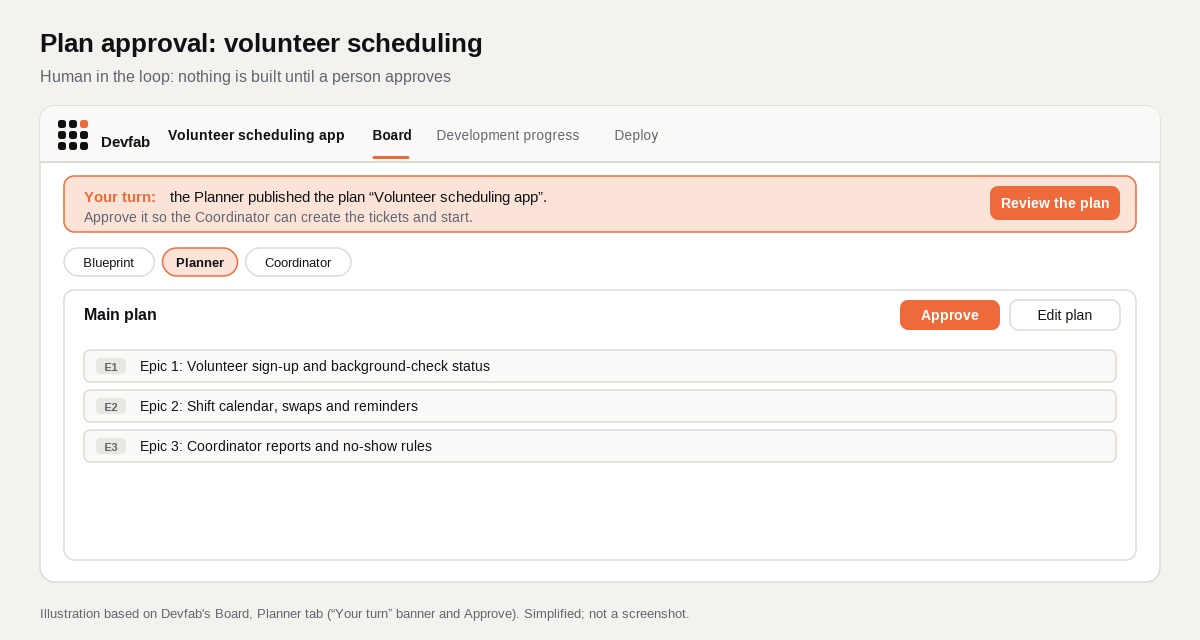
App builders automate the first version. Devfab automates the development lifecycle. Take a nonprofit's volunteer scheduling app. Devfab's Researcher maps the domain first: shift swaps, background-check status, no-show rules. Then it suggests a prototype. A person approves the plan before tickets exist. The QA agent runs UI and flow tests (a volunteer signs up, swaps a shift, gets a reminder) plus logic tests. Code goes to your GitHub, and you deploy to your own server.
Noloco
Verdict: a good portal builder for service firms with tight client permissions. Best for: agencies, law and accounting firms and field services that need branded client portals. Trade-off: Build caps records at 250,000 even with add-ons, and SSO is Enterprise-only. Pricing: Free; Build USD 79 per month (USD 65 billed annually) with 10 seats, then USD 5 per extra seat, as of November 2026 (Noloco pricing).
- Its AI builder, Nola, sets up tables, pages, permissions and workflows from plain language (Noloco).
- Permissions work by role, table, page, record and field (same source).
- Data is hosted on AWS in Ireland; Noloco says it is audited against ISO/IEC 27001 (same source).
Where Knack is still the better choice
- You need a working database app or portal fast at a low flat price, with unlimited app users on every plan.
- You are an agency shipping many similar white-labeled client apps and don't want to maintain code for each.
- A non-technical owner will keep editing the app. Knack's builder suits that better than a codebase.
- You need payments in a portal. Knack portals support Stripe and PayPal payments with secure login (Knack).
How to choose
- Is the problem record caps or compliance? For compliance with unlimited users, Caspio. For caps alone, compare Quickbase's flat platform price.
- Who edits the app next year? Business users: Airtable, Softr, Quickbase or Noloco. Developers or an agency: Devfab.
- Is it mainly a portal for outside users? Softr or Noloco.
- Must the code live in your GitHub and run on your server? Only Devfab on this list is built around that.
- Write a one-page spec before you try anything. List users, records per year, roles and integrations, then test each tool against it.
FAQ
Why do teams look for Knack alternatives?
Mostly plan limits. As of November 2026, Knack Starter caps records at 20,000, apps at 3, AI credits at 25 and API calls at 1,000 per day, and Pro caps records at 50,000. Others need HIPAA, which Knack routes to a separate Knack Health plan, or code they own.
What is the closest alternative to Knack?
Caspio. Both build database-backed apps and portals with unlimited app users on flat plans, and both have an AI builder. Caspio is stronger on regulated work, with HIPAA, SOC 2 Type II and GDPR certified annually, but its plans start higher.
Is there a free Knack alternative?
Airtable and Noloco both have free plans, with caps on records, collaborators or workflow runs. Knack itself offers a 14-day free trial with no credit card but no permanent free plan.
When should I move from Knack to custom code?
When you keep hitting record or API caps, need your own server, or a client wants the code in its own GitHub. A software factory like Devfab rebuilds the app as code you own, with a plan a person approves and UI, flow and logic tests.
Read next
- What is an AI software factory?
- Devfab vs Knack
- Caspio vs Knack
- Knack vs Airtable
- Best no-code app builders
Has your Knack app outgrown its plan? Try Beta
Sources (checked November 2026): Knack; Knack pricing; Caspio; Caspio pricing; Airtable pricing; Airtable newsroom: Back to bases; Airtable Fall Release (Oct 2026); Airtable support: app quick start; Softr; Softr: Beyond building blocks (Nov 9, 2026); Softr MCP; Softr pricing; Jet Admin: Softr review (Sep 30, 2026); Quickbase pricing; Quickbase Pave; Pave pricing; Quickbase announces Pave (Apr 28, 2026); Noloco; Noloco pricing.
Frequently asked questions
Why do teams look for Knack alternatives?
Mostly plan limits. As of November 2026, Knack Starter caps records at 20,000, apps at 3, AI credits at 25 and API calls at 1,000 per day, and Pro caps records at 50,000. Others need HIPAA, which Knack routes to a separate Knack Health plan, or code they own.
What is the closest alternative to Knack?
Caspio. Both build database-backed apps and portals with unlimited app users on flat plans, and both have an AI builder. Caspio is stronger on regulated work, with HIPAA, SOC 2 Type II and GDPR certified annually, but its plans start higher.
Is there a free Knack alternative?
Airtable and Noloco both have free plans, with caps on records, collaborators or workflow runs. Knack itself offers a 14-day free trial with no credit card but no permanent free plan.
When should I move from Knack to custom code?
When you keep hitting record or API caps, need your own server, or a client wants the code in its own GitHub. A software factory like Devfab rebuilds the app as code you own, with a plan a person approves and UI, flow and logic tests.