Short answer: ServiceNow App Engine wins when the new app lives next to service work already on the Now Platform, and AI-built apps must pass AEMC release gates. OutSystems wins when you need a separate platform for many custom apps and agents, including external users, with on-premises or sovereign hosting and 400+ prebuilt connections.
You lead digital services at a state licensing board. Nurses, electricians and contractors renew licenses online. Staff review each renewal by hand. The internal queue already runs on ServiceNow.
One team says extend ServiceNow to the public renewal app. Another says the public deserves its own app platform. The answer depends on who uses the app and where it must run. This page compares both, with vendor pages checked on November 23, 2026.
In this comparison:
- ServiceNow App Engine and OutSystems at a glance
- Feature comparison
- Cost model by team size
- Where ServiceNow App Engine wins
- Where OutSystems wins
The verdicts are by situation, not overall.
ServiceNow App Engine and OutSystems at a glance
Both vendors made outside AI coding tools part of the plan in 2026. OutSystems announced "Agentic Systems Engineering" on March 31, 2026, with an Enterprise Context Graph, next-gen Mentor generally available in OutSystems Developer Cloud (ODC), and support for Claude Code, OpenAI Codex and Cursor (OutSystems news). ServiceNow followed on May 6, 2026: Build Agent skills now work inside Cursor, Windsurf, Claude Code and GitHub Copilot, "governed by default" (ServiceNow, May 2026).
ServiceNow App Engine builds, deploys and governs workflow apps on the Now Platform. It has ServiceNow Studio for business technologists, the ServiceNow IDE for pro developers, and Build Agent for apps from plain-language descriptions (App Engine).
OutSystems is an enterprise low-code platform for building and running apps and AI agents. ODC is a managed PaaS on AWS, and target industries include banking, healthcare, insurance, manufacturing and government (ODC; OutSystems FAQs).
Feature comparison
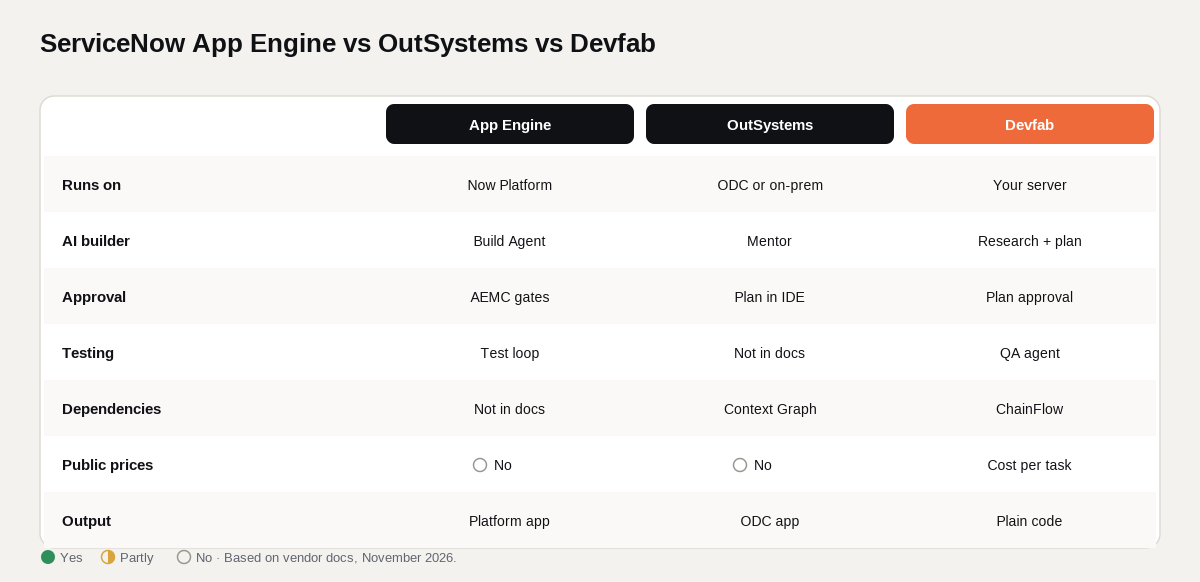
| Aspect | ServiceNow App Engine | OutSystems | Source |
|---|---|---|---|
| Where it runs | Now Platform; ServiceNow Studio, IDE and Build Agent SDK | ODC managed PaaS on AWS; self-hosted runtime; on-prem, private and sovereign cloud | App Engine; OutSystems pricing |
| AI app generation | Build Agent generates workflows, UI and AI agents; MCP client reads Figma and GitHub | Mentor asks clarifying questions and builds data model, logic and UI | App Engine; OutSystems product update |
| Plan approval | AEMC deployment approvals and release management | Mentor in the IDE proposes a plan and applies changes after approval | ServiceNow, May 2026; OutSystems product update |
| Testing | Sandbox and self-healing test loop against quality gates | Not covered in the pages we checked | ServiceNow, May 2026 |
| Dependency view | Not covered in the pages we checked | Enterprise Context Graph: apps, agents, workflows, data and dependencies | OutSystems news |
| AI agents | Agents in apps under AI Control Tower; Otto for App Engine | Agent Workbench with human-in-the-loop, MCP and an agent marketplace | ServiceNow, May 2026; The New Stack |
| Model choice | Not covered in the pages we checked | Anthropic, Cohere, Google, IBM, Mistral, OpenAI, Bedrock and more | The New Stack |
| Compliance and integration | FedRAMP High and DoD IL-4 via US Government Community Cloud | HIPAA, PCI DSS, FedRAMP requirements; SOC 2 Type II; 400+ prebuilt connections | ServiceNow state government; ODC |
| Pricing model | Foundation and Prime packages by quote | Quote by Application Objects, users and add-ons; LLM tokens paid directly | App Engine plans; OutSystems FAQs |
Cost model by team size
| Team size | ServiceNow App Engine | OutSystems | Devfab |
|---|---|---|---|
| 1 person | Personal developer instance with 25 free Build Agent calls | Free Personal Edition: development runtime only, up to 100 internal users | Cost logged per task and per project (Beta) |
| 5 people | Foundation by quote: 15 custom tables, 3 scoped apps | Agentic Systems Platform by quote, starting with 100 internal users and dev, test and prod runtimes | Cost logged per task and per project (Beta) |
| 25 people | Prime by quote: unlimited tables and scoped apps, AEMC, Mobile Publishing | Same platform, sized by Application Objects (about 150 for a typical medium app), external users and add-ons | Cost logged per task and per project (Beta) |
Pricing models as of November 2026 from App Engine plans and OutSystems pricing; neither shows plan prices. ServiceNow customers get 100 free Build Agent calls (ServiceNow, Apr 2026). Devfab is in Beta and offers predictable cost: cost is logged after each run, per task and per project.
For a public renewal app, the user count is the cost driver. OutSystems sizes by non-anonymous end users as well as Application Objects, so thousands of licensees count. Ask ServiceNow how licensees outside your staff are licensed before you compare quotes.
Where ServiceNow App Engine wins
- The staff side already runs on ServiceNow. Review queues, approvals and roles stay on one platform.
- AI-built apps need one gate. Apps from Claude Code or Cursor inherit governance and pass AEMC approvals.
- Generated apps get tested. Each gets a sandbox and a self-healing test loop against quality gates.
- Government cloud under an existing contract. FedRAMP High and DoD IL-4 via the US Government Community Cloud.
- AI is included. ServiceNow says AI and governance are "not a separate purchase" since April 2026.
Where OutSystems wins
- You build many apps that depend on each other. The Enterprise Context Graph shows apps, agents, workflows, data and dependencies.
- You need to choose where it runs. Managed cloud, on-premises, private cloud, sovereign cloud or a self-hosted runtime.
- Connections matter. 400+ prebuilt connections and a private gateway to on-prem systems.
- You want model choice for agents. Agent Workbench supports many model providers, and you pay token costs directly.
- You want a free start. The Personal Edition covers development with up to 100 internal users.
Each has a known gap. OutSystems warns that some third-party Forge components may need to be rebuilt for ODC, and its free edition caps application objects, users and storage (ODC; OutSystems free). ServiceNow's Foundation caps custom tables at 15 and scoped apps at 3.
Switching from one to the other
The pages we checked document no migration path in either direction. Both store apps as platform models, so a move is a rebuild. Export data, list roles and process steps, and give that description to the other platform's builder: Build Agent on ServiceNow, or Mentor on OutSystems, which asks clarifying questions. Keep both running until renewals and reviews pass on the new one.
Where Devfab fits
Both are long-term platforms with vendor support and compliance paperwork. A board that wants one renewal app, as plain code it can host on its own servers and hand to any vendor later, may not want a second platform contract.
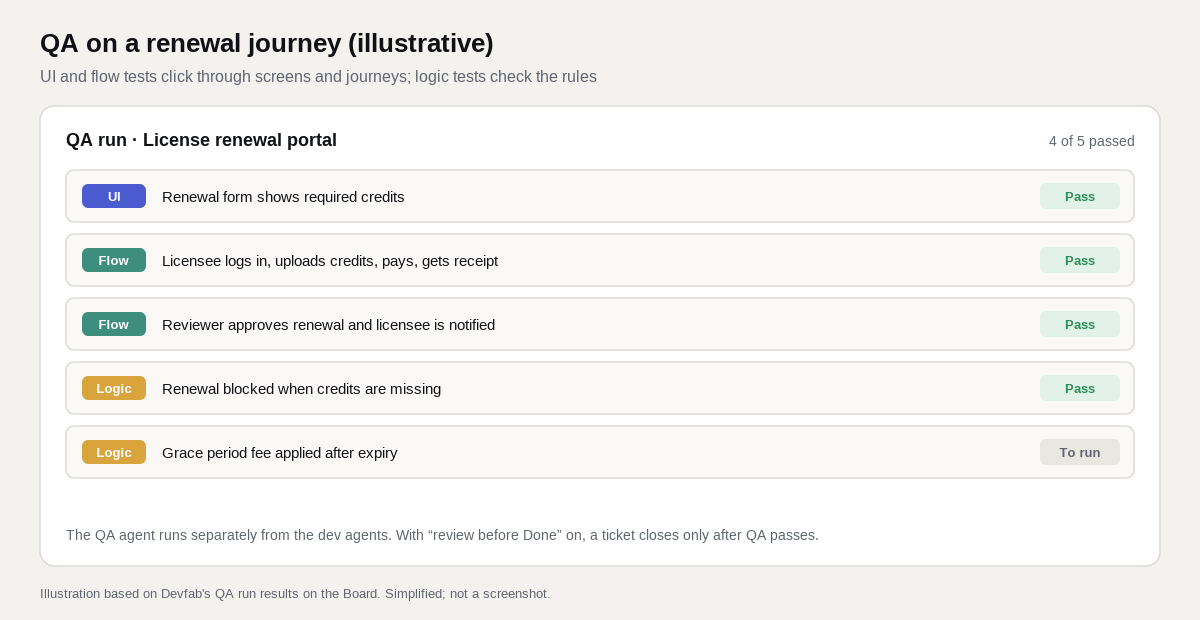
Coding agents automate the developer. Devfab automates the development lifecycle. Its Researcher maps the domain before the plan: license types, continuing-education credits, renewal grace periods, fee waivers and similar systems. A person approves the plan, and the Coordinator creates tickets for developer agents. The QA agent runs UI and flow tests, clicking a renewal from login to payment confirmation, plus logic tests on rules such as missing credits. Deploy ships to your own server.
Devfab is in Beta, with a smaller community and fewer integrations than either platform, and no FedRAMP or SOC 2 claims to cite. It needs a GitHub account. See Devfab vs ServiceNow App Engine.
FAQ
What is the difference between ServiceNow App Engine and OutSystems?
ServiceNow App Engine builds workflow apps on the Now Platform, next to your ITSM, HR and service data, with Build Agent and release governance through AEMC. OutSystems is a separate enterprise platform for building and running apps and AI agents, with Mentor generating apps and an Enterprise Context Graph tracking dependencies.
How are ServiceNow App Engine and OutSystems priced?
Neither shows plan prices as of November 2026. ServiceNow sells App Engine Foundation and Prime packages by custom quote. OutSystems has a free Personal Edition and quotes its paid Agentic Systems Platform by Application Objects, internal and external users, and add-ons. With OutSystems you pay LLM providers directly for tokens.
Which one is better for apps used by the public?
OutSystems sizes its paid platform by internal and non-anonymous external users, and its target industries include banking, insurance and government. ServiceNow App Engine centers on workflow apps around service data. For a public portal, check each vendor's external-user terms and hosting options before you decide.
Can either platform run on-premises?
OutSystems lists managed cloud, on-premises, private cloud and sovereign cloud, plus a self-hosted model where apps run in your infrastructure. ServiceNow's state government page cites a US Government Community Cloud at FedRAMP High and DoD IL-4; on-premises App Engine was not covered in the pages we checked.
Read next
- What is an AI software factory?
- OutSystems alternatives
- ServiceNow App Engine alternatives
- Power Apps vs OutSystems
- ServiceNow App Engine vs Appian
One renewal app, on your own servers? Try Beta
Sources (checked November 2026): ServiceNow App Engine; App Engine plans and packages; ServiceNow press release, Apr 9, 2026; ServiceNow press release, May 6, 2026; ServiceNow for state government; OutSystems: Agentic Systems Engineering (Mar 31, 2026); OutSystems: Next-gen Mentor in ODC; OutSystems Developer Cloud; OutSystems pricing and editions; OutSystems FAQs; OutSystems free edition; The New Stack: OutSystems Agent Workbench (Sep 2025).
Frequently asked questions
What is the difference between ServiceNow App Engine and OutSystems?
ServiceNow App Engine builds workflow apps on the Now Platform, next to your ITSM, HR and service data, with Build Agent and release governance through AEMC. OutSystems is a separate enterprise platform for building and running apps and AI agents, with Mentor generating apps and an Enterprise Context Graph tracking dependencies.
How are ServiceNow App Engine and OutSystems priced?
Neither shows plan prices as of November 2026. ServiceNow sells App Engine Foundation and Prime packages by custom quote. OutSystems has a free Personal Edition and quotes its paid Agentic Systems Platform by Application Objects, internal and external users, and add-ons. With OutSystems you pay LLM providers directly for tokens.
Which one is better for apps used by the public?
OutSystems sizes its paid platform by internal and non-anonymous external users, and its target industries include banking, insurance and government. ServiceNow App Engine centers on workflow apps around service data. For a public portal, check each vendor's external-user terms and hosting options before you decide.
Can either platform run on-premises?
OutSystems lists managed cloud, on-premises, private cloud and sovereign cloud, plus a self-hosted model where apps run in your infrastructure. ServiceNow's state government page cites a US Government Community Cloud at FedRAMP High and DoD IL-4; on-premises App Engine was not covered in the pages we checked.