Short answer: ServiceNow App Engine wins when your service desk, HR cases and approvals already run on ServiceNow, and new apps must share that data under central release governance. Power Apps wins when your company lives in Microsoft 365 and Dataverse, and you want a published per-user price and Microsoft connectors.
You run facilities for a university campus. Work orders arrive by email, phone and a shared spreadsheet. IT already runs ServiceNow. Every staff member already has Microsoft 365.
So the meeting splits. One side says build the request app where tickets already live. The other says build it where people already work. Both are fair points, and neither settles cost or governance. This page acts as referee, using vendor pages checked on November 23, 2026.
In this comparison:
- ServiceNow App Engine and Power Apps at a glance
- Feature comparison
- Cost model by team size
- Where ServiceNow App Engine wins
- Where Power Apps wins
Each section stands alone, so skip to the one you need.
ServiceNow App Engine and Power Apps at a glance
Both platforms opened their doors to outside AI coding tools in 2026. On May 6, 2026, ServiceNow announced that Build Agent skills work inside Cursor, Windsurf, Claude Code and GitHub Copilot, with apps from those tools governed by the platform (ServiceNow press release, May 2026). Microsoft's September 2026 update made the "app-builder skill" generally available, so AI coding tools can build whole model-driven apps (Power Platform September 2026 update).
ServiceNow App Engine is ServiceNow's platform for building, deploying and governing custom workflow apps on the Now Platform. Business technologists use ServiceNow Studio, pro developers use the ServiceNow IDE, and Build Agent generates workflows, UI and AI agents from plain-language descriptions (App Engine).
Microsoft Power Apps is Microsoft's low-code platform for business apps on Dataverse and Microsoft 365. Users describe an app in natural language, and Power Apps supports "pro code, no code, low code, and generated apps" (Power Apps).
One more date matters for Power Apps buyers. From November 15, 2026, new unmanaged developer environments and new Dataverse for Teams environments can't be created (Microsoft licensing FAQ).
Feature comparison
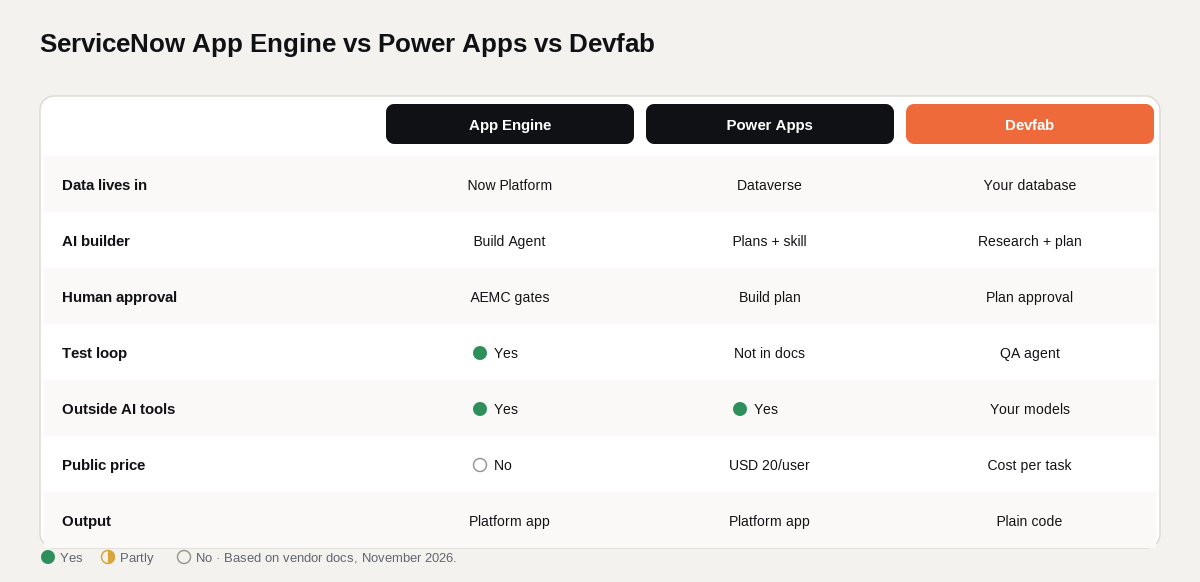
| Aspect | ServiceNow App Engine | Power Apps | Source |
|---|---|---|---|
| Where it runs | ServiceNow Studio, ServiceNow IDE, Build Agent SDK for outside tools | Maker studio in the browser; GitHub Copilot CLI and Claude Code can build apps | App Engine; Power Platform Sept 2026 |
| Planning and spec | Build Agent generates workflows, UI and agents from a description; MCP client pulls context from Figma and GitHub | "Plans" workspace uses agents as requirements analyst, data modeler and solution architect | App Engine; The New Stack |
| Human approval | AEMC deployment approvals and release management | App-builder skill creates nothing until the user approves the build plan | ServiceNow press release; Power Platform Sept 2026 |
| Testing | Generated apps get a sandbox and a self-healing test loop against quality gates | Not covered in the pages we checked | ServiceNow press release |
| Generated code | Platform apps on the Now Platform | Generative pages produce native React code for custom screens | The New Stack |
| Data | Now Platform tables (15 custom tables on Foundation, unlimited on Prime) | Microsoft Dataverse | App Engine plans; Power Apps |
| In-app AI | Otto for App Engine: record summaries, in-app guidance, AI search; agents under AI Control Tower | Agent feed to guide agents inside apps; Microsoft 365 Copilot can be embedded | App Engine; Power Apps |
| Governance | AEMC lifecycle governance; Custom Instructions for org standards | Central policies for environments, data loss prevention, access and auditing | ServiceNow press release; Power Apps |
| Pricing model | Foundation and Prime packages by custom quote | Per user or per app; pay-as-you-go via Azure; free Developer Plan | App Engine plans; Microsoft licensing FAQ |
Cost model by team size
| Team size | ServiceNow App Engine | Power Apps | Devfab |
|---|---|---|---|
| 1 person | Personal developer instances get 25 free Build Agent calls | Developer Plan free (non-production) | Cost logged per task and per project (Beta) |
| 5 people | Foundation package by custom quote; 15 custom tables, 3 scoped apps | Premium USD 20 per user per month, paid yearly | Cost logged per task and per project (Beta) |
| 25 people | Prime package by custom quote; unlimited tables and scoped apps, AEMC, Process Mining | Premium USD 20 per user per month, paid yearly, or per-app licenses; Dataverse capacity USD 40 per GB per month | Cost logged per task and per project (Beta) |
Power Apps prices as of November 2026 from Power Apps pricing; Microsoft notes prices may vary by region, and a 2,000-seat tier is USD 12 per user per month through sales. ServiceNow shows no prices on App Engine plans; customers get 100 free Build Agent calls (ServiceNow, Apr 2026). Devfab is in Beta and offers predictable cost: cost is logged after each run, per task and per project.
Two cost traps to check. On ServiceNow, the Foundation caps (15 custom tables, 3 scoped apps) can push a growing portfolio to Prime. On Power Apps, premium, on-premises and custom connectors need a standalone license beyond Microsoft 365 seeded rights, and AI features draw on AI Builder or Copilot Credits capacity (Microsoft licensing FAQ).
Where ServiceNow App Engine wins
- Your service work already runs on ServiceNow. New apps share the same ITSM, HR and employee service data, roles and workflows.
- AI-written apps must pass central gates. AEMC adds deployment approvals and release management, and apps from Claude Code or Cursor inherit platform governance.
- You want built-in test loops. Generated apps get a sandbox and a self-healing test loop against quality gates.
- Public sector hosting matters. ServiceNow's state government page cites a US Government Community Cloud at FedRAMP High and DoD IL-4 (ServiceNow state government).
- AI is bundled. Since April 2026, ServiceNow says AI, data connectivity, security and governance are "not a separate purchase."
Where Power Apps wins
- Your staff live in Microsoft 365. Apps sit next to Teams, SharePoint and Dynamics 365 data, inside tenant governance and DLP.
- You need a price before a sales call. Premium is listed at USD 20 per user per month, paid yearly.
- Some users already have rights. Limited Power Apps use is included in some Microsoft 365 licenses.
- You want generated code for custom screens. Generative pages produce native React code.
- You plan in a structured way. The Plans workspace has agents act as requirements analyst, data modeler and solution architect before assets are generated.
Each has a known gap. Several Power Apps AI pieces are still in preview, and Microsoft's own September post labels the app-builder skill both GA and preview. ServiceNow's May release lists AEMC at "no additional cost" next to a separate freemium tier without explaining how they fit (ServiceNow press release).
Switching from one to the other
Neither vendor documents a migration path to the other in the pages we checked. Apps on both are platform models, so a switch means a rebuild. Export your tables to a neutral format, write down roles and approval steps, and feed that description to the other side's builder: Build Agent on ServiceNow, or the Plans workspace on Power Apps. Run both apps in parallel until the new one passes acceptance tests with real users.
Where Devfab fits
Both platforms are good homes for apps that belong inside them. The campus request app may not. If the facilities team wants it as a standalone app, as plain code the university owns, neither platform delivers that.
Coding agents automate the developer. Devfab automates the development lifecycle. Its Researcher maps the domain first: work order types, building and room codes, priority rules and similar products. Then the Planner writes a plan, and a person approves it. The QA agent runs UI and flow tests, clicking screens and user journeys end to end, plus logic tests. Code goes to your own GitHub account and deploys to your own server.
Devfab is in Beta, with a smaller community and fewer integrations than these platforms. It has no FedRAMP claims to point to and needs a GitHub account. See Devfab vs Power Apps and Devfab vs ServiceNow App Engine.
FAQ
Is ServiceNow App Engine or Power Apps cheaper?
Power Apps publishes a list price: Premium is USD 20 per user per month, paid yearly, as of November 2026, with a free Developer Plan. ServiceNow App Engine shows no prices; Foundation and Prime packages are sold by custom quote. Compare real quotes for your user count, plus Dataverse capacity and AI credits on the Microsoft side.
Can I use Claude Code or Cursor with either platform?
Yes, both now accept outside AI coding tools. ServiceNow said in May 2026 that Build Agent skills work inside Cursor, Windsurf, Claude Code and GitHub Copilot, under platform governance. Microsoft's September 2026 update lets tools such as GitHub Copilot CLI and Claude Code build model-driven apps after you approve a build plan.
Which one is better for IT service management teams?
ServiceNow App Engine, if your ITSM, HR or employee service work already runs on ServiceNow. New apps share the same data, roles and workflows, and App Engine Management Center adds deployment approvals and release management. Power Apps fits better when the data lives in Dataverse, SharePoint or Dynamics 365.
What are the limits of ServiceNow App Engine Foundation?
As of November 2026, the Foundation package caps you at 15 custom tables and 3 scoped apps. App Engine Prime removes those caps and adds Otto for App Engine, App Engine Management Center, Process Mining and Mobile Publishing.
Read next
- What is an AI software factory?
- ServiceNow App Engine alternatives
- Power Apps alternatives
- Best low-code platforms for enterprises
Need the request app as code you own? Try Beta
Sources (checked November 2026): ServiceNow App Engine; App Engine plans and packages; ServiceNow press release, Apr 9, 2026; ServiceNow press release, May 6, 2026; ServiceNow for state government; Microsoft Power Apps; Power Apps pricing; Power Platform licensing FAQ; Power Platform September 2026 update; The New Stack: Power Apps Plans (May 2025).
Frequently asked questions
Is ServiceNow App Engine or Power Apps cheaper?
Power Apps publishes a list price: Premium is USD 20 per user per month, paid yearly, as of November 2026, with a free Developer Plan. ServiceNow App Engine shows no prices; Foundation and Prime packages are sold by custom quote. Compare real quotes for your user count, plus Dataverse capacity and AI credits on the Microsoft side.
Can I use Claude Code or Cursor with either platform?
Yes, both now accept outside AI coding tools. ServiceNow said in May 2026 that Build Agent skills work inside Cursor, Windsurf, Claude Code and GitHub Copilot, under platform governance. Microsoft's September 2026 update lets tools such as GitHub Copilot CLI and Claude Code build model-driven apps after you approve a build plan.
Which one is better for IT service management teams?
ServiceNow App Engine, if your ITSM, HR or employee service work already runs on ServiceNow. New apps share the same data, roles and workflows, and App Engine Management Center adds deployment approvals and release management. Power Apps fits better when the data lives in Dataverse, SharePoint or Dynamics 365.
What are the limits of ServiceNow App Engine Foundation?
As of November 2026, the Foundation package caps you at 15 custom tables and 3 scoped apps. App Engine Prime removes those caps and adds Otto for App Engine, App Engine Management Center, Process Mining and Mobile Publishing.