Short answer: If you live in Microsoft 365, Power Apps is the natural move. For regulated case work, pick Appian; for a large governed app portfolio, OutSystems or Mendix. Engineers building internal tools on company data should look at Retool. Choose Devfab when the app must be custom code you own, deployed to your own server.
Your city's IT team runs the service desk on ServiceNow. Now the building department wants a permit tracker the public can use. The quote for App Engine Prime arrives, and someone asks whether this app really belongs on the service desk platform.
That question usually starts with three things: prices you can't see, caps on the entry package, and an app that can only live on the Now Platform. This page compares six alternatives using vendor pages re-checked in November 2026.
In this guide, you'll learn:
- Why teams leave ServiceNow App Engine
- Quick comparison
- The alternatives
- Where ServiceNow App Engine is still the better choice
- How to choose
Read the reasons first; the right tool depends on which one is yours.
Why teams leave ServiceNow App Engine
First, what changed in 2026. On May 6, 2026, at Knowledge 2026, ServiceNow said Build Agent skills now work inside Cursor, Windsurf, Claude Code and GitHub Copilot, with apps built there still governed by the platform (ServiceNow, May 6, 2026). Earlier, on April 9, ServiceNow said AI, data connectivity, security and governance are built into all products and "not a separate purchase," with 100 free Build Agent calls per customer (ServiceNow, Apr 9, 2026).
App Engine is ServiceNow's platform for building and governing custom workflow apps on the Now Platform. Build Agent generates workflows, UI and AI agents from a plain-language description (App Engine). The usual reasons people look elsewhere:
- No visible prices. The plans page shows packages and a "Get Custom Quote" button, not numbers (App Engine plans).
- The entry package is capped. App Engine Foundation allows 15 custom tables and 3 scoped apps; unlimited tables and apps need Prime (same source).
- Apps stay on the Now Platform. That is a strength for ITSM data and a limit for a public app that should run elsewhere.
- Some packaging is unclear. ServiceNow's own May release lists App Engine Management Center at "no additional cost" next to a separate freemium tier expected in Q3 2026, without saying how they fit.
- Not every team runs ServiceNow. Outside IT, HR and service management, the platform can be more than one app needs.
Quick comparison
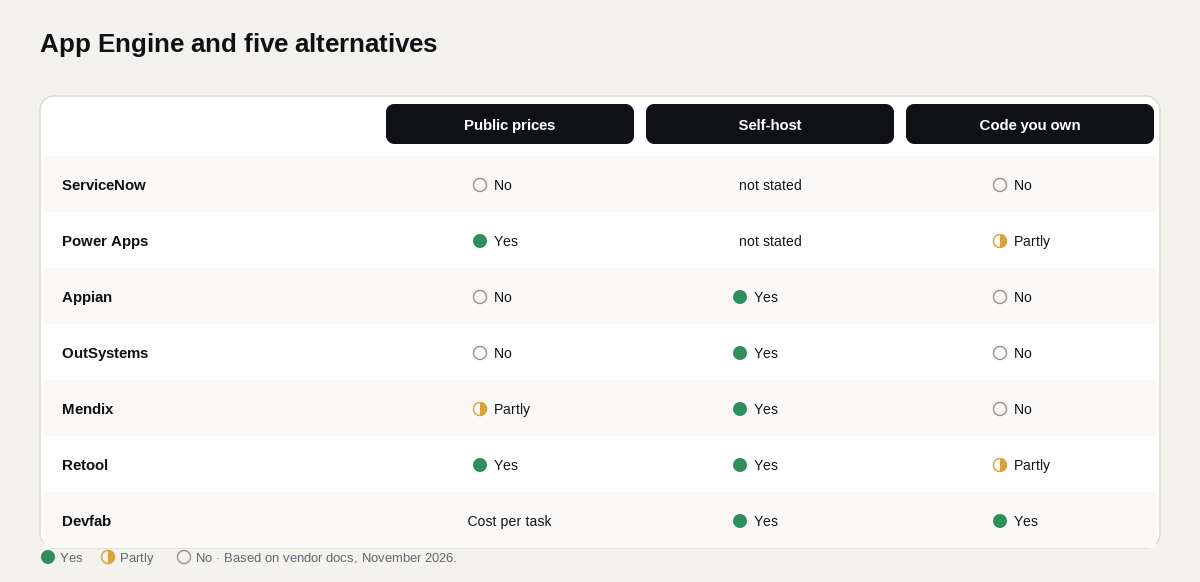
| Tool | Best for | Builds with AI | Where apps run | Pricing (as of November 2026) |
|---|---|---|---|---|
| Microsoft Power Apps | Microsoft 365 shops | Plans workspace, app-builder skill for AI coding tools | Microsoft cloud on Dataverse | Premium USD 20 per user per month, paid yearly |
| Appian | Regulated process and case work | Composer (preview), Agent Studio | Cloud or self-managed, incl. air-gapped AI | Per user, per month, per app; no public numbers |
| OutSystems | Large governed app portfolios | Mentor App Generator | Managed cloud, self-hosted, private or sovereign cloud | Custom quote; free Personal Edition |
| Mendix | Enterprise and Siemens shops | Maia, Maia Plan | Mendix Cloud, Azure, Kubernetes, SAP BTP, own servers | Standard One App from USD 1,090 per month |
| Retool | Engineers building internal tools | Prompt-first React app builder | Retool Cloud, your VPC, or on-prem | Team USD 10 per builder and USD 5 per internal user per month, billed annually |
| Devfab | Custom apps you own as code | Seven agents from research to deploy | Your own server | Cost logged per task and per project (Beta) |
The alternatives
Microsoft Power Apps
Verdict: the shortest move for organizations that already pay for Microsoft 365. Best for: internal apps on Dataverse, governed by the same tenant policies as the rest of Microsoft. Trade-off: premium, on-premises and custom connectors need a standalone license (Licensing FAQ). Pricing: Power Apps Premium USD 20 per user per month, paid yearly; free Developer Plan for non-production use (Power Apps pricing).
- The "Plans" workspace uses AI agents as requirements analyst, data modeler and solution architect (The New Stack).
- The app-builder skill, GA in September 2026, lets AI coding tools build model-driven apps and creates nothing until you approve the build plan (Power Platform blog).
- IT can centralize policies for environments, data loss prevention, access and auditing (Power Apps).
- From November 15, 2026, new unmanaged developer environments can't be created (Licensing FAQ).
Appian
Verdict: the closest match for process-heavy, regulated work like permits, claims and cases. Best for: agencies and financial firms that want case management, agents and governance in one platform. Trade-off: a competitor review cites high per-user pricing for smaller organizations and a steep learning curve (Blaze review). Pricing: "priced per user, per month, per app" across Standard, Advanced and Premium, with no dollar amounts on the page (Appian pricing).
- Composer turns legacy requirements and user stories into a visual app plan, then an implementation; it is listed as a preview feature (Appian what's new).
- AI capabilities can run fully self-managed on air-gapped infrastructure (same source).
- The Appian MCP Server exposes data fabric, process models and rules to external agents (Appian Q2 2026).
- AI Guardrails screen for prompt injection, toxic content and PII leakage (same source).
OutSystems
Verdict: a full enterprise platform for many interdependent apps and agents. Best for: large organizations that want a vendor-supported platform with compliance attestations. Trade-off: no public prices, and some third-party Forge components may need rebuilding for its newer cloud (OutSystems Developer Cloud). Pricing: free Personal Edition; the paid Agentic Systems Platform is quoted by sales, sized by application objects, users and add-ons (OutSystems pricing).
- OutSystems announced "Agentic Systems Engineering" and an Enterprise Context Graph on March 31, 2026 (OutSystems news).
- Mentor App Generator asks clarifying questions, then builds data model, logic and UI; in the IDE it proposes a plan and applies changes after approval (Next-gen Mentor).
- It lists "pre-built connections to 400+ systems" and HIPAA, PCI DSS and FedRAMP requirements (OutSystems Developer Cloud).
- Deployment options include managed cloud, on-premises, private cloud and sovereign cloud (OutSystems pricing).
Mendix
Verdict: an enterprise platform with flexible hosting and an open door for outside AI agents. Best for: Siemens and industrial customers, and portfolios built from approved components. Trade-off: agent policies in 11.12 "bring visibility, but no enforcement" (Mendix 11.12). Pricing: Free plan; Standard One App starting at USD 1,090 per month; Unlimited Apps starting at USD 2,725 per month; Premium by quote (Mendix pricing).
- Deploys to Mendix Cloud, Azure, Kubernetes, SAP BTP, StackIT or your own servers (same source).
- Maia Plan turns user stories into app plans and suggests company-approved Marketplace components (Mendix 11.10).
- Studio Pro acts as an MCP server, and Mendix Cloud MCP connects assistants such as Claude Code and GitHub Copilot (Mendix docs).
- Developers and anonymous users are not charged (Mendix pricing).
Retool
Verdict: the pick when engineers build internal tools on existing databases and APIs. Best for: operations consoles, admin panels and back-office tools with real code underneath. Trade-off: in October 2026 Retool made bring-your-own AI key Enterprise-only, and users complained that managed credits ran out (Retool Forum). Pricing: Free for up to 5 users; Team USD 10 per builder and USD 5 per internal user per month; Business USD 50 per builder and USD 15 per internal user per month, billed annually (Retool pricing).
- The new AI app builder, GA on June 17, 2026, writes React on the frontend and TypeScript on the backend, with a Code tab to edit it (Retool blog).
- Apps can run on Retool Cloud, in your VPC or fully on-prem (same source).
- Apps built in other AI tools can be imported and inherit Retool's authentication and access rules (Retool newsroom).
- Git source control and custom SSO are Enterprise features (Retool pricing).
Devfab
Verdict: the pick when the permit tracker should be custom software you own, not another app on a platform. Best for: IT teams and agencies that want research, an approved plan, tests and deployment to their own server. Trade-off: Devfab is in Beta, has a smaller community and fewer integrations than these platforms, is not a visual builder, and needs a GitHub account. Pricing: predictable cost; cost is logged after each run, per task and per project.
- The Researcher runs before the Planner. For a permit tracker it maps terms such as plan review, inspections and fee schedules, best practices for public permit portals, and competing products, then suggests a prototype.
- The Planner publishes a plan and a person approves it before the Coordinator creates tickets.
- ChainFlow maps which functions and APIs call each other and what is deployed. A change to permit status shows its effect on inspection scheduling, fee invoices and applicant emails.
- The QA agent runs UI and flow tests (screens, buttons and journeys clicked end to end) plus logic tests. Code stays in your own GitHub account, and Deploy ships to your own server.
Coding agents automate the developer. Devfab automates the development lifecycle.
Where ServiceNow App Engine is still the better choice
- Your ITSM, HR or ESM already runs on ServiceNow. New apps reuse the same data, roles and workflows.
- You need FedRAMP High or DoD IL-4 hosting under an existing contract. ServiceNow cites a US Government Community Cloud at those levels (ServiceNow state government).
- You want AI-coded apps under central control. App Engine Management Center adds deployment approvals and release management, and Build Agent apps get a sandbox and a self-healing test loop against quality gates (ServiceNow, May 6, 2026).
- Developers already use Cursor or Claude Code. The Build Agent SDK lets them build while the platform keeps governance.
How to choose
- Start from where your data lives. Microsoft tenant: Power Apps. ServiceNow tables: stay. Your own databases: Retool or Devfab.
- Count apps, not just users. Mendix and Appian price around apps; Power Apps and Retool around people.
- Decide who maintains it. Business technologists suit low-code. A team that wants plain code in GitHub suits Devfab.
- Check the hosting rule. Air-gapped, sovereign or your own server narrows the list fast.
- Run one real app as a pilot. The permit tracker is a good test: public users, staff roles, fees and notices.
FAQ
Why do teams look for ServiceNow App Engine alternatives?
Common reasons are custom-quote pricing with no public numbers, the Foundation package cap of 15 custom tables and 3 scoped apps, and apps that only run on the Now Platform. Teams that don't use ServiceNow for ITSM or HR often find the platform heavy for one app.
Does ServiceNow charge extra for AI in App Engine?
On April 9, 2026 ServiceNow said AI, data connectivity, security and governance are built into all products and are not a separate purchase. Customers get 100 free Build Agent calls and personal developer instances 25. Package prices are still by custom quote.
What is the closest alternative to ServiceNow App Engine for government?
For agencies that need a governed workflow platform, Appian and OutSystems are the closest: both target regulated sectors, and OutSystems lists FedRAMP requirements among its compliance work. If you already run Microsoft 365, Power Apps is the shorter path.
Can I keep ServiceNow and build some apps elsewhere?
Yes. Many teams keep ITSM and HR on ServiceNow and build public-facing or custom apps on another tool. ServiceNow's Build Agent SDK also lets tools such as Cursor and Claude Code build apps that stay under ServiceNow governance.
Is Devfab a low-code platform like App Engine?
No. Devfab is an AI software factory. It researches the domain, writes a plan a person approves, builds, tests with its QA agent and deploys to your own server, with the code in your own GitHub account. It is in Beta and is not a visual builder.
Read next
- What is an AI software factory?
- Devfab vs ServiceNow App Engine
- ServiceNow App Engine vs Power Apps
- Best low-code platforms for government
- Low-code vs an AI software factory
Public app that doesn't belong on the service desk? Try Beta
Sources (checked November 2026): ServiceNow App Engine; App Engine plans and packages; ServiceNow press release, Apr 9, 2026; ServiceNow press release, May 6, 2026; ServiceNow for state government; Microsoft Power Apps; Power Apps pricing; Power Platform licensing FAQ; Power Platform September 2026 update; The New Stack: Power Apps Plans; Appian pricing; Appian what's new; Appian Q2 2026 highlights; Blaze: Appian reviews; OutSystems Agentic Systems Engineering (Mar 31, 2026); OutSystems next-gen Mentor; OutSystems Developer Cloud; OutSystems pricing; Mendix pricing; Mendix 11.10; Mendix 11.12; Mendix docs: external agents; Retool pricing; Retool React AI app builder (Jun 17, 2026); Retool newsroom: governance for vibe-coded apps; Retool Forum, Oct 2026.
Frequently asked questions
Why do teams look for ServiceNow App Engine alternatives?
Common reasons are custom-quote pricing with no public numbers, the Foundation package cap of 15 custom tables and 3 scoped apps, and apps that only run on the Now Platform. Teams that don't use ServiceNow for ITSM or HR often find the platform heavy for one app.
Does ServiceNow charge extra for AI in App Engine?
On April 9, 2026 ServiceNow said AI, data connectivity, security and governance are built into all products and are not a separate purchase. Customers get 100 free Build Agent calls and personal developer instances 25. Package prices are still by custom quote.
What is the closest alternative to ServiceNow App Engine for government?
For agencies that need a governed workflow platform, Appian and OutSystems are the closest: both target regulated sectors, and OutSystems lists FedRAMP requirements among its compliance work. If you already run Microsoft 365, Power Apps is the shorter path.
Can I keep ServiceNow and build some apps elsewhere?
Yes. Many teams keep ITSM and HR on ServiceNow and build public-facing or custom apps on another tool. ServiceNow's Build Agent SDK also lets tools such as Cursor and Claude Code build apps that stay under ServiceNow governance.
Is Devfab a low-code platform like App Engine?
No. Devfab is an AI software factory. It researches the domain, writes a plan a person approves, builds, tests with its QA agent and deploys to your own server, with the code in your own GitHub account. It is in Beta and is not a visual builder.