Short answer: ServiceNow App Engine wins when the new app extends service work already on the Now Platform, such as employee requests, and AI-built apps must pass central release gates. Appian wins when the work is a long, regulated process with cases, documents, RPA and audited AI agents, and AI may need to run air-gapped.
You run card operations at a regional bank. Every card dispute is a case: a customer claim, documents, a provisional credit, a chargeback, a deadline. Today it lives in email and a shared folder.
IT already pays for ServiceNow and wants to build there. Operations has seen an Appian demo and wants a process engine with an audit trail. Both have a point. This page sets the facts side by side, from vendor pages checked on November 23, 2026.
In this comparison:
- ServiceNow App Engine and Appian at a glance
- Feature comparison
- Cost model by team size
- Where ServiceNow App Engine wins
- Where Appian wins
Use it as a scoring sheet for your vendor demos.
ServiceNow App Engine and Appian at a glance
Neither changed owners in 2026; both rebuilt around AI agents. ServiceNow said on April 9, 2026 that AI, data connectivity, security and governance are built into all products and "not a separate purchase" (ServiceNow, Apr 2026). On May 6 it brought Build Agent into Cursor, Windsurf, Claude Code and GitHub Copilot (ServiceNow, May 2026). Appian shipped release 26.3 in March with multi-agent communication, a Q2 update on July 1 with an MCP Server, and release 26.6 with agent cost controls (Appian Q1 2026; Appian What's New).
ServiceNow App Engine builds, deploys and governs custom workflow apps on the Now Platform. It offers ServiceNow Studio for business technologists, the ServiceNow IDE for pro developers, and a Build Agent SDK for outside tools (App Engine).
Appian is an enterprise low-code platform for process automation, case management and data fabric. It adds AI agents (Agent Studio), AI-assisted app planning (Composer) and document AI (DocCenter) (Appian pricing).
Feature comparison
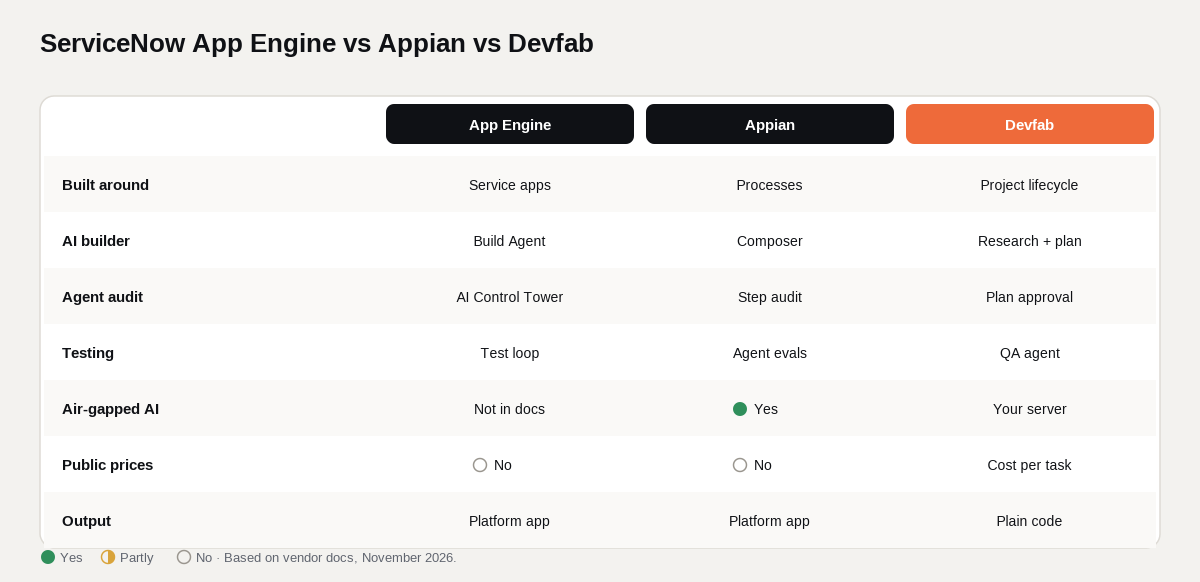
| Aspect | ServiceNow App Engine | Appian | Source |
|---|---|---|---|
| Built around | Workflow apps on the Now Platform, next to ITSM, HR and service data | Process models, case management, RPA and data fabric | App Engine; Appian pricing |
| AI app building | Build Agent generates workflows, UI and AI agents from a description | Composer turns requirements and user stories into a visual app plan (preview) | App Engine; Appian What's New |
| AI agents | In-app agents run under AI Control Tower; Otto adds summaries and guidance | Agent Studio: agents call other agents, audit view of each step, parallel tool calls | ServiceNow, May 2026; Appian Q1 2026 |
| Testing | Sandbox and self-healing test loop against quality gates | Central evaluations to run agent test cases in bulk | ServiceNow, May 2026; Appian Q2 2026 |
| Release governance | AEMC: deployment approvals, release management | Not described in the pages we checked | ServiceNow, May 2026 |
| Model controls | Custom Instructions for org standards | Bring your own Azure OpenAI, custom LLM gateway, AI Guardrails for prompt injection and PII | ServiceNow, May 2026; Appian Q2 2026 |
| Hosting | ServiceNow cloud; US Government Community Cloud at FedRAMP High and DoD IL-4 | Appian cloud (SLA 99.8–99.99%) or AI fully self-managed on air-gapped infrastructure | ServiceNow state government; Appian What's New |
| Outside AI tools | Build Agent skills in Cursor, Windsurf, Claude Code, GitHub Copilot | MCP Server; external assistants such as Claude through a CLI | ServiceNow, May 2026; Appian Q2 2026 |
| Pricing model | Foundation and Prime packages by custom quote | Per user, per month, per app; AI Action quotas by plan | App Engine plans; Appian pricing |
Cost model by team size
| Team size | ServiceNow App Engine | Appian | Devfab |
|---|---|---|---|
| 1 person | Personal developer instance with 25 free Build Agent calls | Free Community Edition instance | Cost logged per task and per project (Beta) |
| 5 people | Foundation by quote: 15 custom tables, 3 scoped apps | Standard: one data source, 5 RPA bots, 200K AI Actions a month; no AI Agents or Composer | Cost logged per task and per project (Beta) |
| 25 people | Prime by quote: unlimited tables and scoped apps, AEMC, Process Mining | Advanced (500K AI Actions, Case Management Studio, 25 bots) or Premium (1M AI Actions, unlimited bots) | Cost logged per task and per project (Beta) |
Pricing models as of November 2026 from App Engine plans and Appian pricing; neither page shows dollar amounts. Customers get 100 free Build Agent calls (ServiceNow, Apr 2026). Devfab is in Beta and offers predictable cost: cost is logged after each run, per task and per project.
Watch the plan gates. On Appian, AI Agents, Composer and DocCenter are not on Standard, so a dispute workflow that reads documents needs at least Advanced. On ServiceNow, Foundation's 15-table cap can bite once you add cases, documents, merchants and chargebacks.
Where ServiceNow App Engine wins
- The work already lives on ServiceNow. New apps reuse ITSM, HR and service data, roles and workflows.
- AI-coded apps need one front door. Apps from Claude Code or Cursor go through AEMC approvals and release management.
- You want a built-in test loop for generated apps. Each gets a sandbox and a self-healing loop against quality gates.
- Government hosting. FedRAMP High and DoD IL-4 via the US Government Community Cloud.
- AI is part of the package. ServiceNow says AI is "not a separate purchase" since April 2026.
Where Appian wins
- The process is long and regulated. Process HQ, Case Management Studio and RPA bots sit on one platform.
- Documents drive the case. DocCenter, with compliance-check agents added in release 26.6.
- Agents must be auditable. Agent Studio shows the exact steps an agent took, and evaluations test agents in bulk.
- Model governance is strict. Bring your own Azure OpenAI, route through your own gateway, and screen for PII leaks.
- AI must stay inside your walls. AI capabilities can run fully self-managed on air-gapped infrastructure.
Each has a known weak spot. A competitor review of Appian (Blaze, February 2026) cites high per-user pricing for smaller firms, a steep learning curve and some coding still needed for fixes (Blaze). ServiceNow's Foundation caps custom tables and scoped apps, and its May release leaves unclear how AEMC's "no additional cost" claim fits a separate freemium tier.
Switching from one to the other
No migration path between the two appears in the pages we checked. Apps on both are platform models, so plan a rebuild. Document the process steps, case states and roles, export the data, and give that description to the other platform's builder: Build Agent on ServiceNow, or Composer on Appian, which takes user stories as input. Keep the old app live until the new one handles real disputes end to end.
Where Devfab fits
Both platforms suit organizations that want a long-term platform with vendor support. Some projects don't. A smaller lender might need one dispute app, as plain code it owns, on its own server.
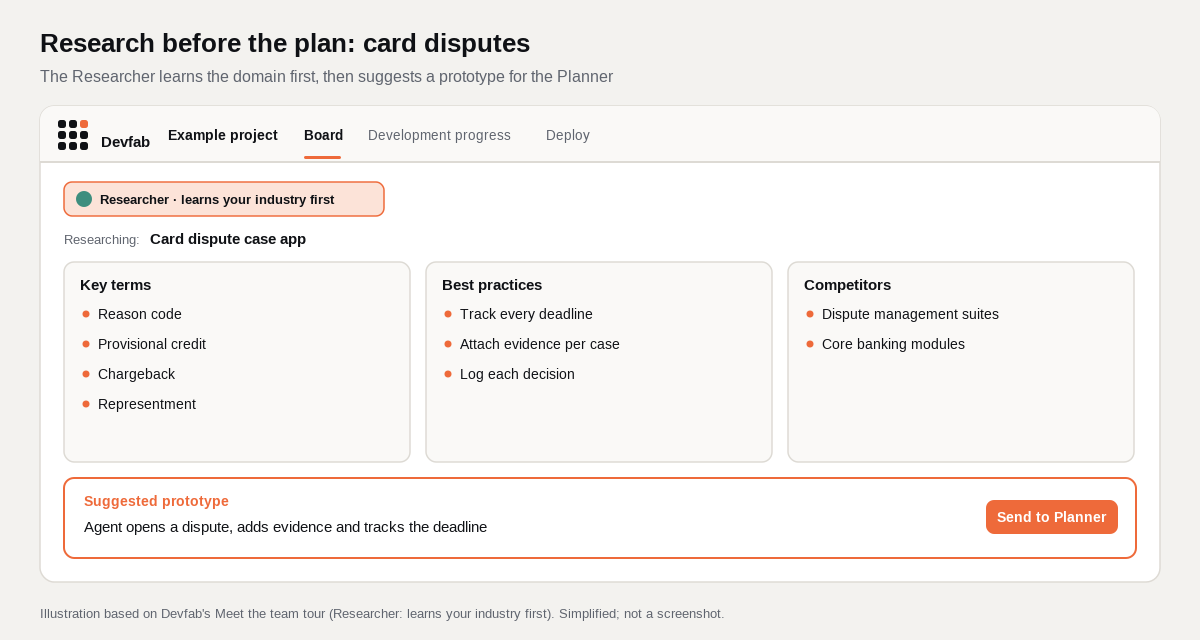
Coding agents automate the developer. Devfab automates the development lifecycle. Its Researcher maps the domain before any plan: dispute reason codes, chargeback deadlines, provisional credit rules and competing products. The Planner writes a plan, and a person approves it. The QA agent runs UI and flow tests, clicking a dispute from intake to resolution, plus logic tests on deadline rules. Code lives in your own GitHub account.
Devfab is in Beta, with a smaller community and fewer integrations than either platform, and no compliance attestations to show a bank auditor. See Devfab vs Appian and Devfab vs ServiceNow App Engine.
FAQ
What is the main difference between ServiceNow App Engine and Appian?
ServiceNow App Engine builds custom workflow apps on the same platform as your ITSM, HR and service data, with Build Agent generating apps and AEMC governing releases. Appian is built around business processes: process models, case management, RPA, document AI and AI agents that run inside those processes.
Do ServiceNow App Engine and Appian publish prices?
No. As of November 2026, ServiceNow lists App Engine Foundation and Prime packages by custom quote. Appian's pricing page lists Standard, Advanced and Premium plans priced per user, per month, per app, with no dollar amounts. Appian offers a free Community Edition instance.
Which one is better for regulated case work?
Appian has the edge for long-running, audited case work: Case Management Studio, RPA bots, an audit view of each step an AI agent took, and AI that can run self-managed on air-gapped infrastructure. ServiceNow is stronger when the cases are service requests already handled on the Now Platform.
Can outside AI coding tools build apps on either platform?
Yes. ServiceNow says Build Agent skills work inside Cursor, Windsurf, Claude Code and GitHub Copilot, with platform governance applied. Appian's MCP Server exposes data fabric, process models and expression rules to external agents, and developers can use assistants such as Claude through a CLI.
Read next
- What is an AI software factory?
- Appian alternatives
- ServiceNow App Engine vs Power Apps
- Appian vs OutSystems
One dispute app, as code your bank owns? Try Beta
Sources (checked November 2026): ServiceNow App Engine; App Engine plans and packages; ServiceNow press release, Apr 9, 2026; ServiceNow press release, May 6, 2026; ServiceNow for state government; Appian pricing; Appian What's New; Appian Q1 2026 release highlights; Appian Q2 2026 product highlights; Blaze: Appian reviews (competitor, Feb 2026).
Frequently asked questions
What is the main difference between ServiceNow App Engine and Appian?
ServiceNow App Engine builds custom workflow apps on the same platform as your ITSM, HR and service data, with Build Agent generating apps and AEMC governing releases. Appian is built around business processes: process models, case management, RPA, document AI and AI agents that run inside those processes.
Do ServiceNow App Engine and Appian publish prices?
No. As of November 2026, ServiceNow lists App Engine Foundation and Prime packages by custom quote. Appian's pricing page lists Standard, Advanced and Premium plans priced per user, per month, per app, with no dollar amounts. Appian offers a free Community Edition instance.
Which one is better for regulated case work?
Appian has the edge for long-running, audited case work: Case Management Studio, RPA bots, an audit view of each step an AI agent took, and AI that can run self-managed on air-gapped infrastructure. ServiceNow is stronger when the cases are service requests already handled on the Now Platform.
Can outside AI coding tools build apps on either platform?
Yes. ServiceNow says Build Agent skills work inside Cursor, Windsurf, Claude Code and GitHub Copilot, with platform governance applied. Appian's MCP Server exposes data fabric, process models and expression rules to external agents, and developers can use assistants such as Claude through a CLI.