Short answer: For a shared hosted builder, pick Lovable or Bolt.new. For Next.js teams that work in pull requests, pick v0. For a team that must ship a tested app to its own server with an approved plan, pick Devfab. Stay on Dyad if you work alone and want free, local, open-source building.
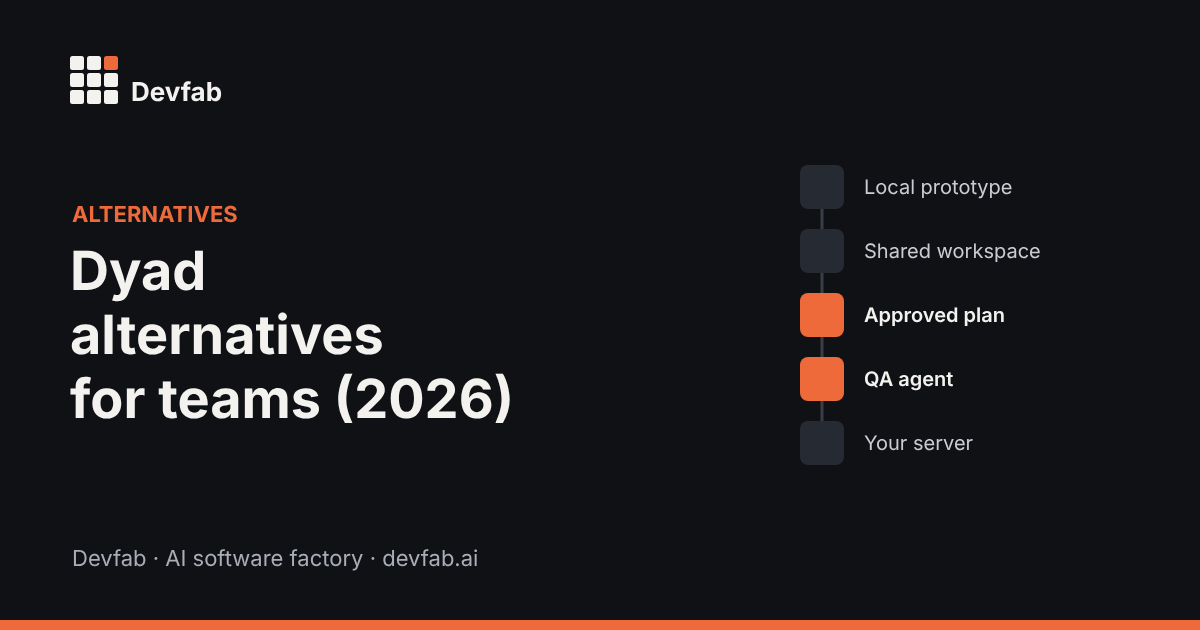
You built a working prototype in Dyad, on your own laptop, for free. Then a colleague asked to help, a client asked for a login, and someone asked who pays for the tokens. Dyad has no shared cloud workspace, and free users manage their own keys and spend (ToolDirectory review, Sep 13, 2026).
None of that makes Dyad a bad tool. It makes it a tool for one person.
In this guide, you'll learn:
Use the sections below as your shortlist.
Why teams leave Dyad
Dyad is active as of November 2026, with no acquisition or rename found. Its latest release is v1.24.0-beta.1, focused on "Improved stability for agent sessions and Git operations" (Dyad). It is a free, open-source desktop app for macOS, Windows and Linux that builds web apps from prompts on your machine, with any AI model.
The triggers we see in reviews and Dyad's own pages:
- One person, one machine. There is no shared cloud workspace for teams, and Dyad is desktop only, with no phone or Chromebook use (ToolDirectory).
- No team admin. No SSO, roles or team admin features are described on the official site (Dyad).
- You run the model bill. Free users bring their own API keys and manage token spend, and output quality "depends heavily on which model you point it at" (ToolDirectory).
- Some parts are experimental. Dyad says "some features are still experimental," and older machines may struggle with local models (Dyad blog).
- No hosting. Dyad deploys to GitHub and Vercel or your own cloud, but does not host apps itself (Dyad).
How we compared
We used vendor docs, pricing pages and dated reviews, re-checked on November 20, 2026. We did not run hands-on tests. Prices appear only where the official pricing page shows them.
Quick comparison
| Tool | Where it runs | Team features | Code and GitHub | Testing | Deploy | Pricing (as of Nov 2026) |
|---|---|---|---|---|---|---|
| Dyad | Desktop app, local | None described | Exports Next.js code | Security scan; parallel E2E test runs | GitHub, Vercel or your cloud | Free (BYOK); Pro USD 20 per month; Max USD 79 per month |
| Lovable | Browser and mobile app | Shared workspace; SSO; SCIM on Enterprise | Git sync creates a new repo; ZIP download on paid plans | Browser testing and frontend tests on request; security scans | Lovable hosting, custom domains | Free; Pro USD 25 per month; Business USD 50 per month |
| Bolt.new | Browser (WebContainers) | Teams plan with admin controls | Import repos; stays on main | Not covered in the docs we checked | Bolt Cloud hosting | Free; Pro USD 25 per month; Teams USD 30 per member per month |
| v0 | Browser, iOS app | Vercel teams; roles and SAML on Enterprise | Works on branches, opens PRs, never pushes to main | Not covered in the docs we checked | Vercel | Free; Plus USD 30 per user per month; Business USD 100 per user per month |
| Replit | Browser cloud workspace | SAML SSO, SCIM, groups, admin policies | Code in Replit workspace | App Testing clicks through the app | Autoscale, Reserved VM, Static, Scheduled | Starter USD 0; Core USD 20 per month; Pro USD 100 per month |
| Devfab | Web workspace | Roles, workspace permissions, Team Delivery Report | Your own GitHub account | QA agent: UI, flow and logic tests | Your own server | Beta; cost logged per task and per project |
| Base44 | Browser | Workspaces with Owner, Editor, Viewer roles | Two-way GitHub sync on Builder and up | Not covered in the docs we checked | Base44 hosting | Free; Starter USD 16 per month; Builder USD 40 per month (annual) |
Sources: Dyad, Lovable FAQ, Lovable pricing, Bolt pricing, v0 pricing, Replit pricing, Base44 pricing.
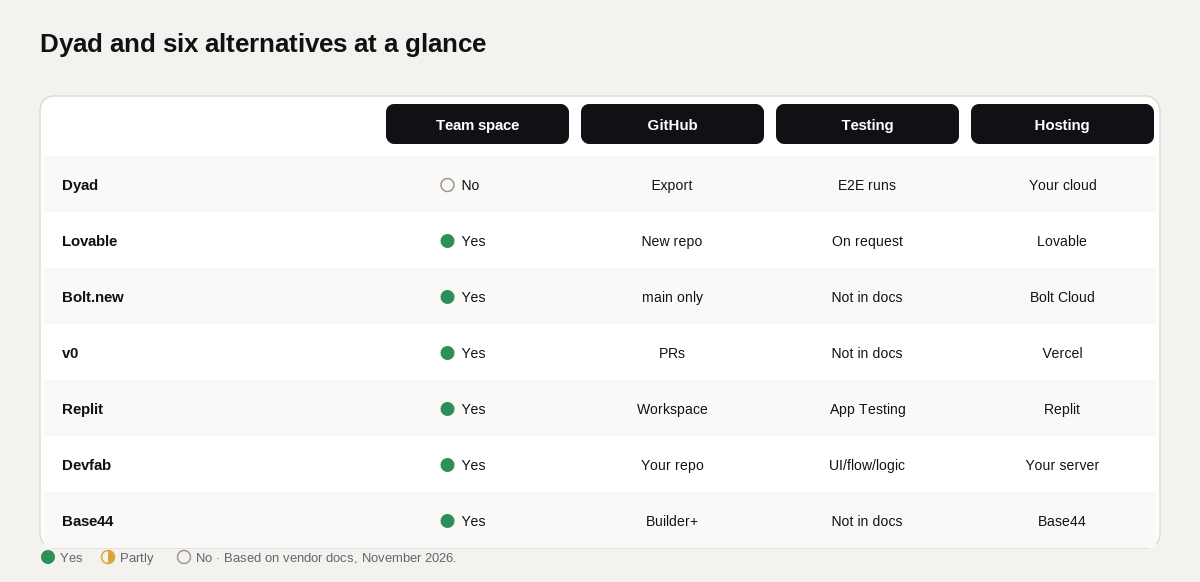
The alternatives
Lovable
Verdict: the closest hosted match to Dyad's prompt-to-app flow, with a shared workspace. Best for: non-coders and mixed teams who want hosting and login built in. Trade-off: no choice of framework, database or model, and Git sync can't link an existing repo. Pricing: Free USD 0; Pro USD 25 per month; Business USD 50 per month; priced by credits, not per user (Lovable pricing).
- Built-in backend with managed PostgreSQL, login and file storage, or Supabase (Lovable FAQ).
- Publish deploys to its own URL with HTTPS; a quick security scan runs on every publish.
- Enterprise adds SSO, SCIM, audit logs and approval-gated publishing (Lovable for Enterprise).
- From September 9, 2026, Free and Pro data may be used for model training unless users opt out (Lovable FAQ).
Bolt.new
Verdict: a full dev environment in the browser, with hosting, databases and payments. Best for: teams who want nothing to install and like to edit code by hand as well as by chat. Trade-off: the project stays on main and cannot switch branches. Pricing: Free USD 0; Pro USD 25 per month; Teams USD 30 per member per month; Enterprise custom (Bolt pricing).
- Starts from a prompt, a Figma frame, a GitHub repo or a Lovable project (Intro to Bolt).
- Bolt Cloud adds hosting, auto-created databases, auth, file storage and Stripe payments (Bolt Cloud).
- When a plan's hosting usage runs out, the site stops displaying publicly until usage resets.
v0
Verdict: the pick for Next.js teams that review every change in a pull request. Best for: teams already on Vercel. Trade-off: the full experience needs Vercel, and branch protection can block v0's merges. Pricing: Free USD 0; Plus USD 30 per user per month; Business USD 100 per user per month; Enterprise custom (v0 pricing).
- Imports existing repos, works on a branch with per-branch previews, and "never pushes directly to
main" (v0 GitHub docs). - Design Mode writes visual edits back to code (v0 Design Mode).
- v0 warns output "may be incomplete" and agents can fail repeatedly and use credits (v0 FAQs).
Replit
Verdict: a cloud workspace where the Agent builds, tests and publishes. Best for: teams that want hosting, testing and admin policies in one cloud product. Trade-off: App Testing covers only full-stack JavaScript and Streamlit Python web apps. Pricing: Starter USD 0; Core USD 20 per month; Pro USD 100 per month; Enterprise custom (Replit pricing).
- App Testing lets Agent click through the app in a real browser and fix issues (App Testing).
- Publishing options include Autoscale, Reserved VM, Static and Scheduled deployments (Publish).
- Admins get SAML SSO, optional SCIM and policies on models and publishing (Replit teams).
Devfab
Verdict: the pick when the app must go to production for a client, with a plan, tests and your own server. Best for: agencies and IT teams that ship client projects. Trade-off: in Beta, with a smaller community and fewer integrations; not an editor and not open source; needs a GitHub account. Pricing: no public price; predictable cost, logged after each run, per task and per project.
- The Researcher maps the domain first, then a person approves the plan before tickets exist.
- ChainFlow maps which functions and APIs call each other and what is deployed, so dev agents see what a change touches.
- The QA agent runs UI and flow tests (screens, buttons and user journeys clicked end to end) plus logic tests.
- Code lives in your own GitHub account or your organization's, and Deploy ships to your own server.
Base44
Verdict: a fully managed builder for internal tools and simple customer apps. Best for: founders who want frontend, backend and database generated and hosted in one place. Trade-off: no GitHub sync on Free or Starter, and a Lovable comparison states the backend stays on Base44 when you export. Pricing: Free USD 0; Starter USD 16 per month; Builder USD 40 per month; Pro USD 80 per month; billed annually (Base44 pricing).
- Owned by Wix since June 2025 and runs as a standalone product (Base44 guide).
- Two-way GitHub sync from the Builder plan; the default branch must be
main(Base44 GitHub docs). - Workspaces have their own plan, a shared credit pool and roles (Base44 workspaces).
Where Dyad is still the better choice
- You build alone and want to own everything locally, including fully offline work with local models through Ollama or LM Studio.
- You want to pay model providers directly. Dyad Free is BYOK with no sign-up.
- Open source matters. Dyad is Apache 2.0 outside its
src/profolder, which uses the fair-source Functional Source License (GitHub). - Your stack is Next.js with Supabase or Neon, and you plan to continue in VS Code.
- No vendor hosting. You deploy where you want.
Where Devfab fits
Coding agents automate the developer. Devfab automates the development lifecycle. App builders like Dyad sit close to that line: they automate the first version. A Dyad prototype proves an idea; a client app also needs research, a plan someone signs off, tests and a home on a server.
Take a tenant maintenance-request app for a property manager. In Devfab, the Researcher maps terms such as work orders and service-level rules, best practices and similar products, then suggests a prototype. The Planner writes the plan and a person approves the plan. Dev agents build with ChainFlow, the QA agent checks that a tenant can file a request with a photo and get a status update, and Deploy ships to your server.
If you already have Dyad code on GitHub, choose "Work on an existing project," leave the change box empty, and ChainFlow maps the code and suggests three small first tickets. See Devfab vs Dyad.
How to choose
- Working alone, offline, on a budget? Stay on Dyad.
- Need a shared, hosted builder fast? Lovable or Bolt.new.
- Next.js team that reviews pull requests? v0.
- Need testing, hosting and admin in one cloud? Replit.
- Shipping a client app with a plan, QA and your own server? Devfab.
- Internal tool, fully managed, low entry price? Base44.
FAQ
What is the best Dyad alternative for a team?
It depends on what the team needs. Lovable and Bolt.new give a shared, hosted workspace with GitHub sync. v0 fits teams on Vercel and Next.js that work through pull requests. Devfab fits teams that need research, an approved plan, QA tests and deployment to their own server.
Is there a free, open-source alternative to Dyad?
Among the tools on this list, no. Dyad is open source (Apache 2.0, with a fair-source Pro folder) and free with your own API key. Lovable, Bolt.new, v0, Replit and Base44 all have free tiers but are hosted products, not open source. Devfab is in Beta and not open source.
Can I move a Dyad project to another tool?
Yes. Dyad exports standard Next.js code you can push to GitHub. Bolt.new and v0 can import a GitHub repo, and Devfab works on an existing repo in your GitHub account. Lovable's Git sync always creates a new repository and cannot link an existing one.
Why do people look for Dyad alternatives?
The usual reasons are teamwork and operations. Dyad is a desktop app with no shared cloud workspace, no SSO or roles described on its site, and free users manage their own API keys and token spend. Output quality also depends on which model you point it at.
Read next
- What is an AI software factory?
- Dyad vs Lovable
- Dyad vs Bolt.new
- Bolt.new alternatives for teams that ship to production (2026)
Prototype done? Take it to production with a plan and a test report. Try Beta
Sources (checked November 2026): Dyad homepage; dyad-sh/dyad on GitHub; Dyad blog: Free AI app builders compared (Jan 29, 2026); ToolDirectory.ai: Dyad review (Sep 13, 2026); Lovable FAQ; Lovable for Enterprise; Lovable GitHub sync; Lovable pricing; Intro to Bolt; Bolt Cloud; Bolt Git integration; Bolt pricing; v0 FAQs; v0 GitHub; v0 Design Mode; v0 pricing; Replit App Testing; Replit publishing; Replit teams; Replit pricing; Base44 guide; Base44 GitHub sync; Base44 workspaces; Base44 pricing; Lovable: Base44 vs Lovable (Jul 17, 2026).
Frequently asked questions
What is the best Dyad alternative for a team?
It depends on what the team needs. Lovable and Bolt.new give a shared, hosted workspace with GitHub sync. v0 fits teams on Vercel and Next.js that work through pull requests. Devfab fits teams that need research, an approved plan, QA tests and deployment to their own server.
Is there a free, open-source alternative to Dyad?
Among the tools on this list, no. Dyad is open source (Apache 2.0, with a fair-source Pro folder) and free with your own API key. Lovable, Bolt.new, v0, Replit and Base44 all have free tiers but are hosted products, not open source. Devfab is in Beta and not open source.
Can I move a Dyad project to another tool?
Yes. Dyad exports standard Next.js code you can push to GitHub. Bolt.new and v0 can import a GitHub repo, and Devfab works on an existing repo in your GitHub account. Lovable's Git sync always creates a new repository and cannot link an existing one.
Why do people look for Dyad alternatives?
The usual reasons are teamwork and operations. Dyad is a desktop app with no shared cloud workspace, no SSO or roles described on its site, and free users manage their own API keys and token spend. Output quality also depends on which model you point it at.