Short answer: Dyad wins when a solo builder wants to own everything: files on their own machine, any model including offline local ones, and an open-source app with no platform subscription. Lovable wins when you want a hosted app with a built-in backend and login, one-click publishing, and a shared workspace where a team builds together.
You want to describe an app and get one. Lovable is the name everyone knows. Dyad pitches itself as the free, local alternative with no lock-in. Vendor comparisons go stale fast: Dyad's own page says Lovable's free plan is public-only, while Lovable's plan docs now list private projects on Free. This page checks both against their current docs.
In this comparison:
- Dyad and Lovable at a glance
- Feature comparison
- Cost model by team size
- Where Dyad wins and where Lovable wins
- Where Devfab fits
Here's how each one compares.
Dyad and Lovable at a glance
Status changes in 2026. Lovable moved new apps to TanStack Start with server rendering on May 13, 2026, introduced one credit balance on June 1, and from September 9, 2026 may use Free and Pro data for model training unless users opt out; Business and Enterprise are excluded by default (Lovable FAQ). Dyad has no renames or acquisitions; its latest release, v1.23.0, added parallel E2E test runs (Dyad).
Dyad is a free, open-source desktop app for macOS, Windows and Linux that builds web apps from prompts on your own computer (Dyad). It connects Supabase or Neon with one click for databases, migrations and auth, runs a security scan, and deploys to GitHub and Vercel or your own cloud. Code outside src/pro is Apache 2.0; src/pro uses the Functional Source License (GitHub).
Lovable is a browser-based builder that generates and hosts full-stack web apps from plain-language prompts, with a mobile app for building from a phone (Lovable FAQ). It serves people with no coding experience and developers who edit the code. Build mode changes the project, Plan mode writes a plan for approval first, and Chat mode answers questions.
Feature comparison
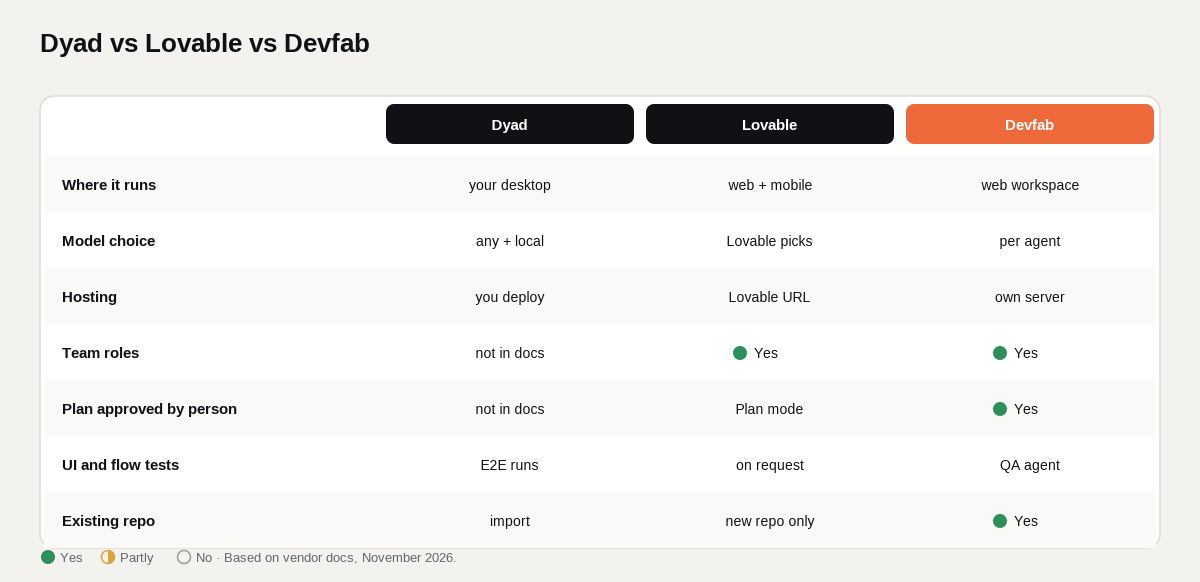
| Aspect | Dyad | Lovable | Source |
|---|---|---|---|
| Where it runs | Desktop app; projects stay on your computer | Web app and mobile app; hosted projects | Dyad; Lovable FAQ |
| Planning | Not covered in the docs we checked | Plan mode writes a plan for approval before changes | Lovable FAQ |
| Backend | One-click Supabase or Neon | Built-in backend (PostgreSQL, login, storage) or Supabase | Dyad; Lovable FAQ |
| Testing and security | Security scan for injection and misconfigurations; parallel E2E test runs | Browser testing and frontend tests on request; Quick scan on every publish, Deep scan on demand | Dyad; Lovable FAQ |
| Deploy and hosting | GitHub and Vercel, or your own cloud; no Dyad hosting | Publish to a Lovable URL with HTTPS; custom domains on paid plans | Dyad; Lovable FAQ |
| Code ownership | Import existing repos; edit in VS Code; export cleanly | Git sync to GitHub, GitLab or Bitbucket (always a new repo); ZIP download on paid plans | Dyad; Lovable GitHub |
| Team and admin | No SSO, roles or team admin described | Roles, drafts, SSO from Business; SCIM and audit logs on Enterprise | Dyad; Lovable Enterprise |
| Model choice | Anthropic, OpenAI, Google or local models; BYOK; offline use | Lovable picks the model; no framework or database choice | Dyad; Lovable FAQ |
| Pricing model | Free with your own key; paid tiers with monthly credits | Credits, not seats; one balance covers building, hosting and backend | Dyad; Lovable plans |
Cost model by team size
| Team size | Dyad | Lovable | Devfab |
|---|---|---|---|
| 1 person | Free with your own API key or local models; Pro USD 20 a month (200 credits); Max USD 79 (900 credits) | Free: 5 daily build credits, up to 30 a month; Pro USD 25 a month for 100 credits (USD 21 a month billed annually) | Cost logged per task and per project (Beta) |
| 5 people | A plan per builder on their own machine; share code through Git | Business USD 50 a month for 100 credits (USD 42 billed annually), with SSO; collaborators spend the workspace's credits | Cost logged per task and per project (Beta) |
| 25 people | No team admin, SSO or roles described | Enterprise by contract: SCIM, audit logs, publish approval | Cost logged per task and per project (Beta) |
Prices as of November 2026 from Dyad and Lovable subscription plans. Lovable's Pro and Business offer higher credit tiers. Devfab is in Beta and offers predictable cost: cost is logged after each run, per task and per project.
Where Dyad wins
- Files must stay on your machine. Projects are stored locally, and Dyad apps are private by default.
- You want any model, even offline. Switch between Anthropic, OpenAI and Google, or run local models through Ollama or LM Studio.
- You'd rather pay the model provider than a platform. The Free plan runs on your own key with no sign-up.
- You already have a repo. Dyad imports existing repos; Lovable's Git sync always creates a new one.
- Your data is sensitive. Lovable's terms do not allow health data, card data or government identifiers, and Lovable is not HIPAA-compliant. Dyad leaves hosting to you.
Where Lovable wins
- You want it live today. Publish gives your app a URL with HTTPS, with no hosting to set up.
- You need a backend without setup. Built-in PostgreSQL, login and file storage come with the plan.
- A team builds together. Roles, drafts and shared credits let several people work in one project.
- You build from anywhere. Lovable runs in a browser and on iOS and Android; Dyad is desktop only.
- Compliance paperwork matters. Lovable holds SOC 2 Type II and ISO 27001:2022, with SSO from Business.
Switching from one to the other
From Lovable to Dyad. Connect your Lovable project to GitHub with Git sync, or download the ZIP on a paid plan (Lovable GitHub). Then import the repo in Dyad (Dyad). If you used Lovable's built-in backend, plan how data and login move to Supabase or Neon before you switch.
From Dyad to Lovable. Lovable's Git sync always creates a new repository and cannot link an existing one, and the docs we checked don't describe importing outside code. Expect to rebuild in Lovable from a description, using your Dyad app as the reference.
Where Devfab fits
Dyad and Lovable both get you a first version fast. In the docs we checked, neither researches your domain before building, runs a separate QA step with UI and flow tests across user journeys, or deploys to your own server with a delivery report.
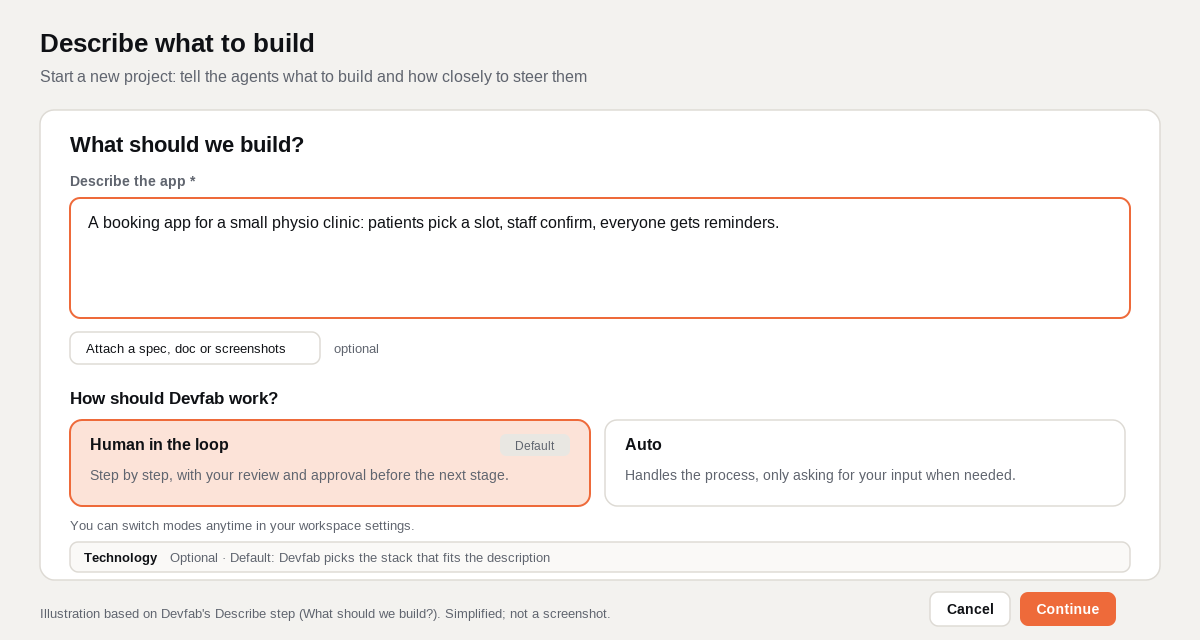
App builders automate the first version. Devfab automates the development lifecycle. You describe what to build, the Researcher maps key terms, best practices and competitors, and the Planner writes a plan that a person approves. Dev agents build with ChainFlow, the QA agent runs UI, flow and logic tests, and Deploy ships to your own server. Code lives in your own GitHub account.
Honest limits: Devfab is new and in Beta, with a smaller community and fewer integrations than Lovable. It is not an editor, it does not run offline like Dyad, and it needs a GitHub account. See Devfab vs Dyad and AI app builder vs AI coding agent.
FAQ
Is Dyad really a free Lovable alternative?
Dyad's Free plan needs no sign-up and runs on your own API key or free local models, so you pay the model provider, not Dyad. Paid plans add credits and Pro modes. Lovable also has a Free plan, with 5 daily build credits capped at 30 a month, and it hosts the app for you.
Can I choose the AI model in Lovable?
No. Lovable's FAQ says it selects the model behind build and chat, and it also does not offer a choice of framework or database. Dyad lets you switch between Anthropic, OpenAI, Google and local models through Ollama or LM Studio.
Does Dyad host my app?
No. Dyad says it deploys to GitHub and Vercel, or to your own cloud, but it does not host apps itself. Lovable's Publish puts a snapshot of your project on its own URL with HTTPS, and paid plans add custom domains.
Which is better for a team?
Lovable, today. It has project and workspace roles, several people can work in one project through drafts, and SSO starts on Business. A September 2026 review notes Dyad has no shared cloud workspace for teams, and its site describes no SSO or roles.
Read next
Ready to take a prototype to a tested app on your own server? Try Beta
Sources (checked November 13, 2026): Dyad homepage; dyad-sh/dyad on GitHub; Dyad docs: Dyad vs Lovable (vendor page); ToolDirectory.ai: Dyad review (Sep 13, 2026); Lovable FAQ; Lovable: Subscription plans; Lovable: Plans and credits; Lovable: GitHub Git sync; Lovable: Collaboration; Lovable for Enterprise.
Frequently asked questions
Is Dyad really a free Lovable alternative?
Dyad's Free plan needs no sign-up and runs on your own API key or free local models, so you pay the model provider, not Dyad. Paid plans add credits and Pro modes. Lovable also has a Free plan, with 5 daily build credits capped at 30 a month, and it hosts the app for you.
Can I choose the AI model in Lovable?
No. Lovable's FAQ says it selects the model behind build and chat, and it also does not offer a choice of framework or database. Dyad lets you switch between Anthropic, OpenAI, Google and local models through Ollama or LM Studio.
Does Dyad host my app?
No. Dyad says it deploys to GitHub and Vercel, or to your own cloud, but it does not host apps itself. Lovable's Publish puts a snapshot of your project on its own URL with HTTPS, and paid plans add custom domains.
Which is better for a team?
Lovable, today. It has project and workspace roles, several people can work in one project through drafts, and SSO starts on Business. A September 2026 review notes Dyad has no shared cloud workspace for teams, and its site describes no SSO or roles.