Short answer: For a like-for-like AI pull request reviewer, pick CodeRabbit. If your code already lives on GitHub, Copilot code review is the simplest add-on. If the gap is proof that the running app works, look at mabl for testing or Devfab, which plans, builds, tests and deploys the app instead of only reviewing it.
Your coding agents write more pull requests than anyone can read, so you bought an AI reviewer. Now the questions change. Credits expire every month. There is no free plan to keep around. And a clean review still doesn't tell you whether the B2B quote tool calculates a discount correctly when a sales rep clicks through it.
Those are the three reasons teams shop around. Some want a cheaper reviewer, some want a reviewer inside the tools they already pay for, and some want testing or a full delivery process instead.
In this guide, you'll learn:
- Why teams leave Qodo
- The six alternatives in one table
- Where Qodo is still the better choice
- How to choose
Use the sections below as your shortlist.
Why teams leave Qodo
Status first: Qodo is active and growing. It was called CodiumAI until 2024, and it raised a USD 70 million Series B led by Qumra Capital on March 30, 2026, for USD 120 million in total funding (Globes). Its homepage now leads with "Code review for agents. Governance for humans." and marks Software Map and the Agentic Toolbox CLI as new. Qodo Gen and Qodo Merge are no longer the headline products (Qodo).
The switching triggers we found, all from Qodo's own pages:
- No permanent free tier. There is a free trial and an open-source program, but nothing to keep running for free (Qodo pricing).
- Credits expire. Pro Team buys pooled credits at USD 0.015 each, in packs of 2,000, 4,000 or 16,000 per month (about 14, 29 or 114 reviews), as of November 2026, and unused credits expire at the end of each cycle (Qodo pricing).
- Review is not delivery. Qodo reviews and governs code. It does not build, host or deploy applications (Qodo).
- Enterprise starts at 30 users, on custom pricing (Qodo pricing).
Quick comparison
| Tool | What it is | Runs where | Tests the running app? | Pricing (as of November 2026) |
|---|---|---|---|---|
| Qodo | Multi-agent PR review and governance | GitHub, GitLab, Bitbucket, Azure DevOps; IDEs; CLI | Not covered in the pages we checked | Pooled credits at USD 0.015 each; Enterprise custom |
| CodeRabbit | AI PR reviewer plus Verify (beta) | GitHub, GitLab, Azure DevOps, Bitbucket; IDEs; CLI | Verify, beta, web apps only | USD 24 to 72 per user per month; Enterprise custom |
| GitHub Copilot code review | PR review inside Copilot | GitHub and editors | Not covered in the pages we checked | Business USD 19 per granted seat per month |
| Cursor Bugbot | PR reviewer with Autofix | Pull requests, with Cursor cloud agents for fixes | Not covered in the pages we checked | Usage-based |
| Harness Cosmos (Augment) | Agent "software factory" with a Deep Reviewer | Cosmos, CLI, IDEs | Not covered in the pages we checked | Standard USD 20 per month flat (Augment page) |
| mabl | Agentic test platform | Cloud plus MCP, PR checks | Yes: web, mobile, API | Quote-based |
| Devfab | AI software factory | Web workspace, your GitHub, your server | QA agent runs UI, flow and logic tests | Cost logged per task and per project (Beta) |
The alternatives
CodeRabbit
Verdict: the closest match to Qodo, with clearer per-seat prices. Best for: teams that want AI review on every PR and in the IDE before they push. Trade-off: SSO, custom roles, audit logs and self-hosting are Enterprise-only. Pricing: Essentials USD 24, Team USD 48 and Advanced USD 72 per user per month, as of November 2026, with fair-usage caps on reviews (CodeRabbit pricing).
- Works on GitHub, GitLab, Azure DevOps and Bitbucket, with IDE extensions and a CLI that "Works with Claude Code, Cursor, Codex, Gemini, and more" (CodeRabbit docs).
- Verify, a beta agent, runs the app in a sandbox, mostly through a browser, and reports bugs with screenshots and recordings. It is free during the beta and does not cover native mobile (Verify docs).
- Blast-radius and architecture impact analysis sit on the Advanced plan (CodeRabbit pricing).
- Raised a USD 143 million Series C on August 12, 2026 (CodeRabbit newsroom).
GitHub Copilot code review
Verdict: the easiest choice if your code, issues and PRs already live on GitHub. Best for: organizations that already pay for Copilot Business or Enterprise. Trade-off: PR code review is not on the Free plan, and the cloud agent only works with repositories hosted on GitHub. Pricing: Business USD 19 and Enterprise USD 39 per granted seat per month, with pooled AI credits, as of November 2026 (Copilot plans).
- Reviews pull requests on GitHub and file diffs in editors on paid plans (Copilot plans).
- Enterprise AI Controls went GA on February 26, 2026, with an AI administrator role and agent activity in audit logs (GitHub changelog).
- GitHub itself warns that Copilot "can produce incorrect or suboptimal code, including code that contains security vulnerabilities" (GitHub Docs).
See also Qodo vs GitHub Copilot.
Cursor Bugbot
Verdict: a reviewer that can also push the fix. Best for: teams already on Cursor that want review and fixes in one loop. Trade-off: Cursor was acquired by SpaceX (closed per Cursor's August 14, 2026 post), and Autofix is billed separately as cloud-agent usage. Pricing: usage-based (Bugbot docs).
- Bugbot "reviews pull requests and identifies bugs, security issues, and code quality problems"; Autofix spawns a cloud agent to push fixes to a branch (Bugbot docs).
- Cloud agents support GitHub, GitLab, Bitbucket Cloud and Azure DevOps (Cursor docs).
- Ownership changed: SpaceX agreed to buy Cursor's maker in June 2026 (Cursor blog).
Harness Cosmos (Augment Code)
Verdict: review as one expert inside a larger agent pipeline, now owned by Harness. Best for: large engineering organizations already on Harness CI/CD. Trade-off: contract and plugin futures are not yet stated after the acquisition. Pricing: Augment's page lists Standard at USD 20 per month flat and Business at USD 100 per month flat, as of November 2026, with no Harness migration notice (Augment pricing).
- Harness acquired Cosmos, the Auggie CLI and the Context Engine on October 8, 2026 (Harness).
- Cosmos runs prebuilt "Experts" such as Deep Code Reviewer and CI Failure Investigator, with quality gates and human approval checkpoints (Augment).
- An analyst note says neither company has said what happens to existing contracts or prepaid credits (BERI).
mabl
Verdict: not a code reviewer, but an independent tester for AI-written code. Best for: QA teams that need a release verdict across web, mobile and API. Trade-off: no public prices; desktop testing was still "coming soon" in October 2026. Pricing: quote-based, with credits from an annual allocation (mabl pricing).
- Promises "an independent verdict before every release" (mabl).
- Its October 2026 harness adds a knowledge graph that maps a change to its tests and "highlights coverage gaps" (SD Times).
- Posts GitHub PR status checks and connects to IDEs and Cursor through an MCP server (mabl platform).
Devfab
Verdict: for teams whose real problem is shipping the whole app, not reviewing one more PR. Best for: agencies and IT teams that deliver client apps and need research, an approved plan, tests and deployment in one place. Trade-off: in Beta, with a smaller community and fewer integrations. It is not a drop-in PR reviewer for code written elsewhere. Pricing: predictable cost; cost is logged after each run, per task and per project.
- The Researcher maps the domain before the Planner writes the plan, and a person approves the plan.
- ChainFlow maps which functions and APIs call each other and what is deployed, so a change to quote pricing shows its impact on discounts, invoices and order emails before it ships.
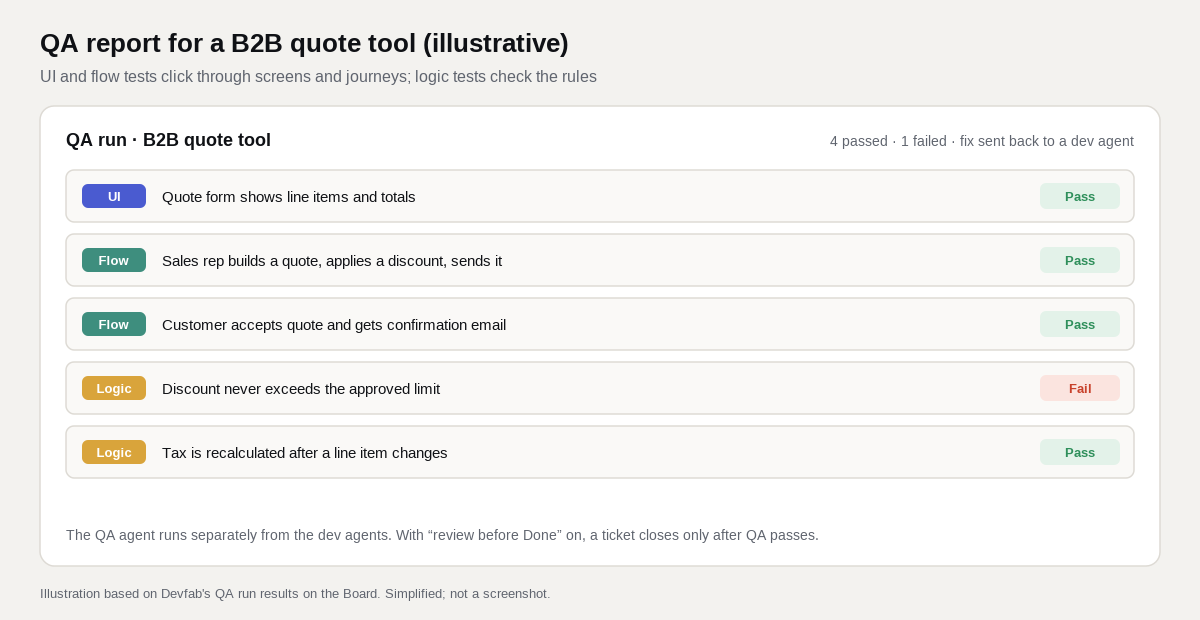
- The QA agent runs UI and flow tests (screens, buttons and user journeys clicked end to end) plus logic tests. Code stays in your GitHub account, and Deploy ships to your own server.
Coding agents automate the developer. Devfab automates the development lifecycle.
Where Qodo is still the better choice
- You need review across many repos. Cross Repo Review flags changes that could break downstream repositories, and Software Map shows how repos, services and contracts connect (Qodo).
- Rules must evolve with the team. Rules & Skills Lifecycle turns engineering practices into standards that every PR is checked against.
- Strict data rules apply. Single-tenant SaaS or on-prem and air-gapped deployment, zero data retention and SOC 2 Type II (Qodo pricing).
- You want to bring your own model, including self-hosted models on Enterprise.
- You run many coding agents. The Agentic Toolbox adds a quality layer for agents such as Codex, Claude and Kiro.
How to choose
- Same job, simpler pricing: CodeRabbit.
- Everything is on GitHub already: Copilot code review.
- Your team works in Cursor: Bugbot.
- You need the running app tested, not just the diff: mabl, or CodeRabbit Verify for web apps.
- You need the project delivered, tested and deployed: Devfab. Read AI code review vs QA agent for where each check fits.
FAQ
What is the closest alternative to Qodo?
CodeRabbit. Both review pull requests with AI across GitHub, GitLab, Azure DevOps and Bitbucket, run in the IDE and CLI, and add security checks. CodeRabbit lists per-user prices; Qodo's Pro Team plan uses pooled credits. CodeRabbit also has Verify, a beta agent that tests running app behavior.
Is Qodo still CodiumAI?
Qodo is the same company. It was called CodiumAI and renamed itself Qodo in 2024. In March 2026 it raised a USD 70 million Series B. Its homepage now leads with multi-agent code review and governance rather than the older Qodo Gen and Qodo Merge names.
Does Qodo have a free plan?
Not a permanent one. As of November 2026, Qodo offers a free trial without a credit card and a free program that qualifying open-source projects can apply for. Pro Team is credit-based, and Enterprise is custom-priced for 30 or more users.
Do I need code review or end-to-end testing for AI-written code?
Usually both. A reviewer like Qodo reads the diff and checks rules. A test platform or QA agent runs the app and clicks through user journeys. Review catches logic and rule problems in code; flow tests catch screens and journeys that break when they run.
Read next
Want the app tested on real user journeys before it ships? Try Beta
Sources (checked November 2026): Qodo homepage; Qodo pricing; Globes: Qodo raises USD 70m (Mar 30, 2026); CodeRabbit pricing; CodeRabbit docs; CodeRabbit Verify docs; CodeRabbit Series C (Aug 12, 2026); GitHub Copilot plans; GitHub Docs: Copilot cloud agent; GitHub changelog: Enterprise AI Controls GA (Feb 26, 2026); Cursor Bugbot docs; Cursor cloud agents; Cursor blog: Joining SpaceX; Augment: software factory; Augment pricing; Harness acquires Augment Code (Oct 8, 2026); BERI: Harness and Augment contracts (Oct 9, 2026); mabl AI test automation; mabl platform; mabl pricing; SD Times: mabl agentic testing harness (Oct 2026).
Frequently asked questions
What is the closest alternative to Qodo?
CodeRabbit. Both review pull requests with AI across GitHub, GitLab, Azure DevOps and Bitbucket, run in the IDE and CLI, and add security checks. CodeRabbit lists per-user prices; Qodo's Pro Team plan uses pooled credits. CodeRabbit also has Verify, a beta agent that tests running app behavior.
Is Qodo still CodiumAI?
Qodo is the same company. It was called CodiumAI and renamed itself Qodo in 2024. In March 2026 it raised a USD 70 million Series B. Its homepage now leads with multi-agent code review and governance rather than the older Qodo Gen and Qodo Merge names.
Does Qodo have a free plan?
Not a permanent one. As of November 2026, Qodo offers a free trial without a credit card and a free program that qualifying open-source projects can apply for. Pro Team is credit-based, and Enterprise is custom-priced for 30 or more users.
Do I need code review or end-to-end testing for AI-written code?
Usually both. A reviewer like Qodo reads the diff and checks rules. A test platform or QA agent runs the app and clicks through user journeys. Review catches logic and rule problems in code; flow tests catch screens and journeys that break when they run.