Short answer: GitHub Copilot wins for almost every team choosing today: it is active, runs across GitHub, IDEs and the terminal, and its cloud agent opens pull requests. Amazon Q Developer wins only for teams that already hold Pro seats and need AWS-aware help until its end of support on April 30, 2027.
You run on AWS, and your developers asked for an AI coding assistant. Q Developer looked like the safe pick. Then AWS announced the end of support. Now you are comparing it with GitHub Copilot, and most reviews online still treat both as long-term options.
One side says stay with the AWS-native tool. The other says move to where the code lives. This page is the referee, using vendor pages checked on November 20, 2026.
In this comparison:
- GitHub Copilot and Amazon Q Developer at a glance
- Feature comparison
- Cost model by team size
- Where GitHub Copilot wins
- Switching from one to the other
Read the status section first. It changes the answer.
GitHub Copilot and Amazon Q Developer at a glance
Amazon Q Developer is being retired. AWS announced on April 30, 2026 that the Q Developer IDE plugins and paid subscriptions reach end of support on April 30, 2027, with Kiro as the migration target. New subscriptions and new Free Tier accounts were blocked from May 15, 2026 (AWS DevOps blog). On November 5, 2026, the console surface was renamed "AWS assistant" and is offered free for now (AWS What's New). The Q Developer CLI was already replaced: "Kiro CLI is the next update of the Q CLI" (Kiro docs).
Until then, Q Developer is an AWS coding assistant with IDE plugins for VS Code, JetBrains, Visual Studio and Eclipse (preview), a CLI agent, and GitHub and GitLab integrations (AWS). It can query your AWS resources, which no general assistant does by default.
GitHub Copilot is active and expanding. It runs on GitHub.com, GitHub Mobile, IDEs, Copilot CLI, Windows Terminal and a desktop app for parallel agent sessions (GitHub Docs). A new "Copilot in the cloud" experience reached paid plans on October 28, 2026, and plans are now described in GitHub AI Credits (GitHub Docs; GitHub plans docs).
Copilot is for developers and organizations whose work already runs through GitHub. Q Developer was for developers building on AWS.
Feature comparison
| Aspect | GitHub Copilot | Amazon Q Developer | Source |
|---|---|---|---|
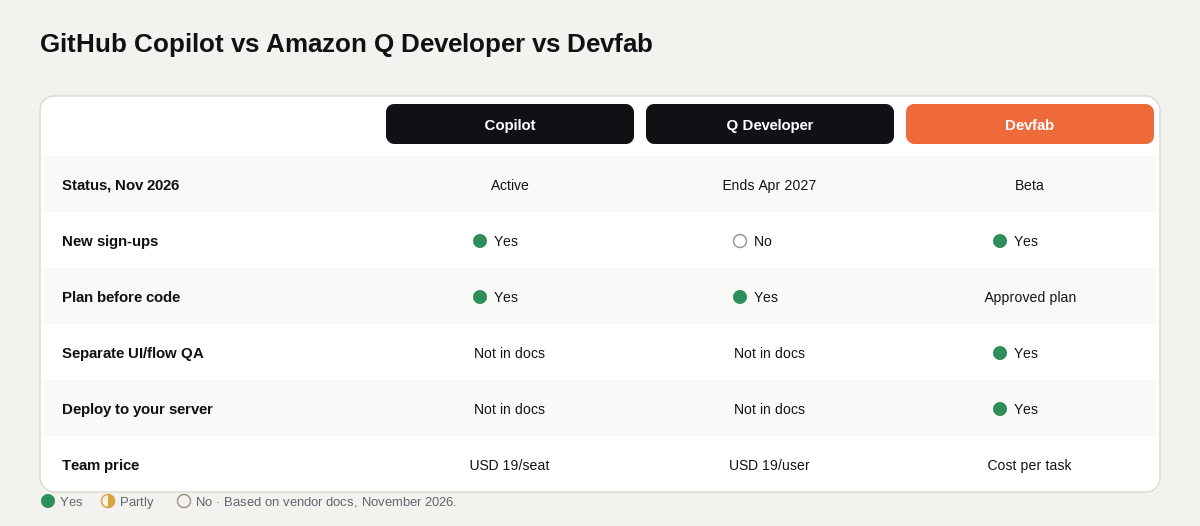
| Status (Nov 2026) | Active | End of support April 30, 2027; new sign-ups blocked | Copilot plans; AWS blog |
| Where it runs | GitHub.com, Mobile, IDEs, CLI, desktop app | VS Code, JetBrains, Visual Studio, Eclipse (preview), CLI, GitHub, GitLab | Copilot features; Q build page |
| Planning | Cloud agent researches the repo and creates an implementation plan | Agent plans multi-file features, then changes code and tests after approval | Copilot features; Q build page |
| Agent autonomy | Cloud agent works in an Actions-based environment or cloud sandbox and opens a PR | Assign GitHub issues to Q; IDE agent writes files and runs shell commands | Copilot cloud agent; Q build page |
| Review and security | PR code review on paid plans | Security scans and automated PR reviews, including IaC checks | Copilot plans; Q build page |
| Deploy and hosting | Not covered in the docs we checked | Not covered in the docs we checked | — |
| Team and admin | Policies, usage data, audit logs (Enterprise), agent control plane GA Feb 26, 2026 | Admin dashboard, Identity Center, IP indemnity on Pro | GitHub changelog; Q pricing |
| Model choice | Models from OpenAI, Anthropic, Google, Microsoft, Moonshot AI and xAI | Newest coding models ship only in Kiro | Copilot models; AWS blog |
| Pricing model | Seats or tiers plus GitHub AI Credits | Free Tier and per-user Pro Tier; Java transformation billed per line | Copilot plans; Q pricing |
Cost model by team size
| Team size | GitHub Copilot | Amazon Q Developer | Devfab |
|---|---|---|---|
| 1 person | Free USD 0; Pro USD 10 per user per month; Pro+ USD 39; Max USD 100 | Free Tier USD 0, but new Free Tier accounts blocked since May 15, 2026 | Cost logged per task and per project (Beta) |
| 5 people | Business USD 19 per granted seat per month, pooled credits | Pro USD 19 per user per month, for existing subscriptions only | Cost logged per task and per project (Beta) |
| 25 people | Business, or Enterprise USD 39 per granted seat per month | Pro, existing subscriptions can add users until end of support | Cost logged per task and per project (Beta) |
Prices as of November 2026 from GitHub Copilot plans and Amazon Q Developer pricing. Copilot bills use beyond the credit pool at USD 0.01 per credit. AWS's pricing page carries no end-of-support notice. Devfab is in Beta with predictable cost: cost is logged after each run, per task and per project.
Where GitHub Copilot wins
- You need a tool with a future. Copilot is active, while Q Developer's plugins and paid subscriptions end on April 30, 2027.
- Your code, issues and reviews live on GitHub. Tasks can start from an issue, a PR, the Agents tab, the CLI or GitHub Mobile.
- You want model choice. Copilot lists models from six providers; AWS says the newest coding models go only to Kiro.
- You need agent governance at scale. Enterprise AI Controls add an AI administrator role and agent activity in audit logs.
- You are a new customer. AWS no longer sells new Q Developer subscriptions.
Where Amazon Q Developer wins
- You already pay for Pro seats and want to keep them until the cutoff while you plan the move.
- You need AWS-account-aware help. Q can query your AWS resources and call AWS APIs from the CLI agent.
- You are mid-way through a Java upgrade. The transformation feature works until April 30, 2027.
- Your developers use Visual Studio or Eclipse. Kiro has no native plugin for either, so Q may be the smoother short-term option there (Kiro docs).
Switching from one to the other
From Q Developer to GitHub Copilot. Your code already sits in your Git host, so nothing needs exporting. Note that Copilot's cloud agent "only works with repositories hosted on GitHub," so GitLab repos need a move or a mirror first (GitHub Docs). Check branch protection rules too: they can block the agent from opening pull requests unless you grant a bypass.
From Q Developer to Kiro instead. If your team prefers to stay with AWS, Kiro CLI is backward compatible with the q command. Spec-driven development is available only in the Kiro IDE (Kiro docs).
From Copilot to Q Developer. This path is closed for new customers.
Where Devfab fits
Both tools help developers write and review code. Neither one, in the pages we checked, researches the business domain before planning, runs a separate QA step on user journeys, or deploys the finished app.
Coding agents automate the developer. Devfab automates the development lifecycle. Its Researcher maps key terms, best practices and competitors before the Planner writes a plan, and a person approves the plan before tickets are created. The QA agent runs UI and flow tests, clicking screens, buttons and user journeys end to end, plus logic tests. Devfab is in Beta, with a smaller community and fewer integrations, and it is not an editor. See Devfab vs GitHub Copilot and Devfab vs Amazon Q Developer.
FAQ
Is Amazon Q Developer being discontinued?
Yes, in stages. AWS says the Q Developer IDE plugins and paid subscriptions reach end of support on April 30, 2027, and it points users to Kiro. New subscriptions and new Free Tier accounts have been blocked since May 15, 2026. The console assistant was renamed AWS assistant on November 5, 2026.
Can I still buy Amazon Q Developer Pro for my team?
Only if you already have a subscription. AWS blocked new subscriptions from May 15, 2026, but existing Pro subscriptions can still add users. The pricing page still lists Pro at USD 19 per user per month, as of November 2026, with no end-of-support notice on that page.
Should we move from Amazon Q Developer to GitHub Copilot or to Kiro?
AWS's own migration target is Kiro, and the Q Developer CLI already became Kiro CLI. Pick Kiro if AWS identity and billing matter most. Pick GitHub Copilot if your code, issues and reviews live on GitHub and you want an agent that opens pull requests there.
Which one costs less for a team of 25?
On list prices as of November 2026, Q Developer Pro is USD 19 per user per month and Copilot Business is USD 19 per granted seat per month. Copilot Business also pools AI credits and bills extra use at USD 0.01 per credit, so heavy agent use can cost more.
Read next
Leaving Q Developer anyway? Look at the whole lifecycle, not just the assistant. Try Beta
Sources (checked November 2026): AWS DevOps blog: Amazon Q Developer end of support; AWS What's New: Q Developer in console renamed AWS assistant; Amazon Q Developer pricing; Amazon Q Developer agentic coding; Kiro: Migrating from Q Developer; Kiro: Upgrading from Q CLI; GitHub Copilot plans; GitHub Docs: Plans for Copilot; GitHub Docs: Copilot features; GitHub Docs: About Copilot cloud agent; GitHub Docs: Supported AI models; GitHub Changelog: Enterprise AI Controls GA.
Frequently asked questions
Is Amazon Q Developer being discontinued?
Yes, in stages. AWS says the Q Developer IDE plugins and paid subscriptions reach end of support on April 30, 2027, and it points users to Kiro. New subscriptions and new Free Tier accounts have been blocked since May 15, 2026. The console assistant was renamed AWS assistant on November 5, 2026.
Can I still buy Amazon Q Developer Pro for my team?
Only if you already have a subscription. AWS blocked new subscriptions from May 15, 2026, but existing Pro subscriptions can still add users. The pricing page still lists Pro at USD 19 per user per month, as of November 2026, with no end-of-support notice on that page.
Should we move from Amazon Q Developer to GitHub Copilot or to Kiro?
AWS's own migration target is Kiro, and the Q Developer CLI already became Kiro CLI. Pick Kiro if AWS identity and billing matter most. Pick GitHub Copilot if your code, issues and reviews live on GitHub and you want an agent that opens pull requests there.
Which one costs less for a team of 25?
On list prices as of November 2026, Q Developer Pro is USD 19 per user per month and Copilot Business is USD 19 per granted seat per month. Copilot Business also pools AI credits and bills extra use at USD 0.01 per credit, so heavy agent use can cost more.