Short answer: GitHub Copilot wins when your work lives on GitHub and you want a stable, per-seat assistant with agents and admin controls. Augment Code wins when deep context on a very large codebase matters most, or when you already run Harness, but check contract terms first after Harness bought its core products in October 2026.
Your monorepo is too big for any one person to hold in their head. A generic assistant keeps suggesting code that ignores how your services connect. Augment promised to fix exactly that. Then Harness bought its main products, and the buying decision got harder.
One camp says context is everything and Augment earns its price. The other says the GitHub-native tool is the safer bet. This page referees, using vendor pages checked on November 20, 2026.
In this comparison:
- GitHub Copilot and Augment Code at a glance
- Feature comparison
- Cost model by team size
- Where Augment Code wins
- Where Devfab fits
Ownership comes first, since it affects every contract question.
GitHub Copilot and Augment Code at a glance
Augment Code's core products moved to Harness. On October 8, 2026, Harness acquired select Augment Code assets: Cosmos, the Auggie CLI, the Code Context Engine and related technology. Cosmos was renamed "Harness Cosmos Software Factory Agent," and the team joins Harness (Harness). Augment's own post gives no pricing or migration details (Augment blog). BERI noted that neither company said what happens to existing contracts, prepaid credits or code indexes, and that the IDE plugins were not named (BERI).
Augment is built for large engineering organizations. Its docs list Cosmos, the Auggie CLI, a VS Code extension, a JetBrains plugin, and Code Review (Augment docs). Cosmos runs loops from a trigger such as a ticket, PR or alert through prebuilt "Experts," in isolated VMs, with quality gates and human approval checkpoints (Augment).
GitHub Copilot is active. It runs on GitHub.com, GitHub Mobile, IDEs, Copilot CLI and a desktop app, and its cloud agent opens pull requests from assigned work (GitHub Docs). It serves individuals on Free through Max tiers and organizations on Business and Enterprise.
Feature comparison
| Aspect | GitHub Copilot | Augment Code | Source |
|---|---|---|---|
| Status (Nov 2026) | Active | Core products owned by Harness since Oct 8, 2026 | Copilot plans; Harness |
| Where it runs | GitHub.com, Mobile, IDEs, CLI, desktop app | Cosmos, Auggie CLI, VS Code, JetBrains, Code Review | Copilot features; Augment docs |
| Planning | Cloud agent can create an implementation plan | IDE agent breaks a request into a plan, with checkpoints | Copilot features; Augment Agent |
| Codebase context | Copilot Spaces, custom instructions, Copilot Memory (preview) | Context Engine, also offered as an MCP server and SDK | Copilot features; Context Services |
| Agents and review | Cloud agent opens PRs; PR code review on paid plans | Cosmos Experts such as Deep Code Reviewer and CI Failure Investigator | Copilot cloud agent; Augment |
| Deploy and hosting | Not covered in the docs we checked | Harness plans to combine Cosmos with its delivery and runtime agents | SD Times |
| Integrations | GitHub only for the cloud agent | GitHub, GitLab, Jira, Linear, Slack, Teams | Copilot cloud agent; Augment |
| Team and admin | Policies, usage data, audit logs on Enterprise | SSO, SCIM, SOC 2, CMEK, ISO 42001, data residency on Enterprise | Copilot features; Augment pricing |
| Model choice | Six model providers, by plan and surface | Prism routes each turn to a model | Copilot models; Augment |
| Pricing model | Seats or tiers plus GitHub AI Credits | Flat team plans plus usage at provider list price and a 40% fee | Copilot plans; Augment pricing |
Cost model by team size
| Team size | GitHub Copilot | Augment Code | Devfab |
|---|---|---|---|
| 1 person | Free USD 0; Pro USD 10 per user per month; Pro+ USD 39 | Standard USD 20 per month flat, plus usage; no free tier | Cost logged per task and per project (Beta) |
| 5 people | Business USD 19 per granted seat per month, pooled credits | Standard USD 20 or Business USD 100 per month flat, no per-seat charge, plus usage | Cost logged per task and per project (Beta) |
| 25 people | Business, or Enterprise USD 39 per granted seat per month | Business USD 100 per month flat (up to 50 seats) plus usage, or custom Enterprise | Cost logged per task and per project (Beta) |
Prices as of November 2026 from GitHub Copilot plans and Augment Code pricing. Augment bills LLM usage at provider list price plus a flat 40% service fee; its pricing page shows no Harness notice. Copilot bills use beyond the pool at USD 0.01 per credit. Devfab is in Beta with predictable cost: cost is logged after each run, per task and per project.
Where GitHub Copilot wins
- You want a vendor with no open ownership questions. Augment's contracts and plugin future were not addressed after the Harness deal.
- Your work starts and ends on GitHub. Issues, PRs and reviews stay in one place.
- You want a free tier or a low entry price. Copilot Free and Pro exist; Augment lists no free tier.
- Usage cost should be simple. Copilot credits are USD 0.01 each, while Augment adds a 40% fee on model use.
Where Augment Code wins
- Your codebase is very large and context quality is the main problem. The Context Engine is built for that.
- You want that context in other agents. It is offered as an MCP server for Claude Code, Codex and Gemini CLI, and as an SDK.
- You already run Harness. Cosmos is being joined with Harness delivery, security testing and cost agents.
- Your repos span GitHub and GitLab, and work starts in Jira or Linear. Cosmos lists all of these.
- A flat team fee suits you. Business covers up to 50 seats without a per-seat charge.
Switching from one to the other
From Augment Code to GitHub Copilot. Your code is already in your Git host. Install Copilot in VS Code or JetBrains, and move rules and project notes into Copilot custom instructions or Copilot Spaces. If you want to keep Augment's context, Copilot supports MCP servers; confirm that the Context Engine MCP server works with your setup first. Ask Harness about prepaid credits and data deletion before you cancel.
From Copilot to Augment Code. Install the VS Code extension or JetBrains plugin, or start with the Auggie CLI, and let the Context Engine index the repo. Trials get community support only, per the pricing page.
Where Devfab fits
Augment now calls Cosmos a software factory, so this is partly a factory question. Augment's loops start from a ticket, PR or alert in an existing engineering organization. Devfab starts earlier, with the client's idea or an existing repo.
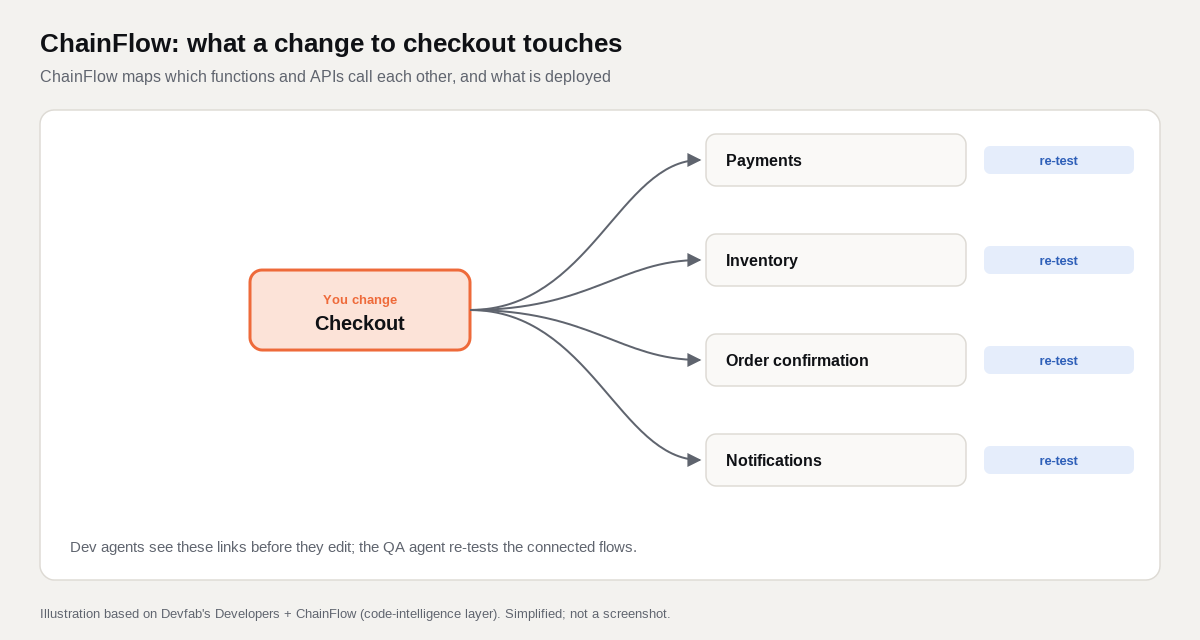
Coding agents automate the developer. Devfab automates the development lifecycle. Its Researcher maps key terms, best practices and competitors before the Planner writes a plan for a person to approve. ChainFlow maps which functions and APIs call each other and what is deployed, so dev agents see that a change to checkout can affect payments, inventory, order confirmation and notifications. Devfab is in Beta, with a smaller community and fewer integrations than mature platforms, and it is not an editor. See Devfab vs Augment Code and Devfab vs GitHub Copilot.
FAQ
Who owns Augment Code now?
Harness acquired select Augment Code assets on October 8, 2026: Cosmos, the Auggie CLI, the Context Engine and related technology. Cosmos was renamed Harness Cosmos Software Factory Agent, and the team is moving to Harness. The augmentcode.com site now carries a Harness copyright line.
What happens to existing Augment Code contracts and IDE plugins?
Not stated. BERI reported on October 9, 2026 that neither company said what happens to existing contracts, prepaid credits or code indexes, and that neither announcement names the IDE plugins. Ask Harness in writing before you renew or sign a long contract.
Is Augment Code cheaper than GitHub Copilot for a team?
It depends on usage. As of November 2026, Augment's Business plan is USD 100 per month flat with no per-seat charge, up to 50 seats, but model use is billed at provider list price plus a flat 40% service fee. Copilot Business is USD 19 per granted seat per month with pooled credits.
Can I use Augment's Context Engine with GitHub Copilot?
Augment documents the Context Engine as an MCP server usable from Claude Code, Codex and Gemini CLI, and Copilot supports MCP servers. Copilot is not named in the Augment page we checked, so test the setup before relying on it.
Read next
Want impact maps and an approved plan before agents touch the code? Try Beta
Sources (checked November 2026): Harness: Harness acquires Augment Code; Augment Code blog: Next chapter; Augment Code pricing; Augment Code: Software Factory; Augment Docs; Augment Docs: Agent; Augment Docs: Context Services; SD Times: Harness acquires Augment Code assets; BERI: Harness buys Augment's Cosmos; GitHub Copilot plans; GitHub Docs: Plans for Copilot; GitHub Docs: Copilot features; GitHub Docs: About Copilot cloud agent; GitHub Docs: Supported AI models.
Frequently asked questions
Who owns Augment Code now?
Harness acquired select Augment Code assets on October 8, 2026: Cosmos, the Auggie CLI, the Context Engine and related technology. Cosmos was renamed Harness Cosmos Software Factory Agent, and the team is moving to Harness. The augmentcode.com site now carries a Harness copyright line.
What happens to existing Augment Code contracts and IDE plugins?
Not stated. BERI reported on October 9, 2026 that neither company said what happens to existing contracts, prepaid credits or code indexes, and that neither announcement names the IDE plugins. Ask Harness in writing before you renew or sign a long contract.
Is Augment Code cheaper than GitHub Copilot for a team?
It depends on usage. As of November 2026, Augment's Business plan is USD 100 per month flat with no per-seat charge, up to 50 seats, but model use is billed at provider list price plus a flat 40% service fee. Copilot Business is USD 19 per granted seat per month with pooled credits.
Can I use Augment's Context Engine with GitHub Copilot?
Augment documents the Context Engine as an MCP server usable from Claude Code, Codex and Gemini CLI, and Copilot supports MCP servers. Copilot is not named in the Augment page we checked, so test the setup before relying on it.