Short answer: Zencoder wins for teams that want an independent agent platform today, with spec-driven workflows in VS Code and JetBrains, a model per step and on-premise deployment. Augment Code wins for large organizations on Harness, or with huge monorepos, that want deep codebase context and Cosmos loops tied to Harness CI/CD, security and cost policies.
You're about to renew an AI coding contract, and one of the two vendors was just bought. The product still works. The roadmap is a question mark.
The Augment camp says context is everything, and Harness will only make it stronger. The Zencoder camp says pick the vendor that controls its own roadmap. Both points hold. This page lays out the facts, including what Harness has and hasn't said, using pages checked in November 2026.
In this comparison:
- Zencoder and Augment Code at a glance
- Feature comparison
- Cost model by team size
- Where Zencoder wins
- Where Augment Code wins
The acquisition comes first, because it shapes every row below.
Zencoder and Augment Code at a glance
Augment Code's core products moved to Harness. On October 8, 2026, Harness acquired select Augment Code assets: Cosmos, the Auggie CLI, the Code Context Engine and related technology. Cosmos became the "Harness Cosmos Software Factory Agent," and the team joined Harness (Harness). Augment says "The team behind these products is moving to Harness to continue advancing them" (Augment blog). augmentcode.com now carries a Harness copyright, yet the pricing page shows no migration notice (Augment pricing).
What isn't settled. BERI reported on October 9, 2026 that neither company has said what happens to existing contracts, prepaid credits or code indexes. It added, "Neither announcement names the IDE plugins, so their future is unstated" (BERI).
Augment Code is a codebase-context platform: the Cosmos software factory, the Auggie CLI, a VS Code extension, a JetBrains plugin and Code Review (Augment docs). Zencoder is an independent agent platform built around Zenflow Code, Zenflow Work, IDE agents, a CLI and Hops (Zencoder pricing).
Feature comparison
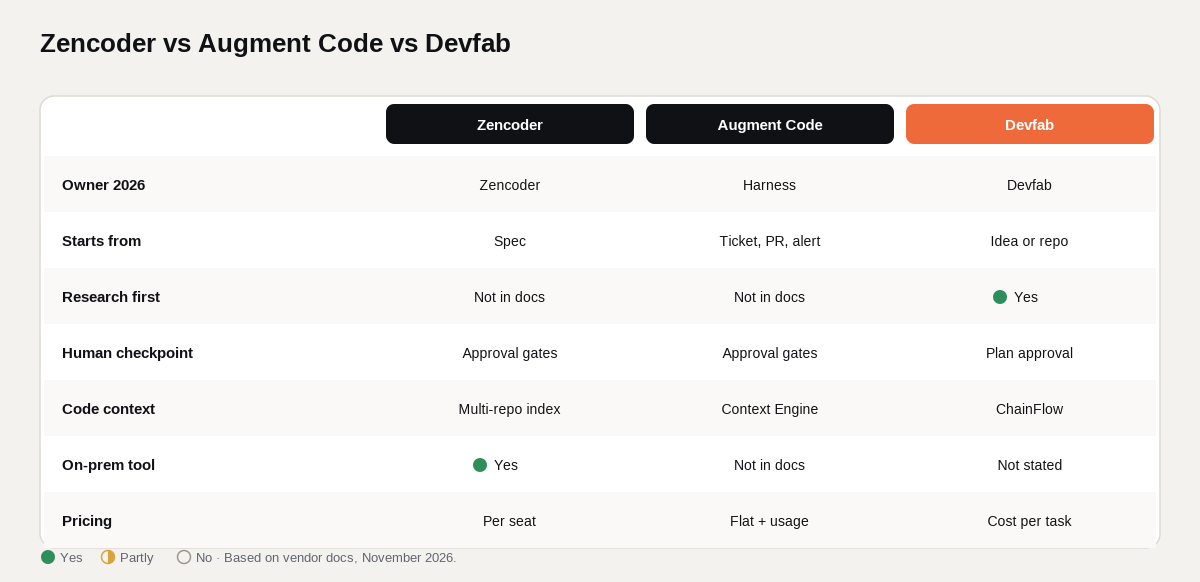
| Aspect | Zencoder | Augment Code | Source |
|---|---|---|---|
| Owner in 2026 | Zencoder | Core products owned by Harness since Oct 8, 2026 | Harness |
| Where it runs | VS Code and JetBrains agents, Zenflow Desktop, CLI | Cosmos, Auggie CLI, VS Code extension, JetBrains plugin, cloud agents | Zencoder; Augment docs |
| Planning | Spec-driven workflows for features, bugs, refactors | Agent breaks a request into a plan; Cosmos loops from ticket, PR or alert | Zencoder; Augment Agent; Cosmos |
| Human checkpoints | Approval gates | Quality gates and human approval checkpoints in Cosmos | Zencoder; Cosmos |
| Review and testing | Verification (tests, lint, review) on every change; Zentester UI tests in public beta since 2025 | Deep Code Reviewer, CI Failure Investigator, Security Vulnerability Triager experts | Zencoder; Zentester; Cosmos |
| Codebase context | Multi-repo indexing from Pro Plus | Context Engine as MCP server, SDK and open-source connectors | Zencoder pricing; Augment context services |
| Deployment of the tool | Cloud, on-premise or hybrid | Cosmos sessions run in isolated VMs; data residency and CMEK on Enterprise | Zencoder pricing; Cosmos; Augment pricing |
| Compliance | SOC 2 Type II, ISO 27001, ISO 42001 | SOC 2 reports, ISO 42001, SSO, OIDC, SCIM on Enterprise | Zencoder; Augment pricing |
| Model choice | Multi-model routing; your own keys use no credits | Prism routes each turn to a model | Zencoder pricing; Cosmos |
| Pricing model | Per seat plus monthly credits that expire | Flat team plans, no per-seat charge; usage at list price plus 40% | Zencoder FAQ; Augment pricing |
Cost model by team size
| Team size | Zencoder | Augment Code | Devfab |
|---|---|---|---|
| 1 person | Free (your own keys only); Pro USD 40 per user per month billed annually (USD 45 monthly) | Standard USD 20 per month flat, plus usage; no free tier | Cost logged per task and per project (Beta) |
| 5 people | Pro Plus USD 85 per user per month billed annually; shared credit pool and SSO | Standard USD 20 or Business USD 100 per month flat (no per-seat charge), plus usage | Cost logged per task and per project (Beta) |
| 25 people | Pro Max USD 175 per user per month billed annually, or Enterprise | Business USD 100 per month flat (up to 50 seats) plus usage, or Enterprise | Cost logged per task and per project (Beta) |
Prices as of November 2026 from Zencoder pricing, the Zencoder pricing FAQ and Augment pricing. Augment bills usage in dollars across LLMs, the Context Engine and compute, with LLM usage at provider list price plus a flat 40% service fee. Zencoder credits expire monthly and top-ups are non-refundable. Devfab is in Beta and offers predictable cost: cost is logged after each run, per task and per project.
Read the two models carefully. Augment's flat fee is low, but its usage line can grow with every agent turn. Zencoder's seat price is higher, with credits included, and a dated review says its credit use is hard to predict (AISO Tools).
Where Zencoder wins
- Roadmap certainty. Zencoder controls its own products; Augment's contracts and IDE plugin futures are not yet stated.
- On-premise or hybrid deployment. Zencoder lists both.
- A model for each step. Planning, building and review can use different models, and your own keys skip credits.
- Work outside code. Zenflow Work targets automations across Jira, Slack, Notion and Gmail.
- A trial before you buy. A trial with 5,000 credits; Augment lists no free tier (Augment pricing).
Where Augment Code wins
- You already run Harness. Cosmos is being combined with Harness delivery, security testing, runtime protection and cost agents (SD Times).
- Huge monorepos. The Context Engine is Augment's core strength, and it plugs into Claude Code, Codex and Gemini CLI over MCP.
- Event-driven loops. Cosmos starts work from a ticket, PR or alert and runs prebuilt experts.
- Many seats on a flat fee. No per-seat charge up to 50 seats.
- Data controls. Paid plans state "No AI training allowed," and Enterprise adds CMEK and data residency.
One caution on Augment's numbers: its productivity figures, such as 4.5x output per developer, are internal observations, not a controlled experiment (Cosmos).
Switching from one to the other
From Augment Code to Zencoder. Install Zencoder's agent in VS Code or JetBrains, or use the CLI, on the same repositories. Before you cancel, ask Harness in writing what happens to prepaid credits and code indexes. Rebuild Cosmos experts as Zencoder spec workflows.
From Zencoder to Augment Code. Install the VS Code extension, JetBrains plugin or Auggie CLI and let the Context Engine index your repos (Augment docs). Harness says Cosmos is available through cosmos.augmentcode.com (Harness).
Where Devfab fits
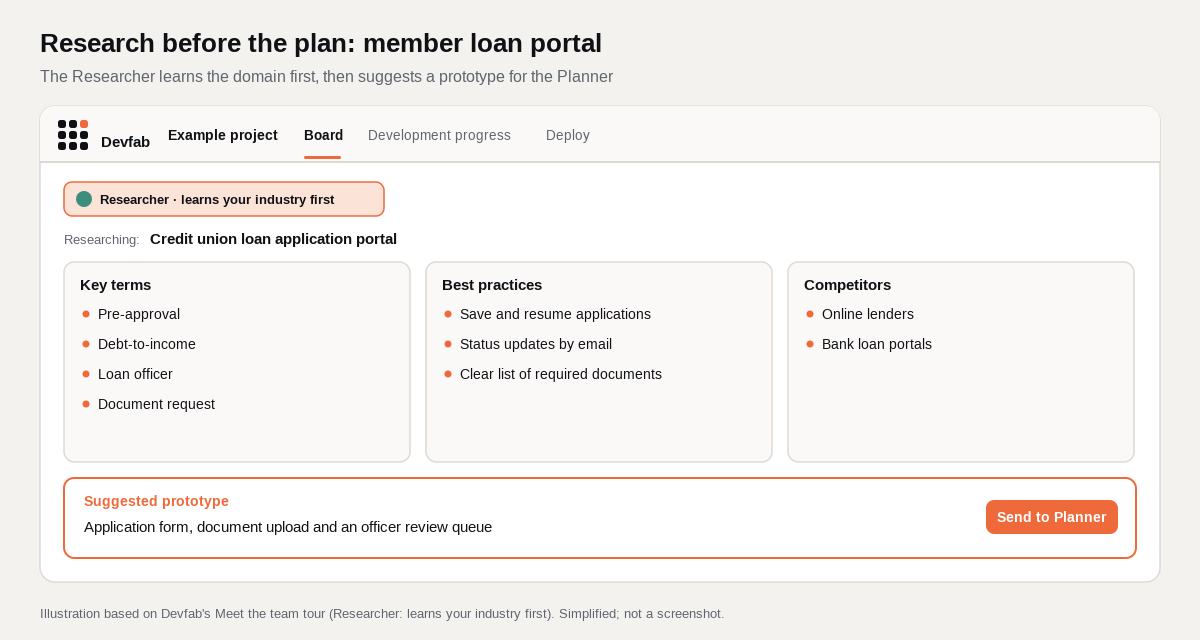
Harness now calls Cosmos a "software factory," so the question changes. Both Cosmos and Zencoder start from an engineering trigger: a ticket, a PR or a spec. Picture a credit union that wants a member loan application portal instead. The hard part comes before any ticket: what the lending rules are, which documents members upload, how competitors handle status updates.
Coding agents automate the developer. Devfab automates the development lifecycle. Devfab's Researcher maps that domain first, then suggests a prototype. A person approves the plan. Blueprint produces the screens, the QA agent runs UI, flow and logic tests (a member uploads documents, an officer requests more, the member resubmits), and Deploy ships to your own server. Devfab is in Beta, has a smaller community and fewer integrations, is not an editor, and needs a GitHub account. See Devfab vs Zencoder and Devfab vs Augment Code.
FAQ
Did Harness buy Augment Code?
Harness acquired select Augment Code assets on October 8, 2026: Cosmos, the Auggie CLI, the Code Context Engine and related technology. The team moved to Harness, and Cosmos was renamed Harness Cosmos Software Factory Agent. augmentcode.com now shows a Harness copyright.
What happens to existing Augment Code contracts?
Not stated yet. An October 9, 2026 BERI article says neither company has said what happens to existing contracts, prepaid credits or code indexes, and that the IDE plugins are not named in either announcement. Ask Harness in writing before renewing.
Is Zencoder or Augment Code cheaper for a team?
It depends on size. As of November 2026, Augment's Business plan is USD 100 per month flat with no per-seat charge (up to 50 seats), plus usage billed at provider list price with a 40% fee. Zencoder Pro Plus is USD 85 per user per month billed annually, with credits included.
Which handles a very large monorepo better?
Augment's main strength is codebase context: its Context Engine is offered as an MCP server, an SDK and open-source connectors, and Zencoder's multi-repo indexing starts at Pro Plus. Test both on your own repository before you decide.
Read next
Want research and an approved plan before the first ticket? Try Beta
Sources (checked November 2026): Harness acquires Augment Code (Oct 8, 2026); Augment Code blog: next chapter (Oct 8, 2026); Augment Code pricing; Augment Code: Software Factory (Cosmos); Augment docs; Augment docs: Agent; Augment docs: Context Services; SD Times (Oct 8, 2026); BERI (Oct 9, 2026); Zencoder; Zencoder pricing; Zencoder Docs: pricing FAQ; Zencoder: Introducing Zentester (Jun 10, 2025); AISO Tools: Zencoder review 2026 (updated Aug 2026).
Frequently asked questions
Did Harness buy Augment Code?
Harness acquired select Augment Code assets on October 8, 2026: Cosmos, the Auggie CLI, the Code Context Engine and related technology. The team moved to Harness, and Cosmos was renamed Harness Cosmos Software Factory Agent. augmentcode.com now shows a Harness copyright.
What happens to existing Augment Code contracts?
Not stated yet. An October 9, 2026 BERI article says neither company has said what happens to existing contracts, prepaid credits or code indexes, and that the IDE plugins are not named in either announcement. Ask Harness in writing before renewing.
Is Zencoder or Augment Code cheaper for a team?
It depends on size. As of November 2026, Augment's Business plan is USD 100 per month flat with no per-seat charge (up to 50 seats), plus usage billed at provider list price with a 40% fee. Zencoder Pro Plus is USD 85 per user per month billed annually, with credits included.
Which handles a very large monorepo better?
Augment's main strength is codebase context: its Context Engine is offered as an MCP server, an SDK and open-source connectors, and Zencoder's multi-repo indexing starts at Pro Plus. Test both on your own repository before you decide.