Short answer: If your company already runs Harness, stay and evaluate Harness Cosmos. For an AI editor with cloud agents, move to Cursor. For a scriptable agent, use Claude Code. For an enterprise software factory with air-gapped options, look at Factory. For research, approved plans, UI and flow tests and deploy to your own server, try Devfab.
You chose Augment for context on a very large codebase. On October 8, 2026, Harness bought the parts you rely on: Cosmos, the Auggie CLI and the Context Engine. The team is moving with them. What the deal did not say matters just as much: nothing about existing contracts, prepaid credits or the IDE plugins. That's reason enough to line up options before your renewal date.
In this guide, you'll learn:
- Why teams leave Augment Code after the Harness deal
- The quick comparison of six alternatives
- Where Augment Code is still the better choice
- How to choose by what you used Augment for
The rest of this page covers it in order.
Why teams leave Augment Code
The status change. Harness announced on October 8, 2026 that it acquired select Augment Code assets, "including Cosmos, the Auggie CLI products, the Code Context Engine, and related technology." Cosmos becomes the Harness Cosmos Software Factory Agent, and "the team behind these products will join Harness" (Harness). Augment's own post says the team is "moving to Harness to continue advancing them" and gives no pricing or migration details (Augment blog). SD Times reports Cosmos will be combined with Harness's delivery, security testing, runtime protection and cost agents (SD Times).
What Augment offered before the deal. Cosmos ran loops from a trigger (a ticket, a PR or an alert) through prebuilt Experts such as a Deep Code Reviewer and CI Failure Investigator, in isolated VMs with quality gates and human approval checkpoints (Augment). The Context Engine was offered as an MCP server for Claude Code, Codex and Gemini CLI, and as an SDK (Augment docs). IDE agents ran in VS Code and JetBrains, and Enterprise listed SSO, SCIM, SOC 2 reports, CMEK and data residency (Augment pricing).
The switching triggers:
- Unanswered continuity questions. BERI notes that "neither company has said what happens to existing Augment contracts, prepaid credits or code indexes," and that the IDE plugins' "future is unstated" (BERI).
- A platform shift. The products are moving into Harness's delivery platform. Teams that don't run Harness may not want that direction.
- Billing. Augment's pricing page lists flat team plans up to 50 seats with usage billed in dollars across LLMs, the Context Engine and compute, with LLM usage at provider list price plus a flat 40% service fee. There is no free tier.
- Proof. Augment's productivity figures are its own internal observations, not a controlled experiment, by its own description.
One more warning: don't trade one acquisition for another without checking. Tabnine, another context-focused assistant, was acquired by Tricentis in July 2026 (Tricentis).
Quick comparison
| Tool | What it is | Large-codebase context | Where it runs | Pricing model |
|---|---|---|---|---|
| Augment Code (baseline) | Factory, CLI, IDE agents; now Harness | Context Engine | Cosmos, CLI, VS Code, JetBrains | Team plans plus usage, 40% fee on LLM |
| Harness Cosmos | The same Cosmos, inside Harness | Context Engine plus Harness knowledge graph | Harness platform | See Harness |
| Cursor | AI editor plus cloud agents | Rules, skills, MCP | Editor, CLI, cloud, Slack, GitHub | Usage pool per tier; Teams per seat |
| Claude Code | Agentic coding tool | CLAUDE.md, skills, MCP | Terminal, IDEs, desktop, web | Paid Claude plans or API |
| Factory | Enterprise agents and software factory | AutoWiki, Router, Missions | CLI, desktop app, IDEs, chat tools | Usage tiers; Teams; Enterprise |
| Devfab | AI software factory | ChainFlow impact map | Web workspace + your GitHub | Cost logged per task and per project (Beta) |
| Amp | Coding agent with cloud sandboxes | AGENTS.md, MCP | Terminal, apps, web, cloud orbs | Subscriptions or credits at provider prices |
The alternatives
1. Harness Cosmos
Verdict: the low-change option if Harness already runs your pipelines. Best for: large organizations on Harness CI/CD and security tooling. Trade-off: you inherit the same open questions on contracts and plugins. Pricing: not stated in the announcement; ask Harness.
- Cosmos keeps its role: automate engineering work "from idea to code," with Harness's other agents taking over after that (Harness).
- The Context Engine is being connected to Harness's Software Delivery Knowledge Graph (SD Times).
- Harness says Cosmos is available now, with versioning and budget controls.
2. Cursor
Verdict: the most direct replacement for Augment's IDE agent. Best for: developers who want AI in the editor plus background agents. Trade-off: owned by SpaceX since August 2026 (Cursor blog). Pricing: free tier, individual tiers with a usage pool, Teams per seat, Enterprise custom (Cursor pricing).
- Cloud agents run in isolated VMs on GitHub, GitLab, Bitbucket or Azure DevOps, and can run tool execution on machines you manage (Cursor docs).
- Bugbot reviews pull requests for bugs and security issues (Cursor docs).
- Enterprise adds SCIM, audit logs and repository, model and MCP access controls (Cursor docs).
3. Claude Code
Verdict: the flexible pick for teams that want to build their own agent workflows. Best for: platform teams and terminal-first developers. Trade-off: Claude models only; context is what you give it. Pricing: included in paid Claude plans; Enterprise is a seat fee plus usage at API rates (Claude pricing).
- Runs in the terminal, IDEs, desktop, web, GitHub Actions and GitLab CI/CD (Claude Code overview).
- Managed Code Review runs several agents on each GitHub PR (Claude Code docs).
- Inference can run through Amazon Bedrock, Google Cloud or Microsoft Foundry (Claude Code enterprise).
4. Factory
Verdict: the closest enterprise "software factory" to what Cosmos was. Best for: enterprises that need on-prem or air-gapped deployment. Trade-off: aimed at large organizations; its pricing page shows usage multiples, not credit amounts (Factory pricing). Pricing: free tier with your own inference, usage-based individual tiers, Teams per seat, Business and Enterprise via sales.
- Factory 2.0 (June 15, 2026) added Missions for parallel long-running work, Automations and a model Router (Factory).
- Docs cover air-gapped deployment and self-hosted GitHub Enterprise Server or GitLab (Factory docs).
- Droids take work from Slack, Linear, Jira, Microsoft Teams and Google Chat.
5. Devfab
Verdict: a factory for teams that want the plan approved, the UI tested and the app deployed to their own server. Best for: agencies and product teams delivering whole apps, new or existing. Trade-off: new and in Beta; far fewer enterprise controls than Augment had. Pricing: predictable cost: cost is logged after each run, per task and per project.
See Where Devfab fits and the full Devfab vs Augment Code comparison.
6. Amp
Verdict: the pick if Augment's 40% LLM fee bothered you. Best for: experienced developers running many parallel agents. Trade-off: not open source; you drive the agent yourself. Pricing: free Hobby tier, monthly subscriptions (beta since July 18, 2026), and paid credits at provider API prices with no markup for individuals and non-enterprise workspaces (Amp pricing).
- "Orbs" are cloud sandboxes where agents keep working after you close your laptop (Amp).
- Teams adds pooled credits, self-hosted orbs and SSO; Enterprise adds SCIM and audit logs.
Where Devfab fits
Augment built context so agents write better code. Devfab builds the process so the right code gets planned, tested and shipped. Coding agents automate the developer. Devfab automates the development lifecycle.
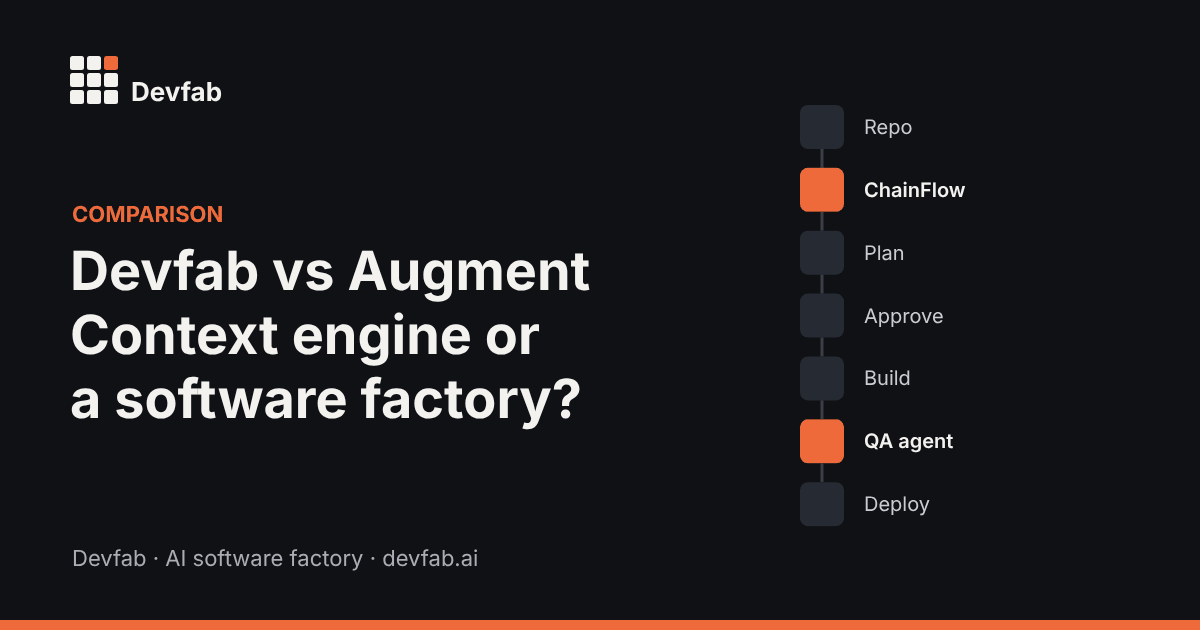
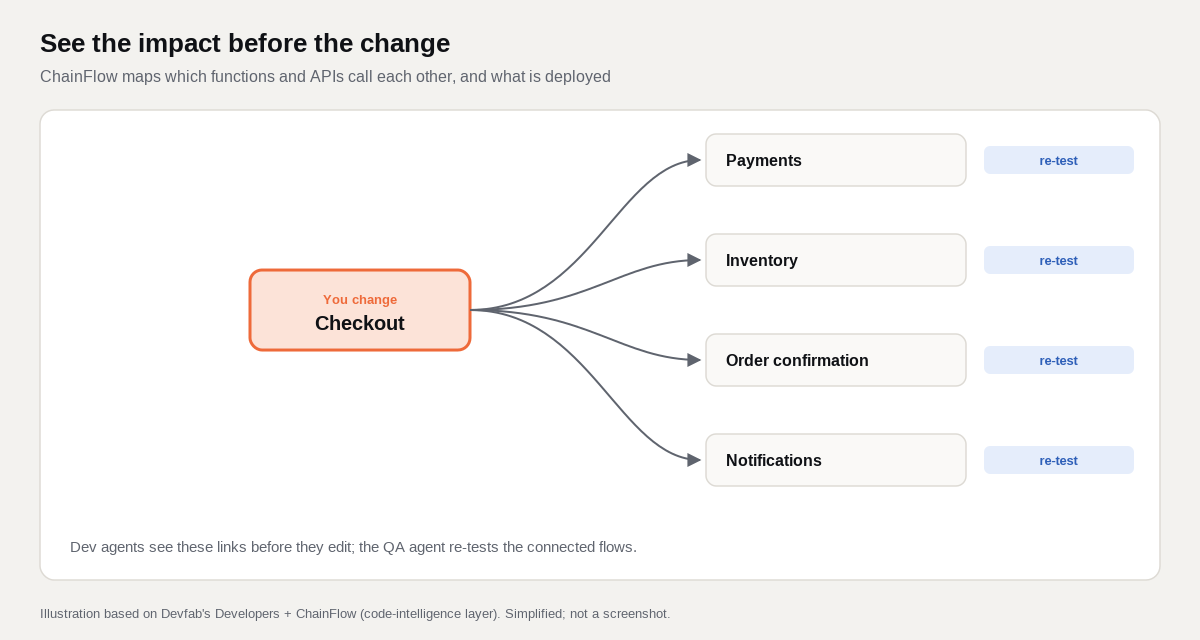
- ChainFlow instead of a context index. Devfab's code-intelligence layer maps which functions and APIs call each other and what is deployed. Developer agents see the impact of a change and don't break connected features. A checkout change can affect payments, inventory, order confirmation and notifications.
- Research before the plan. The research step maps the domain first: key terms, best practices for that kind of app, and competitors. Then it suggests a prototype.
- A plan a person approves. "Your turn: the Planner published the plan. Approve it so the Coordinator can create the tickets." Human in the loop is the default; Auto mode asks only when needed.
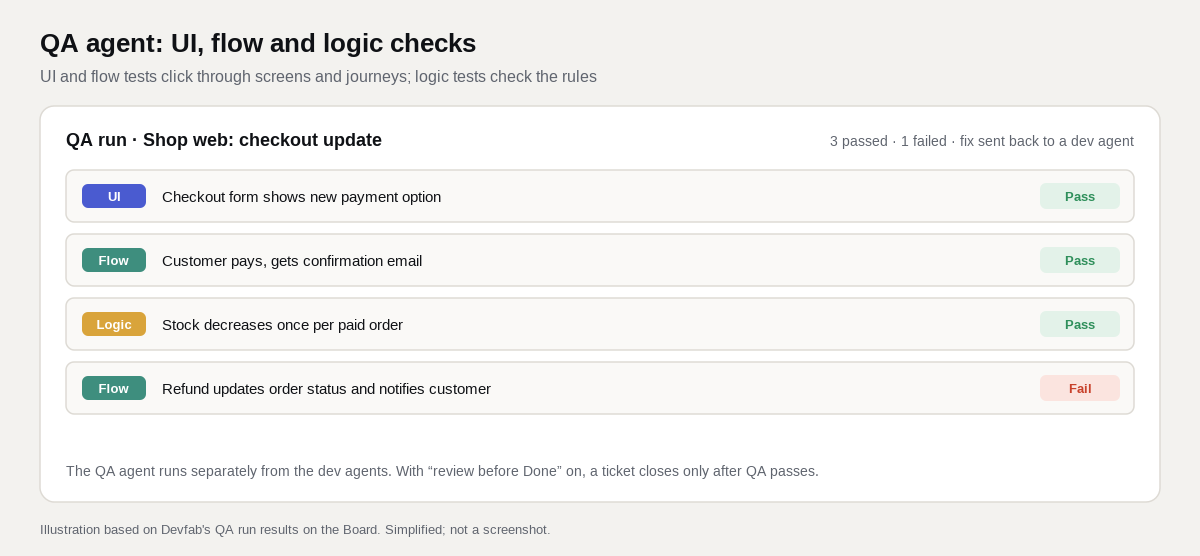
- QA agent. UI and flow tests (screens, buttons and user journeys clicked end to end) plus logic tests, with "QA agent · review before Done."
On an existing repo: choose "Work on an existing project," pick the repo and leave the change box empty. Devfab maps the code first with ChainFlow and suggests three small first tickets. Code stays in your own GitHub account (or your organization's), you deploy to your own server, and you can choose the model for each agent or keep Devfab's default.
Devfab's honest limits:
- It's new and in Beta, with a much smaller community and track record than Augment.
- It has fewer integrations and none of Augment's enterprise compliance list (CMEK, ISO 42001, SIEM).
- It isn't an IDE plugin for hands-on coding.
- It needs a GitHub account; Augment also worked with GitLab.
Where Augment Code is still the better choice
- You already run Harness. Cosmos tied into your CI/CD, security and cost policies is a real advantage.
- Very large monorepos. The Context Engine was built for deep context, and it plugs into other agents through MCP.
- Your contract is long and paid up. If Harness confirms your terms in writing, there's no reason to rush.
- Compliance needs. SSO, SCIM, SOC 2 reports, CMEK, ISO 42001 and data residency were on the Enterprise list.
How to choose
- On Harness already? Evaluate Harness Cosmos first.
- You mostly used the IDE agent? Cursor.
- You want to build your own workflows, maybe on your cloud account? Claude Code.
- You need air-gapped or on-prem agents? Factory.
- You deliver whole apps and want research, an approved plan, UI and flow tests and deploy to your own server? Devfab.
- You want pass-through model pricing? Amp.
Before you move, ask for written answers on three things: your contract terms, your prepaid credits and your code indexes. Our guide to AI agents on a large existing codebase covers the first weeks on a new tool.
FAQ
What happened to Augment Code?
On October 8, 2026, Harness acquired select Augment Code assets: Cosmos, the Auggie CLI, the Code Context Engine and related technology. Cosmos is now the Harness Cosmos Software Factory Agent, and the team is moving to Harness.
Will my Augment contract and IDE plugin keep working?
Neither announcement says. A BERI analysis (October 9, 2026) notes no word on existing contracts, prepaid credits or code indexes, and that the IDE plugins are not named. Ask your Augment or Harness contact in writing before renewing.
What is the best alternative to Augment's Context Engine?
Inside an editor, Cursor's agent works with rules, skills and MCP servers, and its cloud agents run in full VMs. Devfab's ChainFlow maps which functions and APIs call each other and what is deployed, so agents see the impact of a change. Claude Code relies on project instructions, skills and MCP servers.
Is Augment Code a software factory like Devfab?
Augment positioned Cosmos as a software factory: loops triggered by tickets, PRs or alerts, run by prebuilt Experts in isolated VMs with quality gates. Devfab is also a software factory, built around research, a plan a person approves, a QA agent and deploy to your own server. Devfab is newer and in Beta.
Read next
Want a factory that maps your code before it changes it? Try the Devfab Beta
Sources (checked November 13, 2026): Harness: Harness acquires Augment Code (Oct 8, 2026); Augment blog: Next chapter; SD Times: Harness acquires Augment Code assets; BERI: Harness buys Augment's Cosmos (Oct 9, 2026); Augment: Software Factory; Augment pricing; Augment docs: Context Services; Tricentis acquires Tabnine; Cursor docs: Cloud Agents; Cursor docs: Bugbot; Cursor docs: Enterprise; Cursor pricing; Cursor blog: Joining SpaceX; Claude Code overview; Claude Code: Code Review; Claude Code: Enterprise deployment; Claude pricing; Factory: The software factory; Factory pricing; Factory docs; Amp; Amp pricing.
Frequently asked questions
What happened to Augment Code?
On October 8, 2026, Harness acquired select Augment Code assets: Cosmos, the Auggie CLI, the Code Context Engine and related technology. Cosmos is now the Harness Cosmos Software Factory Agent, and the team is moving to Harness.
Will my Augment contract and IDE plugin keep working?
Neither announcement says. A BERI analysis (October 9, 2026) notes no word on existing contracts, prepaid credits or code indexes, and that the IDE plugins are not named. Ask your Augment or Harness contact in writing before renewing.
What is the best alternative to Augment's Context Engine?
Inside an editor, Cursor's agent works with rules, skills and MCP servers, and its cloud agents run in full VMs. Devfab's ChainFlow maps which functions and APIs call each other and what is deployed, so agents see the impact of a change. Claude Code relies on project instructions, skills and MCP servers.
Is Augment Code a software factory like Devfab?
Augment positioned Cosmos as a software factory: loops triggered by tickets, PRs or alerts, run by prebuilt Experts in isolated VMs with quality gates. Devfab is also a software factory, built around research, a plan a person approves, a QA agent and deploy to your own server. Devfab is newer and in Beta.