Short answer: Augment Code is built around its Context Engine, a live semantic index of large codebases, used by its coding agent, CLI, code review and Cosmos, its platform for engineering-team software factories. Devfab is a software factory for whole projects: research, a plan a person approves, ChainFlow impact maps, UI and flow tests, and deploy to your own server.
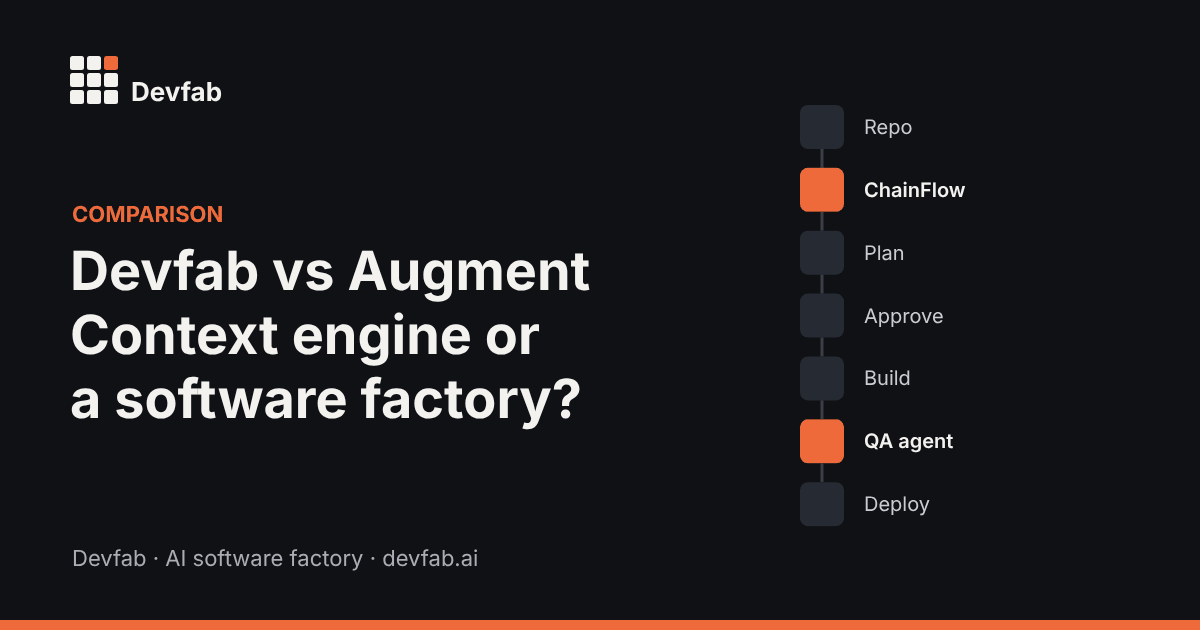
Your agents break connected features when they can't see the rest of the code. Augment Code and Devfab both tackle that problem, at very different sizes. One camp prizes deep context across very large monorepos. The other wants the whole project run as one process, from research to deploy. This page compares both fairly, including what the Harness deal changes.
In this comparison:
- What each tool is built for
- Same-task test: what each would produce
- Comparison table
- When to choose Augment Code
- When to choose Devfab
Use the sections below to make the call.
What each tool is built for
Augment Code
Augment's core is the Context Engine. Augment says it "maintains a live understanding of your stack across repos, services, and history". It semantically indexes code across hundreds of thousands of files, tracks how services depend on each other, and draws on docs, tickets, design decisions and commit history. Through Context Services, other agents can use it too: a Context Engine MCP server works with tools like Claude Code, Codex and Gemini CLI, and there is an SDK and an open-source connectors library.
On top of that context, Augment offers:
- An agent that breaks a request into a plan and implements each step. It saves checkpoints you can roll back to and pauses before terminal commands unless you switch on Auto. Through MCP it can work with GitHub, Linear and Jira. A model picker sets the model per workspace.
- A CLI, cloud agents and code review for GitHub pull requests.
- Cosmos, a platform for building a software factory. Its loop runs ticket, code, review, deploy and monitor. Agents called Experts handle work like deep code review, CI failure checks, dependency upgrades and incident response. Engineers "approve at the checkpoints". It connects to GitHub, GitLab, Jira, Linear, Slack and Microsoft Teams.
One thing to know before you choose: on October 8, 2026, Augment Code announced that Harness acquired select assets, including Cosmos, the Auggie CLI products and the Code Context Engine. Harness says Cosmos will become the Harness Cosmos Software Factory Agent. The Augment site now carries a Harness copyright.
Team plans are flat, with no per-seat charge up to a set number of seats and usage pooled across the team. Enterprise adds SSO, SCIM, audit trails, data residency, SOC 2 reports and ISO 42001.
Its main users are engineering organizations with large, complex codebases.
Devfab
Devfab is an AI software factory in the autonomous software lifecycle category. Coding agents automate the developer. Devfab automates the development lifecycle. Its unit of work is a project, from an idea or an existing repo to a deployed app.
- Research before the plan. The Researcher learns your industry first: key terms, best practices and competitors. Then it suggests a prototype. The Planner works from that.
- ChainFlow. Devfab's code-intelligence layer maps which functions and APIs call each other and what is deployed. Dev agents see the impact of a change and don't break connected features.
- QA agent for UI and flows. It clicks through screens, buttons and user journeys, and runs logic tests. With "QA agent · review before Done", a ticket can't close until QA checks it.
A person approves the plan. Code lives in your own GitHub account (or your organization's), and you deploy to your own server.
Context Engine and ChainFlow, honestly
Both exist because agents break things when they can't see the rest of the system. But they are not the same size. Augment's Context Engine is a broad retrieval layer: code, dependencies, docs, tickets and history, at large scale, and it can serve other vendors' agents. ChainFlow is narrower and built into Devfab's flow: a map of calls and deployed parts that dev agents check before a change, so the plan and the tickets account for connected features. If your main need is the deepest possible code search across a big monorepo, Augment goes further.
Same-task test: what each would produce
One brief, on a client's existing online store: "Add a loyalty discount at checkout. Returning customers get a discount on their fifth order."
[TEST DATA TODO: run the same spec through Augment Code and Devfab; add what each produced]
With Augment, a developer opens the repo and asks the agent. Based on its docs, the Context Engine would pull in the checkout code, related services and recent history. The agent would plan the change, edit the files and pause before commands unless Auto is on. Checkpoints let the developer roll back a step. With Cosmos, the same request could start as a ticket, become a pull request and get a first-pass review before an engineer approves it.
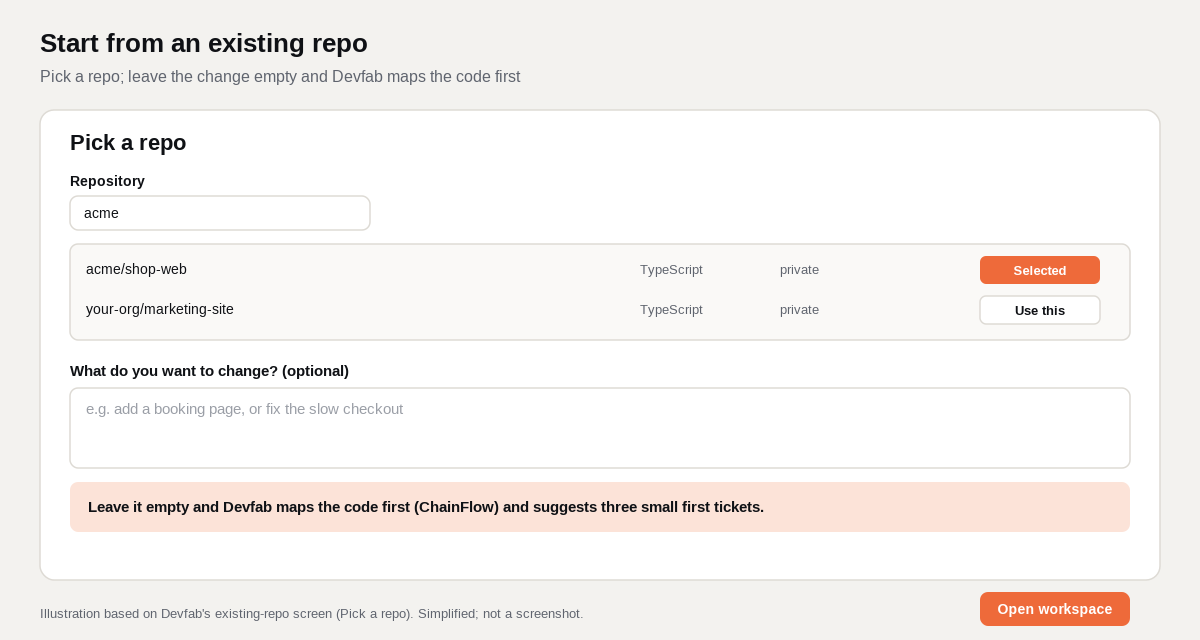
With Devfab, the agency picks "Work on an existing project" and selects the repo. If the change box is left empty, Devfab maps the code first with ChainFlow and suggests three small first tickets. With the brief filled in, ChainFlow shows what checkout touches.
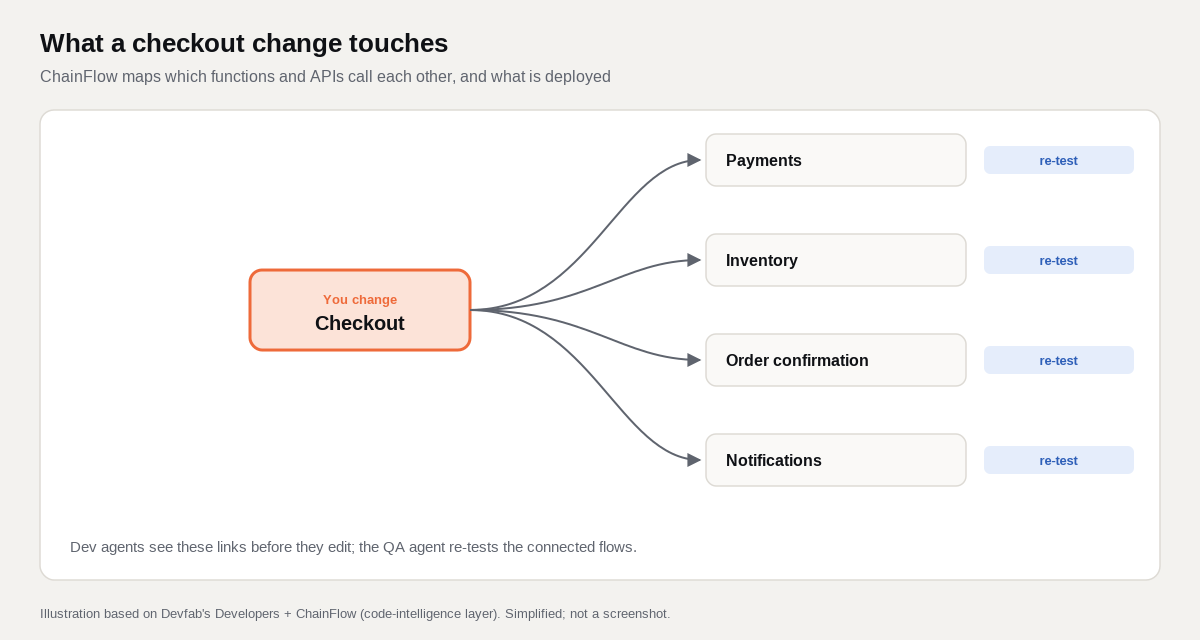
The Planner writes a plan that covers each affected part, and a person approves it. The Coordinator creates tickets. The QA agent runs the journey end to end: a returning customer places a fifth order, sees the discount, pays, gets the right confirmation. Then Deploy ships to the client's server.
Comparison table
| Aspect | Augment Code | Devfab |
|---|---|---|
| Planning | Agent breaks a request into a plan; Cosmos runs ticket loops | Planner writes the plan; Coordinator turns it into tickets |
| Research before planning | Context from code, docs, tickets and history | Researcher maps terms, best practices and competitors, then suggests a prototype |
| Human approval | Pauses before commands unless Auto; Cosmos checkpoints | A person approves the plan; Human in the loop is the default |
| Code | Agent, CLI and cloud agents edit your repos | Dev agents write to your GitHub repository |
| UI and flow tests | Cosmos ticket-to-PR loop exercises changes end to end | QA agent runs UI, flow and logic tests; can gate Done |
| Deploy | Deploy and monitor stages in the Cosmos loop | Deploy to your own server, with optional custom domain |
| Docs | Uses docs as context; not a built-in output | Blueprints, hi-fi designs, sequence flows, prototypes and user manuals |
| Team management | Pooled team usage; SSO, SCIM, audit trails on enterprise | Roles, workspace permissions, Kanban and Gantt, Team Delivery Report |
| Model choice | Model picker; Cosmos auto-routing or a single model | Choose the model for each agent or keep Devfab's default |
| Code ownership | Works in your repositories | Code in your own GitHub account; deploy to your own server |
| Cost visibility | Flat team plans with pooled usage; usage analytics | Predictable cost: logged after each run, per task and per project |
| Existing codebases / impact of changes | Strongest point: Context Engine across repos, services and history | ChainFlow maps calls and deployments; suggests three first tickets |
When to choose Augment Code
Augment Code is the better choice when:
- Your codebase is large and old, and agents keep missing context. The Context Engine is built for exactly that.
- You want better context for agents you already use. The Context Engine MCP works with other coding agents.
- Your engineers want an agent in their own workflow, with checkpoints and a choice of how much it runs on its own.
- You run an engineering org that wants code review, CI checks, dependency upgrades and incident work automated as loops.
- You need enterprise compliance such as ISO 42001, CMEK and data residency.
When to choose Devfab
Devfab is the better choice when:
- You deliver projects, not just changes, often starting from a client brief rather than a ticket.
- The domain is new to the team. Research comes before the plan.
- A client or product owner approves the plan, in plain language, before any ticket exists.
- You need UI and flow test evidence to show the client, plus a user manual at handover.
- The app runs on the client's server, with code in your or the client's GitHub account.
- You quote projects and need predictable cost, logged per task and per project.
Where Devfab is weaker: it's new and in Beta, with a smaller community and fewer integrations than Augment. ChainFlow is not a replacement for a search engine over a very large monorepo. Devfab is not an editor for hands-on coding, and it needs a GitHub account.
Can you use both?
Yes. Developers can use Augment's agent for deep work inside a big codebase, while the agency runs client projects in Devfab. Both work on code in your GitHub repositories, so nothing is locked into either tool.
FAQ
How does ChainFlow compare with Augment's Context Engine?
They solve related problems at different scales. Augment's Context Engine is a broad semantic search layer over code, dependencies, docs, tickets and commit history, built for very large codebases and usable by other agents. ChainFlow is narrower: it maps which functions and APIs call each other and what is deployed, so Devfab's dev agents see the impact of a change inside a project.
Did Harness buy Augment Code?
On October 8, 2026, Augment Code announced that Harness acquired select assets, including Cosmos, the Auggie CLI products and the Code Context Engine. Harness says Cosmos will become the Harness Cosmos Software Factory Agent. Check the vendor's current pages before you buy.
Which is better for a software agency?
If the agency's engineers work in large, long-lived codebases and want the deepest code context, Augment fits. If the agency delivers whole projects for clients, with research, a client-approved plan, UI and flow tests, deployment to client servers and cost per project, Devfab is designed for that.
Can I choose the AI model in each tool?
Yes. Augment has a model picker for its agent, and Cosmos can route each turn or use a single model. In Devfab, you can choose the model for each agent or keep Devfab's default.
Read next
- What is an AI software factory?
- AI software factory vs AI coding tools
- How to stop AI coding agents from breaking existing code
- How to use AI agents on a large existing codebase
- Build log: a client portal
- Augment Code alternatives for teams that ship to production (2026)
- Augment Code vs Cursor
Bring an existing client repo and see what ChainFlow maps. Book a Devfab demo
Sources (checked November 2026): Augment Context Engine; Augment docs: Context Services; Augment docs: Using Agent; Augment software factory (Cosmos); Augment pricing; Augment Code home page; Augment Code: next chapter; Harness acquires Augment Code assets.
Frequently asked questions
How does ChainFlow compare with Augment's Context Engine?
They solve related problems at different scales. Augment's Context Engine is a broad semantic search layer over code, dependencies, docs, tickets and commit history, built for very large codebases and usable by other agents. ChainFlow is narrower: it maps which functions and APIs call each other and what is deployed, so Devfab's dev agents see the impact of a change inside a project.
Did Harness buy Augment Code?
On October 8, 2026, Augment Code announced that Harness acquired select assets, including Cosmos, the Auggie CLI products and the Code Context Engine. Harness says Cosmos will become the Harness Cosmos Software Factory Agent. Check the vendor's current pages before you buy.
Which is better for a software agency?
If the agency's engineers work in large, long-lived codebases and want the deepest code context, Augment fits. If the agency delivers whole projects for clients, with research, a client-approved plan, UI and flow tests, deployment to client servers and cost per project, Devfab is designed for that.
Can I choose the AI model in each tool?
Yes. Augment has a model picker for its agent, and Cosmos can route each turn or use a single model. In Devfab, you can choose the model for each agent or keep Devfab's default.