Short answer: Choose Augment Code if you need deep codebase context for very large repos and agent workflows triggered by tickets, PRs or alerts, and you can wait for Harness to confirm contracts and plugin plans. Choose Cursor if your developers want an AI editor with cloud agents and pull request review, from a vendor whose product line is not being split.
Both of these tools changed owners in 2026. SpaceX bought Cursor's parent company. Harness bought Augment Code's main products in October. If you are choosing between them now, features are only half the question. The other half is what you are signing up for after the deals: plans, credits, plugins and data. This page covers features, cost by team size and the questions to ask, with sources checked on November 13, 2026.
In this comparison:
- Augment Code and Cursor at a glance
- Feature comparison
- Cost model by team size
- Where Augment Code wins and where Cursor wins
- Where Devfab fits
Use the sections below as your checklist.
Augment Code and Cursor at a glance
Status: Augment Code. On October 8, 2026, Harness acquired select Augment Code assets: Cosmos, the Auggie CLI, the Code Context Engine and related technology. Cosmos was renamed "Harness Cosmos Software Factory Agent". Augment says "The team behind these products is moving to Harness to continue advancing them". Its post gives no pricing or migration details. A BERI report from October 9 says neither company has explained what happens to existing contracts, prepaid credits or code indexes. The augmentcode.com footer now reads "© 2026 Harness, Inc."
Status: Cursor. SpaceX agreed to buy Anysphere in a deal confirmed on June 16, 2026. Cursor's August 14 post says the acquisition has closed, and Cursor's plans now bundle Grok products.
Augment Code is a codebase-context agent platform. Cosmos runs loops from a trigger (a ticket, PR or alert) through prebuilt "Experts" such as Deep Code Reviewer, CI Failure Investigator and Security Vulnerability Triager. Sessions run in isolated VMs with quality gates and human approval checkpoints. The Context Engine can be plugged into other agents through MCP. Augment's logos include Adobe, MongoDB and Pure Storage, so it targets large engineering organizations.
Cursor is an AI editor and coding agent for developers. Plan Mode drafts an editable plan, cloud agents work on separate branches in isolated VMs, and Bugbot reviews pull requests.
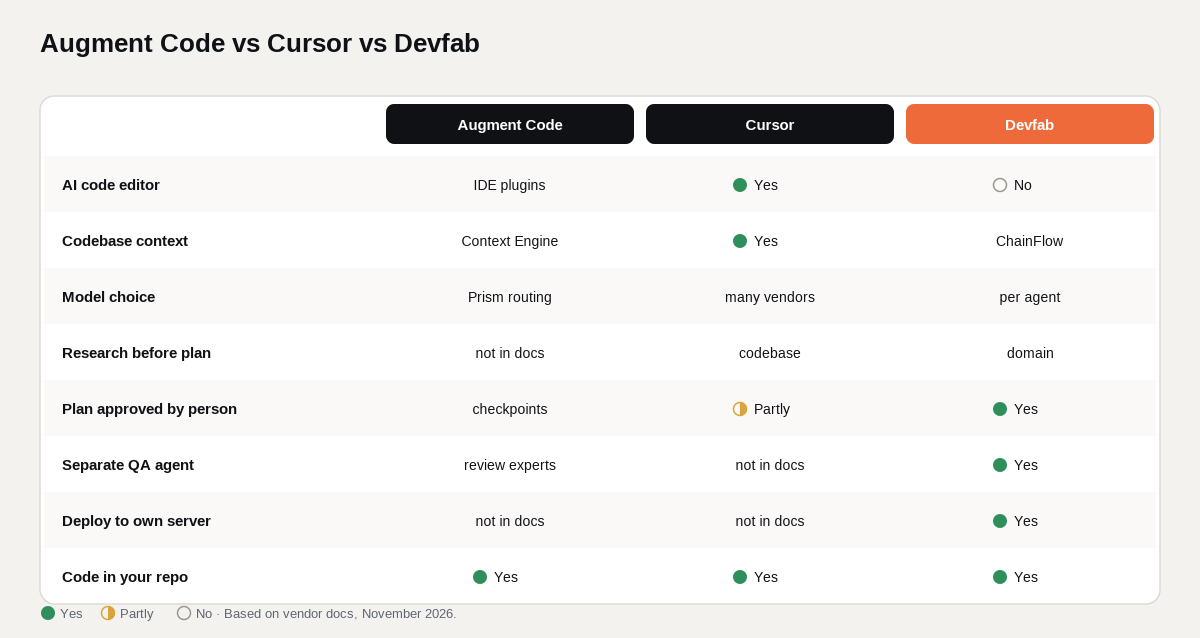
Feature comparison
| Aspect | Augment Code | Cursor | Source |
|---|---|---|---|
| Where it runs | Cosmos, Auggie CLI, cloud agents, Code Review; docs also list VS Code and JetBrains plugins | Desktop editor, CLI, cloud agents, mobile, SDKs | Augment docs; Cursor docs |
| Planning | IDE agent breaks a request into a plan, with checkpoints | Plan Mode with clarifying questions and an editable plan | Augment Agent; Cursor Plan Mode |
| Agent autonomy | Cosmos loops from tickets, PRs or alerts; human approval checkpoints | Parallel cloud agents, one branch each | Augment software factory; Cursor cloud agents |
| Testing and review | Review expert, CI Failure Investigator, quality gates | Bugbot PR review; Autofix | Augment software factory; Bugbot |
| Codebase context | Context Engine as MCP server, SDK and open-source connectors | Codebase research in Plan Mode | Augment context services; Cursor Plan Mode |
| Integrations | GitHub, GitLab, Jira, Linear, Slack, Teams; MCP | Slack, Teams, Jira, Linear, Notion, GitHub, GitLab, Azure DevOps, Bitbucket | Augment software factory; Cursor docs |
| Team and admin | SSO, OIDC, SCIM, SOC 2, CMEK, ISO 42001, SIEM, data residency | SSO on Teams; SCIM, audit logs, model restrictions on Enterprise | Augment pricing; Cursor Enterprise |
| Model choice | Prism routes each turn to a model | Claude, Gemini, GPT, Grok, Composer | Augment software factory; Cursor docs |
| Pricing model | Flat team plans, no per-seat charge up to 50 seats; usage at list price plus a 40% fee; no free tier | Free tier; tiers with a usage pool; Teams per seat | Augment pricing; Cursor pricing |
Cost model by team size
| Team size | Augment Code | Cursor | Devfab |
|---|---|---|---|
| 1 person | No free tier; trials get community support only; smallest flat team plan | Free tier, or an individual tier with a usage pool | Cost logged per task and per project (Beta) |
| 5 people | Flat team plan with included usage; no per-seat charge | Teams, per seat, with SSO | Cost logged per task and per project (Beta) |
| 25 people | Flat team plan (up to 50 seats) or custom Enterprise; pooled top-ups | Teams or custom Enterprise with group spend limits | Cost logged per task and per project (Beta) |
Pricing models as of November 13, 2026, from Augment's pricing page and Cursor's pricing page. Augment bills usage in dollars across LLMs, the Context Engine and compute. Ask Harness whether these plans and any prepaid credits continue.
Where Augment Code wins
- Very large codebases. The Context Engine is the core product, and you can plug it into other agents through MCP or an SDK.
- Agent loops triggered by events. Cosmos starts from a ticket, PR or alert and runs prebuilt experts with quality gates.
- Harness shops. Harness plans to combine Cosmos with its delivery, security testing, runtime protection and cost agents.
- Flat team pricing. No per-seat charge for up to 50 seats, and paid plans state "No AI training allowed".
- Compliance list. SOC 2, CMEK, ISO 42001, SIEM integration and data residency on Enterprise.
Where Cursor wins
- Product continuity. Cursor was acquired whole and survives as a wholly owned SpaceX subsidiary; Augment's products were split off to Harness.
- Hands-on editing. A full AI editor with Plan Mode and chat; Augment's homepage no longer lists IDE plugins.
- Low entry cost. A free tier and individual plans; Augment lists no free tier.
- Pull request review with fixes. Bugbot plus Autofix.
Switching from one to the other
Your code stays in your own repository either way. Plan the move around rules and contracts.
- Ask about your contract first. Before you cancel Augment, ask Harness about prepaid credits, code indexes and data handling.
- Move rules to AGENTS.md. Augment stores rules in
.augment/rulesand reads AGENTS.md and CLAUDE.md files hierarchically. Cursor reads AGENTS.md in the root and subdirectories, plus.mdcrules in.cursor/rules. - Keep the Context Engine if you like it. It runs as an MCP server, and Cursor supports MCP servers. Augment's docs name Claude Code, Codex and Gemini CLI, not Cursor, so test it first.
- Pilot on one repo before moving the whole team.
Where Devfab fits
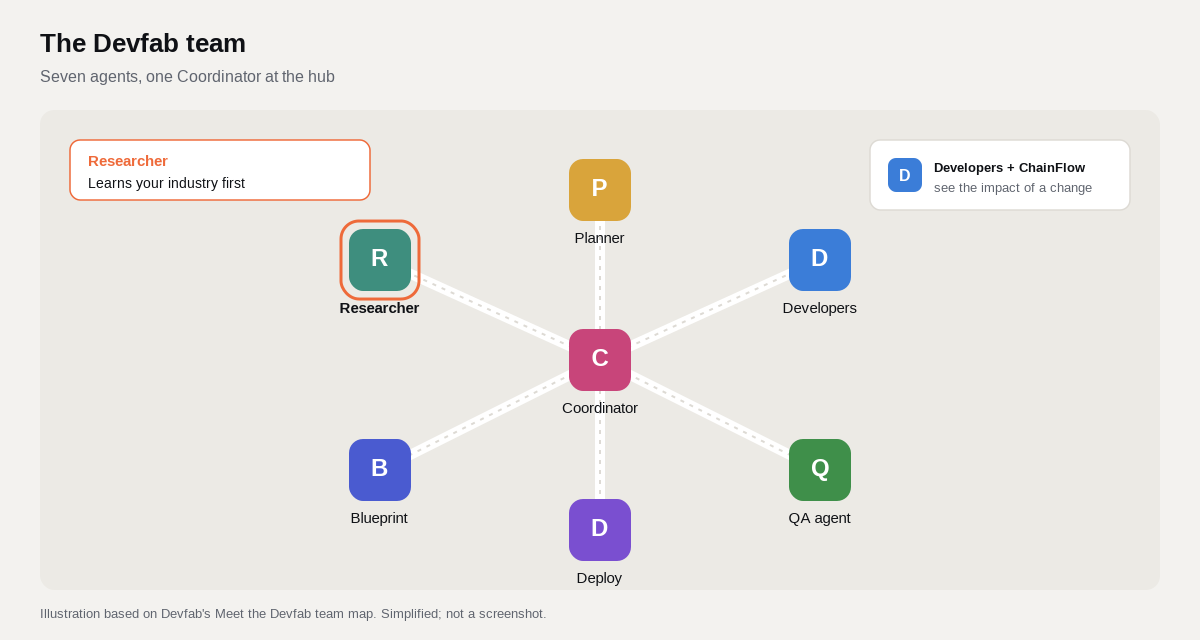
Augment's Cosmos also calls itself a software factory, so this is worth saying plainly. Cosmos is built around engineering loops (review, CI failures, security triage) for large engineering teams. Devfab is built around delivering a whole app, often for a client, from idea to deploy.
Coding agents automate the developer. Devfab automates the development lifecycle. Devfab starts with a Researcher that learns the client's industry first. Then a person approves the plan, the Coordinator creates tickets, and dev agents work with ChainFlow. The QA agent runs UI, flow and logic tests, and Deploy ships to your own server. Docs include blueprints, sequence flows and user manuals.
Honest limits: Devfab is new and in Beta, with a smaller community and fewer integrations than either tool. It is not an editor, and it needs a GitHub account. See Devfab vs Augment Code and Devfab vs Cursor.
FAQ
Who owns Augment Code now?
Harness acquired select Augment Code assets on October 8, 2026: Cosmos, the Auggie CLI, the Code Context Engine and related technology. The team is moving to Harness, Cosmos was renamed Harness Cosmos Software Factory Agent, and augmentcode.com now carries a Harness copyright.
Are Augment's VS Code and JetBrains plugins still supported?
Augment's docs still list a VS Code extension and a JetBrains plugin. But a BERI report from October 9, 2026 notes that neither acquisition announcement names the IDE plugins, so their future is unstated. Ask Harness before you build a team workflow on them.
Can I use Augment's Context Engine inside other tools?
Yes. Augment's docs say the Context Engine is offered as an MCP server usable from Claude Code, Codex and Gemini CLI, as a TypeScript or Python SDK, and through open-source Context Connectors. Cursor supports MCP servers, but Augment's docs do not name Cursor.
Which is cheaper for a team of 25?
It depends on usage. Augment lists flat team plans with no per-seat charge for up to 50 seats, plus usage billed at provider list price and a flat 40% service fee. Cursor Teams is priced per seat with an included usage pool. Check both pricing pages, and ask Harness how existing Augment plans carry over.
Read next
- What is an AI software factory?
- Augment Code alternatives for teams that ship to production (2026)
- How to use AI agents on a large existing codebase
- Devfab vs Augment Code: which fits a team that ships client work?
- Devfab vs Cursor: which fits a team that ships client work?
Re-evaluating after the Harness deal? Try Devfab Beta
Sources (checked November 13, 2026): Harness: Harness acquires Augment Code; Augment Code: Next chapter; Augment Code home; Augment Code Pricing; Augment Code: Software Factory; Augment Docs; Augment Docs: Agent; Augment Docs: Context Services; Augment Docs: Rules and guidelines; SD Times: Harness acquires Augment Code assets; BERI: Harness buys Augment's Cosmos with no word on contracts; Cursor Docs; Cursor Plan Mode; Cursor Cloud Agents; Cursor Bugbot; Cursor Enterprise; Cursor Pricing; Cursor: Joining SpaceX; The Next Web: SpaceX makes its Cursor takeover official.
Frequently asked questions
Who owns Augment Code now?
Harness acquired select Augment Code assets on October 8, 2026: Cosmos, the Auggie CLI, the Code Context Engine and related technology. The team is moving to Harness, Cosmos was renamed Harness Cosmos Software Factory Agent, and augmentcode.com now carries a Harness copyright.
Are Augment's VS Code and JetBrains plugins still supported?
Augment's docs still list a VS Code extension and a JetBrains plugin. But a BERI report from October 9, 2026 notes that neither acquisition announcement names the IDE plugins, so their future is unstated. Ask Harness before you build a team workflow on them.
Can I use Augment's Context Engine inside other tools?
Yes. Augment's docs say the Context Engine is offered as an MCP server usable from Claude Code, Codex and Gemini CLI, as a TypeScript or Python SDK, and through open-source Context Connectors. Cursor supports MCP servers, but Augment's docs do not name Cursor.
Which is cheaper for a team of 25?
It depends on usage. Augment lists flat team plans with no per-seat charge for up to 50 seats, plus usage billed at provider list price and a flat 40% service fee. Cursor Teams is priced per seat with an included usage pool. Check both pricing pages, and ask Harness how existing Augment plans carry over.