Short answer: Lovable wins when a non-developer needs a hosted web app from a prompt, with database, login and publishing included and billed by shared credits. Cursor wins when developers work in a real codebase and want an AI editor, Plan Mode, parallel cloud agents and pull request review, with a choice of models.
Your founder wants an app, not a roadmap, and your one developer wants better tools. Someone suggests Lovable; someone else says "just use Cursor." They are not rivals in the usual sense. One builds the app for you. The other helps you build it. This page referees the choice with vendor docs, and shows how teams use both.
In this comparison:
- Lovable and Cursor at a glance
- Feature comparison
- Cost model by team size
- Where Lovable wins and where Cursor wins
- Switching from one to the other
Each fact links to its source at the bottom.
Lovable and Cursor at a glance
Changes in 2026
- Cursor was acquired by SpaceX. The all-stock deal was confirmed in an 8-K on June 16, 2026, and Cursor's August 14, 2026 post says it "has officially been acquired by SpaceX." Cursor is now a wholly owned subsidiary, and its plans bundle Grok products.
- Lovable moved new apps to TanStack Start with server rendering on May 13, 2026, and unified its credits into one balance on June 1. From September 9, 2026, Free and Pro data may be used for model training unless users opt out; Business and Enterprise are excluded by default.
Lovable
Lovable is a browser-based AI app builder for people with no coding experience and for developers who read and edit the generated code. Build mode changes the project, Plan mode writes a plan for approval first, and Chat mode answers questions without touching code. Apps get a built-in backend (managed PostgreSQL, login, file storage) or Supabase. Publish deploys to a URL with HTTPS, and a quick security scan runs on every publish. "Lovable does not offer a choice of framework or database," and Lovable picks the model. It builds web apps only.
Cursor
Cursor calls itself "a coding agent for building ambitious software." It runs as a desktop editor, a CLI, cloud agents, mobile and SDKs. Plan Mode "creates detailed implementation plans before writing any code," after researching the codebase. Cloud agents "run in isolated VMs in the cloud," many in parallel, each on its own branch. Bugbot reviews pull requests for bugs and security issues. You pick models from Anthropic, Google, OpenAI, xAI, Cursor's own Composer and others.
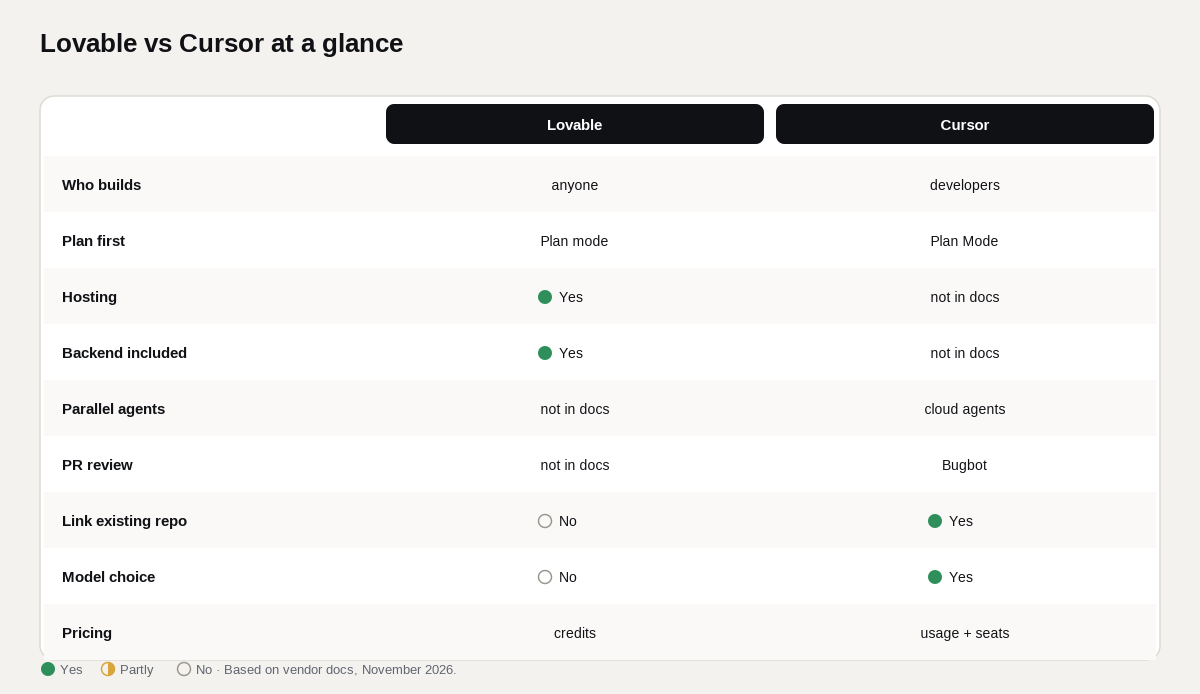
Feature comparison
| Aspect | Lovable | Cursor | Source |
|---|---|---|---|
| Where it runs | Web app with chat, code editor and preview; mobile app | Desktop editor, CLI, cloud agents, mobile, SDKs | Lovable FAQ; Cursor docs |
| Who builds | Non-coders and developers | Developers | Lovable FAQ; Cursor docs |
| Planning / spec | Plan mode writes a plan for approval | Plan Mode researches the codebase and drafts an editable plan | Lovable FAQ; Cursor Plan Mode |
| Agent autonomy | Builds in the project; per-person drafts | Parallel cloud agents in isolated VMs, each pushing a branch | Lovable collaboration; Cursor cloud agents |
| Testing / review | Browser tests and frontend tests when asked; security scans | Bugbot reviews PRs; Autofix pushes fixes | Lovable FAQ; Cursor Bugbot |
| Deploy / hosting | Publish to a URL with HTTPS; built-in backend | Not covered in the Cursor docs we checked | Lovable FAQ; Cursor docs |
| Code and Git | Git sync creates a new repo; one branch syncs | GitHub, GitLab, Bitbucket, Azure DevOps | Lovable GitHub; Cursor cloud agents |
| Team / admin | Roles; SSO from Business; SCIM and audit logs on Enterprise | SSO on Teams; SCIM, audit logs, model limits on Enterprise | Lovable for Enterprise; Cursor Enterprise |
| Model choice | Lovable picks the model | Choose per task from many providers | Lovable FAQ; Cursor docs |
| Pricing model | Monthly credits, not seats | Subscription usage pool; per seat on Teams; models billed by usage | Lovable plans; Cursor pricing |
Cost model by team size
| Team size | Lovable | Cursor |
|---|---|---|
| 1 person | Free plan builds and publishes (5 daily build credits, capped at 30 a month); Pro adds monthly credits that roll over | Free tier with limited agent and chat requests; entry Plus tier limited to Grok models; higher tiers include a weekly usage pool |
| 5 people | Credits, not seats: collaborators spend the owner workspace's credits; SSO from Business | Teams: per seat, SAML/OIDC SSO; cloud agents need Premium or higher, or Teams |
| 25 people | Enterprise by contract: SCIM, audit logs, approval-gated publishing | Enterprise (custom): SCIM, audit logs, repo, model and MCP access controls, group spend limits |
Check Lovable's plans page and Cursor's pricing page as of November 2026. On Cursor, third-party models are billed at API list price with spending caps, and Bugbot is billed by usage. A dev.to review (April 2026) called Cursor's credit pricing "opaque." Devfab (Beta), for comparison, logs cost after each run, per task and per project.
Where Lovable wins
- No developer on the team. Describe the app; Lovable builds, hosts and secures it.
- Backend included. Database, login and file storage come built in.
- One shared budget. Credits cover building, hosting, backend and in-app AI, not per seat.
- Several non-developers edit one app. Roles and per-person drafts keep changes apart until accepted.
Where Cursor wins
- You have a real codebase. Cursor works in any repo on GitHub, GitLab, Bitbucket or Azure DevOps.
- You want to pick the model. Many providers, chosen per task.
- Parallel work. Cloud agents run many tasks at once, each on its own branch, and can run on hardware you manage.
- Mobile, desktop or non-web stacks. Lovable builds web apps only; Cursor edits whatever your repo holds.
Switching from one to the other
From Lovable to Cursor. Connect Lovable's Git sync to GitHub. It creates a new repo. Clone it and open it in Cursor. Lovable keeps two-way sync on one active branch, so commits to that branch show up in Lovable. Cursor's cloud agents work on separate branches, so merge them into the synced branch if non-developers still edit in Lovable.
From Cursor to Lovable. This is the hard direction. Lovable's Git sync "always creates a new repository and cannot link an existing one," so it can't pick up your Cursor repo. Importing outside code was not covered in the Lovable docs we checked.
Where Devfab fits
Lovable gets you the first version. Cursor makes a developer faster. Neither runs the whole delivery: researching the domain, writing a plan a person approves, testing user journeys, and deploying to the client's server.
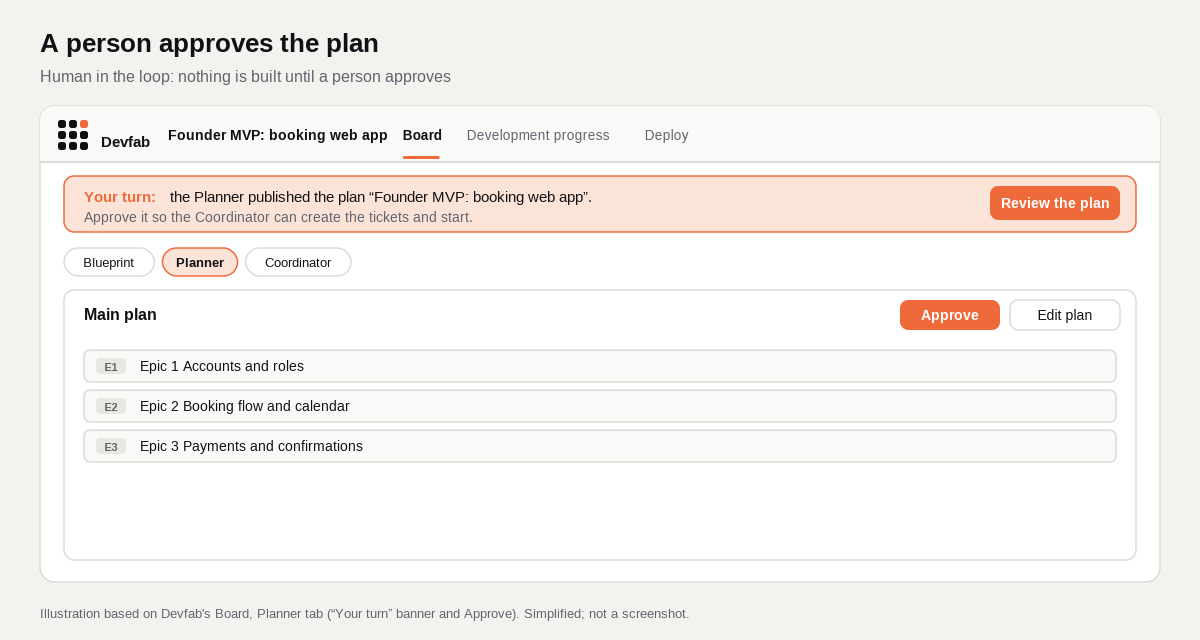
Coding agents automate the developer. Devfab automates the development lifecycle. Devfab's Researcher maps the domain before the Planner writes. A person approves the plan, and the Coordinator splits it into tickets for dev agents that use ChainFlow to see what each change affects. The QA agent runs UI, flow and logic tests. Code stays in your own GitHub account (or your organization's), and Deploy ships to your own server.
Devfab's honest limits: it is new and in Beta, with a smaller community and fewer integrations. It is not an editor for hands-on coding, so a developer who wants AI in the editor should use Cursor. It needs a GitHub account. See Devfab vs Cursor.
FAQ
Can I start in Lovable and continue in Cursor?
Yes. Lovable's Git sync pushes the project to GitHub, GitLab or Bitbucket, with two-way sync on one active branch. Clone that repo and open it in Cursor. Changes pushed to the synced branch flow back to Lovable; work on other branches does not.
Do I need to know how to code to use Cursor?
Mostly, yes. Cursor is a code editor plus a coding agent for developers, with Plan Mode, cloud agents and pull request review. Lovable is built for people with no coding experience as well as developers who read and edit the generated code.
Who owns Cursor now?
SpaceX. The deal was announced on June 16, 2026, and Cursor's August 14, 2026 post says it has officially been acquired. Cursor continues as a wholly owned subsidiary, and its pricing now bundles Grok products into Cursor plans.
Which is cheaper for a team of five?
It depends on how many people build. Lovable prices by monthly credits, not seats, and collaborators spend the owner workspace's credits. Cursor Teams is priced per seat, and third-party models are billed by usage. Check both pricing pages for current amounts.
Read next
- What is an AI software factory?
- Devfab vs Cursor
- Cursor alternatives
- AI app builder vs AI coding agent
- Lovable vs Bolt.new
Need the whole lifecycle, not one step? Try Devfab Beta
Sources (checked November 13, 2026): Lovable FAQ; Lovable for Enterprise; Lovable GitHub Git sync; Lovable plans and credits; Lovable subscription plans; Lovable collaboration; Cursor docs; Cursor pricing; Cursor Plan Mode; Cursor cloud agents; Cursor Bugbot; Cursor Enterprise; Cursor: Joining SpaceX (Aug 14, 2026); The Next Web: SpaceX makes Cursor takeover official; DEV Community: Cursor 3 review (Apr 11, 2026).
Frequently asked questions
Can I start in Lovable and continue in Cursor?
Yes. Lovable's Git sync pushes the project to GitHub, GitLab or Bitbucket, with two-way sync on one active branch. Clone that repo and open it in Cursor. Changes pushed to the synced branch flow back to Lovable; work on other branches does not.
Do I need to know how to code to use Cursor?
Mostly, yes. Cursor is a code editor plus a coding agent for developers, with Plan Mode, cloud agents and pull request review. Lovable is built for people with no coding experience as well as developers who read and edit the generated code.
Who owns Cursor now?
SpaceX. The deal was announced on June 16, 2026, and Cursor's August 14, 2026 post says it has officially been acquired. Cursor continues as a wholly owned subsidiary, and its pricing now bundles Grok products into Cursor plans.
Which is cheaper for a team of five?
It depends on how many people build. Lovable prices by monthly credits, not seats, and collaborators spend the owner workspace's credits. Cursor Teams is priced per seat, and third-party models are billed by usage. Check both pricing pages for current amounts.