Short answer: To keep tests as code at no licence cost, pick Playwright, which Momentic itself builds on. To hand test writing and upkeep to someone else, pick QA Wolf. For a QA team running web, mobile and API tests in one platform, pick mabl. If you also need the app planned and built, Devfab fits.
You picked Momentic because plain-English tests that live in your repo sounded right. Mo explored your gym class booking app, filed bugs and opened pull requests with YAML tests. Then the usage bill grew with every AI step, the Free plan paused at zero mid-sprint, and someone asked whether you need a paid platform on top of Playwright at all.
Those are the usual reasons people look around. Some want to own the framework. Some want less work, not more. Some need mobile or API coverage on a bigger scale.
In this guide, you'll learn:
- Why teams leave Momentic
- All six alternatives in one table
- Where Momentic is still the better choice
- How to choose
Use the sections below as your shortlist.
Why teams leave Momentic
Status first: Momentic is active, with named customers including Notion, Quora, Webflow, Retool and Runway (Momentic). Nothing in its status pushes people away. The triggers are about billing and control, all from Momentic's own pages:
- Usage-based billing in dollars. Steps cost USD 0.0125 each, AI-generated or recovery steps USD 0.025, and hosted browsers USD 0.005 per minute of use, as of November 2026. A suite that self-heals often costs more to run (Momentic pricing).
- Usage doesn't roll over, and the Free plan pauses at zero instead of billing overages.
- Short result history on Free and Scale, and a cap on mobile session length outside Enterprise.
- It sits on Playwright. Momentic's own docs index says so (Momentic llms.txt). Teams with strong engineers sometimes decide to use the base layer directly.
Quick comparison
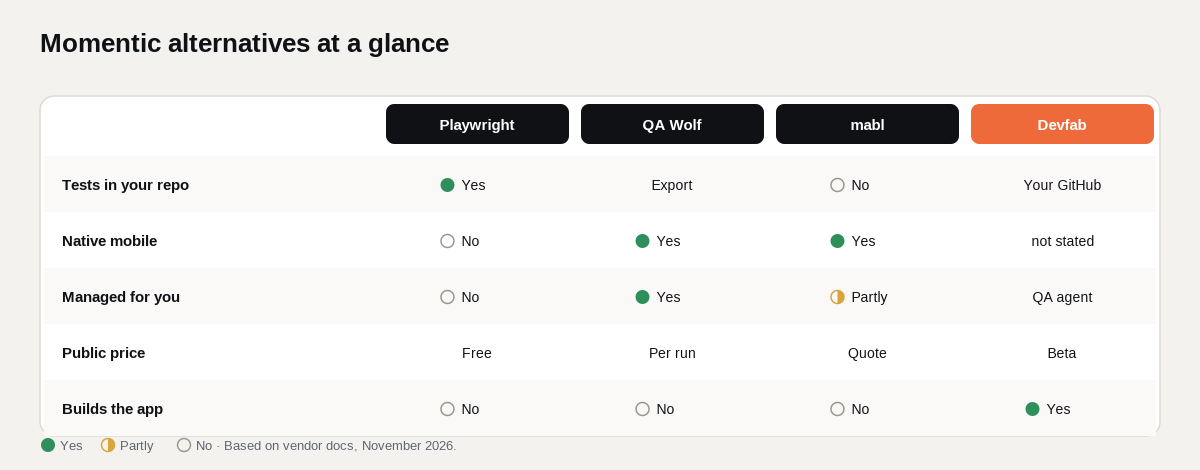
| Tool | Best for | Test format | Runs on | Pricing (as of Nov 2026) |
|---|---|---|---|---|
| Playwright | Engineers who want free, code-first tests | TypeScript, Python, .NET, Java | Your machines and CI | Free, open source |
| QA Wolf | Handing off coverage and maintenance | Playwright and Appium code, exportable | QA Wolf's infrastructure | USD 1 per web run, USD 2 per mobile or desktop run |
| mabl | QA teams covering web, mobile and API | Low-code tests in mabl | mabl cloud, local or CI Runner | Quote; credits for cloud runs |
| Cypress | Web teams that want deep CI debugging | JavaScript tests; cy.prompt for natural language | Your CI plus Cypress Cloud | Starter USD 0; Team from USD 67 per month billed annually |
| CodeRabbit Verify | Testing each pull request's behavior | Generated scenarios | CodeRabbit's sandbox | Free during beta |
| Devfab | Teams that also need the app planned and built | Part of the build (QA agent) | Your GitHub and your server | Cost logged per task and per project (Beta) |
The alternatives
Playwright
Verdict: the base layer Momentic builds on, now with its own test agents. Best for: engineering teams that want tests as code with no licence fee. Trade-off: a framework, not a managed service. You host the runs, CI and maintenance. Pricing: free and open source; no paid tier listed (Playwright).
Playwright drives Chromium, Firefox and WebKit through one API in TypeScript, Python, .NET or Java. Its Test Agents mirror what Momentic sells: a Planner explores the app and writes a Markdown test plan, a Generator turns it into test files, and a Healer repairs failing tests, or skips them if it thinks the feature is broken (Playwright Test Agents). The agents run in VS Code, Claude Code, Codex and OpenCode loops. Playwright MCP lets coding agents drive a browser through accessibility snapshots, so no vision model is needed (Playwright MCP).
QA Wolf
Verdict: the pick when you want fewer tests to look after, not more. Best for: teams that want agents, and optionally QA Wolf engineers, to own coverage. Trade-off: per-run billing grows with suite size times frequency. The vendor's own example is about USD 1,083 a month for 50 web tests run daily, as of November 2026. Pricing: USD 1 per web or Linux Electron test run, USD 2 per mobile or desktop run, no per-seat fees, as of November 2026 (QA Wolf pricing).
QA Wolf's agents plan coverage, write tests, pick the tests each pull request needs, investigate failures and file bugs to Linear or Jira. It covers web, iOS, Android and Windows, with real-device iPhone and iPad testing (QA Wolf). "Your tests are open-source Playwright and Appium code you can export anytime," so leaving is not a rewrite. Its managed Coverage-as-a-Service tier comes with an "80%+ automated coverage" guarantee, quoted by sales.
mabl
Verdict: the platform pick for a QA team, not a developer workflow. Best for: QA groups that need web, mobile, API and AI-feature tests in one suite. Trade-off: no public prices, and tests live in mabl rather than as files in your repo. Pricing: quote-based; cloud runs use credits from an annual allocation; local and CI Runner runs don't use credits; users and apps unlimited (mabl pricing).
mabl's agents author tests from inputs such as Jira requirements, investigate failures and heal broken steps (mabl). Like Momentic, it reaches coding agents through an MCP server, which connects to your IDE, Cursor or CLI (mabl platform). In October 2026 it announced a harness with a knowledge graph that maps each change to its tests and flags coverage gaps (SD Times). See Momentic vs mabl for a head-to-head.
Cypress
Verdict: the mature open-source framework, with natural-language steps arriving. Best for: web teams that want rich failure debugging across many CI runs. Trade-off: cy.prompt is beta, Chromium-only and needs Cypress Cloud; every execution counts toward a quota. Pricing: Starter USD 0 (500 test results and 100 cy.prompt executions a month, 10 users); Team from USD 67 per month billed annually; Business from USD 267 per month billed annually; Enterprise custom, as of November 2026 (Cypress pricing).
The Cypress App is MIT-licensed and free. cy.prompt turns plain-English steps into Cypress commands and moved to beta in Cypress 15.13.0 (cy.prompt docs). Cypress Cloud adds Test Replay, flake detection, UI Coverage and accessibility checks, and a Cloud MCP that gives coding agents access to CI failures and flake history (Cypress).
CodeRabbit Verify
Verdict: an unusual option: behavior testing bolted onto an AI code reviewer. Best for: teams already using CodeRabbit that want each pull request exercised in a running app. Trade-off: beta, web apps and services only, no native mobile, CodeRabbit Cloud only. Pricing: free during the beta; CodeRabbit review plans from USD 24 per user per month, as of November 2026 (CodeRabbit pricing).
Verify "tests how your application behaves, not only how its code reads." It generates scenarios for a pull request, runs the app in a sandbox, mostly through a browser, and reports bugs with screenshots and recordings (Verify docs). It overlaps with Momentic's PR workflow, where Mo tests a preview deployment and posts a review. It won't give you a long-lived regression suite in your repo.
Devfab
Verdict: not a test tool; a software factory with testing built in. Best for: teams that need the app planned, built, tested and deployed, not only tested. Trade-off: Beta, smaller community, fewer integrations, not an editor, needs a GitHub account. Pricing: no published price; predictable cost, logged after each run per task and per project.
Coding agents automate the developer. Devfab automates the development lifecycle. The Researcher maps the domain first (for the gym app: class capacity, waitlists, cancellation windows, competing booking tools). A person approves the plan. ChainFlow maps which functions and APIs call each other, so changing the waitlist shows its effect on bookings, payments and reminder emails. The QA agent runs UI and flow tests plus logic tests, then Deploy ships to your own server. Devfab does not claim native mobile device testing. See Devfab vs Momentic.
Where Momentic is still the better choice
- Plain-English tests as reviewed files. Mo turns an approved flow "into a Momentic YAML test and opens a pull request in your repo" (Momentic). Playwright gives you code; mabl keeps tests in its platform.
- Exploration plus bug reproduction. Mo explores web, iOS and Android apps, and a separate agent reproduces each functional bug it files.
- Coding-agent native. A local or hosted MCP server and a Claude Code plugin (Momentic llms.txt).
- PR preview testing on demand, triggered from PR comments or labels, with a commit check.
- Start at zero. The Free plan includes USD 50 of usage and no per-seat charges, as of November 2026.
How to choose
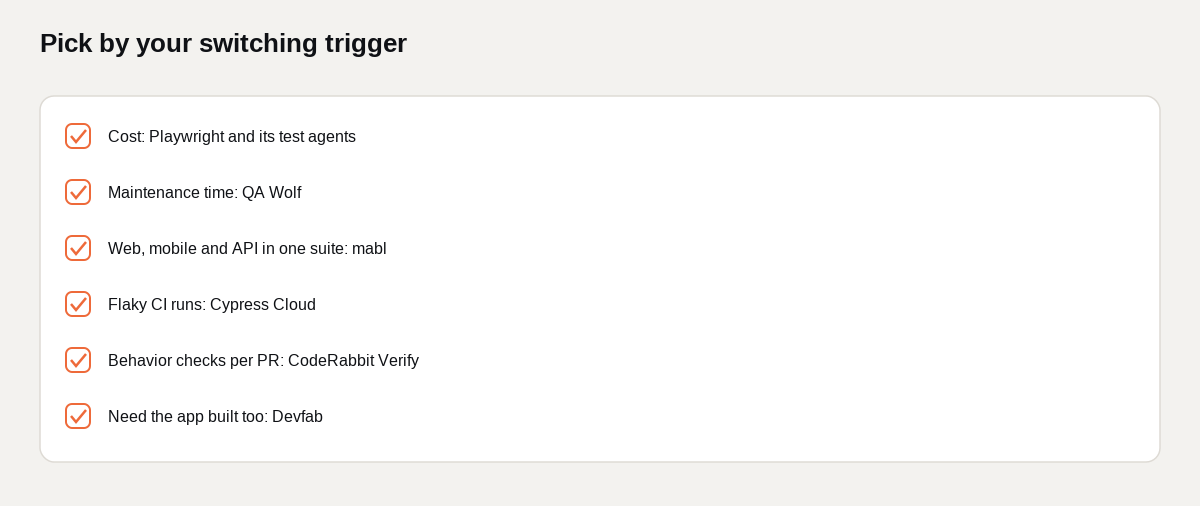
- Cost is the trigger and you have engineers: Playwright, using its agents.
- Time is the trigger and you'd pay to stop maintaining tests: QA Wolf.
- A QA team needs one platform for web, mobile and API: mabl.
- You debug flaky CI runs every week: Cypress with Cypress Cloud.
- You want a reviewer that also clicks through the PR: CodeRabbit Verify, knowing it's beta.
- The bigger gap is building the app with a plan a person approves: Devfab.
FAQ
What is the closest alternative to Momentic?
For tests stored as code in your repo, Playwright is closest, since Momentic itself is built on Playwright and Playwright now ships planner, generator and healer test agents. For a hosted AI service that writes and maintains tests for you, QA Wolf is the closer match.
Is Momentic free?
There is a Free plan at USD 0 per month that includes USD 50 of usage, as of November 2026. It pauses when usage reaches zero rather than billing overages. Scale is USD 500 per month with USD 500 of usage included, and Enterprise is custom.
Why do teams switch from Momentic to Playwright?
Mostly cost and control. Playwright is free and open source, runs on your own CI, and its test agents work with VS Code, Claude Code, Codex and OpenCode. The trade-off is that you host the runs and own the maintenance yourself.
Can Devfab replace Momentic?
Only if you also want the app built. Momentic tests an app you already have. Devfab plans, builds, tests and deploys an app, and its QA agent runs UI, flow and logic tests as one step of that lifecycle. For testing an existing app, a testing tool is the better fit.
Read next
- What is an AI software factory?
- Best end-to-end testing tools
- Momentic vs QA Wolf
- Playwright vs Cypress
Need the app built and tested in one tracked process? Try Beta
Sources (checked November 2026): Momentic homepage; Momentic pricing; Momentic llms.txt; Playwright homepage; Playwright Test Agents; microsoft/playwright-mcp; QA Wolf homepage; QA Wolf pricing; mabl AI test automation; mabl platform; mabl pricing; SD Times: mabl agentic testing harness (Oct 2026); Cypress homepage; Cypress pricing; cy.prompt docs; CodeRabbit Verify docs; CodeRabbit pricing.
Frequently asked questions
What is the closest alternative to Momentic?
For tests stored as code in your repo, Playwright is closest, since Momentic itself is built on Playwright and Playwright now ships planner, generator and healer test agents. For a hosted AI service that writes and maintains tests for you, QA Wolf is the closer match.
Is Momentic free?
There is a Free plan at USD 0 per month that includes USD 50 of usage, as of November 2026. It pauses when usage reaches zero rather than billing overages. Scale is USD 500 per month with USD 500 of usage included, and Enterprise is custom.
Why do teams switch from Momentic to Playwright?
Mostly cost and control. Playwright is free and open source, runs on your own CI, and its test agents work with VS Code, Claude Code, Codex and OpenCode. The trade-off is that you host the runs and own the maintenance yourself.
Can Devfab replace Momentic?
Only if you also want the app built. Momentic tests an app you already have. Devfab plans, builds, tests and deploys an app, and its QA agent runs UI, flow and logic tests as one step of that lifecycle. For testing an existing app, a testing tool is the better fit.