Short answer: OpenCode is the strongest all-round open-source terminal agent, with 200+ model providers under MIT. Cline suits developers who want to approve every edit in VS Code or JetBrains. OpenHands fits teams that self-host agents and automations. goose is a free, foundation-governed general agent. Kilo Code and Aider cover model freedom and git-first editing.
You want an agent you can read, fork and run with your own models. Maybe your security team insists. Maybe you were burned by a vendor price change. Either way, 2026 made this list harder to write: two well-known open-source agents shut down, one was bought, and one is being replaced by a closed product.
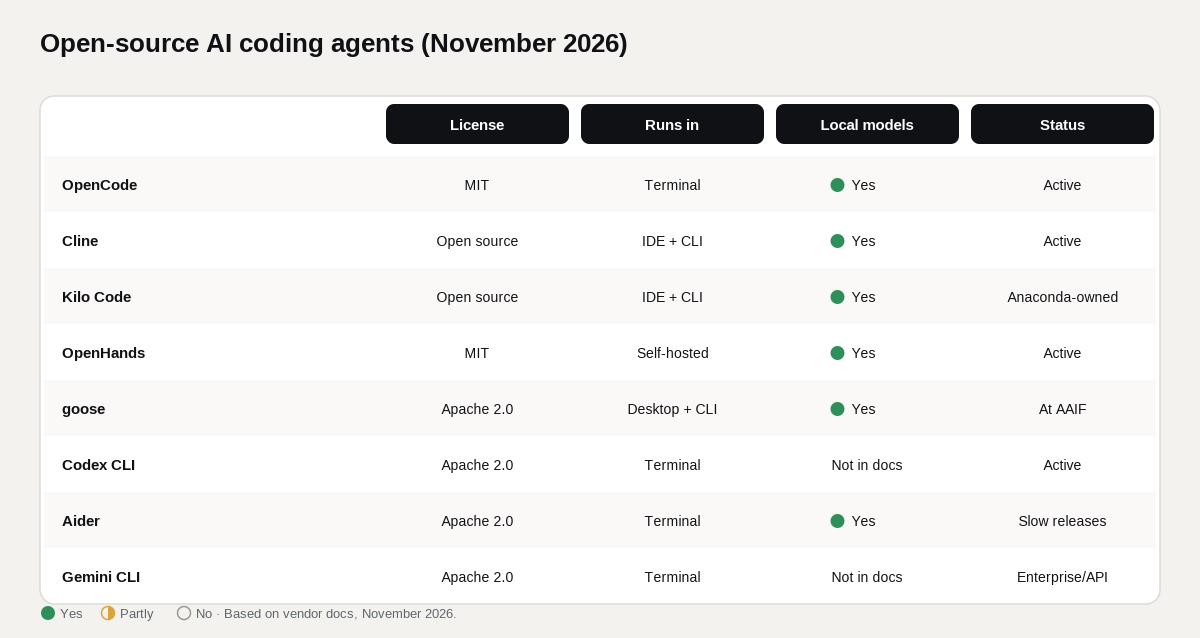
This page compares the eight that are active, with each one's license, interfaces, model options and status as of November 20, 2026.
In this guide, you'll learn:
- How we picked and compared
- The quick comparison table
- Each agent's best use and limits
- Where Devfab fits
- How to choose
Start with the status changes; they rule out two popular names.
How we picked and compared
We included agents whose core code is public under an open-source license and that are active as of November 20, 2026. We compared them from vendor docs, GitHub repos, changelogs and dated reviews. We did not run hands-on tests for this article.
We checked each agent for:
- License and governance. MIT, Apache 2.0 or other; who controls the project.
- Where it runs. Terminal, IDE, desktop, cloud or self-hosted server.
- Model choice. Bring your own key, local models, vendor credits.
- Safety. Approvals, sandboxing and permission rules.
- Team features. SSO, audit logs and shared billing, which are often paid add-ons.
- Status. Releases in 2026, ownership changes, shutdown notices.
Left out because of 2026 status changes:
- Roo Code. "The Roo Code Extension was shut down on May 15th," and the repo is archived; the README points users to Zoo Code, a community fork, and to Cline (Roo Code on GitHub).
- Continue. Cursor acquired Continue around June 16, 2026 and discontinued the product; users had until July 15 to export data. The Apache-2.0 code stays public for forking (The New Stack).
Quick comparison table
| Agent | License | Where it runs | Models | Status (Nov 2026) | Best for |
|---|---|---|---|---|---|
| OpenCode | MIT | Terminal UI, desktop (beta), mobile, SDK | 200+ providers, local, ChatGPT or Copilot logins | Active; repo moved to anomalyco | Terminal users wanting maximum model choice |
| Cline | Open source (extension, CLI, desktop) | VS Code, JetBrains, CLI, desktop, Kanban board | Cline billing, ClinePass, BYOK, local | Active | Approving every action inside the IDE |
| Kilo Code | Open source | VS Code, JetBrains, CLI, cloud agents | 500+ models, BYOK, Ollama, LM Studio | Active; acquired by Anaconda (Jul 2026) | Model freedom with team billing |
| OpenHands | MIT | Agent Canvas (desktop/web), Docker, Kubernetes, VPC | Closed and open-weight, BYOK | Active; Agent Canvas since Jun 2026 | Self-hosted agents and automations |
| goose | Apache 2.0 | Desktop app, CLI, API | 15+ providers, Ollama | Active; now at Linux Foundation's AAIF | A free general agent you can rebrand |
| OpenAI Codex CLI | Apache 2.0 (CLI) | Terminal; also part of OpenAI's wider Codex product | OpenAI models | Active | ChatGPT users wanting an inspectable CLI |
| Aider | Apache 2.0 | Terminal, browser, IDE watch mode | Almost any LLM, incl. local | Active but slow-moving | Git-first edits with local models |
| Gemini CLI | Apache 2.0 | Terminal, GitHub Action | Gemini only | Narrowed to enterprise and paid API users | Gemini Code Assist enterprises |
The agents, one by one
1. OpenCode
OpenCode is an MIT-licensed coding agent that runs on your machine in a terminal UI, a desktop app (beta on GitHub) or a mobile client, with an SDK for scripts and CI (OpenCode; GitHub). It ships two built-in agents: "build" with full access, and "plan," which is read-only, denies edits by default and asks before running bash commands. It supports parallel agents on one project, MCP servers, plugins, custom agents, skills, permissions and undo. Models come from 200+ providers through Models.dev, including local models, and it can use existing ChatGPT Plus/Pro or GitHub Copilot subscriptions. The repo, now at anomalyco/opencode, shows 225.7k stars. Kilo Code's VS Code extension is now built on the OpenCode server (Kilo blog).
Best for: developers who live in the terminal and want a free agent with the widest model choice.
Limits: a June 2026 review reports 1GB+ RAM use by the TUI, releases that sometimes break features, permissive default permissions and immature enterprise compliance features (rywalker.com). OpenCode Go, a subscription for curated open-weight models, starts at USD 10 per month as of November 2026.
2. Cline
Cline is an open-source coding agent where "every action requires your approval" (Cline docs). It runs as a VS Code extension, a JetBrains plugin, a CLI (interactive or headless for CI/CD), a desktop app and an SDK, plus Kanban, a web board that runs many agents in parallel. Plan mode reads and discusses without editing; Act mode carries out the plan, with a different model per mode if you like, and Checkpoints for rollback (Plan & Act). You can pay through Cline's usage billing, use ClinePass for open-weight models, or bring your own key. Cline says the VS Code extension has over 11 million installs (vendor claim). In 2026 it shipped CLI 2.0, Kanban, an SDK rebuild, a new harness and a Desktop beta (Cline blog).
Best for: developers who want to approve each file edit and command in their own editor.
Limits: the 2026 harness migration deprecated "some less-used features," a February 2026 unauthorized npm publish of the CLI needed a post-mortem, and OpenAI hired at least seven Cline staff in January (TEXXR). SSO, RBAC and VPC deployment sit on the custom Enterprise plan (Cline pricing).
3. Kilo Code
Kilo Code is an open-source, model-agnostic agent for VS Code, JetBrains and the terminal, with cloud agents and code review (Kilo docs). Status: Anaconda announced on July 15, 2026 that it acquired Kilo and said nothing changes for current users' products, plans or support (Anaconda). The Kilo Gateway routes 500+ models from 60+ providers; you can also bring your own key or run local models through Ollama or LM Studio (Kilo pricing). Agent Manager runs several agent tabs, isolates them in git worktrees and supports parallel subagents. A diff reviewer adds line comments, and multi-model comparison runs one prompt on several models. Kilo also published a migration path for Roo Code users (Kilo blog).
Best for: teams that want model freedom with governance: Teams is USD 15 per user per month, and Enterprise adds SSO, SCIM and audit logs, as of November 2026.
Limits: inference is billed separately with a 5% fee on credit purchases, and Teams includes no credits. A June 2026 review counted 1,300+ open GitHub issues (rywalker.com).
4. OpenHands
OpenHands is an MIT-licensed platform for running coding agents and automations, self-hosted, in OpenHands Cloud or in an enterprise VPC (GitHub). Since June 16, 2026 its main interface is Agent Canvas, a self-hostable workspace that runs on local, Docker, remote VM, Kubernetes, Modal or VPC backends (OpenHands blog). It can run other harnesses, such as Claude Code and Codex, through the Agent Client Protocol. Automations cover PR reviews, issue triage, issue-to-PR and repo summaries. September releases added /plan and /code modes and an optional Docker runtime that isolates each conversation (OpenHands blog). The homepage showed 93.8k GitHub stars on November 20.
Best for: platform teams that must self-host agents with their own model keys and build automations on top.
Limits: you run and govern models, keys and sandboxes yourself. The Teams plan, USD 500 per month for up to 10 users plus USD 50 per extra seat as of November 2026, "is capped at 5,000 sessions per month" (OpenHands pricing).
5. goose
goose is a free, Apache 2.0, general-purpose AI agent built in Rust, with a desktop app for macOS, Linux and Windows, a CLI and an API (goose README). Status: it moved from Block to the Agentic AI Foundation at the Linux Foundation; the repo is now aaif-goose/goose (goose blog, Apr 7, 2026). It works with 15+ model providers, including Ollama, and can use Claude, ChatGPT or Gemini subscriptions through ACP. It connects to 70+ extensions via MCP, saves workflows as portable YAML recipes, and spawns subagents in parallel (goose docs). Custom distributions can preset providers, extensions and branding. November releases added a context window viewer and resumable subagent delegates (releases).
Best for: teams that want a foundation-governed agent they can embed or rebrand, and individuals who want a free local agent.
Limits: a September 2026 review notes no default sandbox per run, no built-in model, community-only support with no SLA, and that it is not embedded in an IDE (PromptQuorum).
6. OpenAI Codex CLI
The Codex CLI repo (openai/codex) is public under Apache 2.0 and installs through npm, Homebrew or prebuilt binaries (GitHub). The CLI is one surface of OpenAI's Codex, which also runs in the ChatGPT apps, an IDE extension, cloud environments, GitHub and Slack (ChatGPT docs). Documented features include AGENTS.md, MCP, sandboxing (including on Windows), agent approvals and permissions. Codex is included in ChatGPT plans from Free to Enterprise, and it can also use an API key billed at API rates (Codex pricing). In July 2026, OpenAI folded the Codex desktop app into a combined ChatGPT desktop app (The New Stack).
Best for: developers already paying for ChatGPT who want an inspectable CLI they can run locally.
Limits: OpenAI models only. With an API key, cloud features such as GitHub code review and the Slack integration are not available. The open-source part is the CLI, not OpenAI's cloud service.
7. Aider
Aider is an Apache-2.0 AI pair programmer that edits files in your local git repo (GitHub). It builds a repo map for context, commits changes automatically, and lints and tests after each change (Aider docs). It has code, architect, ask and help modes, plus voice input and images or web pages as context. Model support is wide: OpenAI, Anthropic, Gemini, DeepSeek, Bedrock, OpenRouter, Ollama, LM Studio and any OpenAI-compatible API. The repo has 49.8k stars.
Best for: solo developers who want precise multi-file edits, a clean git history and local or air-gapped models.
Limits: the latest PyPI release is still 0.86.2 from February 12, 2026, though the main branch keeps adding model support (PyPI; release history). A dated review lists manual context management, no native MCP support, no team features and a solo-maintainer risk (CodeMySpec).
8. Gemini CLI
Gemini CLI is Google's Apache-2.0 terminal agent, with about 107k GitHub stars (GitHub). It supports MCP, per-project GEMINI.md files, checkpointing and sandboxing, plus headless output in text or JSON. The run-gemini-cli GitHub Action handles PR reviews and issue triage. Status: Google announced on May 19, 2026 that Gemini CLI is transitioning to Antigravity CLI. Since June 18, it no longer serves Google AI Pro, Ultra or free Code Assist individuals; Code Assist Standard and Enterprise customers and paid API-key users keep access (Google Developers Blog).
Best for: enterprises already licensed for Gemini Code Assist that want an auditable agent in CI.
Limits: Gemini models only, and its successor for individuals "won't be open source," per FOSS Force (FOSS Force). Individuals should look elsewhere on this list.
Devfab, with honest limits
Devfab is not on this list as an open-source agent. It is included because many teams look at open-source agents for one reason: control. Devfab gives control in a different place, over the output and the process.
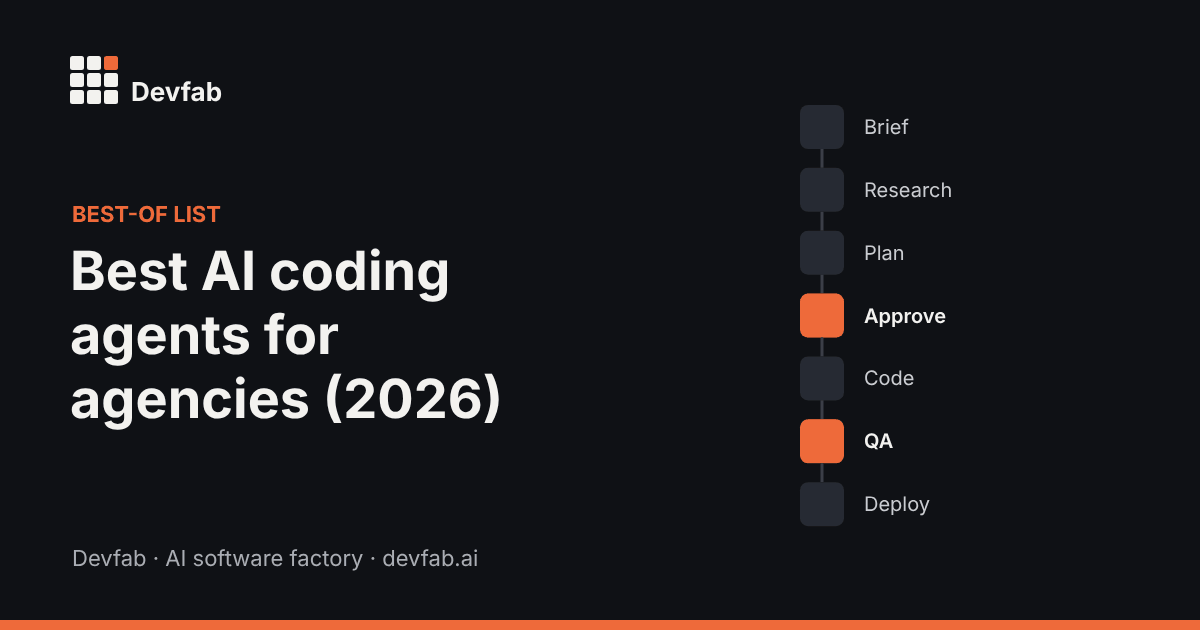
Coding agents automate the developer. Devfab automates the development lifecycle. Every agent above helps a developer change code. Devfab runs a project with seven agents: Researcher, Planner, Coordinator, Developers, Blueprint, QA agent and Deploy.
- The Researcher maps the domain before planning. For a warehouse picking app, that means terms like pick lists and bins, common practices and competing products, then a suggested prototype.
- A person approves the plan before the Coordinator creates tickets.
- ChainFlow maps which functions and APIs call each other, so dev agents see the impact of a change before they make it.
- The QA agent runs UI and flow tests, clicking screens, buttons and journeys end to end, plus logic tests.
- Code lives in your own GitHub account or your organization's, and Deploy ships to your own server. You can choose the model for each agent or keep Devfab's default. Cost is logged after each run, per task and per project.
Limits: Devfab is new and in Beta, has a smaller community and fewer integrations than mature tools, is not an editor for hands-on coding, and needs a GitHub account. If you need to read and fork the agent itself, pick one of the eight above. See Devfab vs OpenCode and Devfab vs Cline.
How to choose
- Decide where you work. Terminal: OpenCode, Aider, Codex CLI. IDE: Cline, Kilo Code. Shared server or VPC: OpenHands.
- Decide who governs the project. Foundation-governed: goose. Company-backed: the rest. Check recent ownership changes, like Kilo's sale to Anaconda.
- Decide on models. Need local or air-gapped models? Aider, Kilo Code, goose and OpenHands all support them. Locked to one vendor: Codex CLI and Gemini CLI.
- Check team features and their price. SSO, audit logs and spend controls are usually paid tiers, even on open-source agents.
- Check the release pulse. A slow release cadence, like Aider's, or a shutdown notice, like Roo Code's, matters more than a feature list.
- If the job is a whole app, not a code change, compare with a software factory too. Our open-source vs commercial coding agents guide covers that trade-off.
FAQ
What is the best open-source AI coding agent in 2026?
For a terminal agent with the widest model choice, OpenCode (MIT). For an agent inside VS Code or JetBrains that asks before every action, Cline. For self-hosted agents and automations across a team, OpenHands (MIT). For a free, foundation-governed general agent, goose (Apache 2.0).
Which open-source coding agents were discontinued in 2026?
Roo Code's extension was shut down and its repo archived on May 15, 2026. Continue was acquired by Cursor around June 16, 2026 and discontinued, with its Apache-2.0 code left public for forking. Google is also moving individual users from Gemini CLI to the closed Antigravity CLI.
Are open-source coding agents free?
The agent software is free, but model use usually is not. Most of these tools let you bring your own API key, use local models through Ollama or LM Studio, or buy credits or a subscription from the vendor. Team features such as SSO and audit logs are often paid.
Can I run an open-source coding agent fully offline?
Several support local models. Aider, Kilo Code and goose list Ollama, and Aider and Kilo Code also list LM Studio. OpenHands runs open-weight models locally or in your VPC. Check that the model you pick is strong enough for your codebase.
Read next
Want control over the whole project, not just the agent? Try Beta
Sources (checked November 2026): OpenCode; anomalyco/opencode on GitHub; OpenCode research note (rywalker.com, Jun 2026); Cline docs; Cline Plan & Act; Cline pricing; Cline blog archive; TEXXR: OpenAI hires seven employees from Cline (Jan 29, 2026); Kilo docs: About Plans; Kilo pricing; Kilo blog: New Kilo for VS Code (Apr 2, 2026); Kilo blog: Thank you, Roo; Kilo research note (rywalker.com, Jun 2026); Anaconda Acquires Kilo Code (Jul 15, 2026); OpenHands on GitHub; OpenHands pricing; Introducing Agent Canvas (Jun 16, 2026); OpenHands in September (Oct 7, 2026); goose README; goose moves to AAIF (Apr 7, 2026); goose docs; goose releases; PromptQuorum: goose review (Sep 12, 2026); openai/codex on GitHub; ChatGPT and Codex docs; Codex pricing; The New Stack: Codex joins ChatGPT desktop app (Jul 9, 2026); Aider-AI/aider on GitHub; Aider docs; aider-chat on PyPI; Aider release history; CodeMySpec: Aider in 2026; google-gemini/gemini-cli on GitHub; Google Developers Blog: Transitioning Gemini CLI (May 19, 2026); FOSS Force (May 22, 2026); Roo Code on GitHub (archived); The New Stack: Cursor acquires Continue (Jun 22, 2026).
Frequently asked questions
What is the best open-source AI coding agent in 2026?
For a terminal agent with the widest model choice, OpenCode (MIT). For an agent inside VS Code or JetBrains that asks before every action, Cline. For self-hosted agents and automations across a team, OpenHands (MIT). For a free, foundation-governed general agent, goose (Apache 2.0).
Which open-source coding agents were discontinued in 2026?
Roo Code's extension was shut down and its repo archived on May 15, 2026. Continue was acquired by Cursor around June 16, 2026 and discontinued, with its Apache-2.0 code left public for forking. Google is also moving individual users from Gemini CLI to the closed Antigravity CLI.
Are open-source coding agents free?
The agent software is free, but model use usually is not. Most of these tools let you bring your own API key, use local models through Ollama or LM Studio, or buy credits or a subscription from the vendor. Team features such as SSO and audit logs are often paid.
Can I run an open-source coding agent fully offline?
Several support local models. Aider, Kilo Code and goose list Ollama, and Aider and Kilo Code also list LM Studio. OpenHands runs open-weight models locally or in your VPC. Check that the model you pick is strong enough for your codebase.