Short answer: OpenHands wins when a platform team wants one self-hostable place to run many agents, automations and harnesses under shared identity, budgets and audit. OpenCode wins when each developer wants a free, fast, model-agnostic agent in the terminal or desktop, and the company does not need central control yet.
You want an open-source coding agent, and two names keep coming up. Some say OpenHands, because it scales to a whole company. Others say OpenCode, because developers actually enjoy using it. Both are MIT licensed. But they solve different problems for different owners. This page compares them using their own docs, re-checked on November 20, 2026.
In this comparison:
- OpenHands and OpenCode at a glance
- Feature comparison
- Cost model by team size
- Where OpenHands wins
- Where OpenCode wins
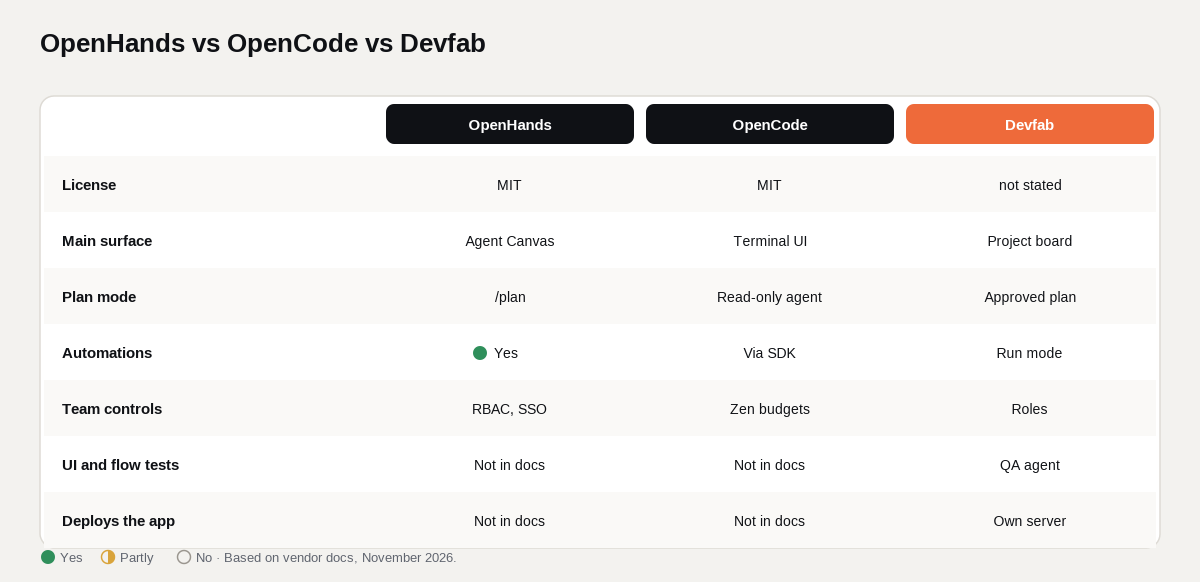
The table near the top answers most questions on its own.
OpenHands and OpenCode at a glance
OpenHands has a new main interface. On June 16, 2026, the company introduced Agent Canvas, a self-hostable workspace it calls its main interface going forward (OpenHands blog: Agent Canvas). The repository now lives at OpenHands/OpenHands (GitHub). OpenHands is an open-source platform for running coding agents and automations, on your own machines, in OpenHands Cloud, or inside an enterprise VPC (OpenHands). It is built for engineering teams and enterprises that need governed agents in their own environment.
OpenCode moved homes too. Its repository is now anomalyco/opencode, run by Anomaly, the team behind SST (GitHub). OpenCode is a coding agent that runs on your machine in a terminal UI, a desktop app (marked beta) or a mobile client, and works with 200+ model providers (OpenCode). It also powers other tools: Kilo Code's VS Code extension is built on the OpenCode server (Kilo blog), and Kilo Code itself was acquired by Anaconda, announced July 15, 2026 (Anaconda). It is built for individual developers who want a model-agnostic agent.
Feature comparison
| Aspect | OpenHands | OpenCode | Source |
|---|---|---|---|
| Where it runs | Agent Canvas app (npm, Docker or source); local, Docker, remote VMs, Kubernetes, Modal or VPC backends; Python SDK | Terminal UI, desktop app (beta), mobile clients, SDK for scripts and CI | Agent Canvas; OpenCode |
| Planning | /plan and /code modes (September 2026) | Built-in "plan" agent is read-only and asks before bash commands | OpenHands September; OpenCode GitHub |
| Agent autonomy | Parallel sessions; scheduled and event-triggered automations | "build" agent with full access; parallel agents on one project | Agent Canvas; OpenCode |
| Other agents | Runs Claude Code and Codex via ACP; homepage lists Gemini CLI | Custom agents, skills, plugins | Agent Canvas; OpenCode |
| Sandboxing | Optional Docker runtime gives each conversation its own container | Permissions system; a review calls defaults permissive | OpenHands September; rywalker.com |
| Testing and deploy | Not covered in the docs we checked | Not covered in the docs we checked | — |
| Integrations | GitHub, Slack, Jira, Linear, Notion, Atlassian, MCP; apps from GitHub, GitLab, Bitbucket, Gitea or Forgejo | MCP servers, plugins | OpenHands; OpenCode |
| Team and admin | Teams: RBAC, SSO/SAML, budgets; Enterprise: VPC, audit of every action, SLA | Zen workspaces: member invites, model enablement, per-member budgets | OpenHands pricing; OpenCode Zen |
| Model choice | Closed and open-weight models; LLM Profiles per task; BYOK | 200+ providers incl. local models; can use ChatGPT Plus/Pro or GitHub Copilot subscriptions | OpenHands; OpenCode |
| Pricing model | Free self-hosted; flat Teams fee plus seats; custom Enterprise | Free agent; Go subscription; Zen pay-as-you-go credits | OpenHands pricing; OpenCode |
Cost model by team size
| Team size | OpenHands | OpenCode | Devfab |
|---|---|---|---|
| 1 person | Open Source USD 0, self-hosted, bring your own keys | Agent free; free models, your own keys, or OpenCode Go from USD 10 per month | Cost logged per task and per project (Beta) |
| 5 people | Self-host free, or Teams USD 500 per month flat (covers up to 10 users) | Agent free; optional Zen workspace with per-member budgets (pay as you go) | Cost logged per task and per project (Beta) |
| 25 people | Teams: USD 500 plus 15 extra seats at USD 50 each = USD 1,250 per month; or Enterprise (custom, unlimited seats) | Agent free; model spend per developer | Cost logged per task and per project (Beta) |
Prices as of November 2026 from OpenHands pricing and the OpenCode homepage. Model costs come on top for both. OpenHands Teams is capped at 5,000 sessions per month and covers one organization. Zen's price is not shown on the OpenCode homepage. Devfab is in Beta and offers predictable cost: cost is logged after each run, per task and per project.
Where OpenHands wins
- Central control. Teams adds multi-user identity, RBAC, SSO/SAML and budgets; Enterprise adds VPC deployment and auditing of every action.
- Automations without glue code. PR reviews, issue triage, issue-to-PR and weekly repo summaries run on schedules or events.
- One home for many harnesses. Platform teams can run OpenHands, Claude Code and Codex side by side.
- Isolation per conversation. The optional Docker runtime gives each conversation its own container.
- Repos beyond GitHub. Apps install from GitLab, Bitbucket, Gitea or Forgejo URLs too.
Where OpenCode wins
- Zero platform cost. The agent is free; you pay only for the model you choose.
- Reuse subscriptions you already pay for. It can use ChatGPT Plus/Pro or GitHub Copilot plans.
- The widest model menu. 200+ providers through Models.dev, including local models.
- Developer experience. A terminal UI, desktop and mobile clients, undo and redo, and a big community (225.7k GitHub stars).
- No server to run. Nothing to deploy before a developer can start.
OpenCode has trade-offs. A June 2026 review reports 1GB+ memory use by the terminal UI, releases that sometimes break features, permissive default permissions and immature enterprise compliance features (rywalker.com). OpenHands has its own: you run and govern models, keys and sandboxes yourself, and automations can be turned off automatically after repeated dispatch failures (OpenHands September).
Switching from one to the other
Both work on your own repositories, so code doesn't move. From OpenCode to OpenHands: install Agent Canvas with npm or Docker, connect the same Git repos, and add the model keys you already use; then rebuild any CI scripts as Canvas automations. From OpenHands to OpenCode: install OpenCode per developer and move scheduled jobs to your CI using the OpenCode SDK. In both cases, write your project rules in a shared instructions file in the repo so either agent can read them.
Where Devfab fits
Both tools give developers agents. Neither, in the docs we checked, researches the business domain, routes a project plan to a person for approval, runs a separate QA step on user journeys, or deploys the app.
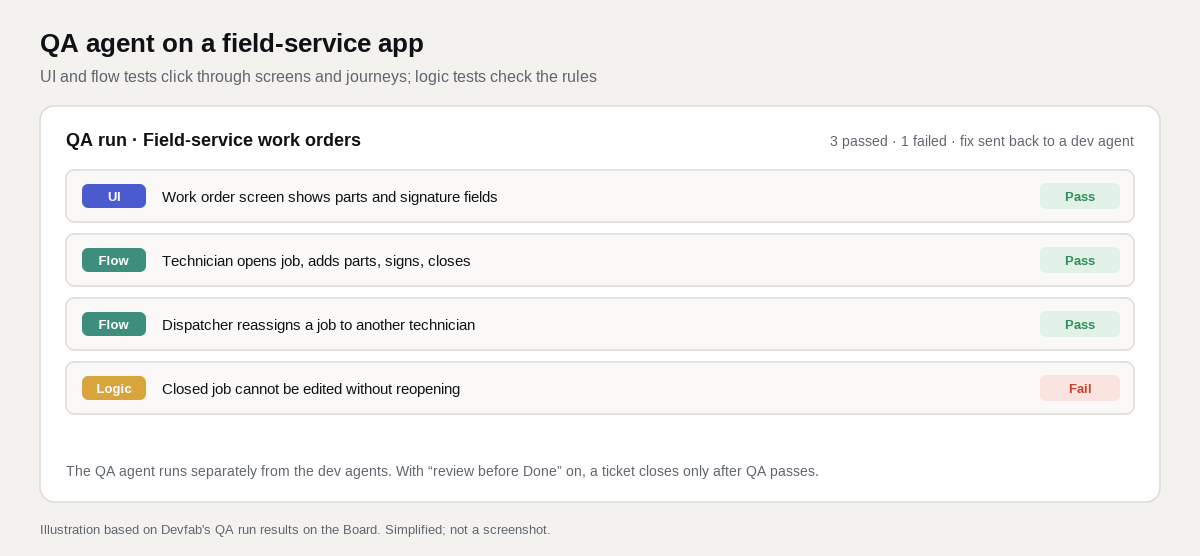
Coding agents automate the developer. Devfab automates the development lifecycle. Devfab's Researcher maps the domain before the Planner writes a plan, a person approves it, developer agents build with ChainFlow, and the QA agent runs UI and flow tests plus logic tests. For a field-service app, the QA agent clicks through a technician's whole job: open the work order, add parts, capture a signature and close it. Code lives in your own GitHub account and deploys to your own server. Devfab is in Beta, has a smaller community, and is not an editor for hands-on coding. See Devfab vs OpenHands and Devfab vs OpenCode.
FAQ
Are OpenHands and OpenCode both open source?
Yes. Both are MIT licensed. OpenHands' repository now lives at OpenHands/OpenHands and OpenCode's at anomalyco/opencode. OpenHands also sells a hosted Teams plan and a custom Enterprise plan, while the OpenCode agent itself is free.
Can OpenHands run OpenCode?
OpenHands' Agent Canvas runs third-party agent harnesses such as Claude Code and Codex through the Agent Client Protocol, and its homepage also lists Gemini CLI. OpenCode is not named in the pages we checked, so test it before you plan on it.
Which one is cheaper for a team of 25?
The OpenCode agent is free, so you pay only for models. As of November 2026, OpenHands Teams is USD 500 per month including 10 users plus USD 50 per month per extra seat, so 25 users is USD 1,250 per month before model costs. Self-hosting OpenHands is free.
Which one is better for scheduled automations?
OpenHands. Agent Canvas has scheduled and event-triggered automations such as PR reviews, issue triage and issue-to-PR. OpenCode has an SDK for scripts and CI, so you can build automations, but you wire them up yourself.
Read next
- What is an AI software factory?
- OpenHands alternatives
- OpenCode alternatives
- Devfab vs OpenHands
- Devfab vs OpenCode
Want agents that take a project from research to your server? Try Beta
Sources (checked November 2026): OpenHands homepage; OpenHands pricing; OpenHands GitHub repository; OpenHands blog: Introducing Agent Canvas (Jun 16, 2026); OpenHands blog: September 2026 updates (Oct 7, 2026); OpenCode homepage; anomalyco/opencode on GitHub; OpenCode Zen docs; rywalker.com: OpenCode research note (Jun 2026); Kilo blog: The new Kilo Code for VS Code (Apr 2, 2026); Anaconda: Anaconda acquires Kilo Code (Jul 15, 2026).
Frequently asked questions
Are OpenHands and OpenCode both open source?
Yes. Both are MIT licensed. OpenHands' repository now lives at OpenHands/OpenHands and OpenCode's at anomalyco/opencode. OpenHands also sells a hosted Teams plan and a custom Enterprise plan, while the OpenCode agent itself is free.
Can OpenHands run OpenCode?
OpenHands' Agent Canvas runs third-party agent harnesses such as Claude Code and Codex through the Agent Client Protocol, and its homepage also lists Gemini CLI. OpenCode is not named in the pages we checked, so test it before you plan on it.
Which one is cheaper for a team of 25?
The OpenCode agent is free, so you pay only for models. As of November 2026, OpenHands Teams is USD 500 per month including 10 users plus USD 50 per month per extra seat, so 25 users is USD 1,250 per month before model costs. Self-hosting OpenHands is free.
Which one is better for scheduled automations?
OpenHands. Agent Canvas has scheduled and event-triggered automations such as PR reviews, issue triage and issue-to-PR. OpenCode has an SDK for scripts and CI, so you can build automations, but you wire them up yourself.