Short answer: Choose no-code when the app is internal, the workflow is still changing and a monthly subscription is cheaper than a build. Choose custom development when you need the code and data on your own servers, the logic outgrows visual workflows, or per-user and usage fees grow faster than the app's value. Switch when you hit a plan limit you cannot buy past.
A food bank started with a volunteer sign-up form built on a no-code tool. It worked. Then came shift swaps, a driver rota, donor receipts and a partner portal for other charities. Each addition was easy on its own. Together, they hit the record cap, the user cap and the workflow-run cap in the same quarter.
That story is common, and it is not a failure of no-code. It is what success looks like on a platform with plan limits. The useful question is not "no-code or code?" but "what will this app need in its second year?" This guide compares cost and control, and lists the limits that tell you it's time to move.
In this guide, you'll learn:
- Definitions
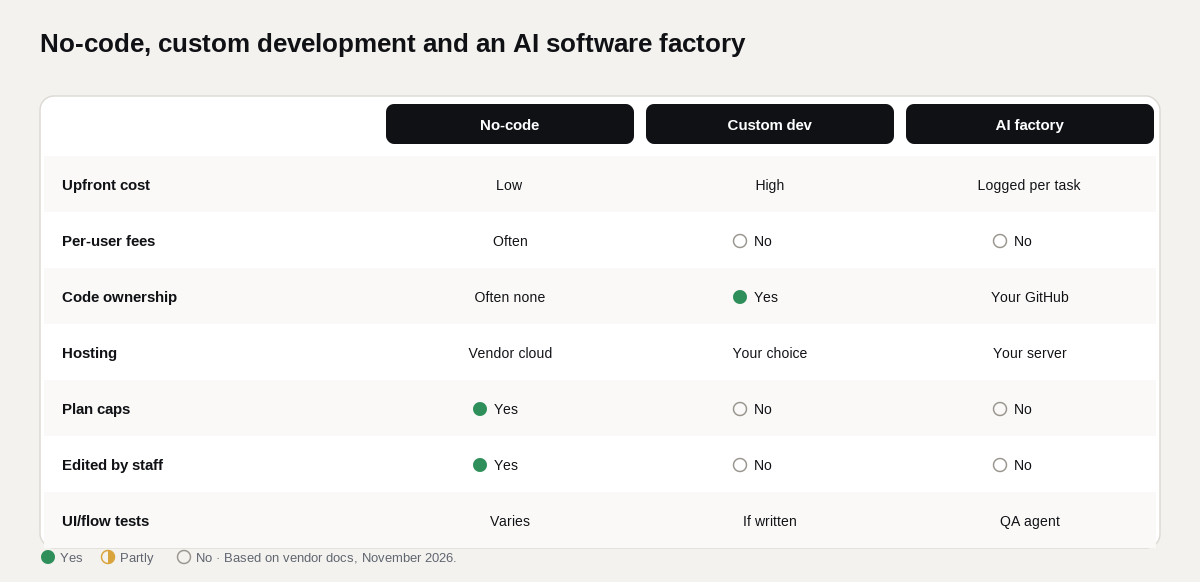
- Cost and control side by side
- The switch signals
- When to choose no-code
- When to choose custom development
Use the switch signals as a checklist for any app you already run.
Definitions
No-code builds software with visual tools only. IBM describes it as "a completely hands-off approach, with 100% dependence on visual tools," aimed at business users, and extendable "only through templated feature sets" (IBM). Microsoft puts it simply: "no-code development doesn't require any coding" (Microsoft).
Low-code sits next to it. IBM calls low-code "aimed at professional developers," extendable with custom code and plugins (IBM, same page). Many no-code products now include AI builders that generate the first version from a prompt, as Airtable's Omni, Knack's AI app builder and Noloco's Nola do (Airtable; Knack; Noloco). That speeds up the start but does not change who hosts the app.
Custom development means writing the application as code: your own repository, your own choice of framework and database, deployed where you decide. A person or team (or a set of AI agents) plans, builds, tests and maintains it.
Cost and control side by side
| Aspect | No-code platform | Custom development |
|---|---|---|
| Upfront cost | Free tier or a monthly plan | Planning, building and testing work before launch |
| Ongoing cost | Subscription, often per user or per builder, plus metered usage | Hosting and maintenance; no platform fee |
| Who changes it | Business users in a visual editor | Developers or coding agents |
| Where it runs | The vendor's cloud (some offer self-hosting on higher plans) | Your servers or your chosen cloud |
| Code ownership | Often none; data export via CSV or API | You own the repository |
| Limits | Records, users, apps, workflow runs and AI credits per plan | Set by your architecture and budget |
| Speed of first version | Fast; AI builders make it faster | Slower without automation |
| Exit cost | Rebuild if the platform does not export code | Low; move the code and data |
Two vendor facts show why "where it runs" and "code ownership" matter. Bubble states that its apps "can only be run on the Bubble platform; there's no way of exporting your application as code" (Bubble manual). And usage pricing makes cost harder to plan: on Glide's new GlideOS, community members reported that credit costs are hard to predict, and Glide staff called credit transparency "one of the biggest pieces of feedback" (Glide community).
The switch signals
Most teams do not switch because no-code is "bad". They switch because a specific limit arrives. These are real limits from no-code pricing pages, as of November 2026.
| Signal | Example from a vendor page | Source |
|---|---|---|
| Record cap | Knack Starter caps 20,000 records, 2 GB and 3 apps; Noloco Build caps 250,000 records even with add-ons | Knack pricing; Noloco pricing |
| Builder or author cap | Caspio Team allows 5 app authors and 500 task runs a month | Caspio pricing |
| Per-user fees | Airtable Team USD 20 per user per month, Business USD 45 per user per month (billed annually) | Airtable pricing |
| Usage meters | Bubble's workload units mean cost scales with server activity | Bubble pricing |
| No code export | Leaving Bubble means rebuilding the application logic | Bubble manual |
| AI builder gaps | Airtable's Omni can't create new views, set up syncs or export data | Airtable support |
| Vendor change | Airtable was acquired by Bending Spoons in September 2026, followed by layoffs announced Oct 12, 2026 | Airtable newsroom |
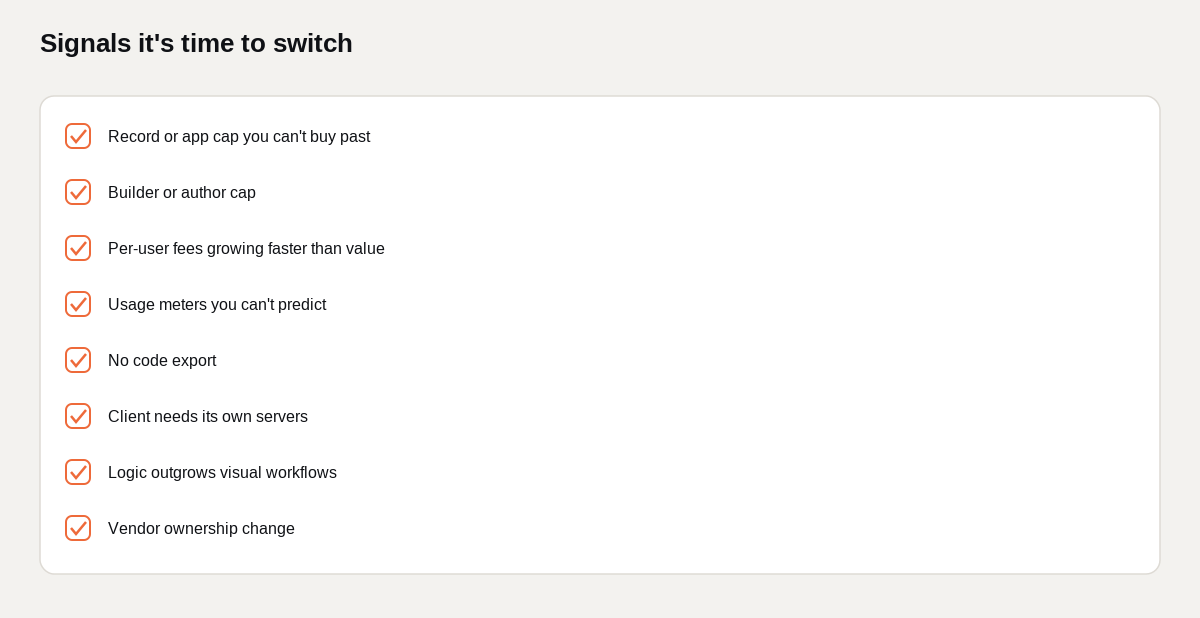
One signal is enough to start planning. Two or more usually mean the app has become core to the business, and core apps deserve code you control.
When to choose no-code
- The workflow is still moving. If the process changes monthly, staff editing it in a visual tool beats a release cycle.
- The app is internal and small. A sign-up sheet, an inventory list or a request form for one team stays well inside plan limits.
- The data already lives in a spreadsheet or base. Tools such as GlideOS turn existing spreadsheets into apps, and Softr and Noloco build portals on existing data (Glide; Softr; Noloco).
- You need compliance paperwork on day one. Some platforms sell it as a plan: Caspio offers a HIPAA/Compliance Edition at USD 500 per month on an annual term (Caspio pricing).
- There is no developer and no budget for one. A free or low monthly plan gets the app live.
When to choose custom development
- Customers or regulators need the code and data on your servers. A public-sector client or a hospital group may require its own hosting.
- The app is the product. If you sell the software, you need to own it, version it and move it.
- User counts are large or unpredictable. Per-user pricing punishes growth; your own hosting does not charge per seat.
- The logic is complex. Pricing rules, multi-step approvals and integrations with older systems strain visual workflows.
- You have hit two or more switch signals. At that point, a rebuild is coming anyway; better to plan it than to be forced into it.
Where an AI software factory fits
The old trade-off was simple: no-code is fast and rented, custom code is owned and slow. AI changes the second half of that sentence.
Coding agents automate the developer. Devfab automates the development lifecycle. Devfab is an AI software factory: you describe the app, and seven agents (Researcher, Planner, Coordinator, Developers, Blueprint, QA agent and Deploy) take it from idea to a deployed, tested codebase.
- Research before the plan. For the food bank, the Researcher maps volunteer scheduling terms, best practices and similar tools, then suggests a prototype.
- A person approves the plan. You see what will be built before agents build it.
- Tested journeys. The QA agent runs UI and flow tests (screens, buttons and user journeys clicked end to end) plus logic tests.
- Changes don't break neighbors. ChainFlow maps which functions and APIs call each other, so a change to shift swaps shows its impact on the driver rota and notifications.
- Ownership. Code in your own GitHub account, deployment to your own server, and predictable cost logged per task and per project.
Honest limits: Devfab is in Beta, has a smaller community and fewer integrations than mature no-code platforms, is not a visual editor for business users, and needs a GitHub account. For an app your staff will keep reshaping by hand, a no-code tool may still be the better fit. See also low-code vs an AI software factory.
FAQ
Is no-code cheaper than custom development?
At the start, almost always. No-code plans begin free or at a monthly fee, while custom work needs people to plan, build, test and host. Over years, the subscription, per-user fees and plan caps add up, and custom code can cost less to run. Compare total cost over the app's expected life.
Can I export my no-code app as code?
It depends on the platform. Bubble says its apps can only run on Bubble and cannot be exported as code; you can export user data as CSV or through its API. Some AI app builders do export code. Check the platform's ownership page before you build.
When should I switch from no-code to custom development?
Switch when you hit a hard plan limit you cannot buy past, when per-user or usage fees grow faster than the value of the app, when customers or regulators need the code and data on your own servers, or when the logic no longer fits visual workflows.
Is low-code the same as no-code?
No. IBM describes low-code as aimed at professional developers and extendable with custom code, while no-code is aimed at business users and relies fully on visual tools. Microsoft says low-code needs some custom coding and no-code needs none.
Where does an AI software factory fit?
Between the two. An AI software factory such as Devfab produces a custom codebase in your own GitHub, with research, a plan a person approves, tests and deployment to your own server. You get the ownership of custom development without assembling a full development team for every step.
Read next
- What is an AI software factory?
- Low-code vs an AI software factory
- No-code vs AI app builders
- How to replace spreadsheets with a custom app
- Bubble alternatives
Hit a plan limit? Get the app back as code you own. Try Beta
Sources (checked November 2026): IBM: Low-code vs no-code; Microsoft: Low-code vs no-code; Bubble: application and data ownership; Bubble pricing; Airtable pricing; Airtable app quick start; Airtable newsroom; Knack; Knack pricing; Noloco; Noloco pricing; Caspio pricing; GlideOS launch recap; Glide community: pricing issues; Softr: Beyond building blocks.
Frequently asked questions
Is no-code cheaper than custom development?
At the start, almost always. No-code plans begin free or at a monthly fee, while custom work needs people to plan, build, test and host. Over years, the subscription, per-user fees and plan caps add up, and custom code can cost less to run. Compare total cost over the app's expected life.
Can I export my no-code app as code?
It depends on the platform. Bubble says its apps can only run on Bubble and cannot be exported as code; you can export user data as CSV or through its API. Some AI app builders do export code. Check the platform's ownership page before you build.
When should I switch from no-code to custom development?
Switch when you hit a hard plan limit you cannot buy past, when per-user or usage fees grow faster than the value of the app, when customers or regulators need the code and data on your own servers, or when the logic no longer fits visual workflows.
Is low-code the same as no-code?
No. IBM describes low-code as aimed at professional developers and extendable with custom code, while no-code is aimed at business users and relies fully on visual tools. Microsoft says low-code needs some custom coding and no-code needs none.
Where does an AI software factory fit?
Between the two. An AI software factory such as Devfab produces a custom codebase in your own GitHub, with research, a plan a person approves, tests and deployment to your own server. You get the ownership of custom development without assembling a full development team for every step.