Short answer: Mendix is the closest like-for-like enterprise platform. Power Apps fits Microsoft 365 shops. Appian fits regulated process and case work. Retool suits engineers building internal tools on company data, and Zoho Creator suits smaller budgets. Devfab fits when you want code you own, deployed to your own server.
Your renewal is coming up, and the quote grew with your app portfolio. Each new screen and table counts. Meanwhile, the team asks why it can't just use the coding agents everyone else uses.
The usual triggers for leaving OutSystems are pricing you can't see in advance, platform-specific apps that are hard to move, and the pull of AI tools that write ordinary code. This page compares six alternatives on those points, from vendor docs checked in November 2026.
In this guide, you'll learn:
- Why teams leave OutSystems
- Six alternatives in one table
- Where OutSystems is still the better choice
- How to choose
Use the sections below as your shortlist.
Why teams leave OutSystems
OutSystems is active and investing in AI. On March 31, 2026 it announced "Agentic Systems Engineering," an Enterprise Context Graph, and next-generation Mentor as generally available in OutSystems Developer Cloud (ODC). Developers can also use outside tools such as Claude Code, OpenAI Codex and Cursor. In 2026 it also gained FedRAMP Authorization through a managed cloud with Knox (press release dated February 3) and Texas TX-RAMP certification (November 3).
The reasons teams still look around:
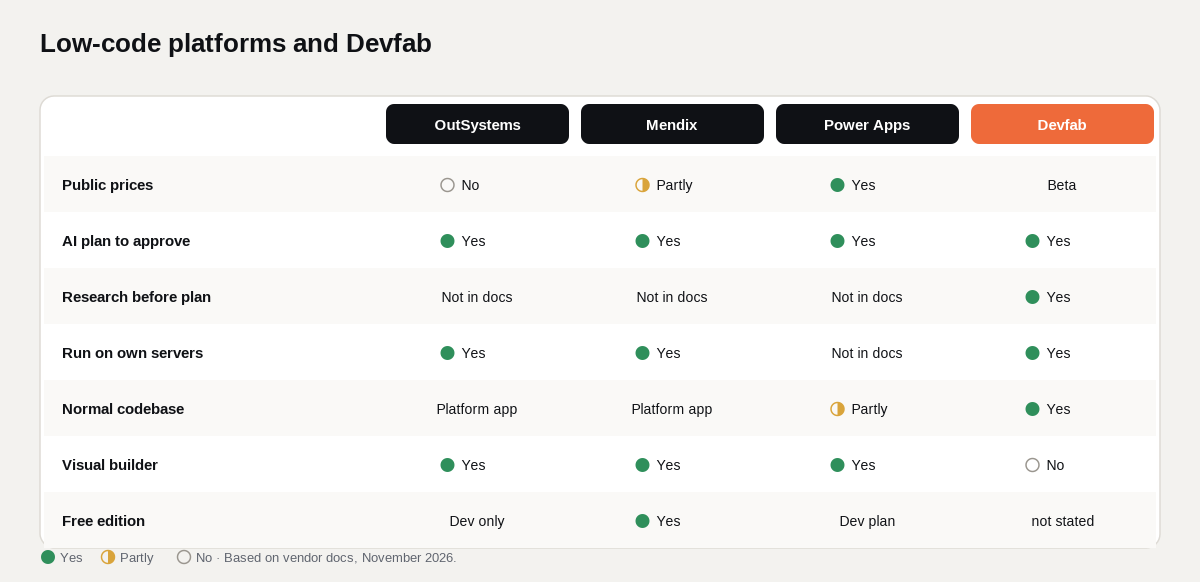
- No public prices. The paid Agentic Systems Platform is sold by estimate, sized by Application Objects (screens, tables and API methods), users and add-ons. A typical medium app is about 150 Application Objects, per the pricing page.
- A separate AI bill. Customers pay LLM providers directly for tokens.
- Free edition is for development. The Personal Edition is a development runtime only, capped at 100 internal users with no uptime guarantee.
- Migration friction. Some third-party Forge components may need to be rebuilt or replaced for ODC.
- Platform apps. Output is standard ODC apps, so leaving later usually means rebuilding.
Quick comparison
| Tool | Type | AI building | Deployment | Code you own | Pricing model |
|---|---|---|---|---|---|
| OutSystems (baseline) | Enterprise low-code | Mentor app generator, plan then approve | Managed cloud, self-hosted, private, sovereign | Platform apps | Custom quote by Application Objects and users |
| Mendix | Enterprise low-code | Maia Plan, Maia Make, external agents via MCP | Mendix Cloud, Azure, Kubernetes, SAP BTP, own servers | Platform apps | Per app and users; public "starting at" prices |
| Microsoft Power Apps | Low-code on Dataverse | Natural-language apps, Plans, app-builder skill | Microsoft cloud | Platform apps; generative pages produce React | Per user or per app |
| Appian | Low-code process platform | Composer (preview), Agent Studio | Appian Cloud, self-managed, air-gapped AI | Platform apps | Per user, per month, per app |
| Retool | Internal-tool builder | Prompt-first React builder | Retool Cloud; VPC or on-prem on Enterprise | React and TypeScript in Retool | Per builder and per user, plus AI credits |
| Zoho Creator | Low-code | Zia, Plan, Build and Test agents | Zoho Cloud, AWS, Azure, GCP, on-prem | Platform apps | Per user per month |
| Devfab | AI software factory | Research, plan approval, dev and QA agents | Your own server | Normal codebase in your GitHub | Cost logged per task and per project (Beta) |
The alternatives
Mendix
Verdict: the closest enterprise swap, with the widest deployment list. Best for: large organizations, especially Siemens and industrial customers, needing governed app portfolios. Trade-off: still a platform; policies for outside agents "bring visibility, but no enforcement" in 11.12. Pricing: Free USD 0; Standard One App "starting at" USD 1,090 per month; Standard Unlimited Apps "starting at" USD 2,725 per month; Premium by quote, as of November 2026.
Mendix's Maia Plan turns ideas and user stories into structured app plans. Since 11.10, Studio Pro works as an MCP server so outside agents can use Maia tools, and 11.12 (June 30, 2026, the first LTS since 10.24) added Mendix Cloud MCP for assistants like Claude Code and GitHub Copilot. Deploy targets include Mendix Cloud, Azure, Kubernetes, SAP BTP and your own servers. See OutSystems vs Mendix.
Microsoft Power Apps
Verdict: the default for organizations standardized on Microsoft 365. Best for: line-of-business apps on Dataverse, SharePoint, Teams and Dynamics 365. Trade-off: premium, on-premises and custom connectors need a standalone license beyond Microsoft 365 rights. Pricing: Developer Plan free; Power Apps Premium USD 20 per user per month, paid yearly, as of November 2026.
Power Apps generates apps from natural language, and its Plans workspace uses AI agents as requirements analyst, data modeler and solution architect. The September 2026 update made an app-builder skill generally available, letting tools such as GitHub Copilot CLI and Claude Code build model-driven apps, creating nothing until the user approves the build plan. IT can centralize data loss prevention, access and auditing. See Power Apps vs OutSystems.
Appian
Verdict: the pick for long-running, auditable business processes. Best for: regulated organizations needing case management, RPA and AI agents under central guardrails. Trade-off: AI Agents and Composer aren't on the Standard plan; a 2026 competitor review cites high per-user pricing for smaller businesses. Pricing: no prices on the official page; plans are per user, per month, per app.
Appian's Agent Studio added multi-agent communication and an audit view of an agent's steps in March 2026. Composer turns legacy requirements into an app plan, but is listed as a preview feature. Customers can connect their own Azure OpenAI accounts, route through an LLM gateway and run AI self-managed on air-gapped infrastructure. Appian Government Cloud holds FedRAMP High. See Appian vs OutSystems.
Retool
Verdict: for engineering teams whose apps are internal tools on company data. Best for: admin panels, dashboards and approval apps with permissions enforced at the data source. Trade-off: Git source control, SSO and self-hosting are Enterprise features. Pricing: Free USD 0 (up to 5 users); Team USD 10 per builder and USD 5 per internal user per month; Business USD 50 per builder and USD 15 per internal user per month, billed annually, as of November 2026.
Retool's AI app builder, generally available since June 17, 2026, writes React on the frontend and TypeScript on the backend, and you can inspect and edit the code. Apps inherit central authentication and role-based access. It can also import apps built in Lovable, Replit, Cursor or Claude Code and govern them in one place.
Zoho Creator
Verdict: the budget option with native mobile for every app. Best for: small and mid-size businesses, especially those already on Zoho. Trade-off: 2026 Capterra reviewers cite a steeper learning curve beyond simple apps and a template-based feel for highly custom work. Pricing: Standard USD 8, Professional USD 20, Enterprise USD 25 per user per month, billed annually, as of November 2026.
Zoho Creator's Plan Agent writes a business requirement document, its Build Agent adds modules and workflows with review of each change, and a Test Agent generates and runs test cases. Every app gets native iOS and Android versions, and apps can run on Zoho Cloud, AWS, Azure, GCP or on-premise.
Devfab
Verdict: for teams that want AI to build ordinary code they own, not more platform apps. Best for: IT teams and agencies replacing platform apps with custom apps on their own servers. Trade-off: in Beta, no visual canvas, far fewer ready-made connectors than OutSystems, and no compliance attestations stated. Pricing: predictable cost: cost is logged after each run, per task and per project.
Devfab is an AI software factory. Before the Planner writes anything, its research step maps the domain: key terms, best practices for that kind of app and competitors, then suggests a prototype. A person approves the plan before the Coordinator creates tickets. ChainFlow maps which functions and APIs call each other and what is deployed, so developer agents see what a change affects. The QA agent runs UI and flow tests plus logic tests. Code lives in your own GitHub account, and you deploy to your own server.
Coding agents automate the developer. Devfab automates the development lifecycle.
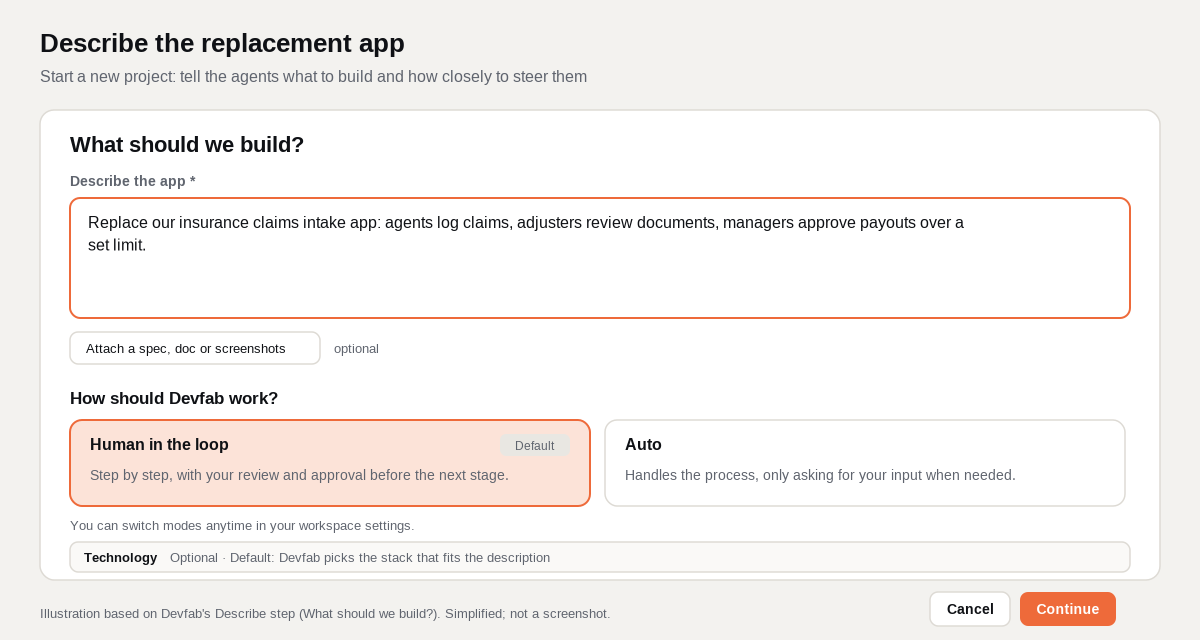
Moving off OutSystems means rebuilding, so do it one app at a time. Write down each app's flows and rules, describe the replacement in Devfab, and approve the plan line by line against your list. Our Low-code vs AI software factory page explains the trade-off.
Devfab's honest limits: it's new, with a smaller community and fewer integrations; there's no drag-and-drop builder for business users; it isn't an editor for hands-on coding; it needs a GitHub account; and you run the servers.
Where OutSystems is still the better choice
- You need vendor-backed compliance attestations: OutSystems lists HIPAA, PCI DSS and FedRAMP requirements, SOC 2 Type II and ISO certifications, plus FedRAMP and TX-RAMP in 2026.
- Large portfolios of connected apps and agents, where the Enterprise Context Graph tracks dependencies in one platform.
- Mixed teams of professional developers and business users in one governed IDE.
- Many legacy systems to connect: OutSystems lists pre-built connections to 400+ systems and a private gateway to on-prem systems.
- Long-lived vendor support matters more to you than owning the code.
How to choose
- Want the closest enterprise swap? Mendix.
- Run on Microsoft 365? Power Apps.
- Process-heavy and regulated? Appian.
- Internal tools built by engineers? Retool.
- Small budget, mobile needed? Zoho Creator.
- Want code you own on your own servers? Devfab. See What is an AI software factory?
FAQ
What is the closest alternative to OutSystems?
Mendix is the closest match: an enterprise low-code platform with an AI assistant, broad deployment options and support for external coding agents. Power Apps is the usual choice for Microsoft 365 organizations, and Appian for process-heavy, regulated work.
Does OutSystems publish its prices?
No. Its pricing page shows a free Personal Edition and a paid Agentic Systems Platform sold by estimate from sales, sized by Application Objects, users and add-ons. Customers also pay LLM providers directly for tokens.
Can I leave OutSystems and keep my apps?
Apps built in OutSystems are platform apps, so moving usually means rebuilding. Plan it one app at a time: write down each app's rules and flows, rebuild in the new tool, and run both until the results match.
Is there an OutSystems alternative where we own the code?
Yes. With Devfab, agents build a normal codebase that lives in your own GitHub account and deploys to your own server. Retool's new builder also writes React and TypeScript you can inspect, though apps run on Retool.
Read next
- What is an AI software factory?
- Low-code vs AI software factory
- OutSystems vs Mendix
- Power Apps vs OutSystems
- Appian vs OutSystems
- Mendix alternatives
Rebuilding a platform app? See Devfab's plan for it before you commit. Try the Devfab Beta
Sources (checked November 2026): OutSystems: Agentic Systems Engineering (Mar 31, 2026); OutSystems: Next-gen Mentor in ODC; OutSystems Developer Cloud; OutSystems pricing and editions; OutSystems FAQs; Business Wire: OutSystems achieves FedRAMP Authorization; OutSystems TX-RAMP certification (Nov 3, 2026); Mendix pricing; Mendix release 11.12; Mendix: Using Maia with external AI agents; Mendix release 11.10; Power Apps pricing; Power Apps product page; Power Platform licensing FAQs; What's new in Power Platform, September 2026; The New Stack: Power Apps Plans; Appian pricing; Appian What's New; Appian Q1 2026 release highlights; Appian Q2 2026 product highlights; Appian Government Cloud FedRAMP High; Blaze: Appian reviews (competitor, Feb 2026); Retool pricing; Retool launches a React AI app builder; Retool extends governance to vibe-coded apps; Zoho Creator; Zoho Creator pricing; Capterra: Zoho Creator reviews.
Frequently asked questions
What is the closest alternative to OutSystems?
Mendix is the closest match: an enterprise low-code platform with an AI assistant, broad deployment options and support for external coding agents. Power Apps is the usual choice for Microsoft 365 organizations, and Appian for process-heavy, regulated work.
Does OutSystems publish its prices?
No. Its pricing page shows a free Personal Edition and a paid Agentic Systems Platform sold by estimate from sales, sized by Application Objects, users and add-ons. Customers also pay LLM providers directly for tokens.
Can I leave OutSystems and keep my apps?
Apps built in OutSystems are platform apps, so moving usually means rebuilding. Plan it one app at a time: write down each app's rules and flows, rebuild in the new tool, and run both until the results match.
Is there an OutSystems alternative where we own the code?
Yes. With Devfab, agents build a normal codebase that lives in your own GitHub account and deploys to your own server. Retool's new builder also writes React and TypeScript you can inspect, though apps run on Retool.