Short answer: A single agent with full context ships more reliably for most coding changes, because one writer makes consistent decisions. Multi-agent setups win when work splits cleanly: parallel tickets on separate branches, a reviewer agent checking diffs, or a coordinator handing well-defined tasks to specialists. The reliable middle path is one writer per change, many helpers around it.
You split a feature across three agents to go faster. Each one finished. The pieces didn't fit. Now a person spends the afternoon stitching them together.
The debate is loud. One side says swarms of agents are the future. The other says a single agent with full context beats any team. The interesting part: the strongest arguments on both sides come from the same companies, sometimes the same author a year apart.
In this guide, you'll learn:
- Definitions
- Side by side
- When to choose a single agent
- When to choose multi-agent
- Where an AI software factory fits
Take the sections in order; the last one ties them together.
Definitions
Single-agent coding. One agent holds the whole task in one context: it reads the code, decides, edits and runs commands in a straight line. Cognition's Walden Yan put it plainly in June 2025: "The simplest way to follow the principles is to just use a single-threaded linear agent." The limit he names is size: very large tasks can overflow the context window (Cognition, Jun 12, 2025).
Multi-agent coding. Several agents split the work. Common shapes:
- Orchestrator and workers. A lead agent plans and hands parts to subagents. Anthropic's research system "uses a multi-agent architecture with an orchestrator-worker pattern" (Anthropic, Jun 13, 2025).
- Parallel agents on separate branches. Cursor's cloud agents run in isolated VMs; many can run at once, each on its own branch (Cursor docs). Kilo's Agent Manager can isolate agents in git worktrees (Kilo blog).
- Generator and verifier. One agent writes; another reviews. Devin and Devin Review iterate against each other (Cognition, Apr 22, 2026).
- Pipelines of stages. Warp Factories use a "foreman" agent that splits work across triage, spec, implementation and review subagents (Warp).
Why the argument exists. In 2025, Cognition argued that "running multiple agents in collaboration only results in fragile systems," because "actions carry implicit decisions, and conflicting decisions carry bad results." Its example: split "build a Flappy Bird clone" in two, and one subagent makes a Super Mario-style background while the other makes a bird that "doesn't look like a game asset" (Cognition, 2025). The next day, Anthropic reported that its multi-agent system "outperformed single-agent Claude Opus 4 by 90.2%" on an internal research eval, while adding that "most coding tasks involve fewer truly parallelizable tasks than research" (Anthropic).
By April 2026, Cognition had refined its view, not reversed it: "writes stay single-threaded and the additional agents contribute intelligence rather than actions" (Cognition, 2026).
Side by side
| Aspect | Single agent | Multi-agent |
|---|---|---|
| Who writes code | One agent | One per branch or ticket, or one writer plus helpers |
| Context | Everything in one thread | Split; must be passed on, and is often lost |
| Main failure | Context overflow on very large tasks | Conflicting decisions between agents that can't see each other's work |
| Token use | About 4x a chat (Anthropic) | About 15x a chat (Anthropic); agent teams about 7x a standard Claude Code session in plan mode |
| Best-proven use | Most single changes in one repo | Research, parallel independent tickets, review loops |
| Review | Self-checks, or a person | A separate reviewer agent with a clean context |
| What still fails | Huge, sprawling tasks | Parallel-writer "swarms," which Cognition says still lack meaningful adoption |
| Examples | Claude Code session; Cline; OpenCode build agent | Cursor cloud agents; Devin subagents; Warp Factories; Claude Code agent teams (experimental) |
Sources: Anthropic; Claude Code costs; Claude Code overview; Cognition 2025; Cognition 2026; Devin Desktop; Cursor.
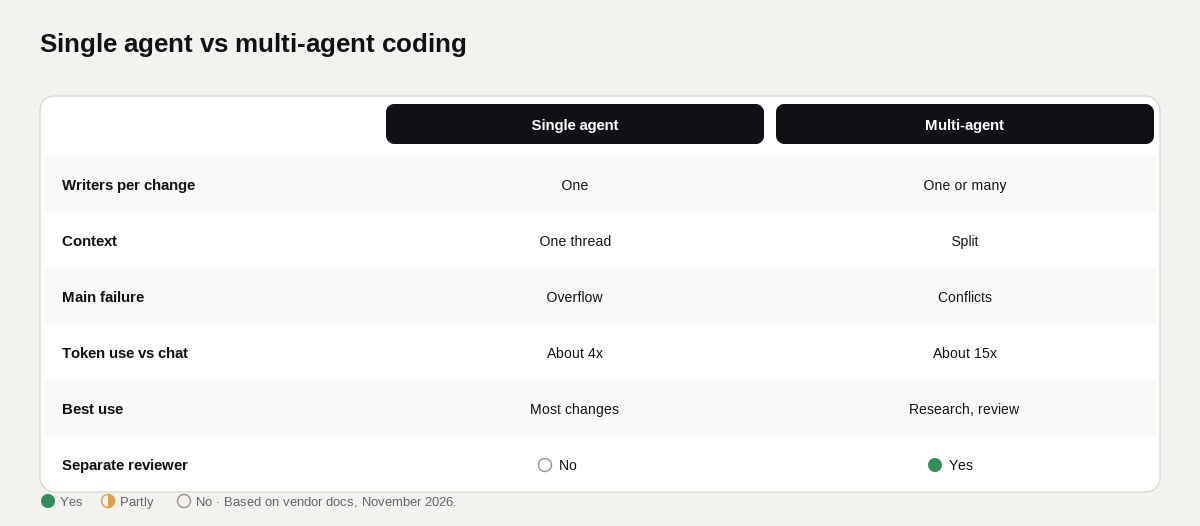
Notice that the two columns don't really compete. Teams that ship reliably tend to use a single writer for each change and multiple agents around it.
When to choose a single agent
- The change touches shared code. A checkout fix that affects payments and notifications needs one mind holding all of it. Split it, and two agents may change the same contract in different ways.
- The task is a normal size. If it fits in one context window, the simplest setup is also the most reliable one, per Cognition.
- You are watching the budget. Anthropic's numbers put multi-agent runs at several times the tokens of a single agent. For routine work, that cost buys little.
- You want to follow the reasoning. One trace is easier for a person to read, review and undo than five.
- The work is a sequence. Migrations and refactors often depend on the step before; Anthropic says domains with many dependencies "are not a good fit for multi-agent systems today."
When to choose multi-agent
- The tickets are truly independent. Separate features on separate branches, each with its own PR, as Cursor's cloud agents and Devin's subagents do.
- You want a second pair of eyes. A reviewer agent reading the diff with a clean context is the pattern with the clearest results; Cognition reports Devin Review "catches an average of 2 bugs per PR."
- The job is research, not writing. Searching docs, mapping a codebase or comparing options splits well, which is where Anthropic saw its big gain.
- The task is too big for one context. A manager agent can split it, spawn children and combine results. Cognition calls the practical shape "map-reduce-and-manage."
- Different steps need different skills or models. Warp lets teams pick a model per pipeline stage; Cognition describes a "smart friend" pattern where a smaller model asks a stronger one for help.
One warning for every multi-agent setup: Cognition says "the open problems are all communication problems." Agents assume shared state that isn't there, and messages between agents don't happen by default (Cognition, 2026).
Where an AI software factory fits
A software factory is a multi-agent system by design, so it has to solve the context problem rather than ignore it. That is how Devfab is built.
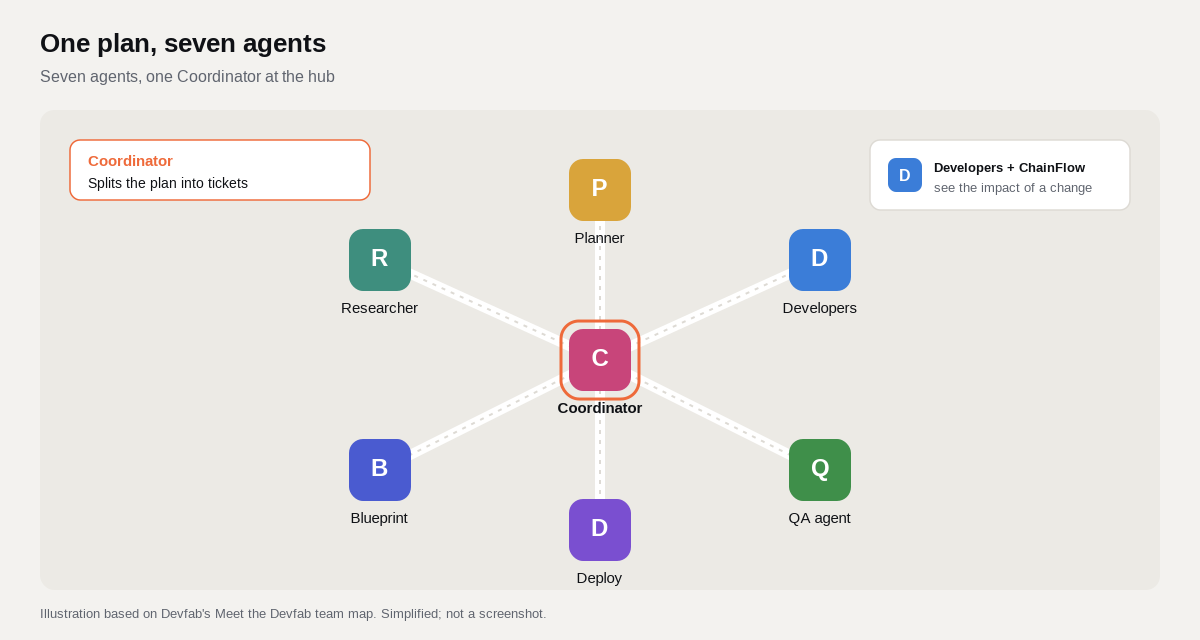
Coding agents automate the developer. Devfab automates the development lifecycle. Its seven agents each own a stage: Researcher, Planner, Coordinator, Developers, Blueprint, QA agent and Deploy. Three choices keep them from making conflicting decisions:
- Shared context comes first. Before any plan, the Researcher maps the domain: key terms, best practices and competitors. For a warehouse picking app, that might be pick lists, wave picking and bin locations. Every later agent works from the same map.
- A person approves one plan. The Planner publishes it, and a person approves it before the Coordinator splits it into tickets and assigns dev agents. Agents don't negotiate scope with each other.
- Dev agents see the impact of a change. ChainFlow maps which functions and APIs call each other and what is deployed. A dev agent changing checkout can see that payments, inventory, order confirmation and notifications depend on it.
Then the QA agent works as the verifier: it runs UI and flow tests (screens, buttons and user journeys clicked end to end) plus logic tests, and with "QA agent · review before Done" switched on, a ticket is reviewed before it closes. Cost is logged after each run, per task and per project.
Devfab's honest limits: it is in Beta, with a smaller community and fewer integrations than mature tools. It is not an editor for hands-on coding, and it needs a GitHub account. For a one-file fix, a single agent in your editor is the better tool.
FAQ
Is a multi-agent coding system better than a single agent?
Not by default. Anthropic found a multi-agent setup beat a single agent by a wide margin on research tasks, but says most coding tasks have fewer truly parallel parts. Cognition's 2026 rule is to keep writes single-threaded and let extra agents add review and advice.
Why do multi-agent coding systems break?
Mostly from lost context. Cognition's 2025 post explains that each action carries hidden decisions, and two subagents that can't see each other's work make conflicting ones, like a game background and a bird that don't match. The fix is shared context and one writer per change.
Do multi-agent setups cost more?
Usually. Anthropic reports multi-agent systems use about 15 times more tokens than chats, versus about 4 times for single agents. Claude Code's docs say agent teams use roughly 7 times more tokens than standard sessions when teammates run in plan mode.
Where does a reviewer agent fit?
It is the multi-agent pattern with the clearest track record. Cognition reports that Devin Review, reading the diff with a clean context, catches an average of two bugs per pull request in a generator-verifier loop with Devin.
Read next
- What is an AI software factory?
- Agentic SDLC: how Planner, Coordinator, dev and QA agents work
- How to stop AI coding agents from breaking existing code
- AI software factory vs AI coding tools
See a multi-agent team that shares one approved plan. Try Beta
Sources (checked November 2026): Cognition: Don't Build Multi-Agents (Jun 12, 2025); Cognition: Multi-Agents: What's Actually Working (Apr 22, 2026); Anthropic: How we built our multi-agent research system (Jun 13, 2025); Claude Code docs: Overview; Claude Code docs: Manage costs; Cursor docs: Cloud agents; Kilo blog: The new Kilo for VS Code (Apr 2, 2026); Devin Desktop; Warp: Terminal history and Warp Factories.
Frequently asked questions
Is a multi-agent coding system better than a single agent?
Not by default. Anthropic found a multi-agent setup beat a single agent by a wide margin on research tasks, but says most coding tasks have fewer truly parallel parts. Cognition's 2026 rule is to keep writes single-threaded and let extra agents add review and advice.
Why do multi-agent coding systems break?
Mostly from lost context. Cognition's 2025 post explains that each action carries hidden decisions, and two subagents that can't see each other's work make conflicting ones, like a game background and a bird that don't match. The fix is shared context and one writer per change.
Do multi-agent setups cost more?
Usually. Anthropic reports multi-agent systems use about 15 times more tokens than chats, versus about 4 times for single agents. Claude Code's docs say agent teams use roughly 7 times more tokens than standard sessions when teammates run in plan mode.
Where does a reviewer agent fit?
It is the multi-agent pattern with the clearest track record. Cognition reports that Devin Review, reading the diff with a clean context, catches an average of two bugs per pull request in a generator-verifier loop with Devin.