Short answer: Softr wins when an operations team needs a portal that outside clients log into, on top of Airtable, Google Sheets or Softr's own database, with record-level permissions set up without code. Power Apps wins when the users are staff inside a Microsoft 365 tenant and IT needs Dataverse, data loss prevention and audit.
Picture an accounting firm in tax season. Clients email scans, partners chase missing receipts, and nobody knows which return is stuck. The operations manager wants a client portal by spring. The IT partner points out the firm already runs on Microsoft 365.
These two tools answer different questions: who logs in, and who governs the app? This page referees, using vendor pages checked in November 2026.
In this comparison:
- Softr and Power Apps at a glance
- Feature comparison
- Cost model by team size
- Where Softr wins
- Where Power Apps wins
Start with the relaunch that changed Softr this month.
Softr and Power Apps at a glance
Softr relaunched on November 9, 2026. In "the new Softr," AI builds the whole app from a description: the database, user roles and permissions, workflows, integrations and a custom frontend that is no longer limited to blocks. Softr's line is "We vibe code your frontend. We don't vibe code your backend." Existing apps keep working, and block-based building stays available (Softr blog).
Softr is for business, operations and IT teams building apps without engineers. Client portals are "the most common starting point," and Softr claims 1M+ builders and 7,000 organizations (Softr). It holds SOC 2 Type II, supports GDPR, and offers EU or US hosting.
Power Apps is Microsoft's low-code platform for business apps on Dataverse and Microsoft 365, built for business users, developers and IT in one workspace (Power Apps). In September 2026 Microsoft made the app-builder skill generally available, so AI coding tools can build model-driven apps after a person approves the build plan (September 2026 update). From November 15, 2026, new unmanaged developer environments and new Dataverse for Teams environments can't be created (Licensing FAQ).
Feature comparison
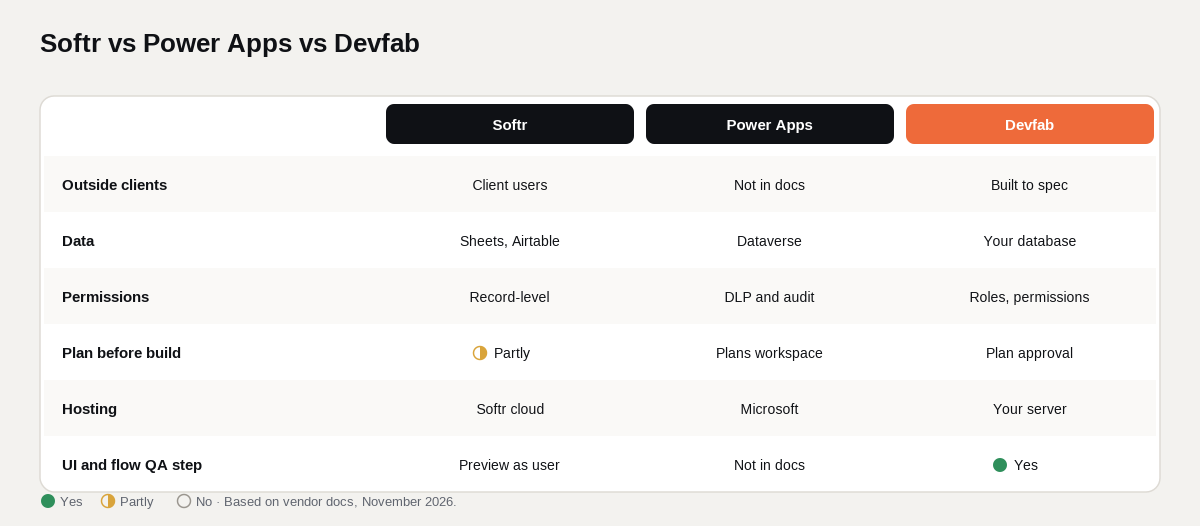
| Aspect | Softr | Power Apps | Source |
|---|---|---|---|
| Where it runs | Hosted web apps from a browser editor; also built through Softr MCP | Maker studio in the browser; also from AI coding tools | Softr MCP; Sept 2026 update |
| Planning or spec | From a prompt, generates pages, database, permissions and workflows | Plans workspace with AI agents as requirements analyst, data modeler and solution architect | Softr AI app builder; The New Stack |
| Agent autonomy | AI agents in workflows can wait for human approval before acting | Agent feed to oversee and guide agents inside apps | Softr; Power Apps |
| Testing | Preview the app as any user | Not covered in the pages we checked | Softr |
| Data | Softr Databases plus 21+ sources; Airtable, Sheets, Notion, REST API on every plan | Dataverse; premium and custom connectors need a standalone license | Softr; Licensing FAQ |
| External users | Plans split app users into Team users and Client users | Not covered in the pages we checked | Softr docs |
| Permissions and admin | User groups, record-level data restrictions; SAML/OpenID SSO and SCIM on Enterprise | Central policies for environments, data loss prevention, access and auditing | Softr; Power Apps |
| Code | Vibe-coding block for custom logic and design | Generative pages produce native React code | Softr AI app builder; The New Stack |
| Pricing model | Workspace plans with set builders and app users, AI credits, workflow limits | Per user, per user per app, or pay-as-you-go via Azure | Softr docs; Licensing FAQ |
Cost model by team size
| Team size | Softr | Power Apps |
|---|---|---|
| 1 person | Free plan; see Softr's pricing page for paid amounts | Developer Plan free for non-production; Premium USD 20 per user per month, paid yearly |
| 5 people | A paid workspace plan that includes enough builders and app users; check the pricing page | Premium USD 20 per user per month, paid yearly, or limited rights in some Microsoft 365 licenses |
| 25 people, plus outside clients | Higher tier with paid add-on users and builders; Client users counted separately | Premium USD 20 per user per month for staff; client access not covered in the pages we checked |
Power Apps prices as of November 2026 from Power Apps pricing; Microsoft notes prices vary by region. Softr's plan amounts did not load in our capture of Softr pricing, so we describe the model from Softr's plan docs: monthly AI credits that do not roll over, a free trial and 50% off for nonprofits and education.
Where Softr wins
- Outside clients log in. Client users are a plan concept, and portals are the main use case.
- Data stays where it is. Airtable, Google Sheets and Notion connect on every plan.
- Ops staff own the app. User groups and record-level rules are set up without code, and you can preview as any user.
- Your coding agent can help. Softr MCP is on every plan, including Free, and does not use Softr AI credits (Softr MCP).
- EU hosting is an option for firms with European clients.
Where Power Apps wins
- Users are staff in your tenant. Apps sit under existing Microsoft identity, data loss prevention and audit.
- Dynamics 365, SharePoint and Teams data. Microsoft connectors are the main draw, though premium ones need a standalone license.
- A plan before the build. The Plans workspace and app-builder skill put requirements and a data model first.
- Large internal rollouts. Premium drops to USD 12 per user per month at a 2,000-seat minimum, as of November 2026.
Softr has limits too. A competitor's September 2026 review notes app users capped per plan, metered records and workflow actions, and no native app store publishing (Jet Admin).
Switching from one to the other
Neither vendor documents a direct converter in the pages we checked. Power Apps to Softr: export the Dataverse tables, load them into Softr Databases or Airtable, then describe the app and let the new Softr generate pages, roles and workflows. Softr to Power Apps: move the data into Dataverse, then use the Plans workspace or the app-builder skill to regenerate the app and its model.
Where Devfab fits
Both tools host the portal for you. That is fine until the firm wants a client app built on its own codebase, tested end to end and running on its own server.
Coding agents automate the developer. Devfab automates the development lifecycle. Its Researcher maps the domain first (engagement letters, document requests, filing deadlines, how other client portals work) and suggests a prototype. A person approves the plan. ChainFlow maps which functions and APIs call each other, so a change to document upload does not break reminders or partner sign-off. Devfab is in Beta, with a smaller community and fewer integrations. See Devfab vs Softr and Devfab vs Power Apps.
FAQ
What is the new Softr?
On November 9, 2026, Softr relaunched so that AI builds the whole app from a description: database, user roles and permissions, workflows, integrations and a fully custom frontend, on Softr's governed backend. Existing apps keep working and block-based building is still available.
Which is better for a portal that outside clients log into?
Softr. It splits app users into Team users and Client users, says client portals are its most common starting point, and controls visible pages and records by user group. External client access is not covered in the Power Apps pages we checked.
How do the two price?
Softr sells workspace plans (Free, Basic, Pro, Business, Enterprise) that include a set number of builders and app users; check Softr's pricing page for current amounts. Power Apps Premium is USD 20 per user per month, paid yearly, as of November 2026.
Can AI coding tools build apps in Softr or Power Apps?
Yes, both. Softr MCP lets Claude, ChatGPT, Cursor and Codex build and manage apps, on every plan and without Softr AI credits. Power Apps' app-builder skill lets AI coding tools build model-driven apps after the user approves a build plan.
Read next
- What is an AI software factory?
- Softr alternatives
- Airtable vs Softr: a database your team works in, or a portal your users log into?
Need a client portal you own as code? Try Beta
Sources (checked November 2026): Softr homepage; Softr AI App Builder; Softr MCP; Softr pricing; Softr docs: pricing and plans; Beyond building blocks: the new Softr (Nov 9, 2026); Jet Admin: Softr review (competitor, Sep 30, 2026); Microsoft Power Apps; Power Apps pricing; Power Platform licensing FAQ; What's new in Power Platform: September 2026; The New Stack: Power Apps Plans (May 19, 2025).
Frequently asked questions
What is the new Softr?
On November 9, 2026, Softr relaunched so that AI builds the whole app from a description: database, user roles and permissions, workflows, integrations and a fully custom frontend, on Softr's governed backend. Existing apps keep working and block-based building is still available.
Which is better for a portal that outside clients log into?
Softr. It splits app users into Team users and Client users, says client portals are its most common starting point, and controls visible pages and records by user group. External client access is not covered in the Power Apps pages we checked.
How do the two price?
Softr sells workspace plans (Free, Basic, Pro, Business, Enterprise) that include a set number of builders and app users; check Softr's pricing page for current amounts. Power Apps Premium is USD 20 per user per month, paid yearly, as of November 2026.
Can AI coding tools build apps in Softr or Power Apps?
Yes, both. Softr MCP lets Claude, ChatGPT, Cursor and Codex build and manage apps, on every plan and without Softr AI credits. Power Apps' app-builder skill lets AI coding tools build model-driven apps after the user approves a build plan.